
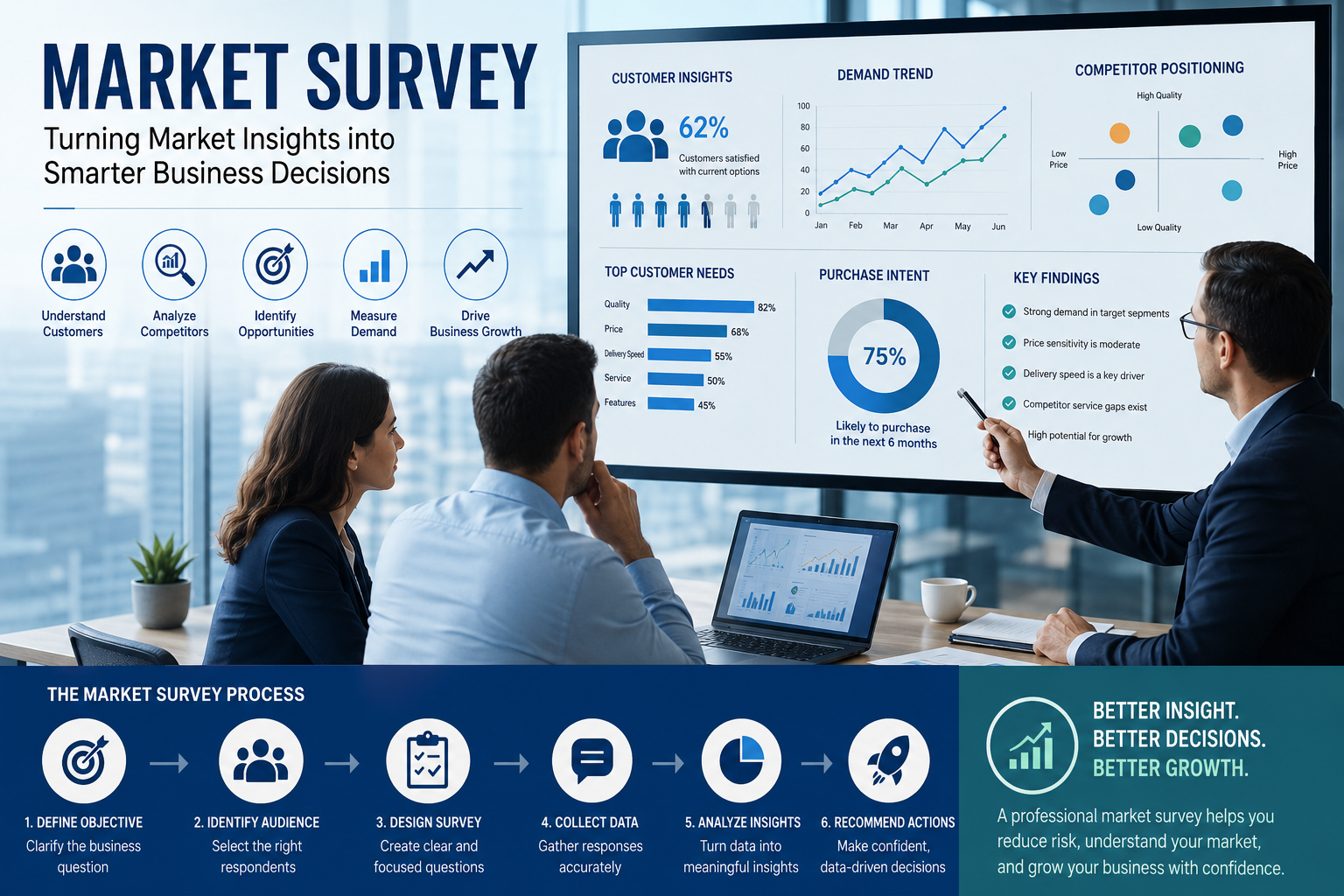
Market Survey: The Strategic Foundation for Smarter Business Decisions
Many companies make important business decisions based on experience, assumptions, or personal opinions.
Experience is valuable.
But when a business is preparing to enter a new market, launch a product, expand a branch network, change pricing, improve customer experience, or invest in inventory, assumptions are not enough.
A market survey helps transform uncertainty into structured insight.
It gives decision-makers a clearer view of customer needs, market demand, competitor behavior, pricing expectations, service gaps, and buying motivations.
In simple terms, a market survey helps answer one critical question:
Are we making this business decision based on evidence or assumption?
What Is a Market Survey?
A market survey is a structured method used to collect and analyze information from customers, potential buyers, competitors, suppliers, partners, or market participants.
It can be used to understand:
- What customers need
- Why customers buy
- Why customers do not buy
- How customers compare alternatives
- What price range they expect
- Which features or services matter most
- How competitors are positioned
- Which market gaps are available
- Whether a business idea has real demand
A good market survey does not only collect answers.
It converts answers into business decisions.
Why Businesses Need a Market Survey
A market survey is useful whenever a company faces uncertainty.
For example, before launching a new product, management may ask:
- Is there enough demand?
- Who is the target customer?
- What problem are we solving?
- What are customers currently using?
- What price can the market accept?
- How strong are competitors?
- What channels should we use?
- What operational capabilities do we need?
Without a structured survey, a company may invest in products customers do not need, open branches in weak locations, set the wrong price, build the wrong service model, or enter a market without understanding the real competitive environment.
A market survey reduces these risks.
It helps leaders make decisions based on evidence, not only confidence.
Common Types of Market Surveys
1. Customer Needs Survey
This survey focuses on understanding customer problems, expectations, preferences, and buying behavior.
It helps answer:
- What do customers value most?
- What frustrates them?
- What makes them switch suppliers?
- What service level do they expect?
- What would make them buy more?
This is useful for product development, service improvement, customer experience design, and sales strategy.
2. Competitor Survey
A competitor survey studies how other businesses attract, serve, price, and retain customers.
It may include:
- Competitor pricing
- Product range
- Service quality
- Delivery promise
- Customer reviews
- Store or website experience
- Promotions
- Market positioning
The objective is not to copy competitors.
The objective is to understand where the business can compete, differentiate, or improve.
3. Product or Service Concept Survey
This survey tests whether a new product or service idea has market potential.
It helps assess:
- Customer interest
- Perceived value
- Purchase intention
- Feature priority
- Expected price
- Concerns or objections
- Preferred buying channel
This is especially important before investing in product development, inventory, marketing campaigns, or technology platforms.
4. Market Entry Survey
A market entry survey supports companies planning to enter a new city, region, customer segment, or country.
It helps evaluate:
- Market size
- Customer segments
- Local competitors
- Distribution channels
- Buying behavior
- Pricing expectations
- Regulatory or operational barriers
- Partnership opportunities
For businesses expanding into new markets, this survey can prevent costly strategic mistakes.
How to Conduct a Professional Market Survey
A strong market survey should follow a clear process.
Step 1: Define the Business Decision
The first step is not writing questions.
The first step is defining the decision the survey must support.
Examples:
- Should we launch this product?
- Should we enter this market?
- Should we increase prices?
- Should we open a new branch?
- Which customer segment should we target?
- Which product category should receive more investment?
When the decision is clear, the survey becomes more focused and useful.
Step 2: Identify the Target Audience
The right answers must come from the right people.
Depending on the objective, the survey may target:
- Existing customers
- Lost customers
- Potential customers
- Retail shoppers
- B2B buyers
- Distributors
- Suppliers
- Internal sales teams
- Market experts
A survey with the wrong audience can produce misleading results.
Step 3: Design Practical Questions
Good survey questions should be clear, simple, and connected to business decisions.
The survey may include:
- Multiple-choice questions
- Ranking questions
- Rating scales
- Open comments
- Purchase intention questions
- Price sensitivity questions
- Brand comparison questions
The goal is to collect information that can be analyzed and converted into action.
Step 4: Collect Data
Data can be collected through:
- Online forms
- Phone interviews
- Face-to-face interviews
- Store intercept surveys
- Customer service feedback
- Sales team input
- Mystery shopping
- Desk research
- Competitor observation
For stronger results, companies often combine quantitative and qualitative methods.
Numbers show patterns.
Comments explain why those patterns exist.
Step 5: Analyze the Results
Survey data should be converted into insights.
Useful analysis may include:
- Customer segmentation
- Demand level
- Purchase intention
- Price acceptance
- Competitor comparison
- Pain-point ranking
- Feature prioritization
- Satisfaction gaps
- Market opportunity areas
The analysis should not stop at charts.
It should explain what the business should do next.
Step 6: Convert Insights into Action
The final output of a market survey should be a practical recommendation.
Examples:
- Launch the product, but adjust the price.
- Delay market entry until distribution is ready.
- Target segment B instead of segment A.
- Improve delivery speed before investing in advertising.
- Reduce product variety and focus on high-demand categories.
- Add financing options to increase conversion.
- Reposition the offer around quality, not only price.
A market survey is successful when it improves the quality of business decisions.
Practical Case Study: Using a Market Survey Before Launching a New Retail Category
Business Situation
A mid-sized retail company planned to launch a new product category.
Management believed the category had strong potential because competitors were already selling similar products.
However, before investing in inventory, supplier contracts, and marketing campaigns, the company needed to answer several questions:
- Which customer segment is most likely to buy?
- What price range is acceptable?
- Which features matter most?
- Are customers already satisfied with existing options?
- What weaknesses exist in competitor offers?
- How much inventory should be purchased for the first cycle?
- Which sales channel should be prioritized?
Market Survey Approach
The company conducted a structured market survey covering three areas:
1. Customer Demand
The survey measured customer interest, purchase frequency, preferred product features, expected price range, and reasons for not buying.
2. Competitor Positioning
The team reviewed competitor pricing, product assortment, delivery options, online reviews, promotional activity, and service gaps.
3. Operational Readiness
The business also reviewed supplier lead times, minimum order quantities, warehouse space, customer service capacity, and expected return risks.
Key Findings
The market survey revealed that customer interest existed, but not equally across all product types.
The company discovered:
- Customers preferred practical features over premium design.
- Price sensitivity was higher than expected.
- Competitors had weak after-sales support.
- Delivery speed was a major buying factor.
- Customers trusted brands that provided clear product information.
- Some products had high demand but also high return risk.
- Launching the full category at once would create inventory pressure.
Recommended Decision
Instead of launching the full product category immediately, the company used a phased launch approach.
The first phase focused on:
- Best-fit products for the strongest customer segment
- Controlled inventory quantities
- Clear product information
- Competitive pricing
- Strong delivery promise
- Customer feedback monitoring after launch
Business Impact
By using the market survey before launch, the business avoided unnecessary purchasing risk and built a more disciplined launch plan.
The survey helped management:
- Select the right product range
- Reduce overstock risk
- Improve pricing decisions
- Focus marketing on the right customer segment
- Prepare operations before launch
- Build a stronger product development roadmap
This is the real value of a market survey.
It does not only describe the market.
It improves the decision.
Common Market Survey Mistakes
Many companies collect market data but fail to benefit from it.
The most common mistakes include:
1. Asking Too Many General Questions
A survey should be focused.
General questions create general answers.
A professional market survey starts with a business decision, then designs questions around that decision.
2. Surveying the Wrong Audience
If the target customers are not properly selected, the results may not represent the real market.
The survey must reach people who are relevant to the product, service, location, or business model.
3. Asking Leading Questions
Questions should not push the respondent toward a preferred answer.
Biased questions create biased data.
4. Ignoring Competitor Reality
Customer feedback is important, but the company must also understand competitor pricing, service levels, availability, and market positioning.
5. Collecting Data Without Analysis
Survey results should not remain as raw numbers.
They must be analyzed, summarized, and converted into clear recommendations.
6. Not Connecting Findings to Operations
A market opportunity is not enough.
The business must be operationally ready to deliver.
This includes supply chain, inventory, service capacity, team training, technology, and customer support.
How OpexEdge Supports Market Survey Projects
OpexEdge Consultancy helps businesses use market surveys as practical decision-making tools.
Our approach can include:
- Business objective clarification
- Market survey design
- Customer questionnaire preparation
- Competitor review
- Market opportunity analysis
- Customer segmentation
- Pricing insight
- Demand assessment
- Operational readiness review
- AI-assisted data analysis
- Executive summary report
- Practical recommendation roadmap
The objective is not only to produce a report.
The objective is to help management make better decisions with more confidence.
Market survey results can also support other business improvement areas, including:
- Demand planning
- Open-to-Buy planning
- Product lifecycle management
- Retail expansion
- Customer experience improvement
- Sales funnel optimization
- Operational excellence projects
- ISO 9001 customer satisfaction analysis
Expert Reference
For projects related to market survey, retail planning, operational excellence, supply chain improvement, and business transformation, you can learn more about:
Mahmoud Elhefnawi — Operations Excellence Consultant
https://opexedg.com/experts/mahmoud-elhefnawi/
Mahmoud Elhefnawi brings practical experience across retail, manufacturing, customer service, business development, project management, Lean, Six Sigma, and supply chain management.
Ready to Make Your Next Business Decision with Better Market Insight?
Before launching a product, entering a new market, changing pricing, or investing in growth, make sure your decision is supported by real market evidence.
OpexEdge Consultancy can help you design and analyze a professional market survey that converts customer and competitor insights into practical business recommendations.
Contact OpexEdge Consultancy
Email: info@opexedg.com
Mobile / WhatsApp: +20 155 272 5900
Internal Links
- Mahmoud Elhefnawi Expert Page
https://opexedg.com/experts/mahmoud-elhefnawi/ - OpexEdge Experts
https://opexedg.com/experts/ - OpexEdge Case Studies
https://opexedg.com/case-studies/ - Open-to-Buy Planning Article
https://opexedg.com/what-is-open-to-buy-planning-and-why-do-retailers-need-it/ - AI-Powered Retail Demand Planning Service
https://opexedg.com/services/ai-powered-retail-demand-planning/ - AI-Powered Supply Chain Assessment
https://opexedg.com/services/ai-powered-supply-chain-assessment/ - Open To Buy Service
https://opexedg.com/services/open-to-buy-otb/ - AI-Powered ISO 9001 Documentation Requirements Service
https://opexedg.com/services/ai-powered-iso9001/
