
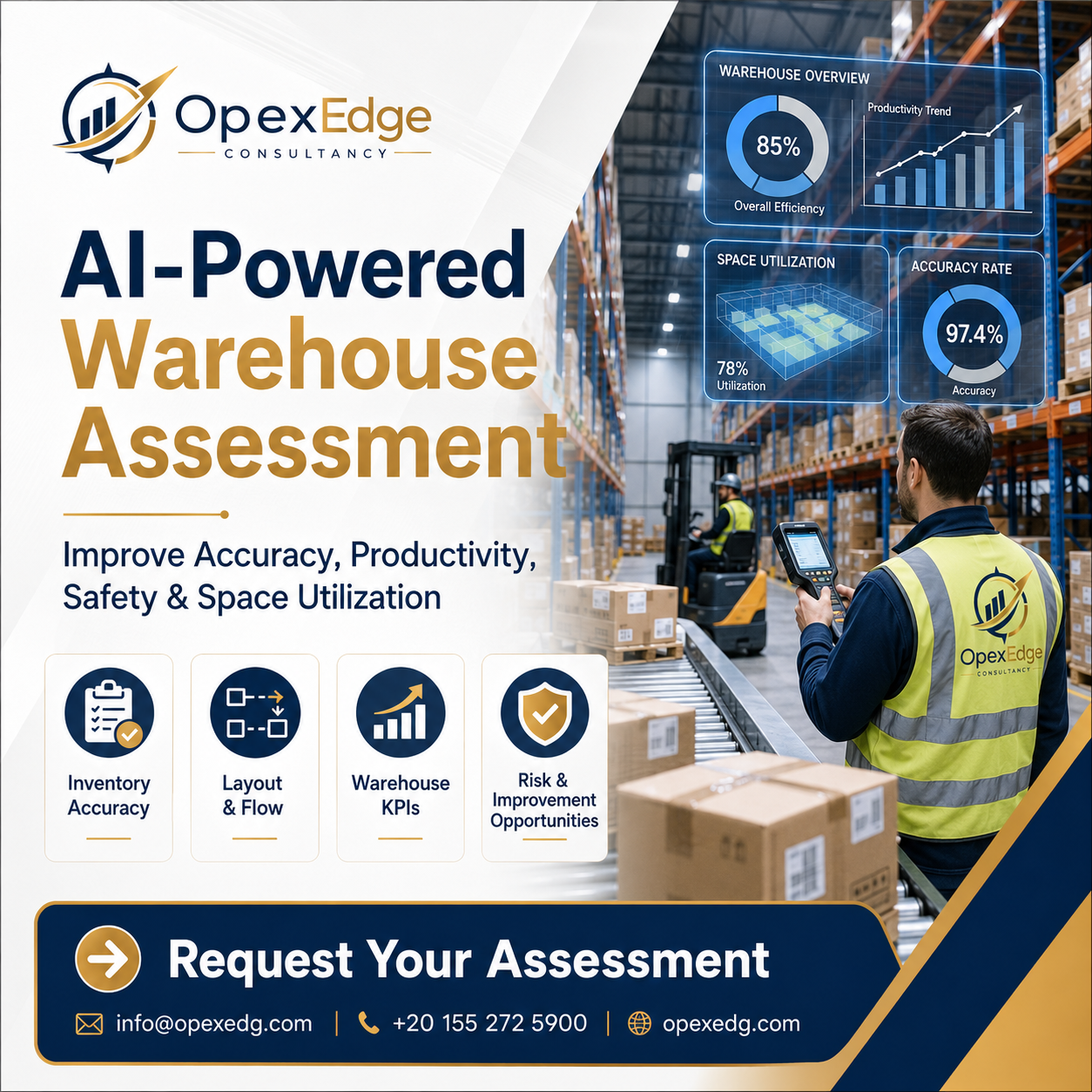
What Is a Warehouse Assessment?
A warehouse assessment is a structured review of warehouse operations to identify inefficiencies, risks, capacity issues, inventory-control gaps, and improvement opportunities.
The objective is to answer a practical question:
Is the warehouse operating efficiently, accurately, safely, and at the right cost?
A good warehouse assessment does not focus only on storage space. It reviews the complete warehouse process, from receiving goods to final dispatch.
What Does a Warehouse Assessment Cover?
| Area | What Is Reviewed |
| Receiving | Delivery checks, unloading, inspection, documentation, and put-away time |
| Storage | Space utilization, rack layout, product locations, and storage conditions |
| Inventory accuracy | Physical stock, system records, cycle counting, and stock discrepancies |
| Picking | Picking method, travel distance, errors, productivity, and order priority |
| Packing and dispatch | Packing quality, staging, loading, documentation, and delivery readiness |
| Returns | Returned items, damaged stock, quarantine areas, and corrective actions |
| Safety | Traffic routes, emergency access, signage, personal protective equipment, and unsafe conditions |
| Workforce | Roles, workload, training, productivity, and shift planning |
| Systems | ERP, warehouse-management systems, barcode use, reporting, and data quality |
| Cost | Labor cost, storage cost, handling cost, damage, delays, and wasted movement |
| KPIs | Service level, order accuracy, inventory accuracy, picking productivity, and dock-to-stock time |
Typical Problems Identified
A warehouse assessment may reveal:
- Poor inventory accuracy
- Excessive picking time
- Frequent stock discrepancies
- Overstock and slow-moving items
- Inefficient layout
- Unclear product locations
- Delayed receiving and put-away
- Order-picking errors
- Weak safety controls
- High labor cost
- Limited warehouse capacity
- Poor visibility of damaged or returned stock
- Lack of useful KPIs
- Manual processes that could be automated
Simple Example
A retailer has frequent delivery delays even though products are available in stock.
The assessment may show that:
- Products are stored in the wrong locations
- Fast-moving items are too far from the dispatch area
- Picking routes are not optimized
- Stock locations are not updated accurately
- Orders wait too long before packing
The solution may include:
- Re-slotting products
- Using ABC analysis
- Redesigning picking routes
- Improving barcode controls
- Tracking picking productivity
- Reviewing orders by priority
Key KPIs Used in a Warehouse Assessment
| KPI | Purpose |
| Inventory Accuracy % | Measures the accuracy of system stock versus physical stock |
| Order Picking Accuracy % | Measures picking errors |
| Dock-to-Stock Time | Measures how quickly received goods become available |
| Order Cycle Time | Measures the time from order release to dispatch |
| Picking Productivity | Measures lines, units, or orders picked per hour |
| Space Utilization % | Measures how effectively storage capacity is used |
| Stock Discrepancy Rate | Tracks inventory differences |
| Damage Rate % | Measures damaged inventory |
| On-Time Dispatch % | Measures dispatch performance |
| Return Rate % | Tracks returned orders |
| Labor Cost per Order | Measures operational efficiency |
| Slow-Moving Stock % | Identifies excess inventory exposure |
Warehouse Assessment vs Inventory Assessment
| Warehouse Assessment | Inventory Assessment |
| Reviews warehouse operations | Reviews stock levels and inventory health |
| Focuses on receiving, storage, picking, packing, and dispatch | Focuses on stockouts, overstock, aging, turnover, and safety stock |
| Reviews layout, productivity, safety, and process flow | Reviews purchasing and replenishment decisions |
| Measures operational efficiency | Measures inventory performance |
Both assessments work well together.
How AI Can Help
AI-assisted warehouse assessment can help identify:
- Inefficient product locations
- Fast-moving and slow-moving items
- Picking-route improvement opportunities
- Space-utilization problems
- Replenishment risks
- Stock-discrepancy patterns
- Labor-productivity gaps
- Seasonal capacity constraints
- Root causes of delays and errors
AI should support management decisions, while warehouse teams validate the recommendations before implementation.

Where you so for a long time were gone?