Focus Groups: The Complete Guide to Understanding
Customers and Making Better Business Decisions
Introduction
Many organizations believe they understand their customers.
Unfortunately, many discover the truth only after launching
a product, opening a new store, redesigning a service, or investing heavily in
marketing.
Customers behave differently than executives often assume.
This is why successful organizations spend time listening
before making decisions.
One of the most effective qualitative market research
methods is the Focus Group.
A properly designed focus group helps organizations
understand:
- Why
customers buy
- Why
they don’t buy
- What
they really value
- What
frustrates them
- What
influences purchasing decisions
- What
improvements customers actually want
Unlike surveys, focus groups allow businesses to explore
emotions, motivations, expectations, perceptions, and hidden customer needs.
For organizations seeking operational excellence and
customer-centric growth, focus groups provide valuable insights that reduce
business risk and improve strategic decisions.
Section Image
Image Suggestion
Professional meeting with customers discussing products
around a conference table with sticky notes and customer journey maps.
What is a Focus Group?
A focus group is a structured discussion led by a trained
moderator involving a small group of carefully selected participants.
The objective is to gather detailed qualitative insights
about:
- Products
- Services
- Brands
- Customer
experiences
- New
concepts
- Marketing
campaigns
- Business
processes
Participants interact naturally, allowing researchers to
observe:
- Opinions
- Emotions
- Behaviors
- Attitudes
- Group
dynamics
- Buying
motivations
Unlike questionnaires, participants explain why they
think a certain way.
That “why” often becomes the organization’s
biggest opportunity.
Section Image
Illustration showing moderator leading customer discussion
around a table.
Why Focus Groups Matter
Business decisions become expensive when based on
assumptions.
Focus groups reduce uncertainty before investing in:
- New
products
- New
services
- Advertising
campaigns
- Pricing
- Packaging
- Digital
transformation
- Customer
experience
- Retail
concepts
Organizations that understand customers make fewer costly
mistakes.
Benefits include:
- Better
product-market fit
- Higher
customer satisfaction
- Better
marketing messages
- Improved
customer loyalty
- Reduced
launch failures
- Better
innovation
- Stronger
competitive advantage
Section Image
Business team analyzing customer insights on dashboards.
When Should Businesses Use Focus Groups?
Focus groups are valuable before major business decisions.
Typical applications include:
Product Development
Validate ideas before launch.
Customer Experience
Understand pain points across the customer journey.
Branding
Evaluate customer perception of the brand.
Advertising
Test marketing campaigns before investing.
Retail
Study shopping behavior.
Manufacturing
Understand customer expectations regarding quality.
Healthcare
Improve patient experience.
Supply Chain
Understand service expectations.
Digital Transformation
Validate customer acceptance of digital solutions.
Section Image
Collage showing retail, manufacturing, healthcare and
digital business.
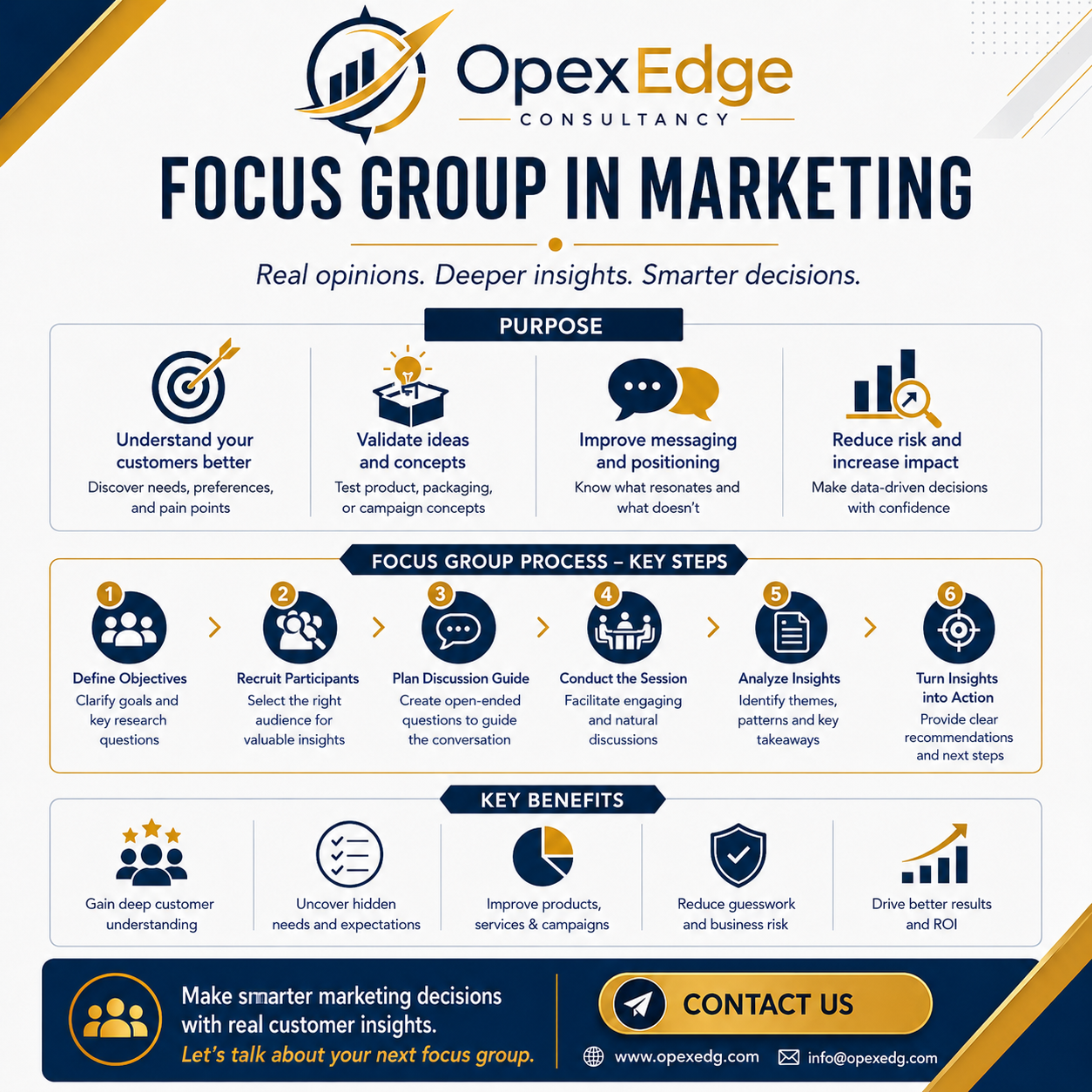
How to Conduct an Effective Focus Group
1. Define Objectives
Know exactly what you want to learn.
Examples:
- Why
are customers leaving?
- Which
packaging is preferred?
- Why
is sales declining?
- What
influences purchase decisions?
2. Recruit the Right Participants
Choose participants who represent your target market.
Typically:
6–10 participants
Common selection criteria:
- Age
- Industry
- Gender
- Buying
behavior
- Customer
segment
- Experience
level
3. Prepare Discussion Guide
Prepare open-ended questions.
Instead of asking
“Do you like our service?”
Ask
“What was your experience?”
or
“What would you improve?”
4. Moderate Professionally
The moderator should:
- Stay
neutral
- Encourage
discussion
- Explore
hidden insights
- Avoid
influencing responses
- Manage
dominant personalities
5. Analyze Findings
Look for:
- Patterns
- Common
frustrations
- Emotional
reactions
- Expectations
- Opportunities
- Repeated
themes
Section Image
Moderator facilitating a professional customer workshop.
Common Mistakes
Many focus groups fail because organizations:
- Ask
leading questions
- Invite
the wrong participants
- Domitinate
discussions
- Ignore
negative feedback
- Focus
only on confirming existing beliefs
- Skip
proper analysis
Remember:
A focus group should challenge assumptions—not confirm them.
Section Image
Business team reviewing sticky notes after customer
workshop.
Practical Case Study
Consumer Electronics Retailer
Background
A regional electronics retailer planned to launch a premium
membership program.
Management believed customers primarily wanted discounts.
Before investing, they conducted three focus groups with
loyal customers, occasional shoppers, and first-time buyers.
Findings
Participants consistently stated:
- Faster
delivery mattered more than discounts.
- Expert
product advice increased trust.
- Easy
returns were a major purchase driver.
- Exclusive
product launches created excitement.
- Mobile
app usability was poor.
Interestingly, only a small percentage considered discounts
the primary reason for joining.
Actions Taken
The company redesigned the membership program to include:
- Free
same-day delivery
- Dedicated
customer support
- Extended
warranty
- Early
product access
- Simplified
mobile app
- Priority
service
Results
Within 12 months:
- Membership
enrollment increased by 38%
- Customer
satisfaction improved by 24%
- Repeat
purchases increased by 19%
- Customer
complaints dropped by 27%
- Net
Promoter Score increased significantly
The company achieved these improvements without increasing
discount levels.
The greatest value came from understanding what customers
truly valued.
Section Image
Retail customers discussing new membership program concepts.
Best Practices
Successful focus groups:
✓ Clearly define objectives
✓ Recruit representative
participants
✓ Keep discussions
conversational
✓ Ask open-ended questions
✓ Listen more than you speak
✓ Record and analyze findings
✓ Convert insights into action
Customer insight has value only when it leads to better
decisions.
Section Image
Executive team converting customer insights into action
plans.
Conclusion
Focus groups remain one of the most powerful qualitative
research methods available.
While surveys tell you what customers think, focus
groups explain why they think that way.
Organizations that regularly listen to customers make better
strategic decisions, reduce business risk, improve customer experience, and
develop products and services that truly meet market needs.
The most successful companies don’t guess what customers
want—they ask, listen, and act.
About the Author
This article was prepared by Mahmoud Elhefnawi,
Founder and Principal Consultant at OpexEdge Consultancy, specializing
in Operational Excellence, Lean Six Sigma, Supply Chain, Customer Experience,
Business Transformation, and AI-powered consulting.
Author Profile:
https://opexedg.com/experts/mahmoud-elhefnawi/
Call to Action
Turn Customer Feedback into Business Growth
Understanding your customers should never rely on
assumptions.
At OpexEdge Consultancy, we help organizations design
and facilitate professional focus groups that uncover actionable customer
insights, validate business ideas, and support smarter strategic decisions.
Our services include:
- Customer
Insight Studies
- Focus
Group Facilitation
- Voice
of Customer (VOC) Programs
- Customer
Journey Mapping
- Market
Research
- Product
Validation
- Service
Design
- Business
Strategy Workshops
- Customer
Experience Improvement
Contact OpexEdge Consultancy
Email: info@opexedg.com
