
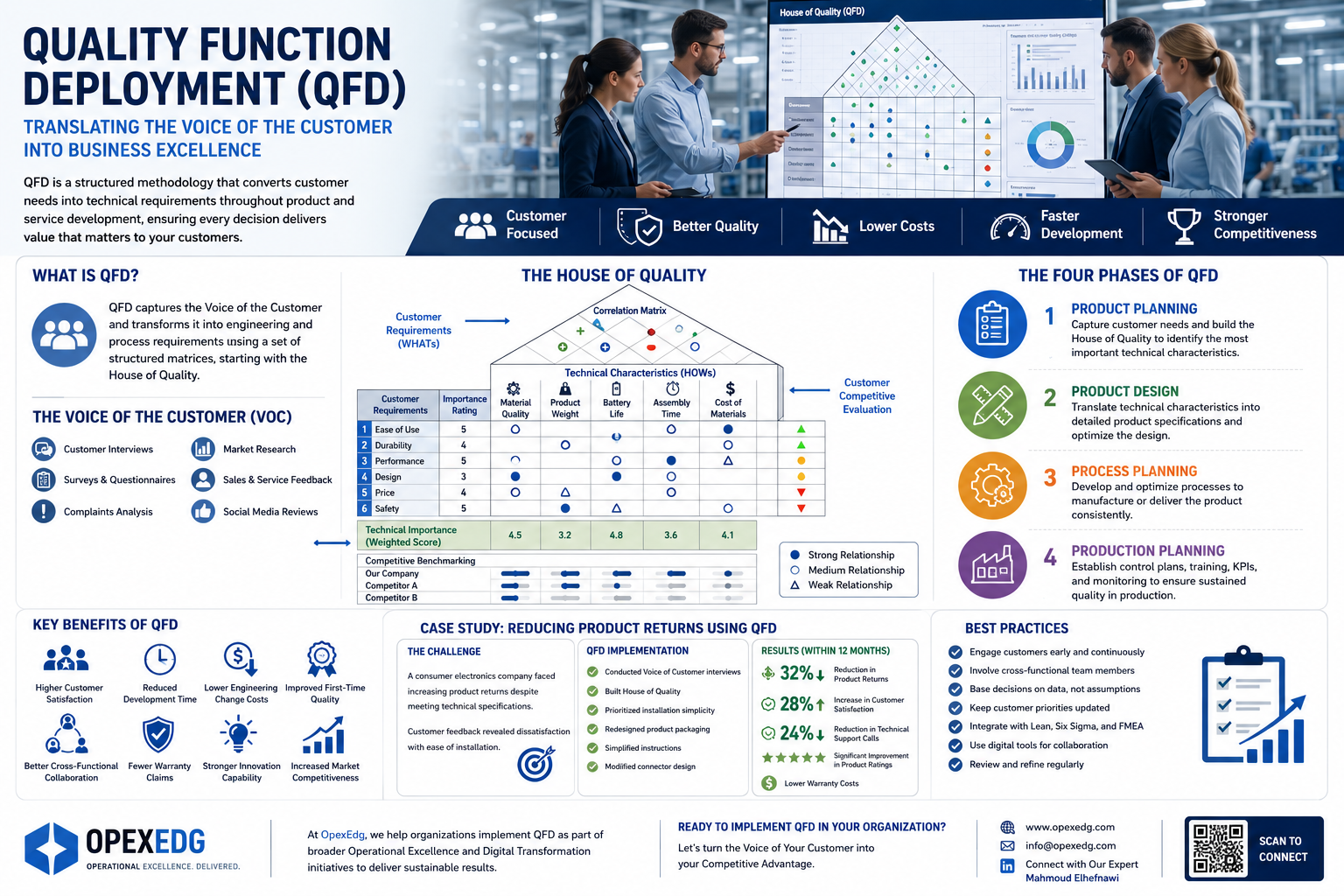
What is Quality Function Deployment?
Quality Function Deployment (QFD) is a structured methodology that converts customer needs into technical requirements throughout product and service development. Rather than relying on assumptions, QFD ensures every design decision aligns with customer expectations, improving quality while reducing development costs and rework.
Often known for its primary tool—the House of Quality—QFD creates a clear relationship between customer requirements (“WHATs”) and engineering or operational specifications (“HOWs”).
Organizations that successfully implement QFD consistently launch products faster, improve customer satisfaction, and reduce costly redesigns.
Why QFD Matters in Today’s Competitive Market
Businesses often invest significant resources in developing products only to discover they do not fully satisfy customer expectations.
QFD addresses this challenge by:
- Capturing the Voice of the Customer (VOC)
- Prioritizing customer requirements
- Translating needs into measurable technical specifications
- Aligning cross-functional teams
- Reducing design changes
- Increasing first-time quality
- Supporting continuous improvement initiatives
Whether you’re in manufacturing, healthcare, logistics, software, retail, or service industries, QFD creates a customer-driven culture.
The Four Phases of Quality Function Deployment
1. Product Planning
Customer requirements are gathered through:
- Customer interviews
- Surveys
- Complaints analysis
- Market research
- Sales feedback
- Social media reviews
The output is the House of Quality, where customer priorities are translated into engineering characteristics.
Suggested Image: Modern House of Quality matrix connecting customer requirements to engineering specifications with a professional blue corporate theme.
2. Product Design
Technical characteristics become detailed product specifications.
Activities include:
- Material selection
- Performance targets
- Functional design
- Engineering optimization
- Risk analysis
This phase ensures customer expectations are embedded into the design itself.
Suggested Image: Engineering team reviewing CAD models connected to customer requirement diagrams.
3. Process Planning
The design is converted into manufacturing or operational processes.
Key considerations include:
- Standard operating procedures
- Equipment capability
- Process parameters
- Quality checkpoints
- Process controls
The objective is to consistently produce products that meet customer expectations.
Suggested Image: Manufacturing workflow integrated with quality control checkpoints.
4. Production Planning
Operational teams establish:
- Inspection plans
- Training requirements
- Control plans
- KPIs
- Continuous monitoring
This phase ensures sustained quality during production.
Suggested Image: Factory production dashboard displaying quality KPIs and real-time monitoring.
The House of Quality Explained
The House of Quality is the core tool of QFD.
It links:
- Customer needs
- Technical characteristics
- Competitive benchmarking
- Correlations between technical requirements
- Importance ratings
- Improvement priorities
This matrix enables organizations to focus investment where it delivers the greatest customer value.
Suggested Image: Professional House of Quality matrix infographic with labeled sections.
Benefits of Implementing QFD
Organizations using QFD typically achieve:
- Higher customer satisfaction
- Reduced product development time
- Lower engineering change costs
- Better collaboration between departments
- Improved product reliability
- Increased market competitiveness
- Reduced warranty claims
- Stronger innovation capability
Case Study: Reducing Product Returns Through QFD
Background
A consumer electronics manufacturer experienced increasing product returns despite meeting technical specifications.
Challenge
Customer feedback revealed dissatisfaction with ease of installation rather than product performance.
QFD Implementation
The project team:
- Conducted Voice of Customer interviews
- Built a House of Quality
- Prioritized installation simplicity
- Redesigned product packaging
- Simplified installation instructions
- Modified connector design
Results
Within 12 months:
- Product returns reduced by 32%
- Customer satisfaction increased by 28%
- Technical support calls reduced by 24%
- Product ratings improved significantly
- Warranty costs decreased
The organization discovered that solving customer problems—not engineering assumptions—created the greatest business value.
Best Practices for Successful QFD
Successful organizations:
- Engage customers early
- Involve cross-functional teams
- Base decisions on customer data
- Keep customer priorities updated
- Integrate QFD with Lean and Six Sigma
- Use digital collaboration tools
- Review technical priorities regularly
Common Challenges
Organizations may struggle with:
- Incomplete customer data
- Poor cross-functional communication
- Excessive complexity
- Lack of executive sponsorship
- Failure to update customer requirements
These challenges can be overcome through structured facilitation and leadership commitment.
Integrating QFD with Business Excellence
QFD complements many operational excellence methodologies, including:
- Lean Manufacturing
- Six Sigma
- Design Thinking
- Voice of Customer (VOC)
- Failure Mode and Effects Analysis (FMEA)
- ISO 9001 Quality Management Systems
- Product Lifecycle Management (PLM)
Together, these approaches create customer-focused organizations capable of sustainable growth.
How OpexEdg Can Help
At OpexEdg, we help organizations implement Quality Function Deployment as part of broader Operational Excellence and Digital Transformation initiatives.
Our consulting services include:
- Voice of Customer assessment
- House of Quality workshops
- Product and process optimization
- Lean Six Sigma integration
- KPI development
- Executive coaching
- Digital transformation roadmaps
Expert Profile: https://opexedg.com/experts/mahmoud-elhefnawi/
Call to Action
Ready to transform customer expectations into measurable business results?
Partner with OpexEdg to implement Quality Function Deployment, improve product quality, reduce costs, and build customer-centric operations.
Contact Us
🌐 Website: https://opexedg.com
👤 Expert: Mahmoud Elhefnawi
📧 Request a consultation through the website to discuss your operational excellence journey.
Suggested Internal Links
- Operational Excellence
- Lean Manufacturing
- Six Sigma Methodology
- Design Thinking
- Voice of Customer (VOC)
- Product Lifecycle Management
- Quality Management Systems
- Continuous Improvement
- Digital Transformation
- Business Process Improvement
