
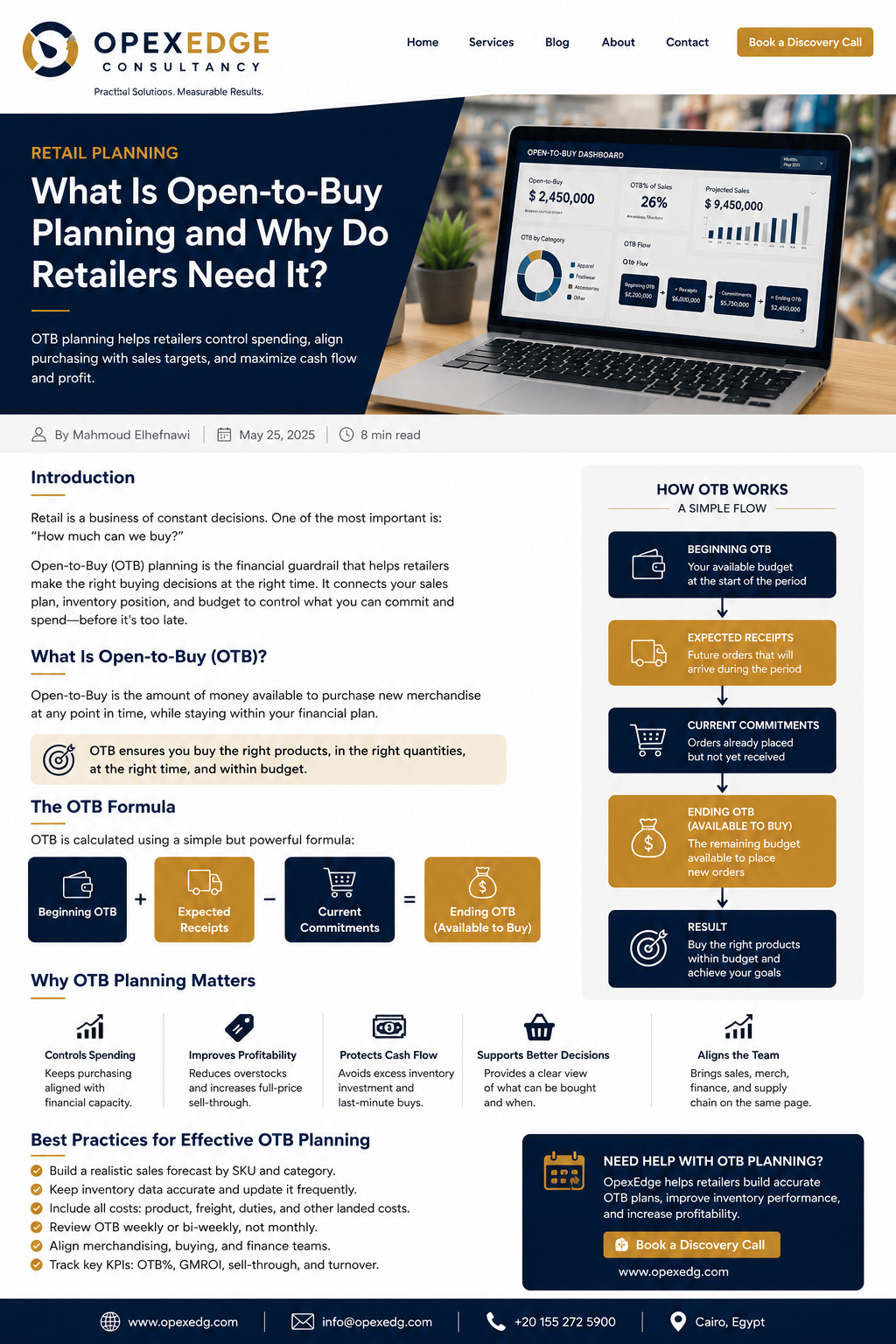
What Is Open-to-Buy Planning and Why Do Retailers Need It?
Retail businesses make purchasing decisions every day.
The challenge is not only deciding what products to buy.
Retailers must also decide:
- How much inventory to purchase
- When to place orders
- Which categories deserve more budget
- How to avoid overstock
- How to reduce stockouts
- How to protect cash flow
- How to improve profitability
Without a structured purchasing plan, retailers may invest too much money in slow-moving products while running out of high-demand items.
This is where Open-to-Buy Planning, commonly known as OTB, becomes essential.
What Is Open-to-Buy Planning?
Open-to-Buy is a retail planning method used to calculate how much money is available for purchasing new merchandise during a specific period.
It helps retailers control purchasing commitments while keeping inventory aligned with expected sales.
In simple terms, OTB answers one important question:
How much can we buy without exceeding our inventory and financial targets?
An effective OTB plan connects:
- Sales forecasts
- Inventory levels
- Purchase orders
- Expected receipts
- Planned markdowns
- Purchasing budgets
- Cash-flow targets
- Category priorities
The objective is to ensure that the retailer buys the right products, in the right quantities, at the right time, and within the available budget.
Why Retailers Need an OTB Plan
Many retailers face the same recurring problems:
- Excess inventory that consumes working capital
- Stockouts of popular products
- Emergency purchases at unfavorable prices
- Weak coordination between buying, finance, and operations
- Slow-moving or obsolete inventory
- Poor visibility of outstanding purchase orders
- Uncontrolled purchasing decisions
- Reduced gross margin
An OTB plan creates a financial guardrail for purchasing decisions.
Instead of buying based only on intuition, retailers can use structured data and approved limits.
The Basic Open-to-Buy Formula
OTB can be calculated at cost value or retail value, depending on the company’s planning method.
A common formula is:
Open-to-Buy = Planned Sales + Planned Markdowns + Planned Ending Inventory − Beginning Inventory − On-Order Inventory
Example
Assume a retailer plans the following for one month:
| Item | Value |
|---|---|
| Planned sales | $100,000 |
| Planned markdowns | $5,000 |
| Planned ending inventory | $80,000 |
| Beginning inventory | $70,000 |
| On-order inventory | $40,000 |
The OTB value is:
$100,000 + $5,000 + $80,000 − $70,000 − $40,000 = $75,000
This means the retailer can place additional purchase orders worth up to $75,000 while remaining aligned with the approved inventory plan.
Positive and Negative OTB
Positive OTB
A positive OTB value means the retailer still has available purchasing capacity.
The buying team may place additional orders, subject to product demand, supplier lead time, and category priorities.
Negative OTB
A negative OTB value means the retailer may already be overcommitted.
This may happen when:
- Too many purchase orders have already been placed
- Sales are lower than expected
- Inventory is moving slowly
- Stock levels are above plan
- Markdown assumptions are inaccurate
When OTB becomes negative, management should review planned purchases before placing new orders.
Benefits of Open-to-Buy Planning
1. Better Purchasing-Budget Control
OTB prevents uncontrolled spending by defining how much money is available for new purchases.
This supports better coordination between buying, finance, and management teams.
2. Reduced Overstock Risk
Retailers can avoid purchasing more stock than they are likely to sell.
This reduces storage costs, markdowns, aging inventory, and working-capital pressure.
3. Lower Stockout Risk
OTB planning helps identify categories where additional purchases are required to meet forecasted demand.
This improves product availability and customer satisfaction.
4. Improved Cash Flow
Inventory is one of the largest investments for many retailers.
A clear OTB plan helps management protect cash flow by allocating purchasing budgets more carefully.
5. Improved Gross Margin
Better purchasing decisions reduce unnecessary markdowns and support full-price sales.
This can improve category profitability and overall gross margin.
6. Stronger Team Alignment
OTB creates a shared view for:
- Merchandising
- Buying
- Finance
- Supply chain
- Warehouse operations
- Senior management
Everyone works with the same targets and purchasing limits.
OTB Planning by Category
Retailers should not manage the entire inventory budget as one number.
OTB works best when it is reviewed by category.
For example:
| Category | Planned Sales | Current Inventory | On Order | OTB Decision |
|---|---|---|---|---|
| Apparel | High | Balanced | Moderate | Maintain purchasing |
| Footwear | Growing | Low | Limited | Increase purchasing |
| Accessories | Stable | High | High | Reduce new orders |
| Seasonal items | Declining | High | Moderate | Review markdown plan |
This allows the retailer to shift budget toward the categories with the strongest demand and profitability potential.
OTB Planning and Demand Forecasting
OTB should not be used alone.
It works best when connected to a realistic demand forecast.
Demand planning helps retailers estimate:
- Expected sales by SKU
- Seasonal demand
- Promotion impact
- Growth trends
- Product lifecycle
- Store-level differences
- Channel-level demand
- Supplier lead times
The forecast tells the retailer what customers are likely to buy.
The OTB plan tells the retailer how much purchasing budget is available.
Together, they create a stronger retail-planning process.
How AI Can Improve OTB Planning
AI-assisted analysis can help retailers identify risks and opportunities faster.
Examples include:
- Detecting stockout risks
- Identifying overstocked categories
- Highlighting slow-moving products
- Forecasting seasonal demand
- Reviewing sales trends
- Comparing actual sales with forecasted sales
- Recommending purchasing adjustments
- Prioritizing categories with strong growth potential
- Identifying categories with declining demand
AI should support management decisions, not replace them.
The best approach combines data analysis with commercial judgment, supplier knowledge, and financial review.
Important KPIs for OTB Management
A strong OTB process should include regular KPI reviews.
| KPI | Purpose |
|---|---|
| OTB available budget | Measures remaining purchasing capacity |
| Inventory turnover | Measures how quickly inventory is sold |
| Days of inventory on hand | Shows how long inventory can support demand |
| Stockout rate | Measures unavailable products |
| Slow-moving inventory percentage | Identifies inventory risk |
| Sell-through rate | Measures how much inventory has been sold |
| Forecast accuracy | Measures planning quality |
| Forecast bias | Shows whether forecasts are consistently too high or too low |
| Gross margin | Tracks profitability |
| Markdown percentage | Measures price-reduction exposure |
| Purchase-plan adherence | Measures execution against approved budgets |
Common OTB Planning Mistakes
Retailers should avoid these common mistakes:
1. Using inaccurate inventory data
OTB calculations depend on accurate stock information.
If inventory records are incorrect, the purchasing plan will also be unreliable.
2. Ignoring outstanding purchase orders
Orders that have been placed but not yet received must be included in the OTB calculation.
3. Using unrealistic sales forecasts
An overly optimistic sales forecast may encourage excessive purchasing.
4. Reviewing OTB too infrequently
Retail conditions can change quickly.
OTB should be reviewed monthly and, for fast-moving categories, weekly.
5. Ignoring seasonality and promotions
Demand may change significantly during holidays, campaigns, school seasons, or special events.
6. Managing all categories in the same way
Each category has different demand patterns, lead times, gross margins, and inventory risks.
Best Practices for Effective OTB Planning
To build a strong OTB process:
- Maintain accurate inventory records.
- Prepare realistic sales forecasts.
- Track open purchase orders.
- Review OTB by category.
- Include promotions and markdown plans.
- Monitor supplier lead times.
- Track forecast accuracy.
- Identify slow-moving products early.
- Review the plan regularly.
- Align buying, finance, supply chain, and management teams.
AI-Powered OTB Planning with OpexEdge Consultancy
OpexEdge Consultancy helps retailers build structured purchasing-budget controls using practical data analysis and AI-assisted planning.
Our AI-Powered Open-to-Buy Planning Service can include:
- Customer data questionnaire
- OTB calculator
- Category-level budget analysis
- Inventory-risk review
- Purchasing-plan evaluation
- KPI dashboard
- AI-assisted alerts
- Management recommendations
- Implementation roadmap
- Training and knowledge transfer
The objective is simple:
Buy the right products, in the right quantities, at the right time, and within budget.
Conclusion
Open-to-Buy planning is not only a purchasing tool.
It is a financial, commercial, and inventory-management system that helps retailers make better decisions.
A well-designed OTB plan can support stronger cash flow, improved product availability, reduced overstock, better gross margins, and more disciplined purchasing.
Retailers that combine OTB planning with demand forecasting and AI-assisted analysis can improve visibility and respond more quickly to changing market conditions.
Ready to Improve Your Purchasing Decisions?
OpexEdge Consultancy can help your business design an AI-powered OTB planning process supported by practical tools, dashboards, KPIs, and management recommendations.
Contact us to request a discovery call.
OpexEdge Consultancy
Email: info@opexedg.com
Mobile: +20 155 272 5900
Website: opexedg.com

2 Comments