
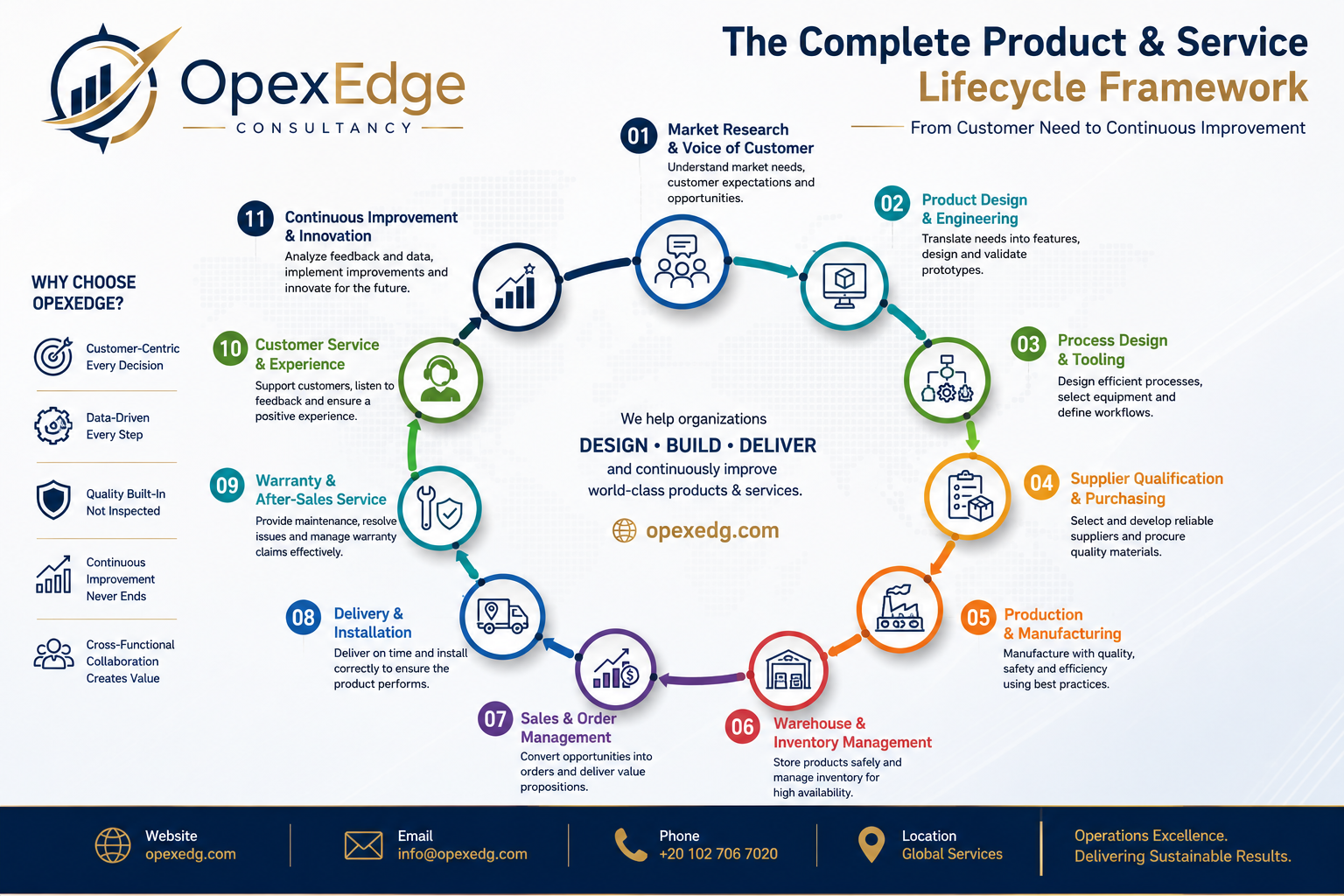
The Complete Product & Service Lifecycle Framework
How to design the full cycle of a product — from market study and customer demand capture to product design, process design, manufacturing, delivery, installation, warranty, maintenance, and continuous improvement.
The Core Idea
A product is not only designed by engineering. It is created by a connected system where customer needs are captured, converted into specifications, produced through controlled processes, delivered correctly, supported after sale, and improved through real customer feedback.
Why This Framework Matters
Many companies treat departments as separate islands: Marketing collects customer needs, Design creates drawings, Production manufactures, Sales sells, and Customer Service handles complaints. The result is slow launches, unclear specifications, rework, poor quality, high warranty cost, and customer dissatisfaction.
Traditional Problem
Customer demand is captured informally, design decisions are not linked to real customer needs, process design starts too late, production discovers problems during launch, and after-sales feedback does not return to marketing or engineering.
OpexEdge Solution
Create a closed-loop lifecycle where every stage has clear inputs, methods, outputs, owners, and KPIs. Each team receives structured information from the previous stage and delivers verified outputs to the next stage.
The Full Product & Service Cycle
The cycle begins with market study and ends with customer feedback feeding the next round of improvement.
VOC
Prototype
Tools
Final Product
Inventory
Orders
Installation
Maintenance
Improvement
Original concept image supplied by Mahmoud Elhefnawi, QMS Consultant:

Market Study & Voice of Customer
Owner: Marketing Team
- Business strategy
- Target market definition
- Previous sales data
- Customer complaints
- Competitor products
- Warranty feedback
- Focus groups
- Customer interviews
- Surveys
- Kano Model
- Voice of Customer analysis
- Competitor benchmarking
- Customer journey mapping
- Market segmentation
- Customer demand list
- Prioritized features
- Kano classification
- Market opportunity report
- Product Requirements Document
- Business case
- VOC completion rate
- Customer insight quality
- Market size
- NPS baseline
- Feature priority score
Product Design & Engineering
Owner: Design / Engineering Team
- VOC report
- Product Requirements Document
- Kano priorities
- Regulatory requirements
- Budget targets
- Target cost
- Design thinking
- QFD
- CAD design
- DFMEA
- Design reviews
- Simulation
- Rapid prototyping
- Design verification and validation
- Approved concept
- Prototype
- BOM
- Technical specifications
- Engineering drawings
- Material specifications
- Design verification report
- Design review closure
- Prototype approval rate
- Target cost achievement
- Design change count
- Compliance status
Manufacturing Process Design
Owner: Manufacturing Engineering / Industrial Engineering
- Approved product design
- Technical specs
- BOM
- Quality requirements
- Demand forecast
- Capacity targets
- Process flow diagram
- PFMEA
- Control plan
- Line balancing
- Tooling and jig design
- Work instructions
- Capacity planning
- Lean layout design
- Manufacturing process plan
- Production line layout
- Tools and fixtures
- SOPs
- Control plan
- Inspection points
- Production readiness checklist
- Process capability
- Cycle time
- Line balance efficiency
- Readiness score
- PFMEA action closure
Production & Final Product
Owner: Production / Quality Team
- Raw materials
- Approved suppliers
- SOPs
- Control plan
- Production schedule
- Trained operators
- Standard work
- SPC
- In-process inspection
- 5S
- TPM
- Kaizen
- Traceability
- Final quality inspection
- Finished products
- Production records
- Inspection reports
- Nonconformity reports
- Traceability data
- Release approval
- OEE
- First pass yield
- Scrap rate
- Rework rate
- Defect rate
- Schedule adherence
Storing & Inventory Management
Owner: Warehouse / Supply Chain Team
- Finished products
- Release status
- Storage requirements
- Packaging specs
- Sales forecast
- Delivery plan
- FIFO/FEFO
- Barcode or QR tracking
- WMS
- Cycle counting
- Inventory classification
- Packaging control
- Damage prevention
- Available inventory
- Stock accuracy report
- Picking list
- Shipping readiness
- Inventory movement records
- Inventory accuracy
- Stock availability
- Damage rate
- Picking accuracy
- Inventory turnover
Sales & Order Management
Owner: Sales / Commercial Team
- Available inventory
- Product catalog
- Pricing policy
- Customer leads
- Sales forecast
- Delivery capacity
- CRM
- Quotation process
- Order review
- Contract review
- Demand forecasting
- Customer qualification
- Sales pipeline management
- Confirmed orders
- Sales contracts
- Customer requirements confirmation
- Delivery request
- Updated demand forecast
- Conversion rate
- Order accuracy
- Forecast accuracy
- Customer acquisition cost
- Revenue
- Margin
Delivery & Installation
Owner: Logistics / Installation Team
- Confirmed order
- Customer site details
- Product availability
- Installation instructions
- Delivery schedule
- Customer contact details
- Route planning
- Delivery checklist
- Installation SOP
- Site readiness check
- Handover checklist
- Customer training
- Acceptance testing
- Delivered product
- Installed product
- Customer acceptance certificate
- Installation report
- Handover documentation
- On-time delivery
- Installation first-time-right
- Damage rate
- Customer acceptance rate
- Delivery cost
Warranty & Maintenance
Owner: After-Sales / Service Team
- Installed product record
- Warranty terms
- Customer service request
- Spare parts list
- Maintenance schedule
- Product history
- Help desk
- Service ticketing
- Preventive maintenance
- Corrective maintenance
- Root cause analysis
- Spare parts management
- Field service reports
- Closed service ticket
- Warranty claim report
- Maintenance report
- Failure analysis
- Customer satisfaction result
- Improvement request
- First response time
- Mean time to repair
- Warranty cost
- Repeat failure rate
- Service satisfaction
Customer Feedback & Continuous Improvement
Owner: Marketing / Quality / Product Management
- Service reports
- Warranty data
- Customer complaints
- NPS results
- Sales feedback
- Production defects
- Market changes
- CAPA
- PDCA
- Pareto analysis
- 8D problem solving
- Kaizen
- Design change process
- Management review
- Lessons learned
- Product improvement plan
- Design change request
- Updated VOC
- Updated specifications
- New product ideas
- Process improvement actions
- CAPA closure
- Complaint reduction
- NPS improvement
- Warranty cost reduction
- Repeat issue reduction
Practical Case Study: Smart Furniture for Small Homes
Imagine a company wants to launch a space-saving smart furniture product for apartments with limited space. The product could be a foldable wall bed, modular sofa, or multi-function storage unit.
1. Market Study
Marketing runs focus groups with apartment owners and asks Kano questions. Customers say they need space-saving, easy cleaning, safety, durability, modern design, and fast installation.
2. Design
The design team converts these needs into a prototype: compact dimensions, strong hinges, anti-fall safety lock, easy assembly, clear specs, and target cost.
3. Process
Engineering designs cutting, edging, assembly, inspection, packaging, and installation methods. Tools, jigs, SOPs, and quality checks are prepared before mass production.
4. Production
Production manufactures the units using approved materials and controlled processes. Quality checks confirm dimensions, finish, strength, safety, and packaging.
5. Delivery & Service
Warehouse prepares the order. Logistics delivers it. Installation team installs the product and customer service records feedback, complaints, and maintenance needs.
6. Improvement
If customers report that installation takes too long or a hinge needs better durability, this data returns to marketing, design, process engineering, and suppliers for the next version.
Management Summary Table
| Stage | Main Purpose | Main Output | Typical Owner |
|---|---|---|---|
| Market Study | Capture customer demand | VOC and PRD | Marketing |
| Product Design | Convert demand into design | Prototype and technical specs | Design / Engineering |
| Process Design | Define how to manufacture | SOPs, tools, control plan | Manufacturing Engineering |
| Production | Manufacture compliant products | Finished product | Production / Quality |
| Storing | Protect and control inventory | Available stock | Warehouse |
| Sales | Convert demand into orders | Confirmed order | Sales |
| Delivery & Installation | Deliver value to customer | Installed product | Logistics / Installation |
| Warranty & Maintenance | Support customer after sale | Service reports | Customer Service |
| Improvement | Close the feedback loop | Improvement actions | Marketing / Quality / Product |
How This Connects to Quality and Operations Excellence
This lifecycle is aligned with modern quality management thinking: customer focus, process approach, evidence-based decision making, relationship management, and continual improvement. It also connects naturally with APQP, Lean, Toyota Production System principles, QFD, FMEA, CAPA, and digital systems such as CRM, PLM, ERP, MES, WMS, and QMS.
Digital System Map
CRM captures leads and customer feedback. PLM controls design and specifications. ERP controls purchasing, costing, and orders. MES controls production execution. WMS controls inventory. QMS controls nonconformities, CAPA, audits, and improvement.
Leadership Message
The goal is not to make one department excellent. The goal is to make the full system excellent. A weak handover between two stages can damage the whole customer experience.
OpexEdge Implementation Checklist
To implement this framework, start by mapping your current lifecycle, defining owners for every stage, documenting inputs and outputs, standardizing handovers, creating KPIs, and building a feedback loop from customer service back to marketing and design.
Selected References
- ISO, ISO 9001:2015 and quality management principles: customer focus, process approach, and continual improvement.
- Toyota, Toyota Production System: Jidoka and Just-in-Time as pillars of controlled, efficient production.
- AIAG, Advanced Product Quality Planning overview: structured approach from concept to launch.
- Kano Model: classification of customer requirements into must-be, performance, attractive, indifferent, and reverse features.

1 Comment