
Retailers do not lose profit only because sales are weak.
They also lose profit when they buy the wrong products, in the wrong quantities, at the wrong time.
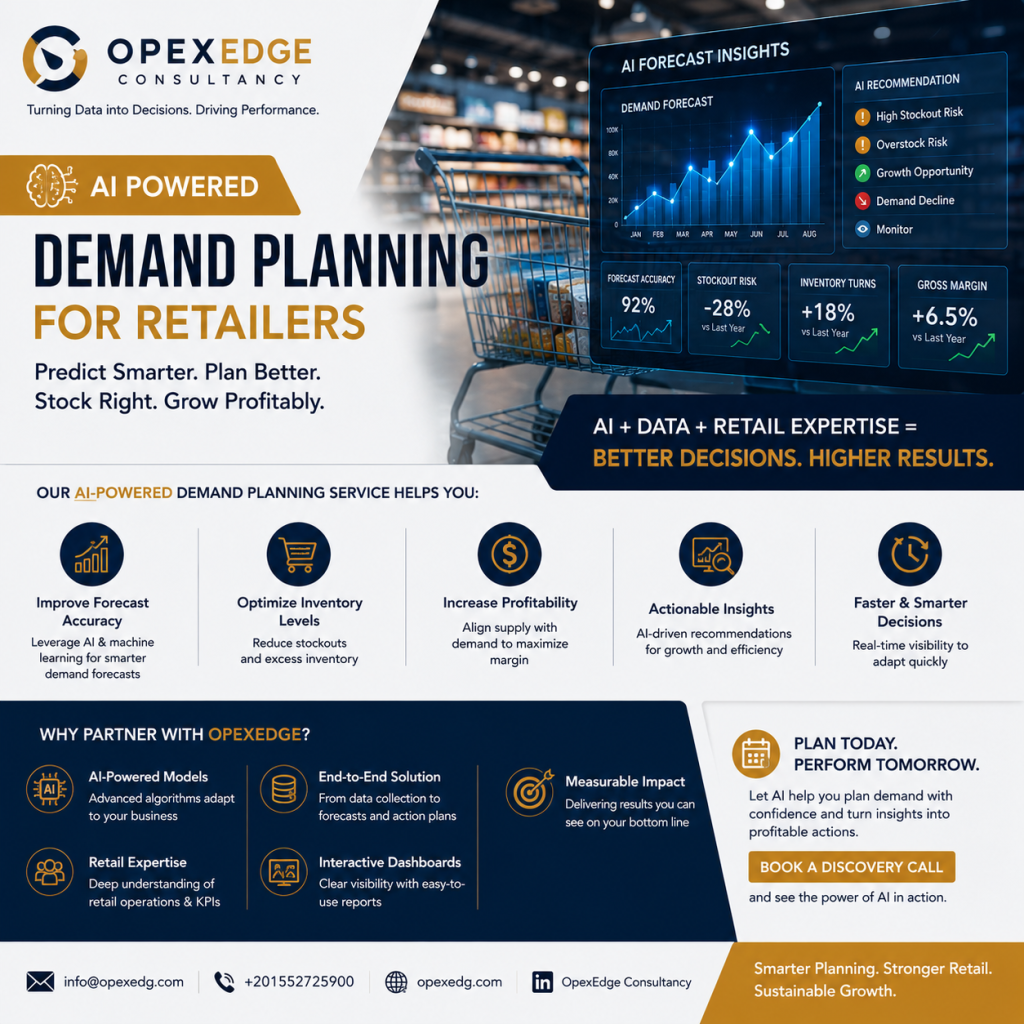
That is why OpexEdge Consultancy is launching:
𝗔𝗜-𝗣𝗼𝘄𝗲𝗿𝗲𝗱 𝗥𝗲𝘁𝗮𝗶𝗹 𝗗𝗲𝗺𝗮𝗻𝗱 𝗣𝗹𝗮𝗻𝗻𝗶𝗻𝗴
A practical service designed to help retailers improve purchasing decisions, reduce stockouts, limit overstock, and protect working capital.
The service combines:
✓ Customer data questionnaire
✓ SKU-level demand forecasting
✓ Seasonality and growth assumptions
✓ Safety-stock and reorder-point calculations
✓ Suggested purchase quantities
✓ Purchase-budget planning
✓ Category-level dashboard
✓ AI-assisted alerts for stockout risk, overstock risk, growth opportunities, and declining demand
The objective is simple:
Buy the right products.
In the right quantities.
At the right time.
The result is a practical demand plan that supports commercial, purchasing, finance, and operations teams with clearer decisions.
Ready to improve your supply chain performance?
Contact OpexEdge Consultancy to request an AI-powered Demand Planning service and discover where your business can reduce cost, improve service, and unlock operational value.
Email: info@opexedg.com
Know your expert
AI-Powered Retail Demand Planning: Turning Retail Uncertainty into Better Buying Decisions
Retailers do not lose profit only because sales are weak. They also lose profit when they buy the wrong products, in the wrong quantities, at the wrong time.
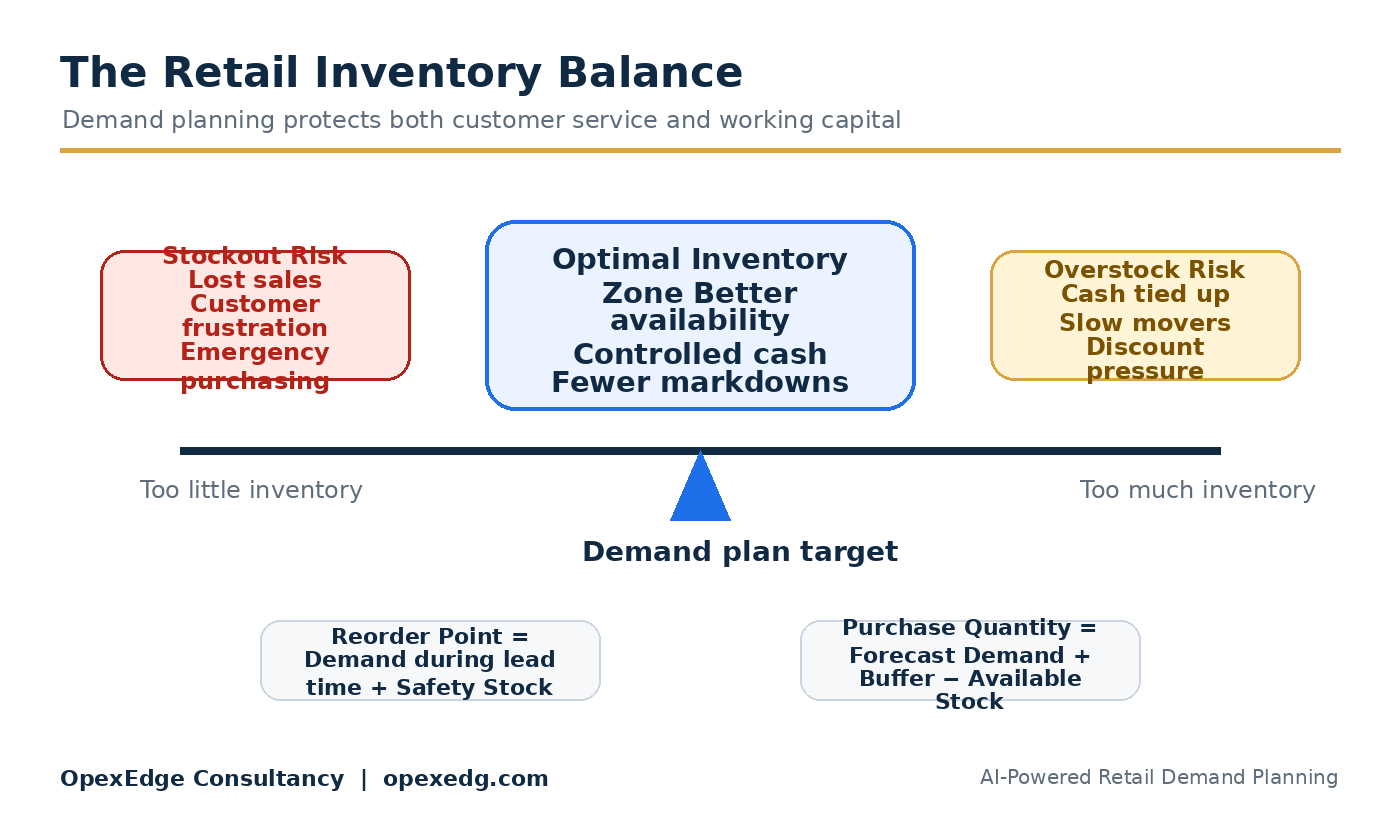
In retail, poor demand planning creates two costly problems at the same time. On one side, stockouts lead to lost sales, unhappy customers, and missed market opportunities. On the other side, overstock ties up cash, increases storage pressure, creates slow-moving inventory, and often ends with discounting or write-offs.
This is why demand planning is no longer just a supply chain activity. It is a strategic business capability that connects commercial planning, purchasing, finance, inventory control, and customer service.
AI-powered retail demand planning helps retailers move from reactive purchasing to data-driven planning. Instead of depending only on experience, manual spreadsheets, or last year’s sales, retailers can use structured data, SKU-level analysis, seasonality, growth assumptions, and AI-assisted alerts to make better buying decisions.
What Is AI-Powered Retail Demand Planning?
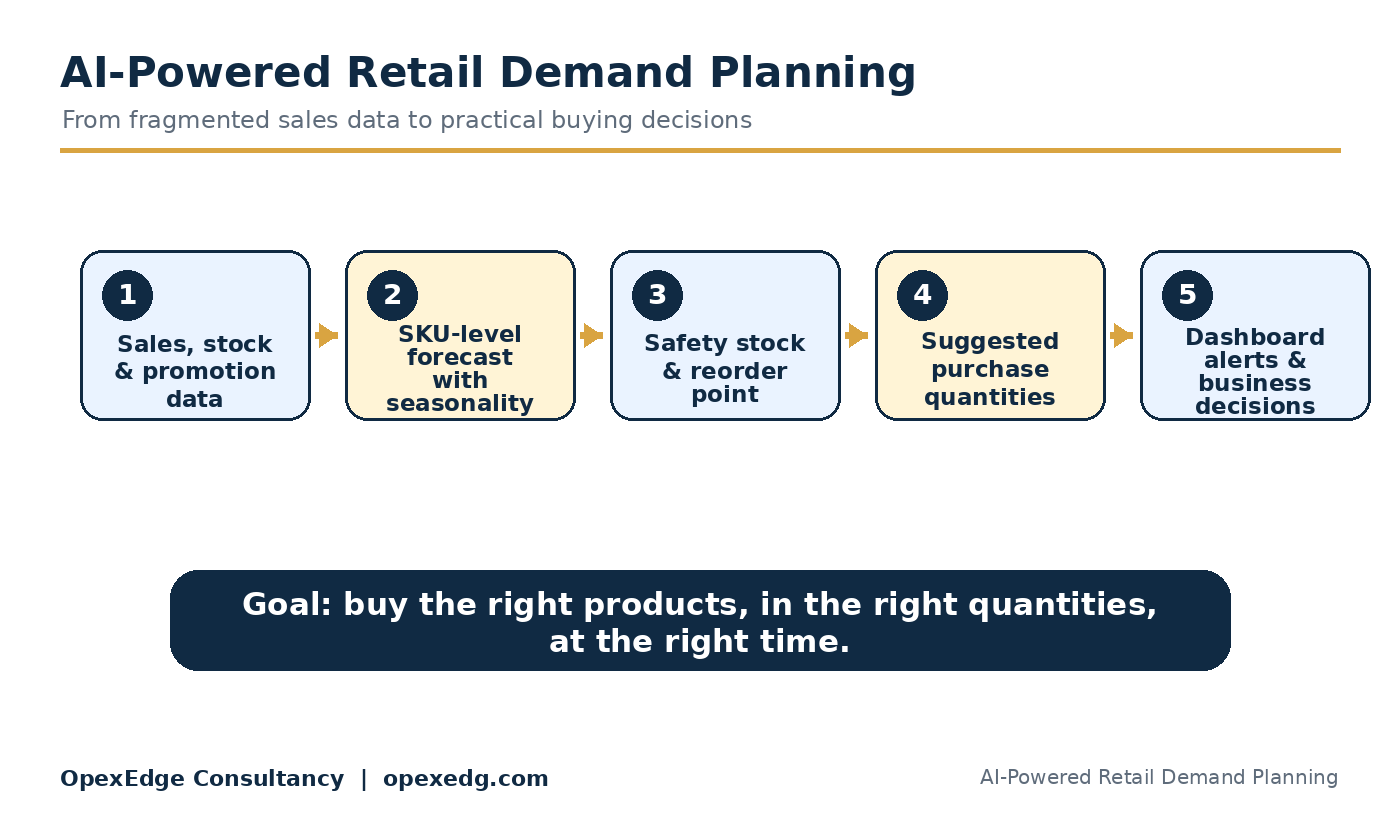
AI-powered retail demand planning is the process of using data, analytics, and AI-assisted logic to estimate future product demand and convert that forecast into practical inventory and purchasing decisions.
The objective is simple:
Buy the right products.
In the right quantities.
At the right time.
A strong demand plan does not only answer “How much will we sell?” It also answers more practical business questions:
Which SKUs are growing?
Which items are declining?
Which products are at risk of stockout?
Which products are overstocked?
How much should we buy?
When should we reorder?
How much budget should be allocated by category?
Where is cash being trapped in slow-moving inventory?
This makes demand planning a bridge between forecasting and execution.
Why Traditional Retail Planning Often Fails
Many retailers still plan demand using simple spreadsheets, historical averages, supplier pressure, or the personal judgment of buyers. While experience is valuable, it is not enough when the business has many SKUs, changing customer behavior, promotions, seasonality, supplier lead times, and limited working capital.
Traditional planning often fails because it looks backward more than forward. It may show what sold last month, but it may not clearly explain what should be purchased next month. It may show total category sales, but it may hide SKU-level problems. It may also ignore the effect of seasonality, campaigns, stock availability, or abnormal demand periods.
The result is a planning cycle that becomes reactive. Teams discover the problem after it has already affected sales, cash, or service level.AI-powered demand planning helps retailers identify these problems earlier and convert data into action.
The Real Cost of Poor Demand Planning
Poor demand planning affects the business in several ways.
First, it reduces sales when fast-moving items are not available. Customers may shift to competitors if they cannot find what they need.
Second, it damages working capital when cash is locked inside slow-moving or excessive stock. This limits the retailer’s ability to invest in better products, marketing, operations, or expansion.
Third, it increases operating pressure. Teams spend more time firefighting, chasing emergency purchases, managing complaints, discounting old stock, and explaining inventory gaps.
Fourth, it weakens decision alignment. Commercial teams may push for availability, finance may push for lower inventory, and purchasing may depend on supplier minimums or past habits. A clear demand plan creates one shared view for all teams.
How AI Improves Retail Demand Planning
AI does not replace business judgment. It improves the quality of the information used to make decisions.
A practical AI-powered demand planning model can analyze SKU-level sales, seasonality, growth assumptions, inventory position, lead time, minimum stock requirements, and category performance. It can then support planners with clearer forecasts, reorder points, safety stock calculations, purchase suggestions, and exception alerts.
This is especially useful because retail demand is not always stable. Some products sell in cycles. Some depend on promotions. Some grow suddenly. Some decline gradually. Some appear healthy only because they were pushed by discounts. Others may have low sales simply because they were out of stock.
AI-assisted planning helps separate real demand signals from noise.
Key Components of an Effective Demand Planning Service
A practical retail demand planning service should not stop at producing a forecast. It should create a full decision-support package that helps the business take action.
The main components include:
1. Customer Data Questionnaire
The process starts by collecting structured information from the retailer. This includes product data, historical sales, current stock, purchase lead times, supplier constraints, category structure, service-level targets, and business assumptions.
Good demand planning depends on good input data. The questionnaire helps organize scattered information into a format that can be analyzed.
2. SKU-Level Demand Forecasting
SKU-level forecasting helps retailers understand demand at the item level instead of relying only on total category sales. This is important because one category may look healthy while several individual SKUs are either understocked or overstocked.
SKU-level analysis supports better buying, replenishment, and inventory prioritization.
3. Seasonality and Growth Assumptions
Retail demand often changes by month, season, holiday, campaign, weather, income cycle, or customer behavior. A demand plan should reflect expected growth, decline, or seasonal movement.
This helps the business avoid buying too much during slow periods or too little before peak demand.
4. Safety Stock and Reorder Point Calculations
Safety stock protects the business from demand variation and supplier delays. Reorder points help define when a product should be purchased again.
A simple but powerful planning logic is:
Reorder Point = Demand during lead time + Safety Stock
When this is applied consistently, the business becomes less dependent on guesswork and more focused on controlled replenishment.
5. Suggested Purchase Quantities
A demand plan should convert the forecast into purchasing recommendations. Suggested purchase quantities help purchasing teams understand how much to buy after considering forecast demand, available stock, lead time, and required buffer.
This supports faster and more confident purchasing decisions.
6. Purchase-Budget Planning
Demand planning should also connect with finance. Purchase-budget planning helps the business allocate cash by category, priority, and expected demand.
This is critical for retailers with limited working capital. The goal is not only to buy more, but to buy smarter.
7. Category-Level Dashboard
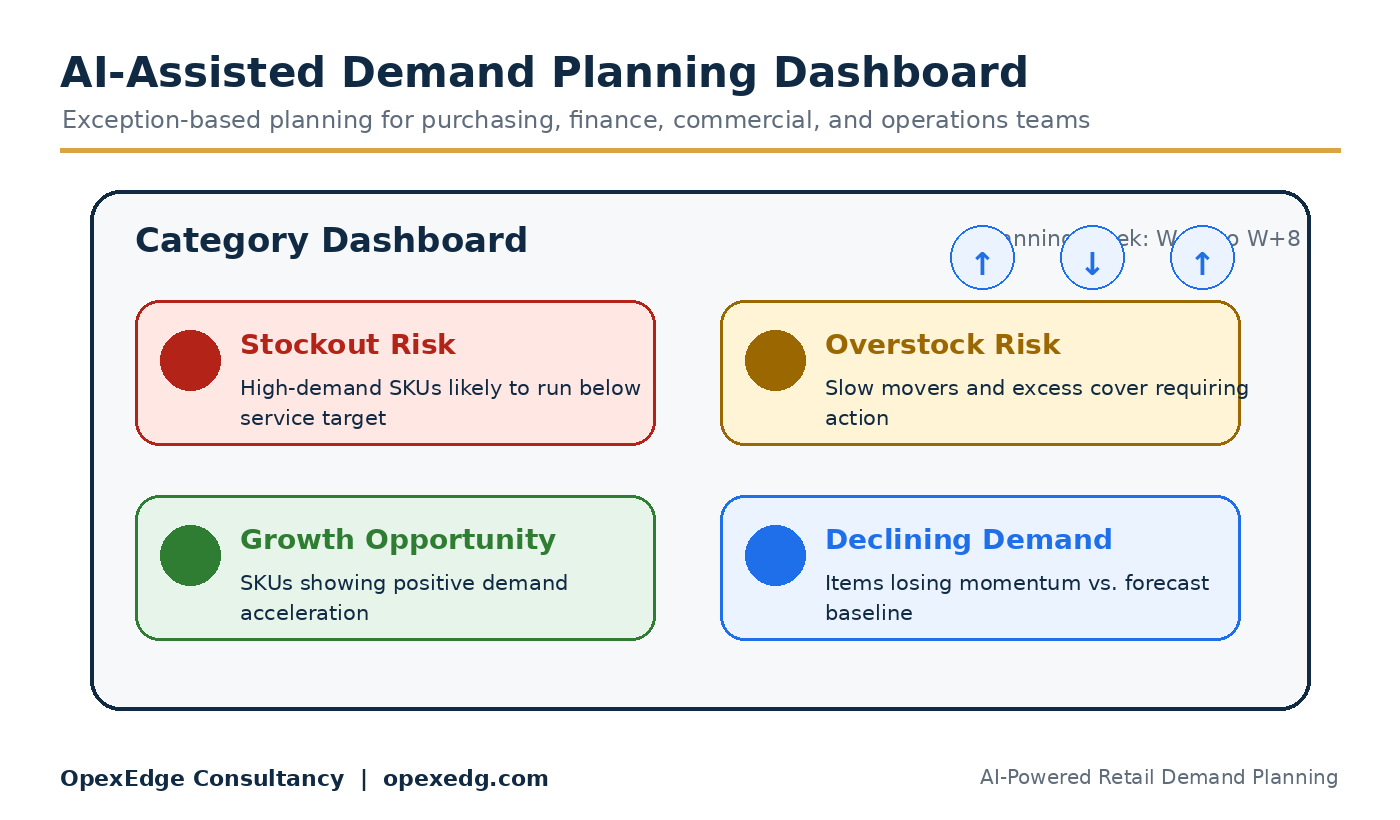
A category dashboard gives management a clearer view of performance, risk, and opportunity. It can show forecast demand, expected purchases, stock cover, overstock risk, stockout risk, and category-level budget needs.
This turns demand planning from a spreadsheet activity into a management decision tool.
8. AI-Assisted Alerts
AI-assisted alerts help teams focus on exceptions instead of reviewing every SKU manually. Useful alerts include:
Stockout risk
Overstock risk
Growth opportunities
Declining demand
Slow-moving inventory
Unusual sales behavior
Budget pressure
Reorder priority
This makes the planning process faster, more focused, and easier to manage.
The Business Value of Demand Planning
The value of demand planning is not only in forecast accuracy. The real value is in better decisions.
A practical demand planning process can help retailers:
Reduce stockouts
Limit excess inventory
Improve product availability
Protect working capital
Reduce emergency purchasing
Improve supplier planning
Support category management
Improve purchasing discipline
Reduce markdown pressure
Align commercial, purchasing, finance, and operations teams
When demand planning is done correctly, it gives the business a clearer answer to one of the most important retail questions:
What should we buy next, and why?
From Forecasting to Decision-Making
Many businesses think demand planning is only about forecasting future sales. This is incomplete.
Forecasting is only the first step. The real objective is to convert the forecast into action. A demand plan should guide purchasing, replenishment, inventory control, supplier coordination, and financial planning.
This is why the best demand planning systems are practical, not theoretical. They do not only produce numbers. They explain priorities.
For example:
If an SKU has strong forecast demand and low stock, it becomes a stockout-risk priority.
If an SKU has weak demand and high stock, it becomes an overstock-risk priority.
If a category is growing, it may need more purchase budget.
If a product is declining, purchasing should be controlled.
If supplier lead time is long, reorder points must be adjusted earlier.
This is where AI-assisted planning becomes powerful. It helps translate complex SKU data into simple business actions.
Why OpexEdge’s Approach Is Practical
OpexEdge Consultancy’s AI-Powered Retail Demand Planning service is designed for practical business use. It combines structured data collection, SKU-level demand forecasting, seasonality and growth assumptions, safety stock, reorder points, suggested purchase quantities, purchase-budget planning, category dashboards, and AI-assisted alerts.
The service is designed to support the teams that make daily business decisions:
commercial, purchasing, finance, operations, and supply chain.
Instead of giving retailers a complex technical model only, the output is a practical demand plan that helps answer clear operational questions:
What products need attention?
What should be reordered?
How much should be purchased?
Which SKUs are risky?
Where is cash tied up?
Which categories need budget?
Which products are growing or declining?
This makes the service useful for retailers that want to improve planning discipline without building a full internal data science department.
Implementation Roadmap
A practical implementation can follow five steps.
Step 1: Data CollectionCollect sales history, product master data, stock levels, supplier lead times, category structure, and business assumptions.
Step 2: Data Review and CleaningReview missing data, abnormal sales, stockout periods, inactive SKUs, duplicate items, and category classification issues.
Step 3: Forecast and Planning LogicPrepare SKU-level forecasts using historical demand, seasonality, growth assumptions, and planning rules.
Step 4: Inventory and Purchasing CalculationsCalculate safety stock, reorder points, suggested purchase quantities, stockout risk, overstock risk, and purchase-budget requirements.
Step 5: Dashboard and Action PlanDeliver a category-level dashboard and practical recommendations for purchasing, finance, and operations teams.
Conclusion
Retail success depends on availability, cash control, and fast decision-making. Demand planning sits at the center of these three priorities.When retailers plan demand poorly, they either lose sales because products are not available or lose cash because too much money is trapped in the wrong stock. AI-powered demand planning helps reduce this uncertainty by converting data into clearer forecasts, smarter purchasing decisions, and practical alerts.
The future of retail planning is not manual, reactive, or based only on last year’s sales. It is structured, data-driven, AI-assisted, and connected to real business decisions.
OpexEdge Consultancy helps retailers build this capability through a practical AI-Powered Retail Demand Planning service designed to improve purchasing decisions, reduce stockouts, limit overstock, and protect working capital.
To improve your retail planning performance, request the AI-Powered Retail Demand Planning service from OpexEdge Consultancy.Contact: info@opexedg.com
