
Introduction: ISO 9001 Is a Management System, Not a Document Collection
ISO 9001 is often presented as a certification standard.
Organizations are told they need procedures, forms, quality manuals, internal audits and corrective actions before an external auditor arrives.
That description misses the bigger picture.
A Quality Management System (QMS) is fundamentally a way of managing how an organization consistently delivers products and services that meet customer and applicable requirements, while monitoring performance and improving the system over time.
ISO describes ISO 9001 as a globally recognized standard whose requirements define how an organization establishes, implements, maintains and continually improves a QMS. ISO 9001:2026 is the sixth edition and is scheduled to replace ISO 9001:2015 on September 16, 2026.
For OpexEdge, the important question is therefore not:
“What documents do I need for ISO 9001?”
The better question is:
“How should the requirements become part of the way my business operates?”
This article explains the ISO 9001:2026 requirements from that practical perspective.
If you are new to ISO 9001, start with our broader guide:
[ISO 9001: More Than a Certificate — How a Quality Management System Becomes a Business Performance Engine]
That article explains the strategic role of ISO 9001 and how a QMS can become a foundation for operational excellence.
ISO 9001:2026 at a Glance
ISO 9001:2026 specifies requirements for a Quality Management System applicable to organizations of different types, sizes and industries.
The standard is designed to help organizations:
- consistently provide products and services that meet requirements;
- enhance customer satisfaction;
- address risks and opportunities;
- demonstrate conformity;
- monitor and improve processes;
- continually improve the effectiveness of the QMS.
The official ISO preview states that the requirements are generic and applicable regardless of organizational type, size or products and services.
The practical structure can be understood as:
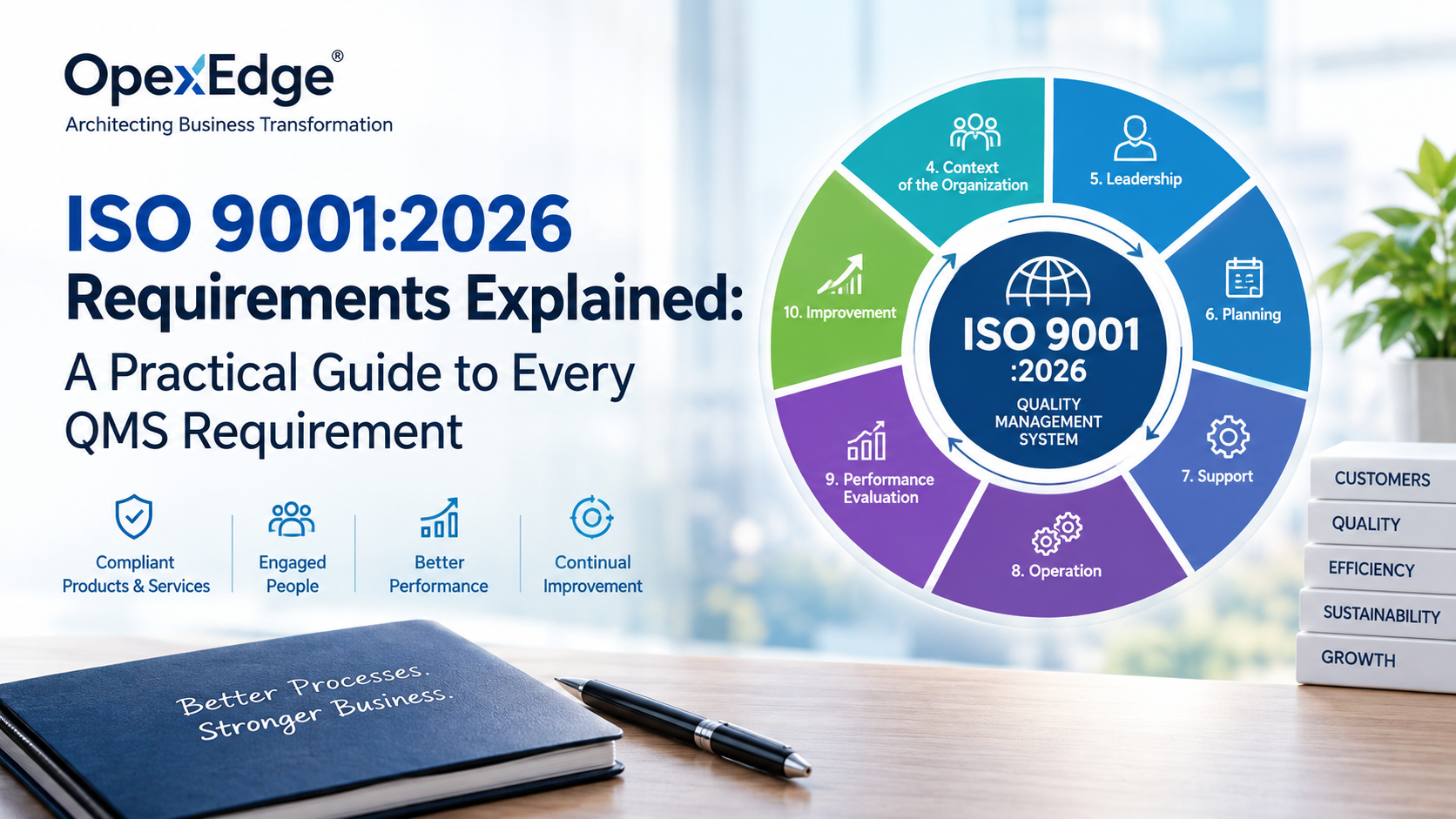
Context → Leadership → Planning → Support → Operation → Performance Evaluation → Improvement
These requirements are not independent boxes.
They form a management cycle.
For example:
Customer requirements
↓
Process design
↓
Risk identification
↓
Operational controls
↓
Performance measurement
↓
Audit and analysis
↓
Corrective action
↓
Improvement
That is the operating logic behind an effective QMS.
ISO 9001 Clauses: Where the Requirements Live
The main QMS requirements are concentrated in Clauses 4 through 10.
| Clause | Main Subject | Practical Business Question |
| 4 | Context of the organization | What affects our ability to deliver quality? |
| 5 | Leadership | Who owns quality and how is it embedded into management? |
| 6 | Planning | What risks, opportunities and objectives must we address? |
| 7 | Support | Do we have the people, resources, knowledge and information needed? |
| 8 | Operation | How do we control the processes that deliver products and services? |
| 9 | Performance evaluation | How do we know the QMS is working? |
| 10 | Improvement | How do we correct problems and improve performance? |
A common implementation mistake is to treat these clauses as separate departments.
They are not.
A customer complaint, for example, can involve:
- Clause 5 — leadership responsibility;
- Clause 6 — risk;
- Clause 7 — competence;
- Clause 8 — operational control;
- Clause 9 — measurement and analysis;
- Clause 10 — corrective action and improvement.
This is why a process-based QMS is usually more powerful than a document-based QMS.
Clause 4 — Context of the Organization
Clause 4 establishes the environment in which the QMS operates.
The organization needs to understand the internal and external issues that can affect its ability to achieve the intended results of the QMS.
4.1 Understanding the Organization and Its Context
An organization should identify relevant issues that can affect its quality objectives and ability to deliver conforming products and services.
These can include:
External issues
- Market conditions
- Customer expectations
- Competition
- Technology
- Regulations
- Economic conditions
- Supply chain conditions
- Environmental or climate-related factors
Internal issues
- Organizational structure
- Competence
- Technology
- Culture
- Process maturity
- Resources
- Equipment
- Knowledge
- Management capability
The important point is that context analysis should not become a decorative SWOT exercise.
The question should be:
Which changes in our environment can actually affect our processes, customers, risks or ability to achieve quality objectives?
For example, a manufacturer dependent on a single overseas supplier has a supply continuity issue that may directly affect product conformity and customer delivery.
That issue should influence the QMS.
4.2 Understanding the Needs and Expectations of Interested Parties
Organizations must determine relevant interested parties and the requirements relevant to the QMS.
Depending on the business, these may include:
- Customers
- Employees
- Suppliers
- Regulators
- Owners
- Distributors
- Contractors
- Certification bodies
- Business partners
But not every stakeholder requirement automatically becomes a QMS requirement.
The organization should determine which requirements are relevant to its QMS.
For example:
A customer may require:
98% on-time delivery
while a regulator may require:
compliance with a specific legal requirement.
Both can influence the QMS, but through different processes and controls.
4.3 Determining the Scope of the QMS
The organization must determine the boundaries and applicability of its QMS.
The scope should make clear:
- what locations are covered;
- what products or services are covered;
- which organizational functions are included;
- what relevant requirements apply.
A weak scope can create confusion.
A good scope tells employees and auditors exactly what the QMS is intended to control.
4.4 Quality Management System and Its Processes
This is one of the most important concepts in ISO 9001.
The organization must establish, implement, maintain and continually improve the QMS, including the processes needed and their interactions.
Think of the business as a network of processes.
For example:
Sales
→ Customer requirements
→ Planning
→ Procurement
→ Production
→ Inspection
→ Delivery
→ Customer feedback
→ Improvement
Each process should have:
- inputs;
- activities;
- outputs;
- resources;
- responsibilities;
- risks;
- performance measures;
- controls;
- interactions with other processes.
This is where tools such as SIPOC become highly useful.
See the OpexEdge guide:
[SIPOC Process Model: How to Map and Improve Business Processes]
Clause 5 — Leadership
ISO 9001 does not intend quality to be the responsibility of the Quality Manager alone.
Leadership must demonstrate commitment to the QMS.
That means quality should be connected to the organization’s business direction.
5.1 Leadership and Commitment
Top management should ensure that the QMS:
- is integrated into business processes;
- supports strategic direction;
- achieves intended results;
- promotes process thinking;
- supports improvement;
- provides necessary resources;
- communicates the importance of effective quality management.
This creates an important distinction:
Weak QMS
Quality Manager owns quality.
Strong QMS
Management owns the system, while quality professionals facilitate and strengthen it.
5.2 Customer Focus
Customer focus is one of the foundations of quality management.
The organization needs to understand customer requirements and monitor whether it is meeting them.
This goes beyond asking:
“Did we deliver the product?”
A stronger question is:
“Did we consistently deliver what the customer actually expected?”
Customer focus can therefore involve:
- customer complaints;
- satisfaction;
- delivery performance;
- product conformity;
- response time;
- service performance;
- customer feedback;
- changing customer expectations.
For service businesses, this becomes particularly important because customer experience is often part of the product itself.
5.3 Quality Policy
The organization should establish an appropriate quality policy that provides a framework for quality objectives and commitment to applicable requirements and improvement.
A quality policy should not simply be framed on a wall.
Employees should be able to understand how the policy relates to their work.
For example:
If the policy emphasizes customer satisfaction, the organization should have processes and measures that demonstrate how customer satisfaction is actually managed.
5.4 Organizational Roles, Responsibilities and Authorities
People need to know:
- who is responsible;
- who has authority;
- who makes decisions;
- who monitors performance;
- who initiates corrective action.
An organizational chart alone is not enough.
Process ownership is equally important.
A purchasing manager may own the purchasing department, but someone should also own the supplier-performance process.
That distinction is often overlooked.
Clause 6 — Planning
Planning converts business context and risks into action.
This is where ISO 9001 moves from:
“What could affect us?”
to:
“What are we going to do about it?”
6.1 Actions to Address Risks and Opportunities
The organization should determine risks and opportunities that need to be addressed.
Risk-based thinking helps the organization move from reactive quality management toward prevention.
Examples include:
| Risk | Possible Effect | Possible Control |
| Supplier failure | Production interruption | Supplier qualification / dual sourcing |
| Employee turnover | Process instability | Competence and cross-training |
| Equipment failure | Defects / downtime | Maintenance |
| Incorrect customer specification | Wrong product | Contract review |
| Process variation | Defects | Process monitoring |
| Regulatory change | Nonconformity | Compliance monitoring |
ISO 9001 does not require every organization to use a particular risk methodology.
However, structured tools can make risk management more practical.
For example, FMEA can help organizations identify potential failure modes before they become customer problems.
See:
[FMEA: A Practical Guide to Failure Mode and Effects Analysis]
6.2 Quality Objectives and Planning to Achieve Them
Quality objectives should be measurable where practical and consistent with the quality policy and strategic direction.
Examples:
- Customer complaints ≤ 1.5% of orders
- On-time delivery ≥ 97%
- First-pass yield ≥ 98%
- Supplier defects ≤ 500 PPM
- Customer satisfaction ≥ 90%
- Corrective action closure within 30 days
But a KPI becomes useful only when someone can act on it.
This is why quality objectives should define:
- what will be achieved;
- how performance will be measured;
- who owns the objective;
- when it will be reviewed;
- what resources are required;
- what happens when performance falls below target.
For a deeper explanation, see:
[KPI Development: Measuring What Matters to Improve Effectiveness and Efficiency]
6.3 Planning of Changes
Organizations rarely operate in a static environment.
They introduce:
- new products;
- new suppliers;
- new equipment;
- new software;
- new employees;
- new locations;
- new processes;
- organizational changes.
Changes can create new quality risks.
Therefore, change should be planned rather than treated as an event that happens after the decision.
A practical change review can ask:
- What is changing?
- Why is it changing?
- Which processes are affected?
- What new risks could appear?
- What resources are required?
- What training is required?
- How will effectiveness be verified?
Clause 7 — Support
Even a well-designed QMS will fail without the necessary resources and capabilities.
Clause 7 addresses the infrastructure that allows the QMS to function.
7.1 Resources
Resources can include:
- people;
- infrastructure;
- equipment;
- work environment;
- monitoring and measuring resources;
- organizational knowledge.
The organization needs to determine what resources are necessary for effective process operation.
This creates an important principle:
Quality cannot be separated from operational capability.
If a process requires calibrated equipment but the equipment is unavailable or unreliable, the problem is not merely documentation.
It is a process-control problem.
7.2 Competence
People performing work that affects quality need appropriate competence.
Competence can come from:
- education;
- training;
- experience;
- skills;
Training attendance alone does not prove competence.
A stronger system asks:
Can the employee actually perform the required task correctly?
Evidence might include:
- skill assessments;
- practical demonstrations;
- qualification tests;
- performance monitoring;
- supervisor evaluations.
7.3 Awareness
Employees should understand:
- the quality policy;
- relevant objectives;
- how their work contributes to the QMS;
- the consequences of failing to meet requirements.
An employee does not need to memorize ISO clauses.
They need to understand what quality means in their job.
7.4 Communication
Organizations should determine:
- what needs to be communicated;
- when;
- with whom;
- how;
- who is responsible.
Communication failures are frequently process failures.
A production operator receiving an outdated specification is not simply experiencing a communication problem.
It can become a product-conformity problem.
7.5 Documented Information
ISO 9001 requires appropriate documented information, but a QMS should not be judged by the number of documents it contains.
The official ISO 9001:2026 preview specifically states that the standard does not intend to require uniform QMS structures or documentation aligned mechanically to the clause structure.
This is an important principle:
Document the information necessary to control the process and demonstrate effective operation.
Not:
Create a document because an auditor might ask for one.
Good QMS documentation should support:
- consistency;
- communication;
- control;
- traceability;
- evidence;
- learning;
Clause 8 — Operation
Clause 8 is where the QMS meets the actual customer.
This is the operational core of ISO 9001.
8.1 Operational Planning and Control
Organizations need to plan, implement and control the processes necessary to meet requirements.
Controls can include:
- procedures;
- work instructions;
- specifications;
- inspection;
- testing;
- acceptance criteria;
- process parameters;
- competence requirements;
- equipment controls;
The objective is not to control everything equally.
The objective is to control what matters to quality.
8.2 Requirements for Products and Services
Before committing to supply a product or service, the organization needs to understand applicable requirements.
These may include:
- customer specifications;
- delivery requirements;
- legal requirements;
- technical requirements;
- service requirements;
- after-sales requirements.
A common quality failure begins before production.
It begins when the organization accepts an unclear or misunderstood customer requirement.
That is why contract and requirement review is a quality-control activity.
8.3 Design and Development
Where an organization designs products or services, it needs a controlled design and development process.
This typically involves:
Inputs → Planning → Development → Reviews → Verification → Validation → Outputs → Changes
The exact methods depend on the organization.
A manufacturer developing a new machine component will need different controls from a company designing a consulting service.
The requirement is not to use one universal design methodology.
The requirement is to control the process sufficiently to produce conforming outputs.
8.4 Control of Externally Provided Processes, Products and Services
Suppliers can have a major impact on quality.
Supplier control can include:
- qualification;
- evaluation;
- selection;
- monitoring;
- re-evaluation;
- specifications;
- incoming inspection;
- supplier development.
Supplier management should be based on risk and importance.
A supplier providing office stationery should not necessarily receive the same level of quality control as a supplier providing a safety-critical component.
8.5 Production and Service Provision
Organizations need controlled conditions for production and service activities.
Depending on the process, controls may include:
- documented information;
- equipment;
- competent personnel;
- monitoring;
- inspection;
- validation;
- identification;
- traceability;
- preservation;
- post-delivery activities.
The key question is:
What conditions must exist for this process to consistently produce the intended result?
8.6 Release of Products and Services
Products and services should not be released until planned requirements have been satisfactorily completed, unless authorized otherwise.
Evidence of conformity should be available where required.
This is where inspection and testing can provide useful evidence.
However, inspection alone is not a complete quality strategy.
A stronger system prevents problems upstream.
8.7 Control of Nonconforming Outputs
When a product or service fails to meet requirements, the organization needs to prevent unintended use or delivery.
Possible responses include:
- correction;
- segregation;
- rework;
- concession;
- rejection;
- customer notification.
But containment is only the beginning.
If the problem is recurring, the organization needs to understand why.
That leads directly to corrective action and Root Cause Analysis.
See:
[Root Cause Analysis: Fishbone Diagram and 5 Whys]
Clause 9 — Performance Evaluation
A QMS cannot be managed effectively without evidence.
Clause 9 addresses how organizations monitor, measure, analyze and evaluate QMS performance.
9.1 Monitoring, Measurement, Analysis and Evaluation
Organizations need to determine what should be monitored and measured.
Potential measures include:
Customer
- Satisfaction
- Complaints
- Retention
- Delivery performance
Process
- Cycle time
- Yield
- Productivity
- Process capability
- Error rate
Supplier
- Defect rate
- Delivery performance
- Responsiveness
QMS
- Audit findings
- Corrective actions
- Objective achievement
This is where KPI architecture becomes important.
A good KPI answers:
What happened?
But an effective management system also asks:
Why did it happen?
and:
What action should we take?
9.1.2 Customer Satisfaction
Customer satisfaction should be monitored using information appropriate to the organization.
Possible sources include:
- surveys;
- complaints;
- returns;
- warranty claims;
- repeat business;
- customer reviews;
- delivery performance;
- service response;
- direct feedback.
Customer satisfaction should not be reduced to a single annual survey.
For many organizations, operational data provides stronger evidence of customer experience.
9.1.3 Analysis and Evaluation
Data becomes valuable when it is analyzed.
Organizations should evaluate information to understand:
- conformity;
- customer satisfaction;
- process performance;
- supplier performance;
- QMS effectiveness;
- risks;
- opportunities;
- improvement requirements.
For processes where variation matters, Statistical Process Control (SPC) can provide a much stronger view than simply comparing monthly averages.
See:
[SPC Statistical Process Control: The Authority Behind Stable, Predictable, and Profitable Processes]
9.2 Internal Audit
Internal audits determine whether the QMS:
- conforms to planned requirements;
- conforms to ISO 9001 requirements;
- is effectively implemented;
- is maintained.
But an internal audit should not become a paperwork inspection.
A strong process audit asks:
Is the process actually working?
For example, instead of asking only whether a purchasing procedure exists, an auditor could follow a real supplier transaction:
Requirement → Supplier selection → Purchase order → Receipt → Inspection → Supplier performance → Corrective action
That provides much stronger evidence of process effectiveness.
9.3 Management Review
Top management should periodically review the QMS.
Inputs can include:
- audit results;
- customer feedback;
- process performance;
- quality objectives;
- nonconformities;
- corrective actions;
- supplier performance;
- resource needs;
- risks and opportunities;
- improvement opportunities.
The management review should lead to decisions.
A meeting that produces no decisions, actions or resource commitments is unlikely to create meaningful improvement.
Clause 10 — Improvement
The final clause closes the management loop.
A QMS should not simply maintain today’s performance.
It should become better.
10.1 General Improvement
Organizations should determine and select opportunities for improvement.
Improvement can involve:
- correcting problems;
- reducing variation;
- improving processes;
- reducing waste;
- improving customer satisfaction;
- improving efficiency;
- introducing new technology;
- changing processes;
Continual improvement does not necessarily mean making small changes every day.
It means systematically improving the suitability, adequacy and effectiveness of the QMS.
10.2 Nonconformity and Corrective Action
When a nonconformity occurs, the organization should:
- React to the problem.
- Control or correct it.
- Deal with consequences.
- Determine whether corrective action is necessary.
- Investigate the cause.
- Implement appropriate action.
- Review whether the action was effective.
- Update relevant risks or processes where appropriate.
This is where Root Cause Analysis becomes essential.
A corrective action such as:
“Retrain operator”
may be appropriate in some cases.
But it may also be a weak response if the real cause is:
- poor process design;
- unclear instructions;
- inadequate equipment;
- unrealistic workload;
- missing controls;
- supplier failure;
- ineffective supervision.
The goal is not to find someone to blame.
The goal is to prevent recurrence.
10.3 Continual Improvement
The strongest QMS organizations treat improvement as a management discipline.
Improvement opportunities can come from:
- KPIs;
- customer complaints;
- audits;
- employee suggestions;
- process data;
- supplier performance;
- risk analysis;
- nonconformities;
- management review.
A mature organization therefore creates a closed loop:
Measure → Analyze → Identify Gap → Find Cause → Improve → Verify → Standardize → Measure Again
This is where ISO 9001 connects naturally with Operational Excellence.
How the ISO 9001 Requirements Work Together
The clauses make more sense when viewed as one system.
Consider a simple example:
Problem
A company experiences repeated customer complaints about late delivery.
Clause 4 — Context
The company identifies increasingly demanding customer lead-time expectations.
Clause 5 — Leadership
Management recognizes delivery performance as a strategic priority.
Clause 6 — Planning
The organization identifies delivery risk and establishes an on-time-delivery objective.
Clause 7 — Support
Employees receive appropriate training and the organization provides the required planning resources.
Clause 8 — Operation
Planning, purchasing, production and logistics processes are controlled.
Clause 9 — Performance Evaluation
On-time delivery is monitored and analyzed.
Clause 10 — Improvement
Root cause analysis identifies recurring planning and supplier issues.
Corrective actions are implemented and effectiveness is verified.
This is what a functioning QMS looks like.
It is not seven departments.
It is one management system.
ISO 9001:2026 — What Organizations Should Pay Attention To
ISO’s official page currently identifies ISO 9001:2026 as Edition 6, under publication, with publication scheduled for September 2026. It will replace ISO 9001:2015.
Organizations transitioning from ISO 9001:2015 should therefore avoid treating the revision as an opportunity to simply replace documents.
The more valuable approach is to review the effectiveness of the existing QMS.
Ask:
1. Does our QMS reflect how the business actually operates?
2. Are risks connected to real processes?
3. Are quality objectives connected to business performance?
4. Are employees actually competent?
5. Are suppliers controlled according to risk?
6. Do KPIs trigger management action?
7. Are internal audits examining process effectiveness?
8. Does corrective action eliminate recurring problems?
9. Does management review lead to decisions?
10. Does the QMS create measurable improvement?
These questions are more valuable than simply asking:
“Do we have the required documents?”
ISO 9001 Requirements Checklist
Use this high-level checklist as a starting point for a QMS gap assessment.
Context
- Organizational context identified
- Relevant interested parties identified
- Relevant requirements determined
- QMS scope established
- QMS processes identified
- Process interactions understood
Leadership
- Top management demonstrates commitment
- Customer focus established
- Quality policy established
- Responsibilities defined
- Process ownership established
Planning
- Risks identified
- Opportunities identified
- Quality objectives established
- Objectives monitored
- Changes planned and controlled
Support
- Resources available
- Competence requirements defined
- Training/competence evidence maintained
- Employee awareness established
- Communication controlled
- Organizational knowledge maintained
- Documented information controlled
Operation
- Customer requirements reviewed
- Design controlled where applicable
- Suppliers evaluated
- Operational processes controlled
- Product/service requirements verified
- Nonconforming outputs controlled
Performance Evaluation
- KPIs defined
- Monitoring and measurement performed
- Customer satisfaction monitored
- Data analyzed
- Internal audits conducted
- Management reviews conducted
Improvement
- Improvement opportunities identified
- Nonconformities controlled
- Corrective actions implemented
- Root causes investigated
- Effectiveness verified
- QMS continually improved
The Most Common ISO 9001 Implementation Mistakes
1. Building the QMS around documents
The organization creates procedures first and tries to make the business fit them.
The better approach is:
Understand the process → identify risks → determine controls → document what is necessary.
2. Treating the Quality Manager as the owner of quality
Quality is a management responsibility.
The Quality Manager should enable the system, not replace operational ownership.
3. Measuring everything
More KPIs do not automatically mean better management.
Measure what helps the organization make decisions.
4. Treating audits as inspections of paperwork
An audit should examine whether processes are effective, not merely whether documents exist.
5. Confusing correction with corrective action
Fixing today’s defective product is correction.
Removing the cause so the problem does not recur is corrective action.
6. Using training as the answer to every problem
Training cannot fix every process failure.
Sometimes the real issue is:
- process design;
- equipment;
- workload;
- information;
- management;
- supplier performance;
- unclear requirements.
7. Preparing for certification instead of improving the business
Certification can be valuable.
But certification should be the result of a functioning management system—not the reason the system exists.
ISO 9001 and Operational Excellence
This is where the ISO 9001 framework becomes particularly interesting.
ISO 9001 establishes the management-system structure.
Operational Excellence provides additional methods for improving how processes actually perform.
For example:
| ISO 9001 Need | Operational Excellence Method |
| Process management | SIPOC / Process Mapping |
| Risk management | FMEA |
| Problem solving | Root Cause Analysis |
| Performance measurement | KPI architecture |
| Process stability | SPC / Control Charts |
| Variation reduction | Six Sigma |
| Waste reduction | Lean |
| Equipment reliability | TPM |
| Customer understanding | Voice of Customer |
These tools do not replace ISO 9001.
They can make the QMS much more effective.
That is the difference between a QMS that exists for certification and a QMS that contributes to business performance.
Frequently Asked Questions
What are the main ISO 9001:2026 requirements?
The main requirements are organized around organizational context, leadership, planning, support, operation, performance evaluation and improvement. Together they define the framework for establishing, implementing, maintaining and continually improving a Quality Management System.
Is ISO 9001 certification mandatory?
No. ISO states that certification to ISO 9001 is not mandatory. Organizations can implement the standard without becoming certified.
What is the difference between ISO 9001:2015 and ISO 9001:2026?
ISO 9001:2026 is the sixth edition and replaces ISO 9001:2015. It builds on the existing QMS framework while updating the standard for current organizational needs. The official ISO page currently lists the 2026 edition as under publication and scheduled for September 16, 2026.
Does ISO 9001 require a quality manual?
ISO 9001:2026 does not intend to prescribe a uniform documentation structure for all organizations. The organization should maintain the documented information necessary for an effective QMS rather than creating documents simply because they appear in a template or traditional quality manual structure.
Does ISO 9001 require FMEA?
No. ISO 9001 does not require every organization to use FMEA. However, FMEA can be a useful structured method for identifying potential process and product risks and planning controls.
Does ISO 9001 require internal audits?
Yes. Internal auditing is part of evaluating whether the QMS conforms to planned arrangements and ISO 9001 requirements and is effectively implemented and maintained.
What is risk-based thinking in ISO 9001?
Risk-based thinking means considering risks and opportunities that can affect the organization’s ability to achieve intended QMS results and taking appropriate action. It encourages organizations to address potential problems before they become failures.
What is the most important part of ISO 9001?
There is no single clause that can make a QMS effective by itself.
The real strength of ISO 9001 comes from the interaction between:
Leadership + Process Management + Risk + Competence + Operational Control + Measurement + Improvement.
Can a small business implement ISO 9001?
Yes. ISO states that its requirements are generic and applicable to organizations regardless of type or size. The QMS should be scaled to the organization’s activities, risks, complexity and customer requirements.
How should a company prepare for ISO 9001:2026?
Start with a gap assessment of the existing QMS.
Review:
- Organizational context
- Interested parties
- Processes
- Risks
- Quality objectives
- Operational controls
- Competence
- Documented information
- Performance measurement
- Internal audit
- Corrective action
- Management review
Then identify which areas require transition or improvement.
Organizations already certified to ISO 9001:2015 should coordinate transition timing with their certification body. ISO states that certified organizations will receive a transition period to migrate to the new edition.
From ISO 9001 Compliance to Operational Excellence
ISO 9001 should not be reduced to a certification project.
A mature QMS creates a management loop:
Customer Requirements
↓
Process Design
↓
Risk Management
↓
Operational Control
↓
Performance Measurement
↓
Internal Audit
↓
Root Cause Analysis
↓
Corrective Action
↓
Continual Improvement
↓
Better Customer Outcomes
This is the point where quality management becomes operational excellence.
The objective is not simply to pass an audit.
The objective is to build a business that can consistently produce the right result—even when the people, products, suppliers, technologies and market conditions change.
Need Help Building or Upgrading Your ISO 9001 QMS?
Building an ISO 9001 system from scratch can become unnecessarily complicated when documentation is created without first understanding the actual business processes.
OpexEdge approaches ISO 9001 differently.
The focus is on connecting:
Business Processes → QMS Requirements → Risks → Controls → KPIs → Documentation → Audit Evidence → Improvement
For organizations that need to build or upgrade their QMS, explore the AI-Powered ISO9001 Documentation service from OpexEdge.
The objective is not to create a pile of generic templates.
It is to develop documentation that reflects how your organization actually operates and supports a practical, auditable Quality Management System.
Final Takeaway
The strongest interpretation of ISO 9001:2026 is not:
“What documents do we need to pass certification?”
It is:
“How do we build a management system that consistently produces the results our customers and business require?”
When ISO 9001 requirements are connected to real processes, measurable objectives, risk management, employee competence, operational controls, data analysis and corrective action, the QMS becomes more than a certification system.
It becomes part of the organization’s operating system.
That is where ISO 9001 meets Operational Excellence.
OpexEdge — Architecting Business Transformation from Zero to Scale.
Related Topics
TPM | Hypothesis Test | Accuracy | 6 Sigma | MSA | POKA YOKE | MUDA | 5S | FMEA | SIPOC | KPI | ISO9001 |
Gage R&R Study and Measurement System Analysis — Complete MSA Guide | OpexEdge Consultancy
Root Cause Analysis: FishBone Diagram and 5-Whys
Quality Function Deployment (QFD)
AI-Powered ISO9001 Documentation Requirements Service
ISO 9001:2026 Requirements Explained: A Practical Guide to Every QMS Requirement
How to Implement ISO 9001: A Step-by-Step Guide to Building an Effective QMS
ISO 9001 Internal Audit: A Practical Guide to Auditing Your Quality Management System
ISO 9001 Risk-Based Thinking: A Practical Guide to Identifying and Controlling QMS Risks
ISO 9001 Documentation: What Documents and Records Does a QMS Really Need?
ISO 9001 Documentation: What Documents and Records Does a QMS Really Need?
