AI-Powered Supply Chain Assessment: Turning Operational Data into Actionable Improvement
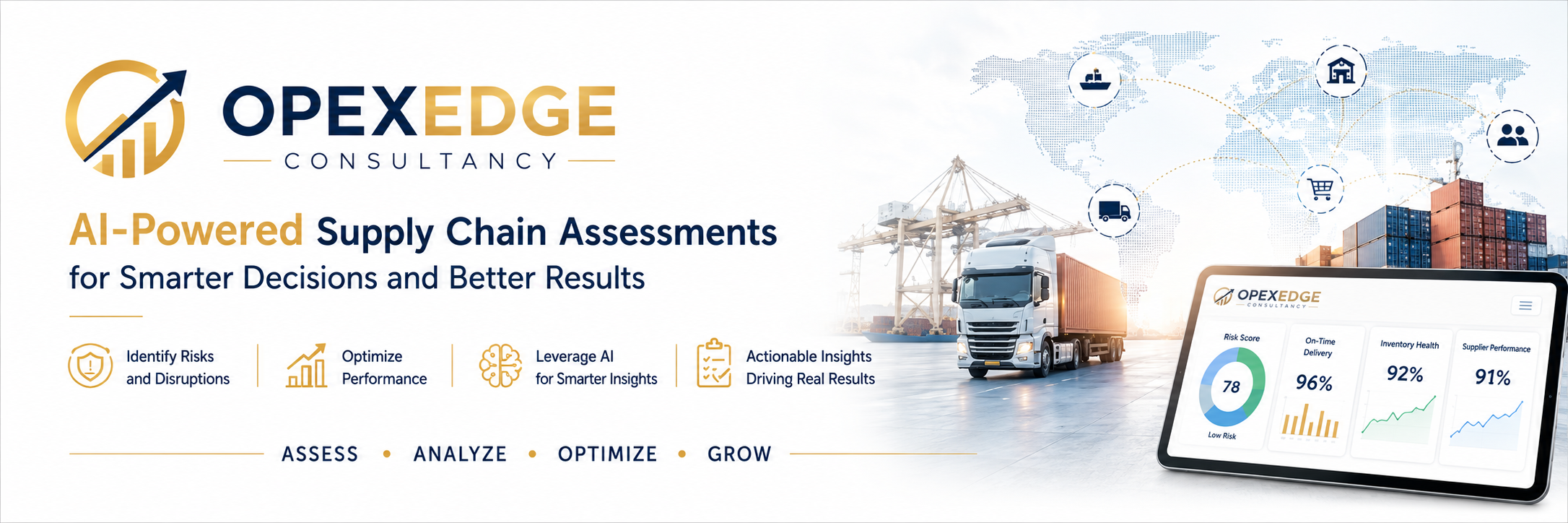
Within five working days, OpexEdge will assess your current supply-chain maturity, identify operational gaps, highlight your highest-priority improvement opportunities, and provide a practical 90-day action roadmap.
OpexEdge Consultancy provides an AI-Powered Supply Chain Assessment designed to help businesses identify:Inventory and stockout risksSlow-moving products consuming working capitalSupplier-performance gapsPurchasing and replenishment weaknessesOrder-fulfilment and delivery bottlenecksAreas where AI can create practical value
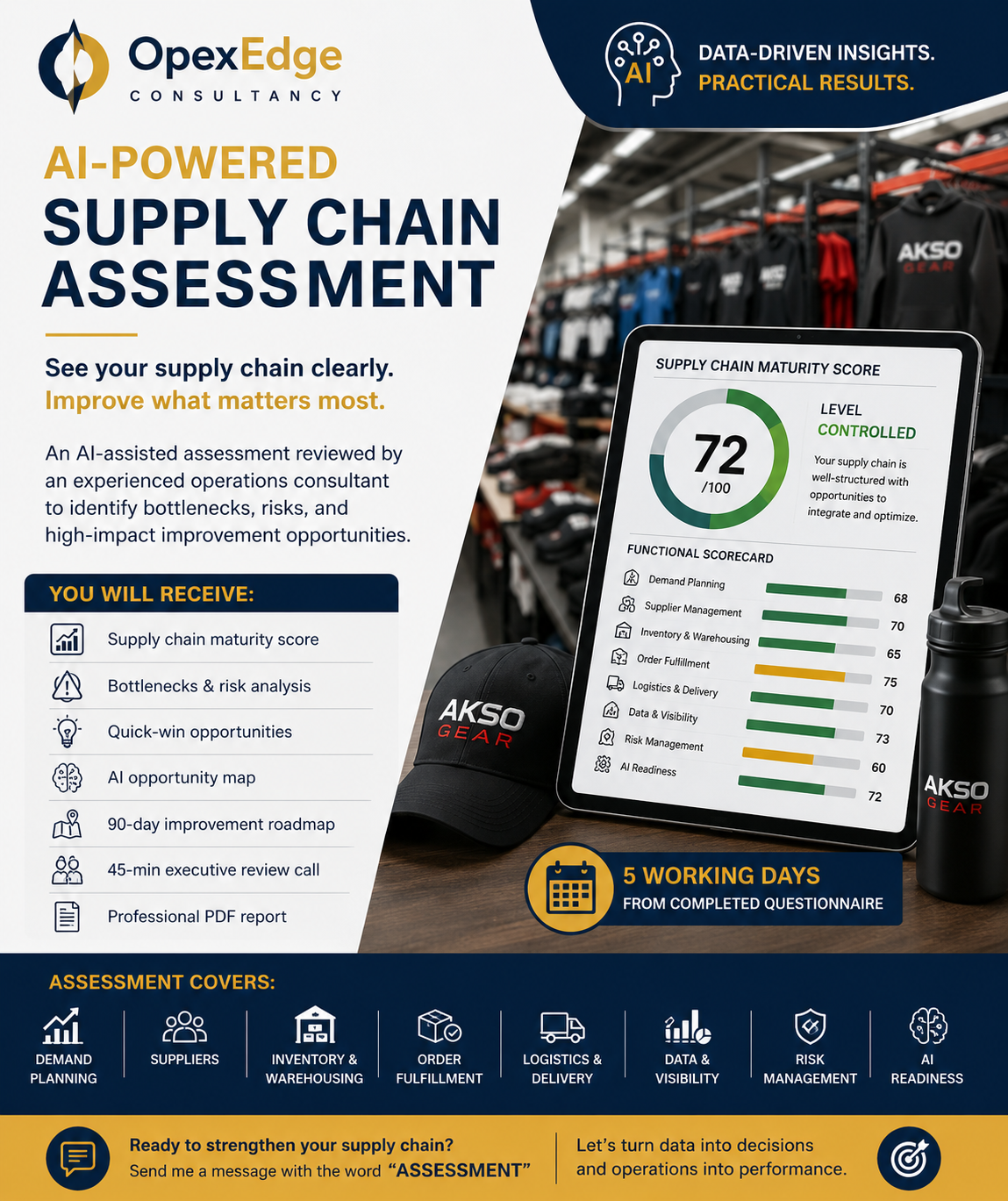
The process begins with a structured questionnaire.
We then provide an AI-assisted assessment reviewed by an experienced operations consultant, including:
✓ Supply-chain maturity score
✓ Priority risk map
✓ Functional scorecard
✓ Quick-win opportunities
✓ Relevant AI use cases
✓ Practical 90-day improvement roadmap
Ready to improve your supply chain performance?
Contact OpexEdge Consultancy to request an AI-powered supply chain assessment and discover where your business can reduce cost, improve service, and unlock operational value.
Email: info@opexedg.com
whatsapp: +20-155-272-5900
Know your expert
Mahmoud Elhefnawi
Introduction
Modern supply chains are no longer simple chains of suppliers, warehouses, transporters, and customers. They are complex operating networks affected by demand uncertainty, supplier performance, inventory accuracy, logistics cost, capacity constraints, cash flow pressure, and customer expectations.
Many companies already have large amounts of operational data, but they still struggle to answer critical questions:
Why are we carrying too much inventory but still facing stockouts?
Why are delivery costs increasing while service levels are unstable?
Which suppliers, products, warehouses, or processes are creating the biggest losses?
Where should management focus first to achieve measurable improvement?
This is where an AI-powered supply chain assessment becomes a practical and strategic tool.
It helps businesses move from opinion-based decisions to data-driven improvement by evaluating the current supply chain, identifying performance gaps, and recommending prioritized actions.
At OpexEdge Consultancy, we use AI-powered assessment methods to help companies understand their supply chain maturity, uncover operational weaknesses, and build a clear improvement roadmap focused on cost reduction, service improvement, working capital optimization, and sustainable growth.
What Is an AI-Powered Supply Chain Assessment?
An AI-powered supply chain assessment is a structured evaluation of supply chain performance using operational data, business inputs, process analysis, and artificial intelligence techniques.
Unlike a traditional assessment that depends mainly on interviews and manual observations, an AI-powered assessment combines:
· Business questionnaires
· Process mapping
· Supply chain KPIs
· Inventory and sales data
· Supplier performance data
· Warehouse and logistics data
· Demand planning accuracy
· Cost and service-level indicators
· AI-supported scoring and recommendations
The objective is not only to describe the current situation, but to identify the root causes of underperformance and recommend practical improvement actions.
Why Traditional Supply Chain Assessments Are No Longer Enough
Traditional supply chain reviews are useful, but they often have limitations.
They may depend heavily on personal judgment, incomplete samples, or high-level observations.
In many cases, the final report identifies general problems without giving a clear action plan.
Modern supply chain challenges require deeper analysis. Companies need to understand patterns, exceptions, correlations, and risks across different functions.For example, a traditional review may say that inventory is high.
An AI-powered assessment can go deeper and identify:
· Which product categories are overstocked
· Which SKUs are slow-moving
· Which items create frequent stockouts
· Which suppliers cause delays
· Which warehouses suffer from accuracy issues
· Which demand forecasts are unreliable
· Which processes increase cost without adding value
This level of analysis gives management a clearer view of where improvement will create the highest impact.Key Areas Covered in an AI-Powered Supply Chain AssessmentA strong supply chain assessment should cover the full operating cycle, from demand to delivery.
1. Demand Planning and Forecast Accuracy
Demand planning is one of the most critical supply chain functions.
Poor demand planning leads to excess inventory, stockouts, emergency purchasing, poor service levels, and cash flow pressure.
The assessment evaluates:
· Forecast accuracy
· Sales variability
· Demand seasonality
· Planning frequency
· Collaboration between sales, operations, and procurement
· Manual planning risks
· Data quality
· Demand review process maturityAI can help detect demand patterns, highlight abnormal sales behavior, and identify where forecasting performance is weak.
2. Inventory Health and Working CapitalInventory is often one of the largest investments in a business.
Too much inventory blocks cash.
Too little inventory damages sales and customer satisfaction.
The assessment analyzes:
· Stock availability
· Overstocked items
· Slow-moving and obsolete inventory
· Stockout frequency
· Inventory turnover
· Safety stock logic
· ABC classification
· Inventory aging
· Reorder point effectivenessThe goal is to find the right balance between availability and cost.
3. Procurement and Supplier PerformanceSupplier reliability has a direct impact on production, sales, inventory levels, and customer service.
Weak supplier management can create delays, quality problems, and unnecessary cost.
The assessment reviews:
· Supplier lead time
· Delivery reliability
· Purchase order accuracy
· Supplier quality performance
· Price variation
· Supplier dependency risk
· Procurement cycle time
· Contract and negotiation effectivenessAI-supported analysis can identify suppliers that create repeated delays, cost increases, or service risks.
4. Warehouse OperationsWarehouse performance affects inventory accuracy, order fulfillment, customer satisfaction, and logistics efficiency.
The assessment covers:
· Receiving process
· Put-away process
· Storage layout
· Picking accuracy
· Packing efficiency
· Dispatch performance
· Space utilization
· Inventory accuracy
· Cycle counting process
· Warehouse productivityA strong warehouse assessment helps identify operational waste, poor layout, weak controls, and process bottlenecks.
5. Logistics and Distribution PerformanceTransportation and distribution costs can significantly affect profitability.
Poor routing, weak planning, low vehicle utilization, and delivery delays all reduce supply chain efficiency.
The assessment evaluates:
· Delivery lead time
· On-time delivery
· Fleet utilization
· Transport cost per order
· Transport cost per unit
· Route efficiency
· Delivery failure rate
· Reverse logistics
· Customer complaint trendsAI can support logistics decisions by highlighting cost patterns, delivery exceptions, and performance gaps by region, customer, product, or carrier.
6. Supply Chain Risk and ResilienceSupply chains are exposed to many risks, including supplier disruption, demand fluctuation, inventory shortage, capacity limitation, transport delays, and cost increases.
The assessment identifies:
· Critical supplier risks
· Single-source dependency
· Demand volatility
· Inventory shortage risk
· Operational bottlenecks
· Process control weaknesses
· Data reliability issues
· Business continuity gapsThe output is a practical risk map that helps leadership focus on the most important vulnerabilities.
How AI Improves Supply Chain AssessmentAI does not replace operational expertise. It strengthens it.
AI improves the assessment by helping teams analyze more data, detect hidden patterns, and prioritize improvement opportunities more accurately.
AI can support the assessment by:
· Detecting abnormal demand behavior
· Identifying slow-moving and dead stock
· Highlighting supplier delay patterns
· Ranking operational risks
· Finding process bottlenecks
· Comparing performance across locations
· Creating maturity scores
· Recommending improvement actions
· Supporting root-cause analysis
· Building a prioritized roadmapThis makes the assessment faster, deeper, and more useful for decision-making.
The Supply Chain Assessment Maturity ScoreOne of the most valuable outputs of an AI-powered assessment is the maturity score.
This score gives management a clear view of how mature the supply chain is across key dimensions such as:
· Demand planning
· Procurement
· Inventory management
· Warehouse operations
· Logistics
· Technology usage
· KPI management
· Risk management
· Process standardization
· Data qualityEach area can be rated based on current practices, performance evidence, system capability, and process discipline.
A simple maturity model may include:
Level 1: Reactive
Processes are manual, unstable, and mainly based on urgent actions.
Level 2: Basic Control
Some procedures exist, but performance is inconsistent and data usage is limited.
Level 3: Standardized
Processes are defined, KPIs are monitored, and teams follow consistent routines.
Level 4: Data-Driven
Decisions are supported by reliable data, dashboards, forecasting, and structured analysis.
Level 5: AI-Enabled and Optimized
The supply chain uses predictive insights, automation, scenario planning, and continuous improvement.
This maturity score helps companies understand where they are today and what they need to improve next.
Typical Deliverables of an AI-Powered Supply Chain AssessmentA professional assessment should produce clear, practical, and decision-ready outputs.
At OpexEdge Consultancy, the assessment can include:
1. Supply Chain Diagnostic Questionnaire
A structured questionnaire covering demand planning, procurement, inventory, warehouse, logistics, systems, KPIs, and risk management.
2. AI-Powered Assessment Score
A scoring model that evaluates supply chain maturity and identifies strong and weak areas.
3. Current-State Analysis
A clear explanation of existing performance, process gaps, operational risks, and improvement opportunities.
4. KPI Review
A review of critical supply chain KPIs such as forecast accuracy, stock availability, inventory turnover, supplier delivery performance, warehouse accuracy, and on-time delivery.
5. Opportunity for Improvement
A prioritized list of improvement opportunities based on impact, urgency, cost, and implementation difficulty.
6. Corrective Action Plan
A practical plan that explains what should be improved, who should be responsible, what data is needed, and which KPIs should be monitored.
7. 90-Day Improvement Roadmap
A focused roadmap that converts assessment findings into short-term actions, quick wins, and measurable business results.
Example of Improvement Opportunities
An AI-powered supply chain assessment may reveal opportunities such as:
· Reducing excess inventory through better ABC classification
· Improving forecast accuracy for high-value SKUs
· Reducing supplier delays through performance tracking
· Improving warehouse picking accuracy
· Reducing transport cost through better route planning
· Increasing service level by adjusting safety stock policies
· Reducing obsolete inventory through aging analysis
· Improving decision-making through supply chain dashboards
· Standardizing planning meetings and review cycles
· Creating stronger links between sales, operations, and procurement
The value of the assessment is not only in identifying these opportunities, but in converting them into a clear and measurable action plan.
Business Benefits of AI-Powered Supply Chain Assessment
A well-executed assessment can deliver strong business value.
Key benefits include:
· Better visibility across the supply chain
· Lower inventory cost
· Improved stock availability
· Reduced operational waste
· Higher service levels
· Better supplier control
· More accurate demand planning
· Improved warehouse performance
· Lower logistics cost
· Stronger risk management
· Faster and better management decisionsFor growing companies, the assessment can also create a foundation for digital transformation and scalable operations.
When Does a Company Need a Supply Chain Assessment?
A company should consider an AI-powered supply chain assessment when it faces one or more of the following challenges:
· Frequent stockouts
· High inventory value
· Slow-moving or obsolete stock
· Poor forecast accuracy
· Supplier delays
· Increasing logistics cost
· Warehouse errors
· Low service level
· Unclear KPIs
· Weak process ownership
· Lack of supply chain visibility
· Cash flow pressure caused by inventory
· Rapid business growth without strong operating systemsThese problems are common, but they should not be accepted as normal.
They are signals that the supply chain needs structured diagnosis and improvement.
Why Choose OpexEdge Consultancy?
OpexEdge Consultancy helps companies improve operational performance through practical, data-driven, and AI-supported methods.
Our approach combines:
· Supply chain expertise
· Operational excellence tools
· AI-powered analysis
· KPI-based evaluation
· Practical improvement planning
· Clear management reporting
· Focus on measurable results
We do not only provide a report.
We help businesses understand the real causes of supply chain problems and create a roadmap that can be implemented.
Conclusion
An AI-powered supply chain assessment is no longer a luxury. It is a powerful tool for companies that want to improve visibility, reduce cost, increase service levels, and make better operational decisions.By combining business knowledge, operational data, and AI-supported analysis, companies can identify hidden inefficiencies, prioritize improvement actions, and build a stronger, more resilient supply chain.
For organizations facing inventory problems, supplier delays, logistics cost increases, or weak planning accuracy, the first step is not to buy more systems or add more people. The first step is to assess the current supply chain clearly and objectively.
OpexEdge Consultancy can help your business evaluate its supply chain maturity, identify improvement opportunities, and build a practical action plan for better performance.Call to ActionReady to improve your supply chain performance?
Contact OpexEdge Consultancy to request an AI-powered supply chain assessment and discover where your business can reduce cost, improve service, and unlock operational value.
Email: info@opexedg.com
AI-Powered Retail Demand Planning Service
Open To Buy Planning
Warehouse Assessment
