
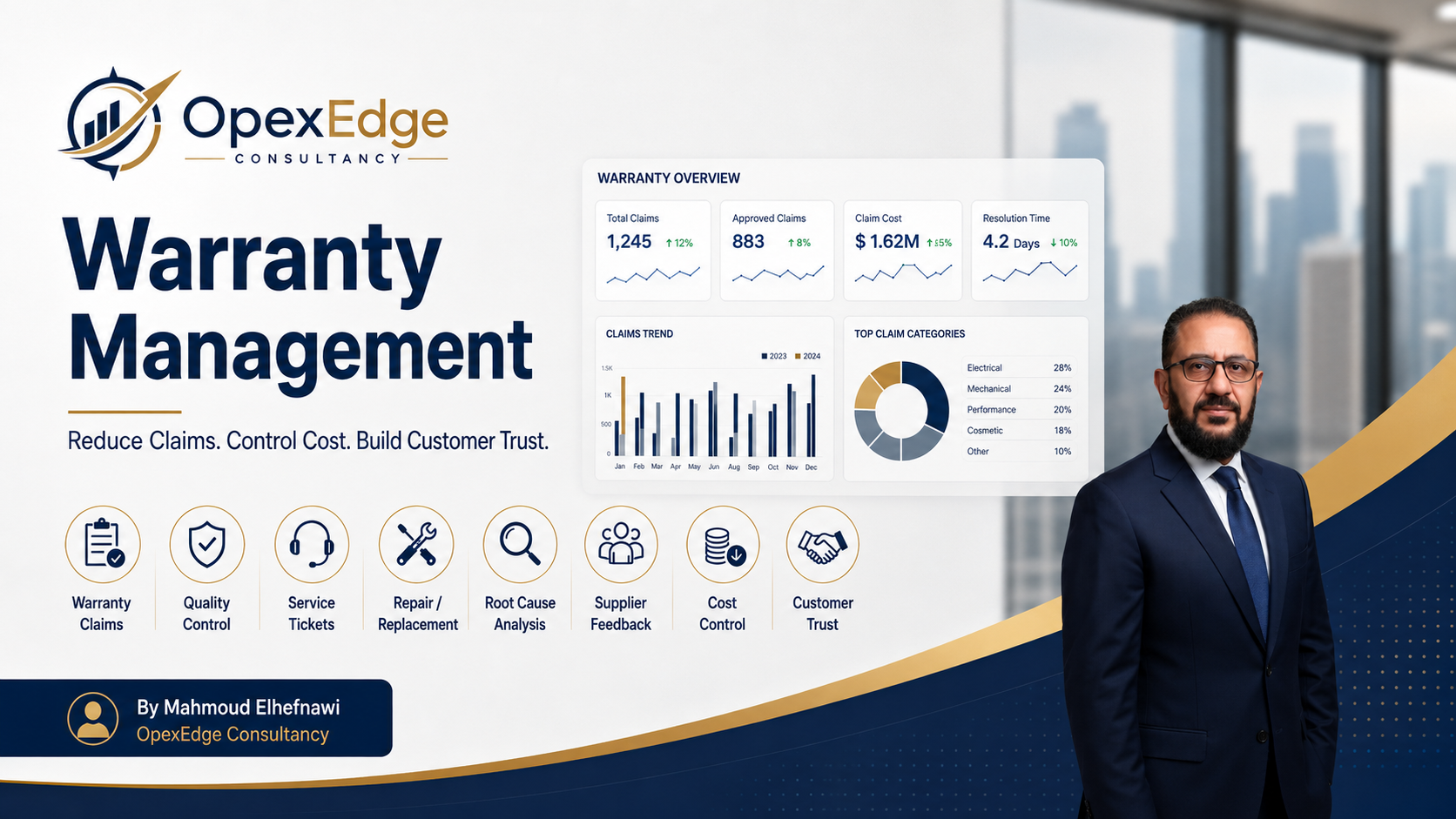
Warranty Management: Turning After-Sales Claims into Quality, Cost Control, and Customer Trust
Author: Mahmoud Elhefnawi – OpexEdge Expert
Introduction
Warranty management is often treated as an after-sales activity: a customer complains, a service ticket is opened, a repair or replacement is approved, and the case is closed.
But in a mature organization, warranty management is much more than claim handling.
It is a powerful business control system that connects customer service, quality, manufacturing, supply chain, product design, finance, and continuous improvement.
Every warranty claim is a signal. It may reveal a design weakness, supplier issue, installation error, training gap, unclear user instructions, poor packaging, weak inspection, or a process failure that was not detected before the product reached the customer.
When warranty data is ignored, the business repeats the same failures.
When warranty data is analyzed, the business improves products, reduces cost, strengthens customer trust, and protects its brand.
Modern warranty management should not only answer one question:
“How do we close this claim?”
It should answer a better question:
“What is this claim teaching us about our product, process, supplier, and customer experience?”
What Is Warranty Management?
Warranty management is the structured process of managing warranty registration, claim intake, claim validation, service response, repair or replacement, cost tracking, supplier recovery, customer communication, and failure analysis.
A strong warranty management system includes:
- Clear warranty policy and terms
- Product registration and traceability
- Standard claim submission process
- Claim eligibility validation
- Service ticket workflow
- Spare parts and replacement control
- Repair and maintenance documentation
- Supplier chargeback or reimbursement process
- Warranty cost analysis
- Root cause analysis
- Corrective and preventive actions
- Customer satisfaction follow-up
- Feedback loop to design, production, and suppliers
In simple words, warranty management is the bridge between what the company promised before the sale and what the customer experiences after the sale.
Why Warranty Management Matters
Warranty issues are not just service problems. They are business performance problems.
Poor warranty management can create:
- High service cost
- Slow claim resolution
- Repeated defects
- Unclear responsibilities
- Supplier disputes
- Weak customer confidence
- Excessive replacement cost
- Poor spare parts planning
- Negative reviews
- Lost repeat sales
- Hidden quality losses
Industry research shows that warranty costs can become a major financial burden. McKinsey reported that global automotive warranty-related costs reached about $58 billion in 2024, representing around 2.2% of industry sales, and for some OEMs warranty costs exceeded 4% of revenue.
Even outside automotive, the same principle applies: when failures reach customers, the cost is much higher than preventing them earlier in design, production, delivery, or installation.
Warranty Management in the Product and Service Lifecycle
Warranty should not be isolated from the product lifecycle.
In the OpexEdge Product and Service Lifecycle Framework, warranty and maintenance come after delivery and installation, but they feed directly into customer feedback and continuous improvement. The framework defines warranty and maintenance as a stage owned by after-sales or service teams, with inputs such as installed product records, warranty terms, customer requests, spare parts lists, maintenance schedules, and product history.
This is important because warranty data must return to the business as structured improvement input.
A strong warranty loop looks like this:
Customer Claim
→ Service Ticket
→ Technical Diagnosis
→ Repair / Replacement
→ Cost Recording
→ Root Cause Analysis
→ Supplier / Process / Design Feedback
→ Corrective Action
→ Product Improvement
→ Reduced Future Claims
Without this loop, companies only “process claims.”
With this loop, companies improve the business.
Common Warranty Management Problems
Many companies lose money in warranty operations because the process is fragmented.
The most common problems include:
1. Claims Managed by Email and Spreadsheets
When warranty claims are handled manually, information becomes scattered. Photos, receipts, serial numbers, approvals, repair notes, and supplier responses may sit in different inboxes.
This creates delays, errors, repeated follow-up, and weak visibility.
2. No Clear Warranty Policy
If warranty terms are not clear, teams make decisions case by case. This creates inconsistency, customer disputes, and unnecessary approvals.
A clear warranty policy should define:
- Coverage period
- Covered defects
- Exclusions
- Required proof
- Approval levels
- Replacement conditions
- Repair conditions
- Customer misuse criteria
- Supplier responsibility
- Escalation rules
3. Weak Product Traceability
Without serial numbers, batch numbers, installation records, production dates, supplier lots, or delivery history, the company cannot identify whether a problem is isolated or systematic.
Traceability allows the business to answer:
- Which batch failed?
- Which supplier provided the part?
- Which production line produced it?
- Which installer handled the job?
- Which customers may be affected?
- Is this a recurring defect or a one-time case?
4. No Root Cause Analysis
Closing a claim is not the same as solving the problem.
If the team replaces a product but does not identify why it failed, the business will pay for the same failure again.
Warranty management must connect with root cause analysis tools such as 5 Whys, Fishbone Diagram, Pareto Analysis, 8D, CAPA, and FMEA.
5. Poor Spare Parts Planning
Warranty service depends heavily on spare parts availability. If the required part is not available, the customer waits, the service team escalates, and satisfaction drops.
Warranty data should support spare parts forecasting by showing:
- Most replaced components
- Failure frequency
- Product age at failure
- Regional demand
- Supplier defect trends
- Seasonal failure patterns
6. Supplier Recovery Is Not Controlled
In many companies, suppliers are responsible for certain failures, but the business does not recover the cost because evidence is incomplete or claims are not submitted on time.
A strong warranty process should capture supplier-related evidence from the beginning.
7. Warranty Data Does Not Reach Design or Production
This is one of the biggest mistakes.
Warranty data is customer-tested quality data. If it stays inside customer service, the company loses a valuable improvement opportunity.
Warranty trends should be reviewed regularly by quality, production, engineering, supply chain, and leadership.
The OpexEdge Warranty Management Framework
OpexEdge recommends treating warranty management as an operational excellence system built around six pillars.
Pillar 1: Warranty Policy Governance
The company must define a clear, approved warranty policy that protects both the customer and the business.
This policy should answer:
- What is covered?
- What is not covered?
- What documents are required?
- Who approves what?
- What is the claim response time?
- When do we repair, replace, refund, or reject?
- When should the supplier be involved?
- When should the issue be escalated to quality or engineering?
Pillar 2: Claim Intake and Validation
Claim intake should be simple for the customer and complete for the company.
A good claim form should capture:
- Customer details
- Product model
- Serial or batch number
- Purchase date
- Installation date
- Failure description
- Photos or videos
- Proof of purchase
- Usage conditions
- Previous repairs
- Customer expectation
Then the system should validate:
- Warranty period
- Product eligibility
- Failure type
- Required evidence
- Approval level
- Service location
- Spare part availability
Pillar 3: Service Execution
Warranty execution must be controlled through service tickets, not informal communication.
Each ticket should include:
- Assigned owner
- Target response time
- Diagnosis
- Required parts
- Service action
- Technician notes
- Customer confirmation
- Cost record
- Final status
The goal is to make the service process visible, measurable, and repeatable.
Pillar 4: Cost and Recovery Control
Warranty cost should be measured accurately.
Typical cost categories include:
- Labor cost
- Spare parts cost
- Replacement cost
- Transportation cost
- Technician visit cost
- Refund cost
- Rework cost
- Supplier recovery amount
- Scrap or disposal cost
- Administration cost
Without accurate cost data, leadership cannot know whether warranty losses are improving or getting worse.
Pillar 5: Failure Analysis and Corrective Action
Every repeated warranty issue should trigger analysis.
The company should classify warranty failures by:
- Product
- Model
- Component
- Supplier
- Batch
- Region
- Failure mode
- Installation team
- Customer use case
- Age at failure
- Cost impact
Then the business should apply structured problem solving.
Examples:
- If failures come from one supplier, review supplier quality.
- If failures happen after installation, review installation SOPs.
- If failures relate to misuse, improve customer instructions.
- If failures repeat in one component, review design or material.
- If claims are frequently rejected, improve sales communication and warranty terms.
Pillar 6: Customer Feedback and Continuous Improvement
A claim should not end when the product is repaired.
The company should measure:
- Was the customer satisfied?
- Was the response fast enough?
- Was the communication clear?
- Did the repair solve the problem?
- Did the same issue repeat?
- What can be improved?
Warranty management becomes powerful when claim data becomes improvement data.
Key Warranty Management KPIs
A warranty system must be measured. Without KPIs, warranty management becomes reactive.
Recommended KPIs include:
|
KPI |
What It Measures |
Why It Matters |
|
Warranty Cost as % of Sales |
Total warranty cost compared to revenue |
Shows financial impact |
|
Claim Cycle Time |
Time from claim submission to closure |
Measures speed and customer experience |
|
First Response Time |
Time until customer receives first response |
Shows service responsiveness |
|
First-Time Fix Rate |
Percentage of issues solved in first visit/action |
Measures service effectiveness |
|
Repeat Failure Rate |
Claims repeated for the same product or issue |
Shows quality of solution |
|
Claim Approval Rate |
Approved claims versus total claims |
Shows policy clarity and product quality |
|
Claim Rejection Rate |
Rejected claims versus total claims |
May reveal misuse, unclear terms, or weak sales communication |
|
Supplier Recovery Rate |
Amount recovered from suppliers |
Measures supplier accountability |
|
Top Failure Modes |
Most frequent failure types |
Guides corrective action |
|
Spare Parts Availability |
Availability of warranty repair parts |
Impacts repair speed |
|
Customer Satisfaction After Claim |
Satisfaction after claim closure |
Measures trust recovery |
|
CAPA Closure Rate |
Corrective actions closed on time |
Measures improvement discipline |
A warranty dashboard should show trends, not only totals. The business needs to see whether claims are increasing or decreasing, where they come from, and which actions are reducing recurrence.
Digital Warranty Management
Digital warranty management replaces scattered emails, spreadsheets, and manual approvals with a structured system.
A digital warranty system may include:
- Customer warranty portal
- Product registration
- QR code or serial number tracking
- Automated eligibility checks
- Service ticket workflow
- Technician mobile reports
- Spare parts linkage
- Supplier claim workflow
- Customer notifications
- Cost tracking
- Analytics dashboard
- Root cause classification
- CAPA integration
- ERP, CRM, WMS, and QMS integration
Warranty management software commonly centralizes the warranty lifecycle, including policy management, claims processing, service provider management, and analytics.
For retail and e-commerce operations, digital warranty tools can also support customer self-service portals, claim tracking, automated validation, analytics, and supplier workflows.
However, technology alone is not enough.
If the process is unclear, software will only digitize confusion.
Before automation, the company must define the policy, workflow, responsibilities, data fields, approval rules, KPIs, and improvement loop.
Practical Case Study: Smart Furniture Manufacturer
Background
A smart furniture manufacturer sells space-saving furniture for small apartments, including foldable beds, modular sofas, and storage units.
The company has strong sales, but warranty claims are increasing. Customers report problems such as:
- Hinges becoming loose after installation
- Difficulty opening and closing folding units
- Scratches after delivery
- Missing small parts
- Long repair response time
- Repeated service visits for the same issue
At first, the company treats these as normal after-sales problems. Customer service replaces parts and sends technicians, but the same issues continue.
The Problem
After reviewing warranty data, the company discovers that the issue is not only one problem. It is a system problem.
The data shows:
- 40% of claims are related to hinge adjustment.
- 25% of claims are related to delivery damage.
- 15% of claims are related to missing screws or accessories.
- 10% of claims are caused by customer misunderstanding of operating instructions.
- 10% of claims are other issues.
The company was spending money on repairs without understanding the pattern.
OpexEdge Analysis
Using the OpexEdge warranty management approach, the company maps the full process:
Market Promise
→ Product Design
→ Supplier Selection
→ Production
→ Packaging
→ Delivery
→ Installation
→ Customer Use
→ Warranty Claim
→ Root Cause Analysis
→ Improvement
The team identifies four root causes:
- The hinge supplier changed material specifications without proper approval.
- Installation technicians were using different adjustment methods.
- Packaging did not protect corners during transportation.
- The customer manual did not clearly explain safe folding operation.
Improvement Actions
The company applies corrective actions:
- Updates supplier quality agreement for hinge specifications
- Adds incoming inspection for hinge strength
- Creates a standard installation checklist
- Trains technicians on one approved adjustment method
- Adds a QR code video guide for customers
- Improves corner packaging protection
- Adds a final accessory checklist before dispatch
- Tracks warranty claims by model, batch, installer, and supplier
- Reviews top warranty issues every month with quality and operations
Results After 6 Months
The company achieves:
- Lower repeat claims
- Faster claim resolution
- Better spare parts planning
- Fewer delivery damage claims
- More consistent installation quality
- Higher customer satisfaction
- Better supplier accountability
- Clearer product improvement priorities
Lesson Learned
The company did not reduce warranty cost by rejecting more claims.
It reduced warranty cost by learning from claims.
Warranty management became a continuous improvement engine.
Warranty Management Checklist
Use this checklist to assess your current warranty process.
Policy and Governance
- Do we have a clear written warranty policy?
- Are warranty terms communicated before sale?
- Are exclusions clearly defined?
- Are approval limits documented?
- Are claim rejection reasons standardized?
Claim Process
- Can customers submit claims easily?
- Do we collect all required evidence from the beginning?
- Is every claim assigned to an owner?
- Do we track claim status?
- Do we measure claim cycle time?
Service Execution
- Do technicians use standard diagnosis forms?
- Are repair actions documented?
- Is spare parts usage recorded?
- Do we confirm customer satisfaction after closure?
- Do we track repeat issues?
Cost Control
- Do we measure warranty cost by product?
- Do we measure cost by failure mode?
- Do we recover supplier-related costs?
- Do we compare warranty cost against sales?
- Do we report warranty cost to leadership?
Improvement
- Do we perform root cause analysis for repeated claims?
- Do warranty trends reach quality and production?
- Do suppliers receive failure feedback?
- Do warranty claims trigger CAPA when needed?
- Do product designs improve based on warranty data?
If the answer to many of these questions is “no,” the business is not managing warranty.
It is only reacting to warranty claims.
How OpexEdge Can Help
OpexEdge helps organizations design practical operational excellence systems that connect quality, customer service, supply chain, retail operations, manufacturing, and business performance.
For warranty management, OpexEdge can support your organization with:
- Warranty process assessment
- Warranty policy review
- Claim workflow design
- Warranty KPI dashboard
- Root cause analysis system
- CAPA integration
- Supplier recovery process
- Service ticket structure
- Spare parts control model
- Customer satisfaction follow-up process
- Digital warranty system requirements
- Training for service, quality, and operations teams
The objective is not only to close claims faster.
The objective is to reduce repeated failures, control cost, improve customer trust, and turn after-sales data into business improvement.
Ready to turn warranty claims into a source of business improvement?
OpexEdge Consultancy can help you assess your current warranty process, identify hidden cost leakage, build a structured claim workflow, and create a closed-loop improvement system.
Contact OpexEdge today:
Email: info@opexedg.com
Phone: +20-155-272-5900
Website: opexedg.com
Expert: Mahmoud Elhefnawi
Internal Links
- Mahmoud Elhefnawi – OpexEdge Expert
Use near the author line and CTA section. - The Complete Product & Service Lifecycle Framework
Use in the section “Warranty Management in the Product and Service Lifecycle.” - Root Cause Analysis: Fishbone Diagram and 5 Whys
Use in the section about failure analysis. - Poka Yoke: A Practical Guide to Mistake-Proofing Processes
Use when discussing prevention of repeated defects and service mistakes. - Voice of the Customer Study
Use when discussing customer feedback after warranty closure. - Case Studies | OpexEdge Consultancy
Use after the practical case study section.
