
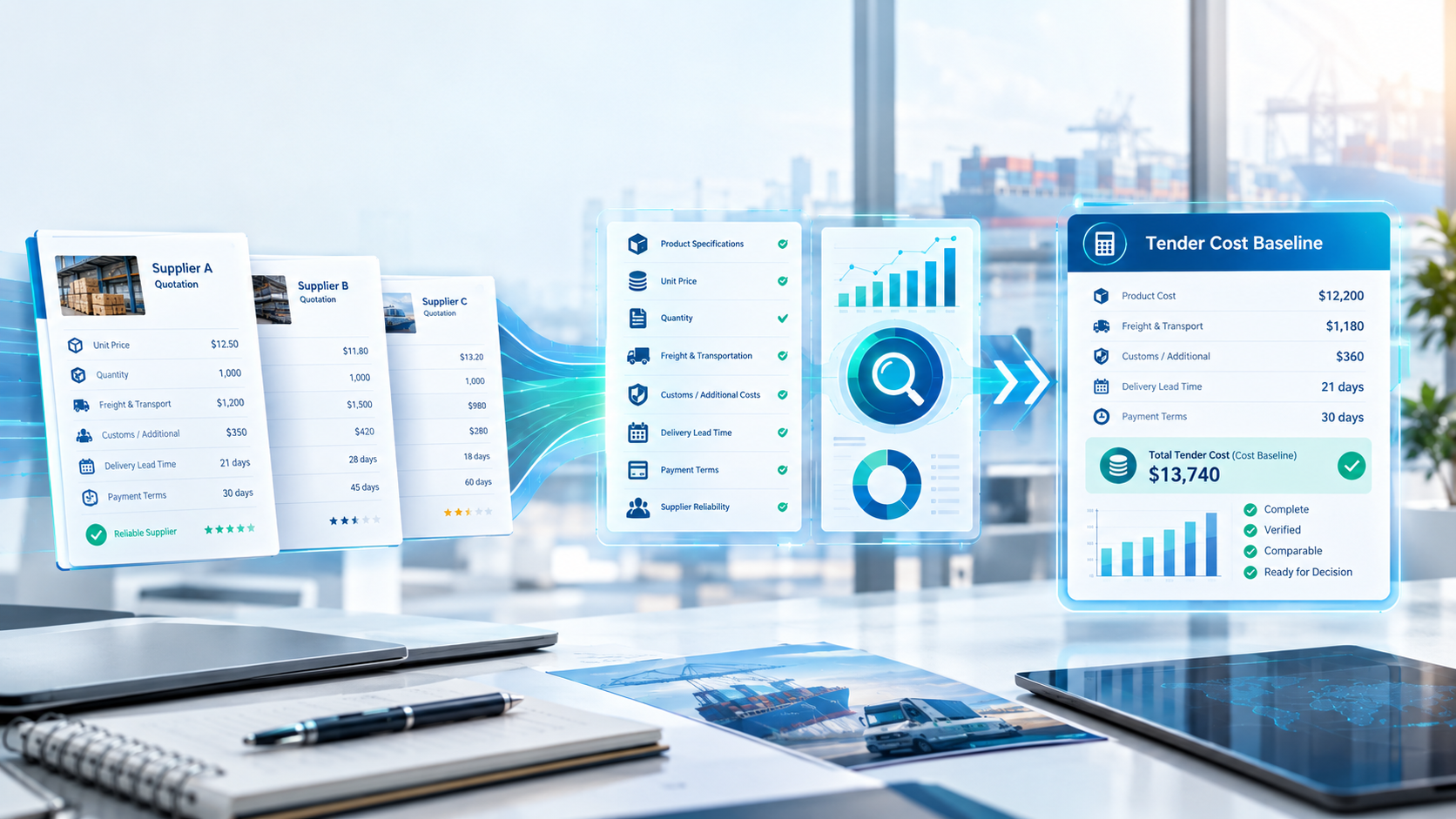
How to Find Reliable Suppliers and Calculate Your Real Tender Cost
Once a tender has passed the initial screening, the next question is not:
“What price should we offer?”
It is:
“What will this tender realistically cost us?”
This distinction is critical.
A tender may look highly profitable when the selling price is compared with an optimistic supplier quotation. But after freight, delivery, payment terms, availability, customs, warranty exposure, and other costs are considered, the expected margin can change significantly.
That is why a disciplined tender process follows a simple rule:
Cost comes before price.
The Procurement Function establishes the cost baseline. The Commercial Function then uses that baseline to make the pricing and Go/No-Go decision.
1. Procurement Starts With the Tender Requirements
The first mistake in tender sourcing is asking suppliers for prices before understanding exactly what the customer is requesting.
The Procurement Function should first review:
- Product description
- Technical specifications
- Quantities
- Required brands or acceptable alternatives
- Required certifications
- Delivery requirements
- Packaging requirements
- Warranty requirements
- Installation requirements, if applicable
- Required delivery location
- Required delivery date
A supplier cannot provide a meaningful quotation if the company has not clearly defined what it needs.
A low quotation for the wrong specification is not a low cost.
It is simply the wrong number.
2. Build the Supplier Shortlist
Once the requirements are understood, Procurement identifies potential suppliers.
Depending on the product category, suppliers may include:
- Manufacturers
- Authorized distributors
- Importers
- Local wholesalers
- Specialized suppliers
- Existing approved suppliers
- International suppliers
The objective is not necessarily to find the cheapest supplier.
The objective is to identify suppliers capable of providing the required product, at the required quality, within the required timeframe and commercial conditions.
A supplier offering a lower unit price but unable to deliver on time may create a much higher business cost.
3. Never Depend on One Supplier Quote
Whenever practical, Procurement should obtain multiple quotations.
For example:
| Supplier | Unit Cost | Availability | Lead Time | Payment Terms |
| Supplier A | $92 | In stock | 5 days | 30 days |
| Supplier B | $88 | Limited | 20 days | Advance |
| Supplier C | $95 | In stock | 7 days | 60 days |
At first glance, Supplier B appears to be the winner.
But price is only one variable.
If the tender requires delivery within 10 days, Supplier B may no longer be a realistic option.
Supplier A may actually represent the stronger commercial choice.
This is why Procurement should evaluate the total commercial situation, not simply sort quotations from lowest to highest.
4. Establish the Real Supply Cost
The supplier’s quotation is usually only the starting point.
The company may also incur:
- Freight
- Transportation
- Customs and duties
- Insurance
- Handling
- Storage
- Packaging
- Inspection
- Installation
- Testing
- Local delivery
- Financing costs
- Warranty-related costs
- Other tender-specific expenses
Therefore:
Real Tender Cost ≠ Supplier Quotation
A simplified cost structure could look like this:
Supplier Cost
+
Freight & Transportation
+
Import / Customs Costs
+
Handling & Storage
+
Inspection / Installation
+
Other Tender-Specific Costs
│
▼
REAL TENDER COST
This is the number Commercial needs before deciding what price to offer.
5. Availability Can Be More Important Than Price
Imagine two suppliers:
Supplier A
- Cost: $100
- Available immediately
- Delivery: 5 days
Supplier B
- Cost: $92
- Not currently available
- Delivery: 45 days
If the customer requires delivery within 10 days, Supplier B is not really a $92 solution.
It may not be a viable solution at all.
This illustrates an important procurement principle:
A quotation is only commercially useful when the supplier can actually fulfill the requirement.
Procurement should therefore verify availability rather than simply record the supplier’s stated price.
6. Lead Time Must Be Connected to the Tender Deadline
Supplier lead time should be compared with the customer’s required delivery date.
Consider the complete timeline:
Tender Award
│
▼
Purchase Order
│
▼
Supplier Production / Preparation
│
▼
Transportation
│
▼
Receiving / Inspection
│
▼
Customer Delivery
If the supplier needs 30 days and transportation requires another 10 days, the company cannot promise a 25-day customer delivery without accepting a significant execution risk.
The Procurement Function must therefore provide Commercial with a realistic delivery assumption.
7. Payment Terms Affect the Real Economics
Supplier payment terms can significantly influence tender profitability and cash requirements.
Consider two suppliers:
| Supplier A | Supplier B | |
| Cost | $100,000 | $97,000 |
| Advance Payment | 100% | 30% |
| Balance | — | On Delivery |
| Lead Time | 15 days | 20 days |
Supplier B is cheaper, but more importantly, it may require less cash upfront.
For a company with limited working capital, that difference can be commercially significant.
This is why Procurement should capture payment terms alongside price.
8. Supplier Reliability Is Part of Cost
A supplier who frequently delivers late, sends incorrect quantities, or provides inconsistent quality creates costs that may not appear on the quotation.
Potential consequences include:
- Emergency transportation
- Replacement purchases
- Customer penalties
- Additional labor
- Delayed invoicing
- Warranty claims
- Reputation damage
- Management time
Therefore:
The cheapest supplier is not necessarily the lowest-cost supplier.
Procurement should consider previous performance where reliable information is available.
9. Create a Tender Cost Baseline
After supplier research is complete, Procurement should produce a simple Tender Cost Baseline.
For example:
| Cost Component | Estimated Cost |
| Supplier purchase cost | $100,000 |
| Freight | $4,000 |
| Customs / duties | $6,000 |
| Local transportation | $2,500 |
| Inspection / handling | $1,500 |
| Other tender costs | $1,000 |
| Tender Cost Baseline | $115,000 |
This is not yet the selling price.
It is the company’s best current estimate of what the tender will cost to fulfill.
10. Separate Known Costs From Assumptions
Not every number will be confirmed during tender preparation.
For example:
- Supplier quotation: confirmed
- Freight: estimated
- Customs: estimated
- Delivery cost: estimated
- Warranty exposure: assumption
- Exchange rate: assumption
This distinction matters.
A good tender process does not hide uncertainty inside a single number.
It makes assumptions visible.
For example:
Estimated Tender Cost = $115,000 based on supplier quotation, current freight estimate, and assumed customs and delivery costs.
That gives Commercial a much stronger foundation for its decision.
11. Procurement Should Not Set the Selling Price
This is one of the most important functional boundaries in the process.
Procurement asks:
What will it realistically cost us?
Commercial asks:
What should we charge, and should we bid?
The two questions are connected but different.
If Procurement starts adjusting supplier costs simply to make a desired selling price work, the process becomes dangerous.
The company may end up building a price around an unrealistic cost.
Instead:
Procurement establishes the cost. Commercial makes the pricing decision.
12. The Procurement Handover
When Procurement completes its work, Commercial should receive a clear cost package.
At minimum:
- Supplier
- Product
- Quantity
- Unit cost
- Total supplier cost
- Availability
- Lead time
- Payment terms
- Freight assumptions
- Other additional costs
- Total Tender Cost Baseline
- Cost validity period
- Major procurement risks
- Outstanding assumptions
This creates a clean handover.
Commercial can then evaluate the opportunity without having to repeat the entire supplier investigation.
13. The Complete Flow
The first two stages of the tender business model now connect:
TENDER OPPORTUNITY
│
▼
TENDER INTELLIGENCE
Find & Screen
│
▼
PROMISING TENDER
│
▼
PROCUREMENT
Source & Establish Cost
│
▼
TENDER COST BASELINE
│
▼
COMMERCIAL
Price & Go / No-Go
The process is deliberately simple.
Tender Intelligence protects the company’s time.
Procurement protects the company’s cost assumptions.
Commercial then decides whether the opportunity makes economic sense.
Conclusion
A supplier quotation is not the same thing as tender cost.
A low purchase price can become an expensive decision when delivery, freight, payment terms, availability, quality, and execution risks are ignored.
The Procurement Function therefore has one fundamental responsibility:
Establish the most realistic cost baseline possible before the company decides what price to offer.
Once that cost baseline is ready, the decision moves to Commercial.
The next question becomes much more difficult:
What price gives us a realistic chance of winning while still making the tender worth winning?
That is the subject of the next stage:
Tender Pricing Strategy: How to Set a Competitive Price and Decide Whether to Bid.
OpexEdge Tender Business Model
Find → Screen → Source & Cost → Price & Decide → Submit → Win/Lose → Execute → Learn
OpexEdge approaches tender procurement as a connected business process, helping growing supply and contracting companies evaluate opportunities, establish realistic costs, make stronger commercial decisions, and execute awarded projects with greater control.
Related Topics
Government Tender Procurement Service | OpexEdge
Tenders Management-How to Find Reliable Suppliers and Calculate Your Real Tender Cost
Tenders Management-Tender Pricing Strategy: How to Set a Competitive Price and Decide Whether to Bid
