
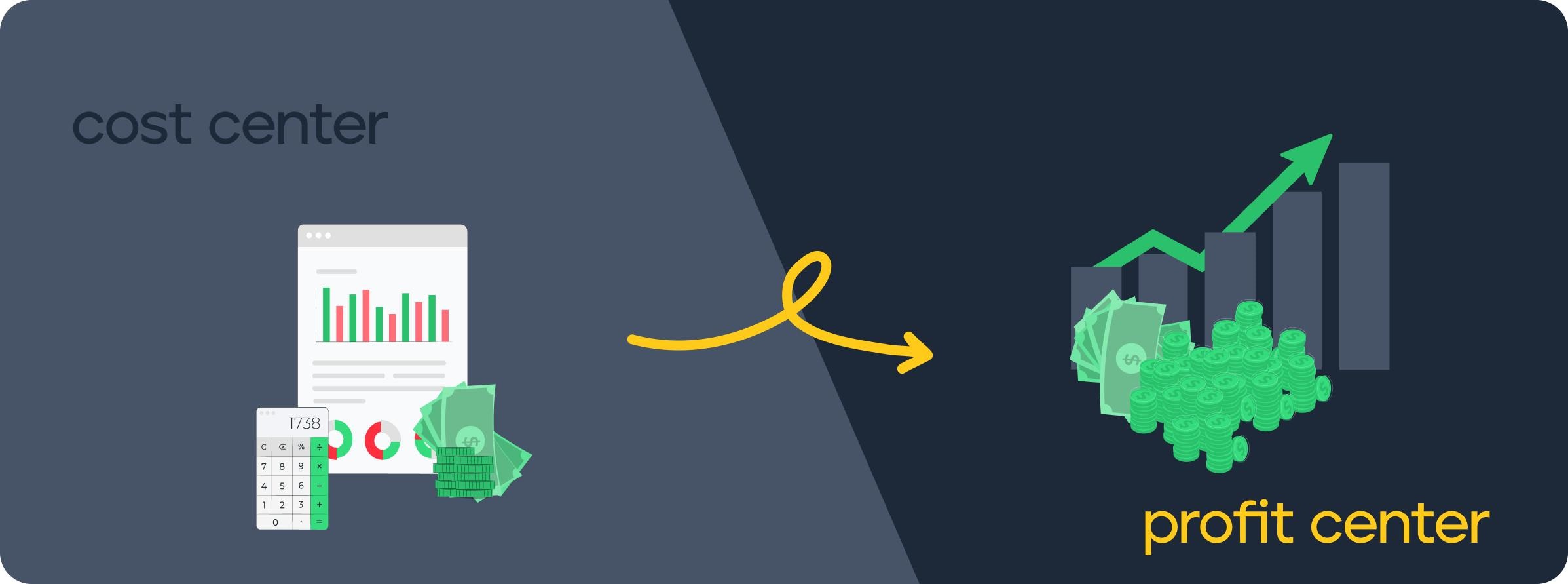
From Cost Center to Profit Center: My After-Sales Transformation Journey at eXtra
A 12-year journey in building after-sales services as a business, not just a support function
When I joined eXtra in 2006, the assignment was to lead the quality of after-sales services.
At that time, the after-sales operation was being built essentially from the ground up.
The challenge was not simply to establish repair centers or hire technicians.
The bigger question was:
Could after-sales service become a competitive advantage and a profitable business in a market where after-sales support was still significantly underdeveloped?
Looking back at the journey from 2006 to 2018, this became one of the most important professional experiences in shaping how I think about operations, customer experience, technology, and profitability.
The Market Pain Was the Opportunity
The Saudi electronics and appliances market was growing rapidly, but after-sales service was still a significant pain point for customers.
Customers could buy the product.
The difficult part often came afterward:
Who would install it?
Who would repair it?
Where would the customer go?
Who would provide the spare parts?
How quickly could a technician respond?
This created an important strategic opportunity.
Instead of viewing after-sales as an unavoidable cost associated with selling products, the strategy was to turn the customer pain into a business opportunity.
The objective was clear:
Transform after-sales from a cost center into a profit center.
Building the Capability from the Ground Up
The operation required much more than a service counter.
A technical workforce was established with technicians from different countries, including the Philippines, India, Egypt, Syria, Jordan, and Pakistan.
Service centers were established in Riyadh, Jeddah, and Al Khobar, supported by a field-service vehicle fleet.
The operation covered several major categories, including:
- Smart devices
- Consumer electronics
- Large home appliances
- Air conditioners
But the real opportunity was not limited to repairing products.
It was in designing value-added services around customer needs.
These included extended warranty services, smart-device setup and protection, air-conditioner installation and maintenance, and other services designed around the products and customer expectations.
This changed the commercial question from:
“How much does after-sales cost us?”
to:
“What value-added service can we create around the customer’s need?”
Designing Services Around the Customer
One of the approaches used in developing the services was the Kano Model, which helped distinguish between basic customer expectations and service elements capable of creating additional value.
Not every customer requirement has the same impact on satisfaction.
Some elements are basic expectations.
Some improve the customer experience.
Others can create additional perceived value and become commercially attractive services.
This led to an important principle:
Different services require different customer journeys.
A smart-device setup journey is different from an air-conditioner installation.
An extended warranty contract is different from a repair request.
Therefore, each service required its own journey while operating within a common operational framework.
The Operational Challenge
The rapid growth of the business created another level of complexity.
eXtra was expanding at remarkable speed, moving from a single branch in 2003 to more than 50 branches across Saudi Arabia, Bahrain, and Oman.
After-sales had to grow at the same speed.
That created pressure on:
- Human resources
- Technical capabilities
- Spare parts
- Logistics
- Service centers
- Customer communication
- Process control
- Information systems
There was also a fundamental technology challenge.
At that time, there was no ready-made ERP solution that naturally matched the specific requirements of this type of after-sales business model.
The answer was not to start with technology.
The answer was to design the operation first.
Process Before Technology
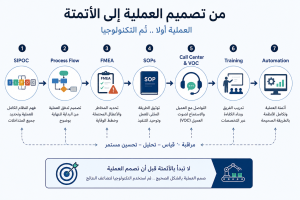
The operating model was developed using structured process methodologies.
The work included:
SIPOC to understand the complete process ecosystem.
Process Flow to define how the service should move from one stage to another.
FMEA to anticipate potential failures and operational risks.
SOPs to establish standardized ways of working.
A Call Center was established to create a structured customer interface and capture the Voice of Customer (VOC).
Training became another essential pillar, particularly because the operation involved multiple nationalities, products, brands, and technical disciplines.
Only after the processes were designed did technology become the next step.
The internal IT team was then used to customize a local solution and automate the overall service process.
This experience reinforced a principle I still believe in today:
Do not automate a bad process. Design the process first, then automate it.
Standardization Without Losing Flexibility
One of the important operational challenges was that the business could not rely on a single customer journey.
Different services required different workflows.
The common architecture was standardized, but the service journey was adapted to the nature of each service.
This balance between standardization and flexibility became critical.
Too much standardization would make the service rigid.
Too much flexibility would make the operation difficult to control at scale.
Operational excellence required finding the right balance.
The Hybrid Operating Model
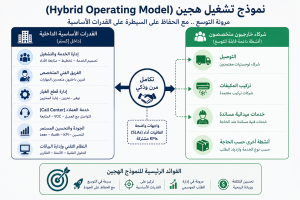
The speed of expansion created another challenge: resources could not always be developed internally as quickly as the business was growing.
This led to a hybrid operating model.
The core capabilities remained internal, while selected activities were supported by external service providers.
Examples included delivery and air-conditioner installation.
This approach provided the flexibility required for rapid expansion while keeping control over the critical capabilities of the business.
It was not simply outsourcing for the sake of reducing cost.
The real question was:
Which capabilities must remain inside the organization, and which activities can be scaled more efficiently through specialized partners?
Technology Was Changing the Game
The market was changing extremely fast.
The transition from traditional mobile phones to smartphones and then to the iPhone created completely new customer requirements.
Television technology was also moving rapidly from older technologies toward LCD and newer display technologies.
The products were changing.
Therefore, the services had to change too.
Every technology shift created new requirements for:
Skills → Training → Processes → Spare Parts → Customer Support → Value-Added Services
After-sales could not remain static while the products were evolving.
The service organization had to move faster than the technology curve.
From Service Operation to Business Model
The most important transformation was commercial.
After-sales was no longer treated simply as something that happened after the sale.
Services were designed as commercial propositions and contracts.
A significant part of the business opportunity came from value-added services rather than traditional repair activity.
Combined with Lean process methodology, strong internal auditing, standardized processes, and continuous training, this created a highly efficient operating model.
The result was a substantial after-sales business capable of generating very high service profitability while maintaining a strong customer experience.
The sector eventually reached a scale measured in hundreds of millions of Saudi Riyals and achieved one of the highest margins that could be achieved in a service business.
Customer satisfaction remained strong as well.
That combination was important.
Profitability and customer experience did not have to be competing objectives.
When the process is designed correctly, they can reinforce each other.
When Competitors Started to Copy
Success naturally attracted competitors.
Some attempted to replicate the service model.
But there was an important lesson:
It is relatively easy to copy a service offering.
It is much harder to copy the operating system behind the service.
The competitive advantage was not one particular service.
It was the combination of:
People + Processes + Technology + Training + Audit + Customer Insight + Scale
This is why simply reproducing the visible part of the model was not enough.
The capability was embedded in the organization.
What I Learned
My role in this journey was only one part of a much larger team and management system.
One of the most valuable lessons was the importance of bold decision-making.
In a rapidly changing market, waiting for perfect information can be more dangerous than making a well-considered decision and measuring its outcome.
But there is an important second part:
Be bold enough to make the decision, but disciplined enough to validate it with numbers.
The cycle is simple:
Decide → Execute → Measure → Learn → Adjust
The other lesson was speed.
Markets do not wait for organizations to finish their internal discussions.
Technology does not wait.
Customers do not wait.
Competitors do not wait.
Therefore:
You have to be faster than the market.
Looking Back
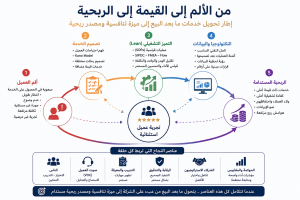
The most valuable part of this experience was not building a number of service centers or launching a number of services.
It was seeing how several disciplines could come together:
Customer pain created the opportunity.
Service design turned the opportunity into an offering.
Process engineering made the offering scalable.
Lean methodology improved efficiency.
Technology enabled automation.
Training and auditing protected consistency.
And commercial thinking turned after-sales into a profitable business.
That is the real lesson I took from my journey at eXtra between 2006 and 2018:
After-sales does not have to be the cost of selling a product. When it is designed around customer value and supported by operational excellence, it can become a business in its own right.
And sometimes, the biggest business opportunity is hiding inside the problem that everyone else considers a cost.
A Final Thought
This experience continues to influence how I look at business transformation today.
When a company tells me that a function is “just a cost,” my first question is:
Is it really a cost—or have we simply not yet designed the business model around it?
