
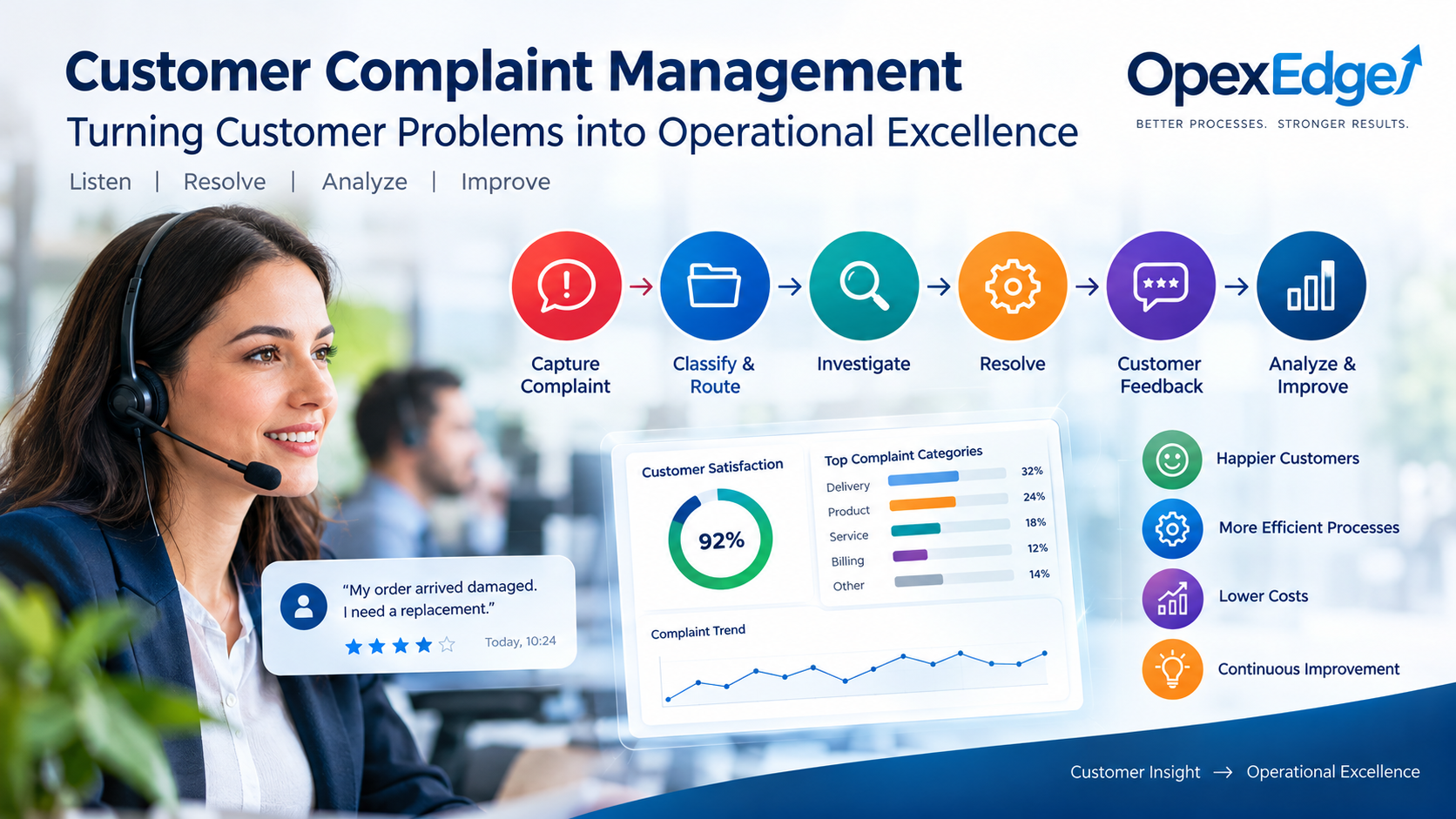
How to Design a Customer Complaint Handling System That Captures the Voice of the Customer, Solves Problems, and Improves the Business
A customer complaint is rarely just a customer-service problem.
It may be evidence of a defective product, a broken process, poor communication, inadequate training, a system limitation, a supplier problem, a delivery failure, a warranty issue, or a gap between what the company promised and what the customer actually received.
Yet many organizations still manage complaints as individual cases:
Customer complains → employee apologizes → problem is fixed → ticket is closed.
That approach may resolve the immediate customer problem, but it does not necessarily solve the business problem.
A mature organization asks a different question:
What is this complaint telling us about our operation?
This is the foundation of effective Customer Complaint Management.
At OpexEdge, complaint handling is best viewed as a closed-loop operational system connecting:
Customer → Complaint → Data → Classification → Routing → Resolution → Feedback → Root Cause → Improvement → Performance Management
The objective is not simply to reduce the number of complaints.
The objective is to build an operation that:
- Detects customer problems quickly
- Responds consistently
- Resolves issues effectively
- Prevents unnecessary escalation
- Identifies recurring failures
- Converts customer feedback into operational intelligence
- Improves processes
- Reduces repeat problems
- Strengthens customer trust
- Creates measurable business performance
1. Complaint Handling Starts With Strategy
A complaint management system should not begin with software.
It should begin with strategy.
Before selecting a CRM, ticketing platform, call-center system, WhatsApp workflow, or customer portal, management should define what the complaint process is intended to achieve.
A practical complaint-management strategy should answer:
What is the purpose?
For example:
- Protect customer trust
- Resolve customer problems quickly
- Reduce repeat complaints
- Identify systemic failures
- Improve products and services
- Reduce warranty and service costs
- Strengthen customer retention
- Capture Voice of the Customer
- Support ISO 9001 and QMS objectives
What types of complaints are covered?
The organization should define whether the system covers:
- Product complaints
- Service complaints
- Delivery complaints
- Installation complaints
- Warranty complaints
- Billing complaints
- Employee behavior complaints
- Communication complaints
- Technical problems
- Availability problems
- Quality defects
- Digital-channel problems
- Supplier-related issues
What is the management philosophy?
The most important principle should be:
Do not manage complaints only as cases. Manage them as signals from the business system.
2. Design the Complaint Management System Before Choosing Technology
One of the lessons from operational transformation is that process should come before technology.
In my after-sales transformation experience, the operation was first designed using tools such as:
- SIPOC
- Process Flow
- FMEA
- SOPs
- Voice of Customer
- Training
- Performance measurement
Only after the process architecture was defined was technology used to automate it.
This principle remains important for complaint management:
Do not automate a bad complaint process. Design the process first, then automate it.
The technology could eventually be:
- CRM
- Customer Service Management System
- Help Desk
- Ticketing System
- ERP
- Call Center Platform
- Customer Portal
- Mobile Application
- WhatsApp integration
- Email management
- AI-powered customer-service platform
But the system should serve the process—not define it.
This approach is consistent with the OpexEdge experience of designing after-sales operations around process architecture before technology.
3. The Customer Interface: Make It Easy to Complain
A complaint system cannot capture problems that customers cannot easily report.
The customer interface may include:
- Telephone
- Call center
- Website form
- Customer portal
- Mobile application
- Social media
- Physical service center
- Sales representative
- Technician
- Store employee
- Chatbot
The customer should not have to understand the company’s organizational structure.
For example, a customer should not need to know whether the problem belongs to:
Sales → Logistics → Warehouse → Warranty → Technical Service
The customer simply explains the problem.
The organization should handle the internal routing.
This is an important distinction between customer experience design and organizational structure.
OpexEdge’s UX/UI approach similarly treats interface design as a business-performance issue: the interface should help users understand what to do, complete tasks easily, and reduce friction.
4. Capture the Right Data at the Beginning
A complaint record should provide enough information for another employee to understand the case without asking the customer to repeat everything.
A practical complaint record can contain:
Data Element | Purpose |
Complaint ID | Unique case identification |
Customer ID | Customer history |
Date/time | Response and SLA measurement |
Channel | Identify source of complaints |
Product/service | Identify affected offering |
Order/invoice | Trace transaction |
Location | Identify geographic patterns |
Complaint description | Understand problem |
Category | Statistical classification |
Subcategory | More precise analysis |
Severity | Prioritization |
Customer impact | Business/customer impact |
Assigned function | Ownership |
Target response time | SLA |
Target resolution time | SLA |
Root cause | Prevent recurrence |
Corrective action | Resolve systemic cause |
Resolution | Record outcome |
Customer confirmation | Validate closure |
Feedback score | Measure experience |
Escalation level | Management visibility |
Closure date | Aging and cycle-time measurement |
The objective is to collect useful data, not simply more data.
5. Complaint Classification: The Foundation of Analysis
If every complaint is recorded simply as “customer complaint,” the organization cannot learn much from the database.
Classification should be designed carefully.
A practical structure could include:
By Problem Type
- Product quality
- Service quality
- Delivery
- Installation
- Warranty
- Billing
- Availability
- Technical support
- Employee behavior
- Communication
- Pricing
- Documentation
By Cause
- Product
- Process
- People
- System
- Supplier
- Logistics
- Customer expectation
- Communication
By Severity
Level 1 — Minor
Limited customer impact and easy local resolution.
Level 2 — Significant
Requires coordination or supervisor involvement.
Level 3 — Major
Significant financial, operational, reputational, or customer impact.
Level 4 — Critical
Potential safety, legal, regulatory, major financial, or serious reputational impact.
The exact classification should be customized to the organization.
The important principle is:
Classification should support decisions.
6. Redirection: Put the Complaint in the Right Hands
One of the most common weaknesses in complaint handling is incorrect routing.
A customer complains about delayed delivery.
Customer service sends it to logistics.
Logistics discovers that the order was never released by sales.
The complaint moves again.
Then finance discovers a payment issue.
The customer experiences the organization as one company.
Internally, however, the complaint is moving between departments.
A strong system therefore needs routing rules.
For example:
Complaint → Classification → Ownership → SLA → Action
Routing can be based on:
- Complaint category
- Product
- Location
- Customer segment
- Severity
- Warranty status
- Financial impact
- Technical complexity
- Regulatory implications
The customer should not become the coordinator between departments.
Solution: Fix the Customer Problem First
Complaint resolution has two dimensions.
Dimension 1 — Customer recovery
What does the customer need now?
Examples:
- Replacement
- Repair
- Refund
- Delivery correction
- Technician visit
- Explanation
- Compensation where appropriate
- Service correction
- Information
Dimension 2 — Business correction
Why did the problem happen?
Examples:
- Incorrect process
- Training gap
- System error
- Supplier defect
- Poor planning
- Capacity problem
- unclear SOP
- defective product
- communication failure
Solving the first dimension closes the customer case.
Solving the second dimension improves the business.
A mature complaint system must do both.
Customer Feedback After Resolution
Closing a complaint in the system does not necessarily mean the customer considers the problem resolved.
The organization should therefore verify the customer’s experience.
Possible measures include:
CSAT — Customer Satisfaction Score
“How satisfied were you with the way your complaint was handled?”
Resolution Satisfaction
“Was your problem resolved?”
Effort Score
“How easy was it to get your problem resolved?”
NPS
“Would you recommend the company?”
These measures should not be treated as interchangeable.
A complaint may be resolved successfully while the customer remains dissatisfied with the overall experience.
The important question is therefore:
Did we close the ticket—or did we close the customer’s problem?
Escalation: Not Every Complaint Should Follow the Same Path
A mature system defines escalation rules before the crisis occurs.
Escalation may be triggered by:
- High severity
- Safety risk
- Legal risk
- VIP/customer importance
- Financial exposure
- Repeated complaints
- SLA breach
- Social-media exposure
- Regulatory issue
- Multiple customers reporting the same failure
- Failure to resolve within defined time
A simple escalation structure could be:
Level 1 — Frontline
Resolve routine complaints.
↓
Level 2 — Supervisor
Handle complex or delayed cases.
↓
Level 3 — Functional Manager
Coordinate cross-functional resolution.
↓
Level 4 — Senior Management
Handle critical business, financial, legal, safety, or reputational issues.
Escalation should be controlled by rules—not personality.
Complaint Handling Process Mapping
Before improving the process, map it.
A simple end-to-end complaint process could look like:
Customer identifies problem
↓
Complaint received
↓
Complaint registered
↓
Customer/account verified
↓
Complaint classified
↓
Severity determined
↓
Immediate containment if required
↓
Complaint assigned
↓
Investigation
↓
Root cause analysis where required
↓
Solution defined
↓
Customer informed
↓
Solution implemented
↓
Customer feedback
↓
Complaint closed
↓
Data analyzed
↓
Corrective / preventive action
↓
Process improvement
↓
Management review
This is where SIPOC and process mapping become useful.
OpexEdge’s SIPOC methodology emphasizes understanding the complete process and connecting process structure with KPIs, root-cause analysis, and improvement.
Complaint Management as a Data System
Every complaint generates data.
But data becomes valuable only when converted into information.
For example:
Raw data
1,200 complaints.
Information
420 relate to delivery.
Analysis
70% of delivery complaints come from three distribution locations.
Investigation
The three locations share the same dispatch process.
Root cause
Orders are released without a standardized delivery-readiness check.
Action
Introduce a dispatch verification step.
Result
Delivery complaints decline.
This is the transformation:
Complaint → Data → Pattern → Cause → Action → Result
That is operational excellence.
Root Cause Analysis: Don’t Treat Symptoms
A customer complains that a product failed.
Replacing the product may solve the customer’s immediate problem.
But the organization should ask:
Why did it fail?
Possible tools include:
- 5 Whys
- Fishbone Diagram
- Pareto Analysis
- FMEA
- A3 Problem Solving
- 8D
- CAPA
- PDCA
OpexEdge’s Root Cause Analysis methodology emphasizes eliminating underlying causes rather than repeatedly treating symptoms.
For recurring or high-impact complaints, RCA should become mandatory.
Pareto Analysis: Find the Vital Few Complaints
Not every complaint deserves the same improvement effort.
Suppose an organization receives:
Complaint Type | Number |
Delivery delay | 420 |
Installation delay | 230 |
Product defect | 180 |
Billing | 120 |
Communication | 90 |
Other | 160 |
Management should not simply say:
“We have 1,200 complaints.”
The next question should be:
Which problems are driving the largest share of customer pain?
Pareto analysis helps identify the vital few categories that deserve deeper investigation.
OpexEdge’s Pareto methodology explains how an uneven distribution of causes can be used to focus improvement resources on the problems creating the greatest impact.
Complaint KPIs
A complaint-management system needs a balanced KPI structure.
Volume KPIs
- Total complaints
- Complaint rate
- Complaints per 1,000 orders
- Complaints by product
- Complaints by branch
- Complaints by channel
Speed KPIs
- First response time
- Average resolution time
- Median resolution time
- SLA compliance
- Complaint aging
Effectiveness KPIs
- First Contact Resolution
- Resolution rate
- Repeat complaint rate
- Reopened complaints
- First-Time Fix where applicable
Customer KPIs
- CSAT
- Complaint-resolution satisfaction
- Customer effort
- NPS
- Retention after complaint
Quality KPIs
- Recurring complaints
- Defect-related complaints
- Warranty complaints
- Complaint escape rate
- Root-cause closure rate
Improvement KPIs
- Corrective actions completed
- Corrective-action effectiveness
- Reduction in repeat complaints
- Reduction in complaint cost
- Reduction in warranty cost
OpexEdge’s KPI methodology distinguishes effectiveness from efficiency and emphasizes defining the KPI formula, owner, target, frequency, and data source.
Targets: Don’t Set “Zero Complaints” as the Only Goal
A target such as:
Zero complaints
may sound attractive but can create unintended behavior.
Employees may become reluctant to record complaints.
A better KPI system measures both customer problems and organizational responsiveness.
For example:
- First response: ≤ 2 hours
- SLA compliance: ≥ 95%
- First Contact Resolution: ≥ 75%
- Repeat complaint rate: ≤ 5%
- Customer satisfaction after resolution: ≥ 90%
- Corrective-action effectiveness: ≥ 95%
The actual targets must be based on the organization’s baseline, customer expectations, business model, and service commitments.
The purpose of targets is not to make dashboards look good.
It is to create a management trigger for action.
Reporting: Turn Complaints Into Management Information
A complaint dashboard should answer management questions quickly.
Executive Dashboard
- Total complaints
- Complaint trend
- Complaint rate
- Top five complaint categories
- Critical complaints
- SLA performance
- Customer satisfaction
- Repeat complaints
- Open aging cases
- Corrective actions
- Financial impact
Operational Dashboard
Managers need more detail:
- Complaints by employee/team
- Complaints by branch
- Complaints by product
- Complaints by supplier
- Response-time distribution
- Resolution-time distribution
- Escalations
- Reopened cases
- Root causes
Improvement Dashboard
Focus on:
- Pareto trends
- Recurring problems
- Corrective actions
- CAPA status
- Improvement projects
- Before/after performance
A dashboard should not merely show what happened.
It should help management decide:
What needs attention now?
Training Is Part of the Complaint System
Even the best process and software will fail if employees do not know how to use them.
Complaint-handling training should cover:
Customer communication
- Listening
- Empathy
- Questioning
- Clarification
- Professional communication
Process
- How to register a complaint
- How to classify it
- How to route it
- When to escalate
- How to document the solution
- How to close the case
Problem solving
- 5 Whys
- Fishbone
- Pareto
- RCA
- Corrective action
System usage
- Ticket creation
- Data quality
- Status updates
- Attachments
- Escalation
- Closure
Customer recovery
Employees should understand the difference between:
Winning an argument with a customer
and
Recovering the customer relationship.
The objective is the second.
FMEA: Prevent Complaints Before They Happen
Complaint management should not be purely reactive.
If the organization knows that a process can create customer problems, it should identify the failure modes before customers experience them.
This is where FMEA can contribute.
For example:
Failure Mode: Incorrect product delivered
Potential Cause: Picking error
Customer Effect: Customer receives wrong product
Current Control: Final inspection
Improvement: Barcode verification / mistake-proofing
The goal is to move from:
Detect → Correct
toward:
Prevent → Control
OpexEdge’s FMEA and Poka Yoke methodologies support this preventive approach to operational quality.
Complaint Management and the Voice of the Customer
Complaints are one component of Voice of the Customer (VOC).
VOC can include:
- Complaints
- Reviews
- Surveys
- Interviews
- Social-media feedback
- Call-center records
- Warranty claims
- Returns
- Service reports
- Sales feedback
The important step is to translate customer language into operational requirements.
For example:
Customer says:
“Your technician took too long.”
The organization should investigate:
- Response time
- Technician capacity
- Scheduling
- Geographic coverage
- Spare parts
- Work-order process
- Appointment communication
The complaint is the customer statement.
The operational analysis reveals the system problem.
OpexEdge’s VOC framework specifically connects customer feedback to service redesign, KPI development, corrective actions, and continuous improvement.
Closing the Feedback Loop
A powerful complaint system does not end when the company solves the problem.
The loop should continue:
Complaint
→
Resolution
→
Customer feedback
→
Data analysis
→
Root cause
→
Improvement
→
Measurement
→
Customer communication
This creates a closed-loop customer experience system.
For example:
A customer complains about repeated installation delays.
The company investigates.
The root cause is scheduling.
The scheduling process is redesigned.
The KPI improves.
Customers are informed that installation scheduling has been changed.
The organization has now converted a complaint into a business improvement.
Complaint Management Within the Product & Service Lifecycle
Complaint handling should not operate as an isolated customer-service activity.
It should connect with the complete Product & Service Lifecycle.
The OpexEdge Product & Service Lifecycle Framework describes a closed loop:
Market Study & VOC
→ Product Design
→ Process Design
→ Production
→ Storage
→ Sales
→ Delivery & Installation
→ Warranty & Maintenance
→ Customer Data
→ Improvement
This means a complaint generated after the sale can become an input into the next product, process, service, or business decision.
A complaint about installation can improve installation design.
A complaint about product reliability can influence engineering.
A complaint about delivery can improve logistics.
A complaint about service communication can improve the customer interface.
A complaint about spare-parts availability can improve inventory planning.
This is how customer service becomes part of enterprise improvement.
Management Review
Complaint data should reach management at the appropriate level.
A monthly management review could examine:
Customer
- Satisfaction
- Complaint volume
- Critical complaints
- Repeat complaints
Process
- Response time
- Resolution time
- SLA performance
- Process failures
Quality
- Defect trends
- Warranty trends
- Root causes
- Corrective actions
Financial
- Warranty cost
- Compensation
- Returns
- Service cost
- Cost of poor quality
Improvement
- Open actions
- Completed actions
- Effectiveness
- Trend improvement
The question should not simply be:
“How many complaints did we receive?”
It should be:
“What are our customers telling us about the performance of our business?”
A Practical OpexEdge Complaint Management Architecture
A mature complaint-management system can be represented as ten connected layers:
Layer 1 — Strategy
Define objectives, scope, ownership, policies and service principles.
Layer 2 — Customer Interface
Provide accessible complaint channels.
Layer 3 — Data Capture
Create a standardized complaint record.
Layer 4 — Classification
Categorize type, cause, severity and impact.
Layer 5 — Routing
Assign ownership based on predefined rules.
Layer 6 — Resolution
Contain, investigate and resolve the customer’s problem.
Layer 7 — Escalation
Escalate based on severity, risk, SLA and impact.
Layer 8 — Feedback
Confirm customer satisfaction and capture VOC.
Layer 9 — Analysis
Use KPIs, Pareto, RCA, FMEA and trend analysis.
Layer 10 — Improvement
Implement corrective action, prevent recurrence and feed learning back into the business.
The system therefore becomes:
Customer Complaint Management → Customer Experience → Operational Intelligence → Continuous Improvement
What Good Complaint Management Looks Like
A mature organization should be able to answer these questions:
Can the customer complain easily?
Can we capture the complaint accurately?
Can we classify it consistently?
Can we route it automatically or quickly?
Does someone clearly own the problem?
Do we know the required response time?
Do we know when escalation is required?
Can we measure resolution effectiveness?
Do we ask the customer whether the problem was actually resolved?
Can we identify recurring problems?
Can we identify root causes?
Do corrective actions have owners and deadlines?
Do we verify that corrective actions worked?
Does complaint data reach management?
Does complaint data influence product and process improvement?
If the answer to these questions is yes, complaint handling is no longer simply a customer-service activity.
It has become an operational management system.
Common Complaint-Management Mistakes
Mistake 1: Treating every complaint as an isolated event
This prevents systemic learning.
Mistake 2: Measuring only complaint volume
A rising complaint count can sometimes mean better reporting rather than worse service.
Mistake 3: Closing tickets without customer confirmation
Administrative closure is not necessarily customer resolution.
Mistake 4: Fixing symptoms instead of causes
The same problem returns.
Mistake 5: Using too many categories
Complex classification can reduce data quality.
Mistake 6: Having no escalation rules
Critical cases can remain trapped in frontline workflows.
Mistake 7: Automating before redesigning
Technology can make a bad process faster without making it better.
Mistake 8: Ignoring employee training
The system depends on people using it correctly.
Mistake 9: Collecting feedback without acting on it
Customers eventually stop believing that their feedback matters.
Mistake 10: Keeping complaints inside customer service
The real cause may belong to product development, procurement, warehouse, logistics, sales, finance, IT, or operations.
From Complaint Handling to Operational Excellence
The real opportunity is bigger than complaint reduction.
Consider this chain:
Customer complaint
↓
Customer experience signal
↓
Operational data
↓
Process analysis
↓
Root cause
↓
Corrective action
↓
Process improvement
↓
Better customer experience
↓
Lower cost
↓
Higher reliability
↓
Stronger customer loyalty
This is why complaint management belongs inside the broader discipline of Operational Excellence.
Operational Excellence is about designing, managing, measuring and continuously improving the processes that create business value.
Customer complaints provide direct evidence of where the customer’s experience and the organization’s intended process are not aligned.
The OpexEdge Principle
One principle summarizes the entire approach:
A complaint is not merely a customer problem. It is a data point showing where the business may have failed to deliver its intended value.
The strongest organizations do not simply become better at apologizing.
They become better at detecting problems, understanding causes, fixing processes, preventing recurrence and learning from customers.
That is the transition from:
Complaint Handling
to
Customer Experience Management
and ultimately to:
Operational Excellence.
Related OpexEdge Knowledge
This complaint-management framework connects directly with several OpexEdge methodologies and articles:
After-Sales Service Excellence
A broader framework covering customer support, warranty, field service, spare parts, feedback and service KPIs.
From Cost Center to Profit Center: My After-Sales Transformation Journey at eXtra
A practical account of building after-sales operations using process design, SIPOC, process flow, FMEA, SOPs, VOC, training and technology.
Voice of the Customer
How customer feedback can become a structured input into business decisions and improvement.
SIPOC Process Model
How to understand the complete process, its inputs, outputs, customers, KPIs and improvement opportunities.
Root Cause Analysis
Fishbone and 5 Whys for moving from symptoms to underlying causes.
A3 Problem Solving
A structured approach for investigating problems, implementing corrective actions and preventing recurrence.
Pareto Principle
A method for identifying the relatively small number of causes creating a large proportion of problems.
KPI Development
A practical framework for defining meaningful measures, formulas, targets, owners and data sources.
FMEA
A preventive approach for identifying potential failures before they reach customers.
Poka Yoke
Designing processes to prevent mistakes rather than relying entirely on inspection and correction.
Product & Service Lifecycle Framework
Connecting customer demand, delivery, warranty, customer data and continuous improvement into one closed-loop lifecycle.
ISO 9001
Complaint handling fits naturally into a process-based QMS where customer feedback, process performance, corrective action and continual improvement are connected.
Conclusion
Customer complaint management should not be designed as a department that receives angry customers and attempts to make them go away.
It should be designed as a business intelligence and improvement system.
The customer provides the signal.
The complaint system captures the signal.
Classification organizes it.
Routing creates ownership.
Escalation protects the business.
Resolution restores customer value.
Feedback measures the experience.
Root cause analysis identifies why the failure occurred.
KPIs measure performance.
Management reviews the patterns.
Continuous improvement changes the process.
And the improved process creates a better customer experience.
That is the real purpose of customer complaint management:
Not simply to close complaints—but to make the business better because customers complained.
OpexEdge Approach
OpexEdge helps organizations connect customer experience, process performance, quality management and operational improvement rather than treating them as separate initiatives.
Potential areas of support include:
- Customer Complaint Management System Design
- Customer Service Process Assessment
- After-Sales Service Assessment
- Complaint Process Mapping
- Customer Journey Analysis
- VOC Programs
- KPI Dashboard Design
- Root Cause Analysis
- Service Process Improvement
- Warranty Process Improvement
- Corrective Action Systems
- Customer Experience Improvement
- AI-assisted customer-service analytics
- Operational Excellence Transformation
Mahmoud Elhefnawi — Operational Excellence Architect
OpexEdge Consultancy
Scale Your Team’s Capacity to Enterprise Level.
