
Six Sigma: A Data-Driven
Methodology for Operational Excellence
Introduction
In today’s competitive business environment,
organizations cannot rely on effort alone to improve performance. Customers
expect consistent quality, faster delivery, lower cost, and reliable service
every time. This is where Six Sigma becomes a powerful management methodology.
Six Sigma is not just a quality tool. It is a
disciplined, data-driven approach to improving processes, reducing variation,
eliminating defects, and building a culture of continuous improvement. When
applied correctly, Six Sigma helps organizations move from opinion-based
problem solving to fact-based decision making.
Whether in manufacturing, retail, healthcare,
logistics, finance, supply chain, or service operations, Six Sigma provides a
structured way to identify problems, measure performance, analyze root causes,
implement improvements, and sustain results.
What Is Six Sigma?
Six Sigma is a process improvement
methodology focused on reducing defects, minimizing process variation, and
improving customer satisfaction. The term “sigma” refers to standard deviation,
which is used to measure variation in a process.
In simple terms, Six Sigma asks one
important question:
How can we make this process perform
correctly, consistently, and predictably?
The goal is to create processes that
produce fewer errors, less waste, and more reliable outputs. At a high level,
Six Sigma aims to achieve near-perfect performance by reducing defects to a
very low level.
However, the real value of Six Sigma is
not only in the statistical target. Its true value comes from the mindset it
creates: understand the process, measure the facts, find the root cause, solve
the real problem, and control the improvement.
Why Six Sigma Matters
Many organizations suffer from
repeated problems that appear normal over time: late deliveries, rework,
customer complaints, high scrap, inaccurate forecasts, inventory errors, long
approval cycles, and inconsistent service quality.
Without a structured improvement
method, teams often jump directly to solutions. This usually leads to temporary
fixes instead of sustainable improvement.
Six Sigma prevents this by forcing
the organization to slow down, define the problem clearly, validate it with
data, and attack the root cause rather than the symptom.
This makes Six Sigma valuable
because it helps organizations:
Improve product and service quality.
Reduce operational waste and cost.
Improve process stability and
predictability.
Increase customer satisfaction.
Reduce rework, delays, and
complaints.
Support better decision-making.
Build stronger cross-functional
teamwork.
Create measurable financial impact.
The DMAIC Framework
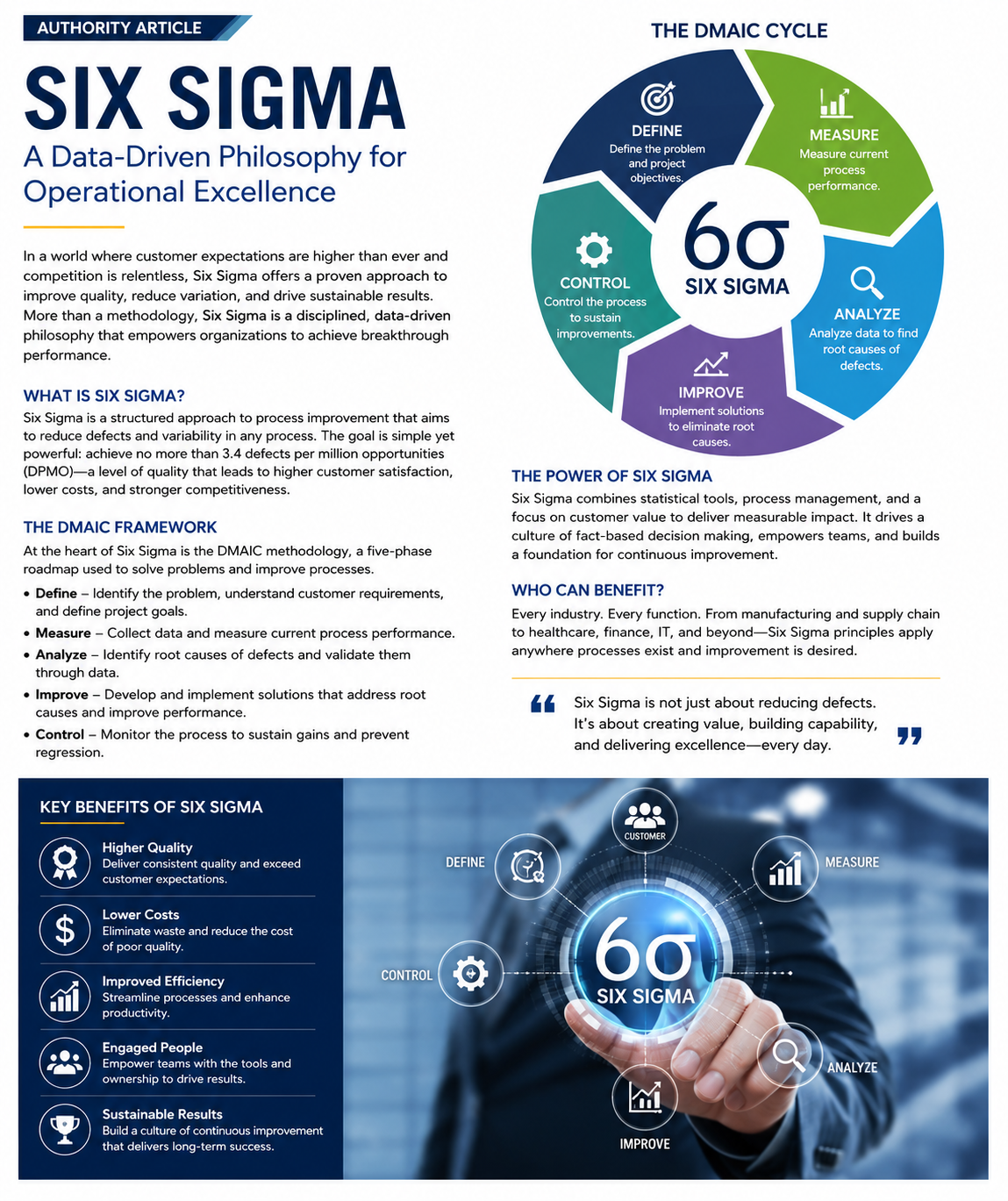
At the heart of Six Sigma is the DMAIC
methodology. DMAIC stands for Define, Measure, Analyze, Improve, and Control.
It is mainly used to improve existing processes that are not performing as
expected.
1. Define
The
Define phase clarifies the business problem, customer requirements, project
scope, goals, and expected benefits.
A
strong Six Sigma project starts with a clear problem statement. Instead of
saying “quality is poor,” the team should define the problem in measurable
terms, such as “customer complaints increased by 18% in the last quarter due to
late deliveries.”
Key
outputs of this phase may include:
Problem
statement.
Project
charter.
Customer
requirements.
Process
scope.
High-level
process map.
Target
improvement.
2. Measure
The
Measure phase focuses on understanding current performance. Teams collect data
to establish a baseline and confirm the size of the problem.
Without
measurement, improvement becomes guesswork. This phase answers questions such
as:
How
often does the defect happen?
Where
does the problem occur?
How
long does the process take?
What
is the current performance level?
What
data is reliable enough for analysis?
Common
tools include data collection plans, process maps, check sheets, control
charts, measurement system analysis, and baseline performance calculations.
3. Analyze
The
Analyze phase identifies the root causes behind the problem. This is where Six
Sigma creates real discipline because the team must prove causes using data,
not assumptions.
Common
tools used in this phase include:
Pareto
analysis.
Fishbone
diagram.
5
Whys.
Hypothesis
testing.
Regression
analysis.
Failure
Mode and Effects Analysis.
Process
capability analysis.
The
purpose is to separate symptoms from causes. For example, a warehouse may
suffer from delayed orders, but the root cause could be inaccurate inventory
records, unclear picking routes, poor slotting, or late supplier replenishment.
4. Improve
The
Improve phase develops, tests, and implements solutions that address the
validated root causes.
This
phase is not about implementing random ideas. It is about selecting solutions
that directly remove or reduce the causes proven in the Analyze phase.
Examples
of improvement actions include:
Redesigning
process flow.
Reducing
unnecessary steps.
Standardizing
work instructions.
Improving
supplier controls.
Changing
layout or material flow.
Automating
repetitive tasks.
Improving
training and accountability.
Introducing
mistake-proofing methods.
Pilot
testing is important before full implementation. It reduces risk and helps the
team confirm that the solution actually improves performance.
5. Control
The
Control phase ensures that the improvement does not disappear after the project
ends. Many organizations improve temporarily, then return to old habits. Six
Sigma avoids this by building controls into the process.
Control
actions may include:
Updated
SOPs.
Control
plans.
Visual
dashboards.
Process
ownership.
Audit
checklists.
Training
materials.
Performance
KPIs.
Control
charts.
Regular
review meetings.
The
Control phase turns improvement into a new standard.
Six Sigma Tools and Techniques
Six Sigma uses a wide range
of tools depending on the problem type and project complexity. Some of the most
practical tools include:
SIPOC
SIPOC stands for Supplier, Input, Process, Output, and Customer. It
helps teams understand the high-level process before going into detailed
analysis.
Voice
of Customer
This tool translates customer needs into measurable
requirements. It ensures the project focuses on what truly matters to the
customer.
Pareto
Analysis
Pareto analysis helps identify the most significant causes
contributing to the majority of problems. It supports prioritization.
Fishbone
Diagram
Also known as the cause-and-effect diagram, this tool helps
teams brainstorm possible causes under categories such as manpower, method,
machine, material, measurement, and environment.
5 Whys
The 5 Whys technique helps teams dig deeper into the cause of a problem
by repeatedly asking why until the root cause becomes clearer.
Control
Charts
Control charts monitor process performance over time and help
distinguish normal variation from abnormal variation.
Process
Capability
Process capability analysis evaluates whether a process can
consistently meet customer or specification requirements.
FMEA
Failure Mode and Effects Analysis helps identify potential failures,
assess their risk, and prioritize preventive actions.
Six Sigma vs Lean
Six Sigma and Lean are often combined,
but they are not the same.
Lean focuses mainly on eliminating waste
and improving flow. It targets non-value-added activities such as waiting,
transportation, excess inventory, overprocessing, motion, defects, and
overproduction.
Six Sigma focuses mainly on reducing
variation and defects through data-driven analysis.
When combined as Lean Six Sigma, the
organization gains a powerful improvement approach: Lean improves speed and
flow, while Six Sigma improves consistency and accuracy.
Where Six Sigma Can Be Applied
Six Sigma can be applied
wherever there is a repeatable process. It is not limited to factories.
Manufacturing
Reducing defects, scrap, downtime, rework, and process
variation.
Supply
Chain
Improving supplier reliability, delivery accuracy, inventory
control, and lead-time stability.
Warehousing
Reducing picking errors, improving order fulfillment, optimizing
layout, and increasing productivity.
Retail
Improving demand planning, stock availability, checkout performance,
customer service, and returns management.
Healthcare
Reducing waiting time, improving patient flow, reducing medication
errors, and improving administrative processes.
Finance
Reducing invoice errors, improving approval cycle time, and increasing
transaction accuracy.
Customer
Service
Reducing complaint resolution time, improving first-contact
resolution, and standardizing service quality.
Benefits of Six Sigma
A well-executed Six Sigma program
can deliver significant operational and financial benefits.
Higher
Quality
Six
Sigma reduces defects and variation, leading to more consistent products and
services.
Lower Cost
By
reducing rework, scrap, complaints, and inefficiencies, Six Sigma helps reduce
the cost of poor quality.
Better Customer Satisfaction
When
processes become more reliable, customers receive better service and fewer
errors.
Improved
Productivity
Six
Sigma removes process problems that slow down teams and consume unnecessary
effort.
Stronger
Decision-Making
Teams
use data instead of assumptions, making decisions more objective and reliable.
Sustainable
Improvement
The
Control phase ensures that improvements are maintained over time.
Common Six Sigma Mistakes
Many Six Sigma initiatives fail
not because the methodology is weak, but because implementation is poor.
Common mistakes include:
Starting projects without a
clear business problem.
Collecting data without a
measurement plan.
Jumping to solutions too early.
Focusing only on tools instead
of results.
Ignoring frontline employees.
Selecting projects with no
financial or customer impact.
Failing to sustain improvements
after implementation.
Treating Six Sigma as a training
program instead of a business improvement system.
How to Implement Six Sigma
Successfully
To implement Six
Sigma effectively, organizations need more than training. They need leadership
commitment, project selection discipline, data availability, and
accountability.
A practical
implementation roadmap includes:
Identify strategic
business problems.
Select high-impact
improvement projects.
Assign process
owners and project leaders.
Train teams on
DMAIC and relevant tools.
Collect reliable
performance data.
Run improvement
projects with clear milestones.
Validate financial
and operational benefits.
Standardize the
improved process.
Monitor results
through KPIs and dashboards.
Scale successful
practices across the organization.
The Role of Leadership in Six Sigma
Leadership is critical
to Six Sigma success. Leaders must provide direction, remove obstacles,
allocate resources, and ensure that projects are connected to business
priorities.
Without leadership
support, Six Sigma becomes a technical exercise. With leadership support, it
becomes a business transformation engine.
Leaders should ask:
Which process problems
are hurting customers?
Which defects are
costing the business money?
Which delays reduce
competitiveness?
Which processes create
the most waste?
Which improvements
support strategic growth?
Six Sigma and Digital Transformation
Modern Six Sigma is
becoming stronger through digital tools, automation, artificial intelligence,
dashboards, and real-time data analytics.
Digital
transformation allows organizations to measure process performance faster and
detect variation earlier. AI-powered analytics can help identify patterns,
predict failures, and recommend improvement opportunities.
However, technology
alone does not solve process problems. Six Sigma provides the structure needed
to turn data into action.
The future belongs to
organizations that combine operational excellence, data analytics, and
continuous improvement culture.
Conclusion
Six Sigma remains one of the most powerful
methodologies for improving quality, reducing variation, and driving
operational excellence. Its strength comes from its disciplined structure,
measurable approach, and focus on root causes.
It helps organizations move beyond firefighting
and build processes that are stable, efficient, customer-focused, and
continuously improving.
Six Sigma is not only about reducing defects.
It is about creating value, building capability, improving decision-making, and
delivering excellence every day.
For organizations that want sustainable
performance improvement, Six Sigma is not an optional tool. It is a strategic
capability.
