
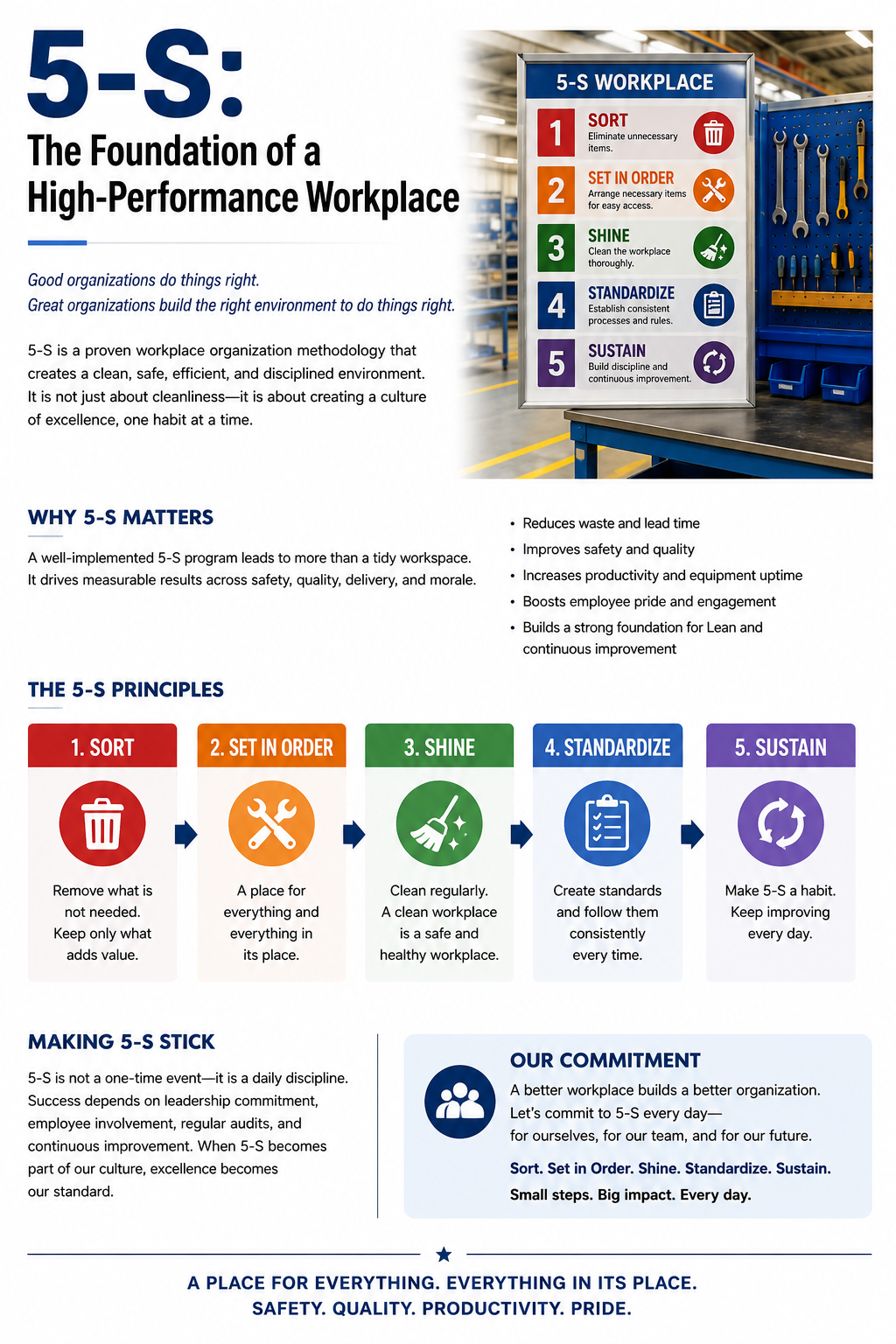
Introduction
Many companies
try to improve productivity by investing in new systems, machines, software, or
automation. However, one of the most powerful operational improvements often
starts with something much simpler: organizing the workplace.
The 5S methodology
is a lean management approach used to create clean, safe, efficient, and
disciplined work environments. It is widely applied in manufacturing,
warehouses, laboratories, offices, healthcare facilities, maintenance
workshops, retail backrooms, and service operations.
At first glance,
5S may look like a housekeeping activity. In reality, it is much more than
cleaning. 5S is a structured operating discipline that helps people see
problems, reduce waste, improve flow, prevent errors, and build a culture of
ownership.
A workplace that
is disorganized hides problems. Tools are missing, materials are misplaced,
documents are outdated, machines are dirty, and employees waste time searching,
waiting, walking, correcting, and reworking. A 5S workplace makes abnormal
conditions visible, so teams can act quickly before small problems become major
losses.
For organizations
seeking operational excellence, 5S is often one of the best starting points
because it creates the foundation for lean transformation, visual management,
standard work, safety improvement, quality control, and continuous improvement.
What Is 5S?
5S is a
systematic workplace organization method built around five practices:
1. Sort
2. Set in Order
3. Shine
4. Standardize
5. Sustain
The original
Japanese terms are commonly known as Seiri, Seiton, Seiso, Seiketsu, and
Shitsuke.
The purpose of 5S is
to ensure that every workplace has only what is needed, everything has a
defined location, the area is clean and inspectable, standards are clearly
visible, and the discipline is maintained every day.
A successful 5S
system answers five practical questions:
What is needed here?
Where should it be
located?
Is the workplace
clean and safe?
What is the agreed
standard?
How do we make the
standard a daily habit?
When these questions
are answered clearly, teams work faster, safer, and with fewer interruptions.
Why 5S Matters in
Operational Excellence
5S
matters because operational performance is directly affected by workplace
conditions.
If
employees spend time searching for tools, moving around obstacles, correcting
mistakes, or working around unsafe conditions, the organization loses
productivity every day. These losses may look small individually, but across
many people, shifts, departments, and locations, they become significant
operational waste.
5S
helps reduce several forms of waste, including:
Waiting
caused by missing tools or materials.
Motion
caused by poor layout and unnecessary walking.
Defects
caused by using wrong, damaged, or outdated items.
Overprocessing
caused by unclear methods or duplicate work.
Inventory
waste caused by keeping unnecessary items.
Safety
risks caused by clutter, leaks, poor access, or blocked areas.
Low
morale caused by stressful, messy, and uncontrolled workplaces.
In
this sense, 5S is not only a workplace organization tool. It is a performance
management system that supports efficiency, quality, safety, and
accountability.
The Five Steps of 5S
1. Sort: Remove What Is Not Needed
Sort
means separating necessary items from unnecessary items and removing anything
that does not support the current work.
Many
workplaces accumulate unused tools, old files, expired materials, broken
equipment, obsolete spare parts, duplicate forms, damaged fixtures, and “just
in case” inventory. These items consume space, create confusion, and make it
harder to find what is actually needed.
The
goal of Sort is to simplify the workplace.
Typical
Sort actions include:
Removing
unused tools and materials.
Disposing
of obsolete documents and expired items.
Tagging
doubtful items with red tags.
Creating
a temporary red-tag area.
Reviewing
items based on frequency of use.
Keeping
only what is needed for current operations.
A
good Sort activity should involve the people who actually use the area.
Operators, technicians, warehouse staff, nurses, engineers, and office teams
often know which items are useful and which items simply occupy space.
The
key question is simple: Does this item support the work performed in this area?
If
the answer is no, it should be removed, relocated, recycled, repaired, or
disposed of according to company rules.
2. Set in Order: A Place for
Everything
Set
in Order means arranging needed items so they are easy to find, easy to use,
easy to return, and easy to control.
After
unnecessary items are removed, the next step is to design a logical arrangement
for the remaining items. The workplace should support flow, safety, and speed.
Good
Set in Order practices include:
Labeling
shelves, tools, cabinets, files, and storage locations.
Using
shadow boards for tools.
Marking
floors for walkways, equipment, and material locations.
Arranging
items based on frequency of use.
Placing
critical tools near the point of use.
Using
color coding and visual signs.
Defining
minimum and maximum stock levels.
Making
abnormal conditions visible.
The
objective is not only to make the area look neat. The objective is to make the
correct behavior obvious.
When
a tool is missing from a shadow board, the gap is immediately visible. When a
material is stored outside its marked location, the abnormality is clear. When
labels are consistent, new employees can understand the workplace faster.
A
good Set in Order system reduces searching time, improves response speed, and
supports standard work.
3. Shine: Clean and Inspect
Shine
means cleaning the workplace, tools, equipment, and surrounding areas while
also inspecting for abnormalities.
In lean
thinking, cleaning is not separate from performance. A clean workplace makes it
easier to detect leaks, wear, damage, loose parts, contamination, defects, and
unsafe conditions.
Shine
should not be treated as an occasional campaign before a visit or audit. It
should be part of daily work.
Effective
Shine practices include:
Cleaning
machines, floors, tables, tools, and storage areas.
Removing
dust, oil, waste, and unnecessary packaging.
Inspecting
equipment during cleaning.
Identifying
sources of dirt, leakage, or contamination.
Fixing
root causes instead of repeatedly cleaning the same problem.
Assigning
cleaning responsibilities.
Creating
daily or shift-based cleaning checklists.
The
deeper value of Shine is inspection. When employees clean their own work areas,
they become more familiar with the normal condition of equipment and processes.
This helps them detect early warning signs before breakdowns, defects, or
safety incidents occur.
A clean
workplace improves visibility. Visibility improves control. Control improves
performance.
4. Standardize: Make the Best
Way Visible
Standardize
means creating clear, visual, and repeatable standards to maintain Sort, Set in
Order, and Shine.
Without
standardization, 5S results fade quickly. One team cleans the area one way,
another team organizes it differently, and after a few weeks the workplace
returns to its previous condition.
Standardization
turns improvement into routine.
Examples
of 5S standards include:
Visual
workplace layouts.
Before-and-after
photos.
Cleaning
checklists.
Tool
location maps.
Color-coding
rules.
Labeling
formats.
Audit
checklists.
Responsibility
matrices.
Daily
5S routines.
Standard
operating procedures.
The
best standards are simple, visual, and easy to follow. A standard that requires
long explanation is usually too complicated.
For
example, a photo showing the correct condition of a workbench can be more
effective than a long written instruction. A floor marking can be more
effective than a reminder email. A labeled cabinet can be more effective than
verbal instructions.
Standardize
helps teams agree on what “good” looks like.
5. Sustain: Build the Daily
Discipline
Sustain
means maintaining the 5S system through leadership commitment, daily habits,
audits, coaching, and continuous improvement.
This
is the most difficult step because it depends on behavior. Many organizations
launch 5S with energy, clean the workplace, take photos, and celebrate the
result. Then, after a few weeks, the area slowly returns to old habits.
Sustain
prevents this regression.
Strong
Sustain practices include:
Daily
5S checks.
Weekly
area audits.
Clear
ownership by area.
Visible
audit scores.
Leader
standard work.
Employee
involvement.
Recognition
for good practices.
Fast
correction of deviations.
Continuous
improvement actions.
Training
for new employees.
The
goal is not to create a “cleaning police” culture. The goal is to create
ownership.
When
employees understand why 5S matters, they protect the standard. When leaders
follow up consistently, 5S becomes part of the operating system. When problems
are solved rather than blamed, people participate more actively.
Sustain
is where 5S becomes culture.
5S and Safety: Why Many
Companies Add the Sixth S
Many
organizations use 6S by adding Safety as an additional pillar. Safety can also
be considered an outcome of good 5S.
A
well-organized workplace helps reduce hazards such as blocked walkways, poor
access, spills, sharp objects, misplaced tools, electrical risks, poor
visibility, and uncontrolled materials.
Safety
should never be treated as an afterthought. During every 5S activity, teams
should ask:
Can
people move safely?
Are
emergency exits accessible?
Are
materials stored safely?
Are
tools in good condition?
Are
chemicals, sharp objects, or heavy items controlled?
Are
risks visible and clearly marked?
Adding
Safety makes 5S more complete, especially in factories, warehouses,
construction sites, laboratories, hospitals, workshops, and logistics
operations.
Benefits of 5S
A
well-implemented 5S system can deliver practical and measurable benefits.
1. Higher Productivity
Employees
spend less time searching, walking, waiting, and correcting. Work becomes
easier and faster because tools, materials, and information are available at
the point of use.
2. Better Quality
Clear
organization reduces the risk of using wrong materials, outdated documents,
damaged tools, or incorrect work methods. Clean and visual workplaces make
defects easier to detect.
3. Improved Safety
Clutter
removal, proper storage, floor marking, and cleaner work areas reduce hazards
and improve movement.
4. Better Space Utilization
Sorting
unnecessary items releases valuable space. Many organizations discover that
they do not need more space; they need better control of existing space.
5. Faster Training
Visual
standards help new employees understand the workplace quickly. This reduces
dependency on verbal instructions and informal habits.
6. Stronger Accountability
When
ownership is clear, teams know who is responsible for maintaining the area,
checking standards, and correcting deviations.
7. Foundation for Lean Tools
5S
supports other lean methods such as standard work, visual management, Kaizen,
TPM, SMED, Kanban, quality at source, and daily management systems.
Common 5S Mistakes
Many 5S
programs fail because they are treated as cleaning campaigns instead of
operational systems.
Common
mistakes include:
Starting
with posters instead of workplace problems.
Focusing
only on appearance.
Ignoring
employee involvement.
Creating
standards that are too complicated.
Conducting
audits without coaching.
Using scores
to blame people.
Failing to
remove root causes of disorder.
Not
assigning ownership.
Launching 5S
once and not following up.
Treating 5S
as a one-time project.
The most
dangerous mistake is thinking that 5S is only about cleanliness. Cleanliness is
important, but the real purpose is control, visibility, flow, safety, and
discipline.
How to Implement 5S Successfully
Step 1: Select a Pilot Area
Start
with one area where improvement will be visible and valuable. This could be a
production line, warehouse zone, maintenance workshop, laboratory, office
process, retail storage area, or receiving area.
Avoid
starting everywhere at once. A focused pilot creates learning and momentum.
Step 2: Define the Current
Condition
Take
photos, observe the work, identify waste, measure searching time, check safety
risks, and collect employee feedback.
The
current condition should be understood before changes are made.
Step 3: Train the Team
Explain
what 5S means and why it matters. Use practical examples from the selected
area. Employees should understand that 5S is designed to make work easier,
safer, and more reliable.
Step 4: Run the Sort Activity
Remove
unnecessary items. Use red tags for items that need review. Decide what to
keep, move, repair, return, recycle, or dispose of.
Step 5: Design the Workplace
Layout
Arrange
needed items based on flow and frequency of use. Use labels, signs, floor
markings, shadow boards, and visual controls.
Step 6: Clean and Inspect
Clean
the area thoroughly. Identify sources of dirt, damage, leakage, or repeated
disorder. Convert cleaning into inspection.
Step 7: Create Visual Standards
Document
the expected condition using photos, layouts, checklists, and simple standards.
Make the standard visible in the workplace.
Step 8: Audit and Improve
Create
a simple audit routine. Review results with the team. Use findings to coach,
solve problems, and improve the standard.
Step 9: Expand Gradually
After
the pilot area becomes stable, expand to other areas using the lessons learned.
Practical 5S Audit Criteria
A
5S audit should be simple enough to use regularly but strong enough to drive
improvement.
Example
audit categories:
Sort:
Unnecessary items are removed from the area.
Set
in Order: Needed items are labeled and stored in defined locations.
Shine:
The area is clean, inspectable, and free from obvious abnormalities.
Standardize:
Visual standards, checklists, and responsibilities are available.
Sustain:
The team follows the standard and corrective actions are closed.
Each
category can be scored from 1 to 5.
A
good audit does not only produce a score. It produces action.
The
most important audit question is: What must be improved before the next review?
5S Examples by Business Area
Manufacturing
Tool shadow
boards, machine cleaning standards, floor markings, material staging lanes,
defect zones, and daily operator checks.
Warehouse and Logistics
Labeled
storage locations, defined picking paths, pallet zones, barcode discipline,
damaged goods areas, and minimum/maximum stock indicators.
Maintenance Workshop
Organized
spare parts, tool control, lubrication stations, repair status labels, and
preventive maintenance visual boards.
Office
Organized digital
files, controlled document templates, clean shared drives, standard naming
rules, and visible workflow boards.
Healthcare
Organized
treatment rooms, clearly labeled supplies, expiry-date control, clean work
surfaces, and emergency equipment readiness checks.
Retail
Backroom
organization, shelf replenishment standards, visual stock control, cleaning
schedules, and customer-facing area standards.
Measuring the Impact of 5S
To
prove the value of 5S, organizations should measure before and after
performance.
Useful
5S metrics include:
Time
spent searching for tools or documents.
Walking
distance.
Number
of misplaced items.
Audit
score.
Safety
observations.
Housekeeping
findings.
Equipment
abnormalities detected.
Space
released.
Inventory
reduction.
Setup
time reduction.
Employee
suggestions.
Corrective
action closure rate.
The
best 5S programs connect workplace organization to business performance. For
example, if a maintenance team reduces tool searching time, the benefit may
appear as faster repair response. If a warehouse improves location labeling,
the benefit may appear as fewer picking errors. If a production line improves
visual control, the benefit may appear as fewer defects and faster changeovers.
5S
should not be measured only by cleanliness. It should be measured by
operational impact.
5S as a Culture-Building Tool
5S
is powerful because it changes how people interact with their workplace.
When
employees participate in improving their own work areas, they develop
ownership. When leaders respect standards, employees take standards seriously.
When problems are visible, teams solve them earlier. When small improvements
become daily habits, continuous improvement becomes natural.
This
is why 5S is often described as a foundation for lean culture.
It
teaches teams to observe, question, improve, standardize, and sustain.
These
behaviors are essential for operational excellence.
Conclusion
5S is one of the
most practical and effective methods for improving workplace organization,
safety, productivity, and operational discipline.
It is simple to
understand, but it requires consistent leadership and daily ownership to
sustain. The real value of 5S is not a clean workplace photo. The real value is
a workplace where problems are visible, work flows smoothly, employees are
safer, and standards are followed.
For companies
starting a lean transformation, 5S is a strong first step. For companies
already using lean tools, 5S strengthens the foundation. For any organization
seeking better performance, 5S provides a practical way to turn workplace
discipline into measurable business results.
A successful 5S
system does not ask employees to work harder. It helps them work smarter,
safer, and with fewer obstacles.
Need to improve workplace organization, productivity, and operational discipline?
OpexEdge can help your team implement 5S, visual management, workplace audits, and lean
operating standards through practical consulting, training, and implementation
support.
