
Introduction
Every business
wants fewer mistakes, fewer defects, and fewer customer complaints.
But many organizations still depend heavily on inspection, correction, rework,
and employee reminders to control quality.
The problem is
simple: inspection finds defects after they happen.
Poka Yoke prevents mistakes before they become defects.
Poka Yoke is one
of the most practical concepts in Lean, Six Sigma, and operational excellence.
It focuses on designing work, tools, machines, systems, and processes in a way
that makes errors difficult, obvious, or impossible.
Instead of asking
people to “be more careful,” Poka Yoke asks a better question:
How can we
design the process so the mistake cannot happen in the first place?
This mindset
changes quality from a reactive activity into a built-in feature of the
process.
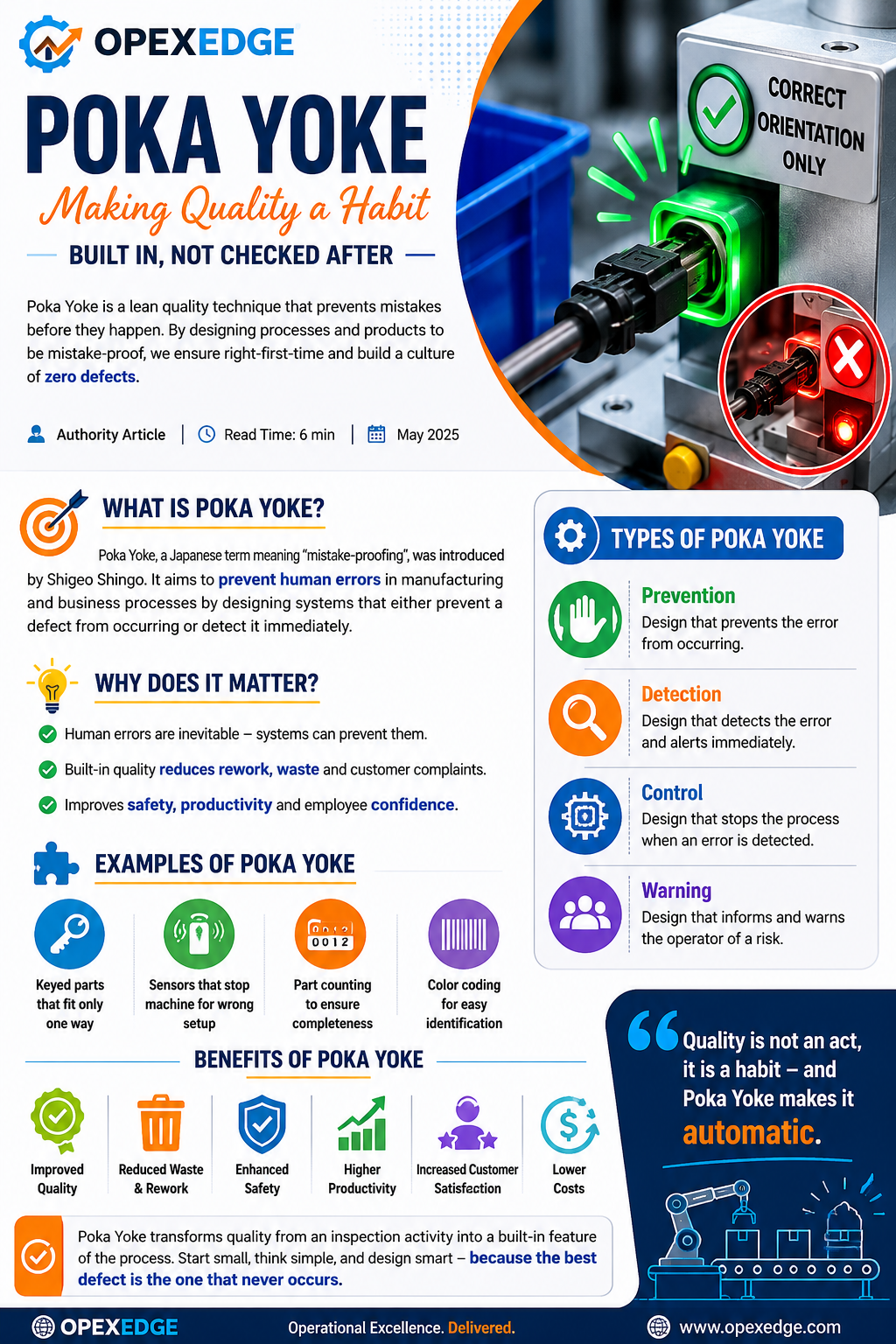
What Is Poka Yoke?
Poka Yoke
is a Japanese term commonly translated as mistake-proofing or error
prevention.
It refers to
methods, devices, checks, and process designs that help prevent human errors or
detect them immediately before they create a defect, safety issue, delay, or
customer problem.
A Poka Yoke
solution can be very simple.
It does not have to be expensive, digital, or complex.
Examples
include:
·
A plug that can only fit in
one direction.
·
A fixture that prevents a
part from being assembled incorrectly.
·
A sensor that stops a
machine if a component is missing.
·
A checklist that prevents a
critical step from being skipped.
·
A barcode scan that
confirms the correct item before shipment.
·
A color-coded storage
system that prevents wrong material selection.
The goal
is not to blame people for mistakes.
The goal is to design processes that protect people from mistakes.
Why Poka Yoke Matters
Human
error is a normal part of work. People get tired, distracted, rushed,
overloaded, or interrupted. Even skilled employees can make mistakes when the
process allows mistakes to happen.
This is
why mature organizations do not rely only on training, reminders, supervision,
or final inspection.
They
build quality into the process.
Poka Yoke
matters because it helps organizations:
·
Reduce defects.
·
Reduce rework.
·
Improve first-time-right
performance.
·
Improve safety.
·
Reduce customer complaints.
·
Increase productivity.
·
Lower the cost of poor
quality.
·
Strengthen process
discipline.
·
Make standard work easier
to follow.
When
errors are prevented at the source, quality becomes more reliable and less
dependent on individual memory or personal effort.
The Difference Between
Error and Defect
To
understand Poka Yoke clearly, it is important to separate two terms:
Error:
A mistake made during the process.
Defect: The result of an error that reaches the next process or
customer.
For
example, selecting the wrong component is an error.
Shipping a product with the wrong component is a defect.
Poka
Yoke works by preventing the error from happening or stopping the error before
it becomes a defect.
This
is a key principle in operational excellence:
the earlier a problem is prevented or detected, the lower the cost and
impact.
Poka Yoke and the Cost of
Poor Quality
Poor
quality is expensive.
It
creates visible and hidden costs, including:
·
Scrap.
·
Rework.
·
Extra inspection.
·
Delayed delivery.
·
Warranty claims.
·
Customer dissatisfaction.
·
Lost trust.
·
Production interruptions.
·
Repeated problem-solving
meetings.
·
Extra labor and overtime.
Many
organizations treat these costs as normal business reality.
Poka Yoke challenges that thinking.
Instead
of accepting repeated errors, the organization studies the process and asks:
·
Where does the mistake
happen?
·
Why is the mistake
possible?
·
What condition allows it?
·
How can we prevent it?
·
How can we detect it
immediately?
·
How can we make the correct
action easier than the wrong action?
This
shifts improvement from firefighting to prevention.
Types of Poka Yoke
Poka Yoke
solutions usually fall into three main categories.
1.
Prevention Poka Yoke
Prevention methods make the mistake
impossible or very difficult to make.
This is the strongest form of Poka
Yoke because it eliminates the error before it occurs.
Examples:
·
A part that can only be
installed in the correct orientation.
·
A machine guard that
prevents unsafe operation.
·
A software form that does
not allow submission unless required fields are complete.
·
A fixture that only accepts
the correct component.
·
A connector designed with a
unique shape to prevent wrong connection.
Prevention is more powerful than
detection because no correction is needed.
2.
Detection Poka Yoke
Detection methods identify an error
immediately when it occurs.
The process may alert the operator,
stop the machine, reject the product, or block the next step.
Examples:
·
A sensor that detects
missing parts.
·
A scale that confirms
correct weight before packing.
·
A barcode system that
checks product identity.
·
A camera inspection system
that detects wrong orientation.
·
A system alert when
required information is missing.
Detection is useful when prevention is
not fully possible, but fast feedback is still necessary.
3.
Warning Poka Yoke
Warning methods notify the user that an
error or risk may occur.
Examples:
·
Warning lights.
·
Audible alarms.
·
Color signals.
·
Dashboard alerts.
·
Visual labels.
·
Andon signals.
Warning systems are helpful, but they
are weaker than prevention or automatic detection because they still depend on
human response.
A warning should not be the final
solution if a stronger control is possible.
Practical Examples of Poka Yoke
Poka
Yoke can be used in almost every industry, not only manufacturing.
Manufacturing Example
A production line has repeated
defects because operators sometimes install a component backward.
A Poka Yoke solution could be a
fixture that only allows the component to fit in the correct direction. This
prevents incorrect assembly instead of relying on inspection at the end of the
line.
Warehouse Example
A warehouse team sometimes picks the
wrong item because similar products are stored close together.
A Poka Yoke solution could include
barcode scanning, color-coded locations, product images, and system validation
before picking confirmation.
Retail Example
A cashier sometimes applies the wrong
discount manually.
A Poka Yoke solution could be an automated
pricing rule inside the POS system that applies discounts based on product
code, date, and customer type.
Healthcare Example
Medication errors can happen when
labels look similar.
A Poka Yoke solution could include
barcode verification, separated storage, color-coded labels, and system alerts
before medication administration.
Office Process Example
A finance team receives incomplete
payment requests.
A Poka Yoke solution could be a
digital form that prevents submission unless all required fields and
attachments are included.
E-Commerce Example
Customers may enter incomplete delivery
details.
A Poka Yoke solution could be address
validation, mandatory phone number format, delivery zone selection, and
automatic confirmation before order submission.
Poka Yoke in Service Businesses
Many
people associate Poka Yoke with factories, but it is equally valuable in
service operations.
Service
mistakes can be costly because they directly affect customer experience.
Examples
of service Poka Yoke include:
·
Mandatory fields in CRM
systems.
·
Automated appointment
reminders.
·
Standardized quotation
templates.
·
Built-in approval
workflows.
·
Drop-down menus instead of
free-text entry.
·
Digital checklists for
customer onboarding.
·
System alerts for missing
documents.
·
Automatic duplicate
detection.
·
Standard email templates
for repeated communication.
In
service businesses, Poka Yoke improves consistency, speed, and reliability.
Poka Yoke and Lean Thinking
Poka
Yoke supports Lean thinking because it reduces waste.
Defects
are one of the classic forms of waste.
Every defect consumes extra time, labor, material, management attention, and
customer trust.
Poka
Yoke helps remove this waste by making the process more stable and predictable.
It
also supports other Lean practices such as:
·
Standard work.
·
Visual management.
·
5S.
·
Root cause analysis.
·
Kaizen.
·
Jidoka.
·
First-time-right quality.
·
Continuous improvement.
A
strong Lean system does not only improve speed.
It improves speed with quality.
Poka Yoke and Six Sigma
Six
Sigma focuses on reducing variation and defects.
Poka Yoke supports this goal by controlling the causes of errors.
During
a DMAIC project, Poka Yoke is usually applied in the Improve and Control
phases.
For
example:
·
In Define, the team
identifies the customer problem.
·
In Measure, the team
quantifies defect frequency.
·
In Analyze, the team
identifies root causes.
·
In Improve, the team
designs Poka Yoke solutions.
·
In Control, the team
standardizes and monitors the solution.
Poka
Yoke is especially powerful when the root cause is related to human error,
missing information, wrong sequence, wrong part selection, or process
complexity.
How to Implement Poka Yoke
A
good Poka Yoke solution should be simple, practical, and close to the source of
the error.
Step 1: Identify the Problem
Start with a recurring
mistake, defect, complaint, delay, or safety issue.
Use data where possible.
Examples include defect logs, customer complaints, audit findings, rework
records, or process observations.
Step 2: Understand the Process
Go to the actual workplace
and observe the process.
Ask:
·
What is the expected
standard?
·
What actually happens?
·
Where does the error occur?
·
Who is involved?
·
What tools, materials, or
information are used?
·
What makes the wrong action
possible?
The best Poka Yoke ideas
often come from the people doing the work.
Step 3: Identify the Root Cause
Do not jump directly to
solutions.
Use simple problem-solving
tools such as:
·
5 Whys.
·
Fishbone diagram.
·
Process mapping.
·
Pareto analysis.
·
Failure Mode and Effects
Analysis.
·
Gemba observation.
The goal is to understand
the condition that allows the error.
Step 4: Design the Poka Yoke
Choose the simplest effective
solution.
A good Poka Yoke should be:
·
Easy to use.
·
Easy to understand.
·
Low cost where possible.
·
Reliable.
·
Close to the error source.
·
Designed into the process.
·
Hard to bypass.
·
Easy to maintain.
Try to prevent the error
first.
If prevention is not possible, detect it immediately.
If detection is not possible, provide a clear warning.
Step 5: Test the Solution
Before full implementation, test
the solution in real conditions.
Check:
·
Does it prevent the error?
·
Does it create new
problems?
·
Is it easy for employees to
use?
·
Does it slow the process
unnecessarily?
·
Can it be bypassed?
·
Is it sustainable?
A Poka Yoke that looks good on
paper but is ignored in daily work will not deliver results.
Step 6: Standardize the New Method
Once the solution works,
update the standard process.
This may include:
·
Standard operating
procedures.
·
Work instructions.
·
Training material.
·
Visual aids.
·
Control plans.
·
Audit checklists.
·
Maintenance routines.
·
System permissions.
·
Quality control points.
Standardization turns
the improvement into a repeatable way of working.
Step 7: Monitor and Improve
Track performance after
implementation.
Useful indicators include:
·
Defect rate.
·
Rework hours.
·
Customer complaints.
·
Process cycle time.
·
Safety incidents.
·
First-pass yield.
·
Audit findings.
·
Cost of poor quality.
If the problem returns, review
the solution and strengthen it.
Characteristics of a Good Poka
Yoke
Not
every control is a good Poka Yoke.
Strong
Poka Yoke solutions usually share these characteristics:
·
They are simple.
·
They are practical.
·
They work at the source of
the error.
·
They do not depend only on
memory.
·
They provide immediate
feedback.
·
They are difficult to
ignore.
·
They support the operator.
·
They reduce process
variation.
·
They make the correct
action easy.
·
They make the wrong action
difficult or impossible.
The
best Poka Yoke is often invisible to the customer but powerful inside the
process.
Common Mistakes When
Applying Poka Yoke
Organizations
sometimes fail to get value from Poka Yoke because they treat it as a tool
instead of a mindset.
Common
mistakes include:
·
Depending only on training.
·
Adding more inspection
instead of prevention.
·
Designing complex controls
that people avoid.
·
Blaming operators instead
of improving the process.
·
Applying solutions without
root cause analysis.
·
Creating warnings that are
too frequent and ignored.
·
Not updating standard work.
·
Not measuring the result.
·
Not involving frontline
employees.
Poka
Yoke should make work easier, safer, and more reliable.
If it makes work harder without reducing errors, the design should be reviewed.
Poka Yoke in Digital
Transformation
As
businesses become more digital, Poka Yoke can be built into software,
workflows, dashboards, and automation.
Examples
include:
·
Mandatory fields in ERP
systems.
·
Automated approval
workflows.
·
Barcode and QR code
validation.
·
AI-based visual inspection.
·
Duplicate order detection.
·
Automated stock
availability checks.
·
Error messages with clear
corrective action.
·
Role-based access controls.
·
Digital forms with built-in
logic.
·
Real-time alerts for
abnormal conditions.
Digital
Poka Yoke can reduce human error at scale, especially in complex operations
with many transactions.
However,
digital systems should still be designed around the process. Automation without
process understanding can simply make mistakes faster.
Poka Yoke and Organizational
Culture
Poka
Yoke is not only a technical method.
It is also a cultural signal.
When
a company uses Poka Yoke, it shows that quality is everyone’s responsibility
and that management is willing to improve the system instead of blaming people.
This
builds trust.
Employees
become more willing to report problems because the focus is on improving the
process, not punishing individuals.
A
strong Poka Yoke culture asks:
·
What made this error
possible?
·
How can we prevent it next
time?
·
What can we simplify?
·
What can we make visual?
·
What can we automate?
·
What can we standardize?
·
How can we protect the
customer?
This
is the foundation of operational excellence.
Poka Yoke Implementation
Checklist
Use
this checklist when applying Poka Yoke in your business:
1.
Define the recurring error
or defect.
2.
Measure its frequency and
impact.
3.
Observe the process at the
workplace.
4.
Identify the exact point
where the error occurs.
5.
Analyze the root cause.
6.
Decide whether prevention,
detection, or warning is needed.
7.
Design a simple solution.
8.
Test the solution with real
users.
9.
Confirm that the error is
reduced or eliminated.
10. Update standard work.
11. Train the team.
12. Monitor the result.
13. Improve the solution if needed.
Conclusion
Poka Yoke is one
of the most practical ways to improve quality, reduce waste, and protect
customers.
It does not depend
on asking people to be perfect.
It depends on designing better processes.
When organizations
use Poka Yoke effectively, they move from inspection-based quality to
prevention-based quality. They reduce rework, improve safety, increase
productivity, and create a more reliable customer experience.
The strongest
quality systems do not wait for mistakes to happen.
They design mistakes out of the process.
At OpexEdge, we help
organizations build practical operational excellence systems that improve
quality, efficiency, and business performance.
Quality is not
inspected into a process.
Quality is designed into it.
