
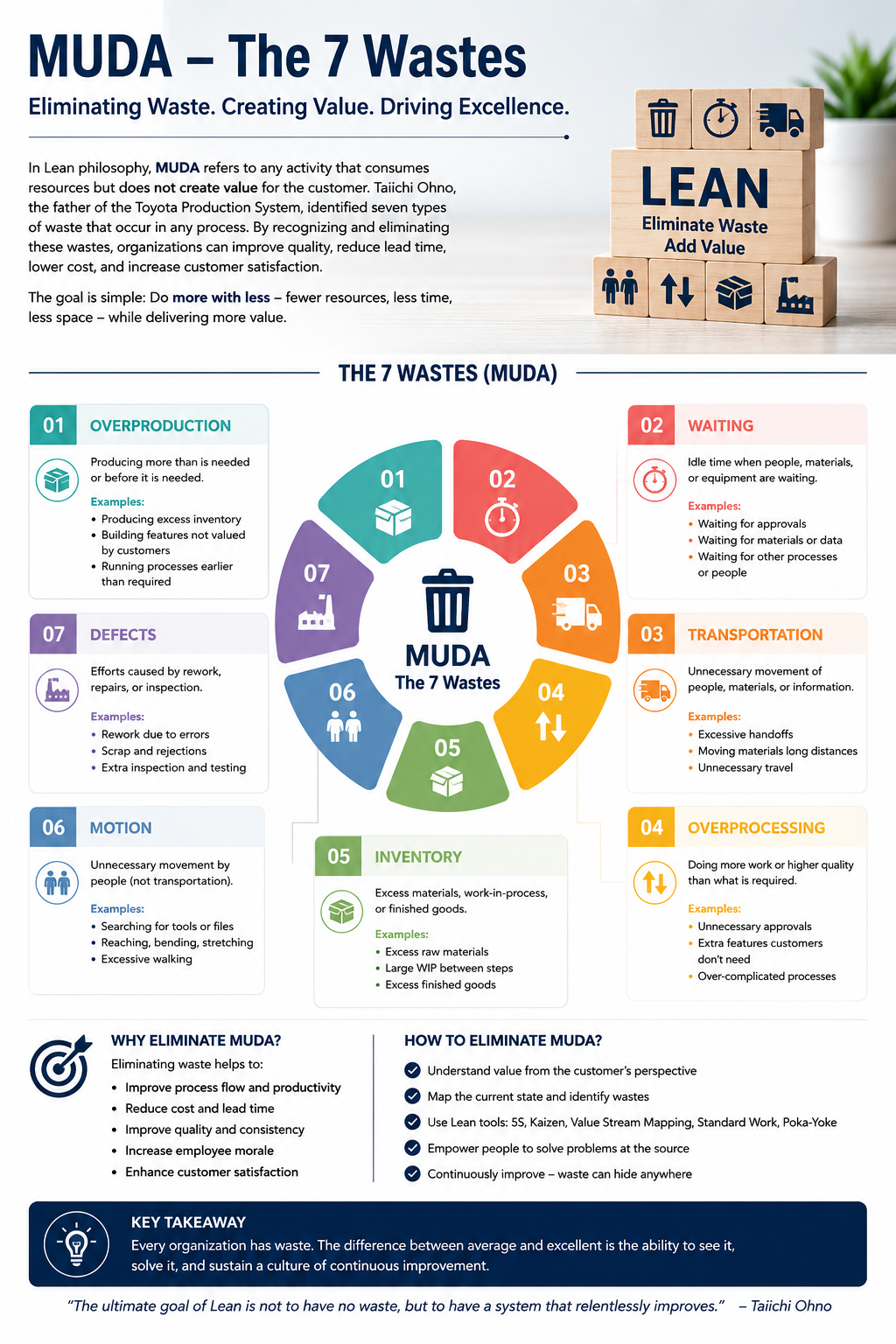
MUDA and the 7 Wastes: How Lean Organizations Eliminate Waste and Create
More Customer Value
Introduction
Every
organization has waste. It may appear as waiting time, unnecessary approvals,
excess stock, repeated rework, unclear handoffs, duplicated effort, or people
spending hours searching for information that should already be available.
In Lean
management, this waste is called MUDA.
MUDA is a Japanese
term meaning waste, uselessness, or any activity that consumes resources
without creating value for the customer. It is one of the most important
concepts in the Toyota Production System and Lean thinking because it helps
organizations see hidden inefficiencies inside daily operations.
The purpose of
MUDA elimination is not simply to “cut cost.” The deeper objective is to create
a better flow of value. When waste is reduced, processes become faster,
simpler, safer, more reliable, and easier for people to manage.
Lean organizations
do not improve performance by asking people to work harder in a broken process.
They improve performance by redesigning the process so people can work smarter,
problems become visible, and value flows with less interruption.
What Is MUDA?
MUDA refers to
any activity that uses time, money, people, materials, space, equipment, or
information but does not add value from the customer’s perspective.
A value-adding
activity has three conditions:
1. The customer is willing to pay for it.
2. The activity changes the product, service, or information in a
meaningful way.
3. The activity is done right the first time.
Anything
outside these conditions should be challenged. Some non-value-added activities
may still be necessary, such as legal checks, safety controls, or regulatory
documentation. However, many activities exist only because the process is
poorly designed.
Examples include
unnecessary movement, repeated approvals, excessive inventory, unclear
specifications, waiting for decisions, correcting avoidable errors, or
producing more than needed.
MUDA is not
limited to factories. It exists in warehouses, hospitals, retail stores,
offices, construction projects, logistics operations, supply chains, software
teams, service centers, and government processes.
Wherever there is
a process, there is usually waste.
Why MUDA Matters
Waste
directly affects business performance. It increases cost, extends lead time,
reduces quality, lowers productivity, frustrates employees, and damages
customer experience.
A company may
invest in new systems, automation, hiring, or digital transformation, but if
the underlying process is full of waste, the investment may only make the waste
move faster.
For example,
automating a poor approval process does not remove the waste. It only makes a
bad process digital. Lean thinking asks a better question:
Should this
activity exist at all?
MUDA
elimination helps organizations improve performance by focusing on the flow of
value, not just departmental efficiency. It encourages teams to look across the
end-to-end process and identify where work is delayed, duplicated,
overcomplicated, or disconnected from customer needs.
The 7 Wastes of Lean
The
traditional seven wastes are commonly remembered using the acronym TIMWOOD:
Transportation,
Inventory, Motion, Waiting, Overproduction, Overprocessing, and Defects.
Each type
of waste highlights a different way value is lost inside a process.
1. Transportation
Transportation
waste refers to unnecessary movement of materials, products, documents, tools,
or information from one place to another.
In
manufacturing, this may include moving materials between distant workstations.
In logistics, it may appear as avoidable handling, poor route planning, or
unnecessary transfers between storage areas. In office work, transportation
waste can appear as sending files between multiple departments without clear
ownership.
Transportation
does not usually change the product or service. It only adds handling, time,
risk, and cost.
Examples of transportation waste
·
Moving raw materials across
long distances inside a warehouse.
·
Repeatedly transferring
work between departments.
·
Sending documents through
too many approval stages.
·
Poor layout causing
unnecessary material handling.
·
Multiple handoffs between
teams before a decision is made.
How to reduce transportation waste
Organizations can
reduce transportation waste by improving layout, simplifying process flow,
reducing handoffs, locating materials close to the point of use, applying value
stream mapping, and redesigning workflows around the shortest practical path to
customer value.
2. Inventory
Inventory waste is
excess material, work-in-progress, finished goods, spare parts, documents, or
information waiting to be used.
Inventory often hides
deeper process problems. High inventory may cover unreliable suppliers, poor
forecasting, long changeover times, unstable demand, weak planning, or quality
defects.
In service
operations, inventory can appear as backlogs, unread requests, pending
approvals, open tickets, unprocessed applications, or accumulated reports
waiting for review.
Inventory consumes
cash, storage space, management attention, and control effort. It also
increases the risk of damage, expiry, obsolescence, and hidden defects.
Examples
of inventory waste
·
Excess raw materials beyond
actual demand.
·
Too many finished goods
waiting for customers.
·
Large work-in-progress
between process steps.
·
Backlogs of customer
service tickets.
·
Unused reports, dashboards,
or data files.
·
Spare parts stocked without
consumption analysis.
How
to reduce inventory waste
Inventory waste can be
reduced through better demand planning, pull systems, Kanban, supplier
reliability improvement, shorter lead times, smaller batch sizes, inventory
classification, and stronger process discipline.
3. Motion
Motion waste is
unnecessary movement by people.
This is different from
transportation. Transportation refers to movement of items or information.
Motion refers to movement of people.
Motion waste is common
in workplaces where tools are not organized, layouts are poor, information is
difficult to find, or employees must repeatedly walk, search, bend, reach, or
switch systems to complete a task.
Motion waste increases
fatigue, reduces productivity, and can create ergonomic or safety risks.
Examples
of motion waste
·
Searching for tools, files,
documents, or data.
·
Walking long distances to
collect materials.
·
Repeatedly switching
between software systems.
·
Poor workstation layout
causing bending or reaching.
·
Employees asking multiple
people to find basic information.
·
Manual copying between
systems.
How to
reduce motion waste
Motion waste can be reduced
through 5S, workplace organization, visual management, ergonomic design,
digital workflow simplification, standard work, and placing frequently used
tools or information within easy reach.
4. Waiting
Waiting waste occurs
when people, materials, information, machines, systems, or decisions are idle.
Waiting is one of the
most visible forms of waste, but it is often accepted as normal. Teams wait for
approvals, customers wait for responses, machines wait for maintenance,
operators wait for materials, and managers wait for reports.
Waiting extends lead
time without adding value.
Examples
of waiting waste
·
Waiting for management
approval.
·
Waiting for materials or
spare parts.
·
Waiting for customer
confirmation.
·
Waiting for machine setup
or maintenance.
·
Waiting for data before
making a decision.
·
Waiting for another
department to finish its task.
How
to reduce waiting waste
Waiting waste can be reduced
by improving planning, clarifying decision rights, balancing workload, removing
bottlenecks, setting service-level agreements, using visual workflow boards,
improving maintenance reliability, and designing faster escalation paths.
5. Overproduction
Overproduction
means producing more than needed, earlier than needed, or faster than the next
process can use.
In Lean
thinking, overproduction is often considered one of the most serious wastes
because it creates or hides other wastes. When organizations produce too much,
they create extra inventory, extra handling, extra storage, extra inspection,
and higher risk of defects or obsolescence.
Overproduction
can also happen in office and service environments. Teams may create reports
nobody reads, develop features customers do not value, or prepare presentations
before the real need is clear.
Examples of overproduction waste
·
Manufacturing products
before customer demand exists.
·
Producing large batches to
keep machines busy.
·
Creating reports that are
not used.
·
Building software features
customers do not need.
·
Preparing excessive
documentation.
·
Purchasing materials
earlier than required.
How to reduce overproduction waste
Overproduction can be
reduced through pull systems, demand-driven planning, smaller batch sizes, takt
time alignment, customer validation, sales and operations planning, and clear
prioritization based on actual demand.
6. Overprocessing
Overprocessing
means doing more work, using more complexity, or delivering a higher
specification than the customer requires.
This waste often
appears when organizations confuse “more work” with “better quality.” In
reality, quality means meeting customer requirements consistently, not adding
unnecessary features, approvals, checks, formatting, or complexity.
Overprocessing
can also happen when processes are designed around internal habits instead of
customer value.
Examples of overprocessing waste
·
Too many approval levels.
·
Re-entering the same data
in multiple systems.
·
Excessive inspection
because the process is not reliable.
·
Creating overly complex
reports.
·
Adding features the
customer does not value.
·
Using expensive materials
where standard materials are sufficient.
·
Reworking documents for
formatting instead of decision value.
How to reduce overprocessing waste
Organizations can
reduce overprocessing by clarifying customer requirements, simplifying
standards, removing duplicate approvals, applying process mapping, using
mistake-proofing, and challenging every step that does not clearly support
customer value, compliance, safety, or risk control.
7. Defects
Defects are errors,
mistakes, rework, scrap, returns, complaints, corrections, or failures to meet
requirements.
Defects are expensive
because they consume resources twice: once to create the error and again to fix
it. They also damage trust, delay delivery, increase cost, and create
frustration for both customers and employees.
In service operations,
defects may include wrong invoices, incorrect orders, missing information,
failed handoffs, poor data quality, or customer complaints caused by process
mistakes.
Examples
of defect waste
·
Rework due to incorrect
specifications.
·
Scrap caused by process
variation.
·
Customer returns.
·
Wrong delivery quantity.
·
Incorrect data entry.
·
Missing documents.
·
Repeated complaints for the
same issue.
How
to reduce defect waste
Defect waste can be reduced
through root cause analysis, standard work, quality at the source, poka-yoke,
training, process control, visual standards, supplier quality improvement, and
stronger feedback loops.
The 8th Waste: Underutilized
Talent
Many
modern Lean practitioners also recognize an eighth waste: underutilized
talent.
This
waste occurs when organizations fail to use people’s knowledge, creativity,
experience, and problem-solving ability. It appears when employees are treated
only as task executors instead of process experts who understand the real work.
Underutilized
talent may be the most hidden waste because it does not always appear in
reports. However, it affects innovation, engagement, improvement speed, and
long-term competitiveness.
Examples of underutilized talent
·
Employees are not involved
in improvement activities.
·
Frontline ideas are
ignored.
·
People are not trained to
solve problems.
·
Managers make decisions
without understanding the real process.
·
Skilled employees spend
time on repetitive low-value tasks.
·
Teams are not empowered to
fix small problems quickly.
How to reduce underutilized talent
Organizations can
reduce this waste by building a culture of respect, involving employees in
kaizen, developing problem-solving skills, encouraging suggestions, creating
cross-functional teams, and giving people ownership of process improvement.
MUDA, MURA, and MURI
MUDA is
often discussed with two related Lean concepts: MURA and MURI.
MURA means
unevenness or inconsistency. It appears when workload, demand, process timing,
or output varies too much. MURA creates instability.
MURI means
overburden. It appears when people, machines, or systems are pushed beyond
reasonable limits. MURI creates stress, breakdowns, safety risks, and quality
problems.
MUDA, MURA,
and MURI are connected. Unevenness creates overburden, and overburden creates
waste. For example, unstable demand may force employees to rush, causing
mistakes, waiting, overtime, excess inventory, and rework.
A strong
Lean system does not only attack visible waste. It also stabilizes the process
and protects people and equipment from overburden.
How to Identify MUDA in a Process
The
best way to identify MUDA is to observe the actual work. Reports and dashboards
are useful, but waste becomes clearer when teams go to the process, watch the
flow, speak with employees, and follow the customer journey from start to
finish.
A
practical MUDA identification approach includes:
·
Define the customer and
what they value.
·
Map the current process
from request to delivery.
·
Separate value-added,
necessary non-value-added, and waste activities.
·
Measure lead time, waiting
time, rework, handoffs, inventory, and defects.
·
Ask why waste exists, not
only where it appears.
·
Prioritize the waste that
has the highest impact on customer value, cost, quality, or speed.
·
Improve the process through
small, controlled experiments.
·
Standardize the improved
way of working.
·
Monitor results and
continue improving.
Value
Stream Mapping is especially useful because it helps teams see the full process
instead of optimizing isolated departments.
Practical Example: MUDA in
an Order Fulfillment Process
Consider
a customer order process in an e-commerce or manufacturing business.
The
customer places an order. The sales team confirms it. The planning team checks
availability. Procurement contacts suppliers. Production prepares the item. The
warehouse packs it. Logistics delivers it. Customer service follows up.
At
first, the process may look normal. But after mapping the flow, several wastes
may appear:
·
Waiting for order
confirmation.
·
Re-entering order data into
multiple systems.
·
Excess inventory for
slow-moving items.
·
Unclear handoffs between
sales, procurement, and production.
·
Rework due to wrong
customer specifications.
·
Unnecessary movement inside
the warehouse.
·
Overprocessing through
excessive manual checks.
·
Transportation waste from
poor delivery route planning.
The
solution is not to blame individuals. The solution is to redesign the process.
The
company may introduce standard order forms, clear handoff rules, inventory
classification, supplier lead-time tracking, visual order status, warehouse
layout improvement, and customer confirmation at the right point in the
process.
The
result is better flow, fewer mistakes, faster delivery, and improved customer
satisfaction.
How Leaders Should
Approach MUDA Elimination
MUDA
elimination is not a one-time cost reduction campaign. It is a leadership
discipline.
Leaders
must create an environment where problems are visible and employees feel safe
to report waste. If people hide problems, the organization loses the
opportunity to improve.
Effective
leaders ask:
·
What does the customer
truly value?
·
Where does the process
stop, wait, or repeat?
·
What work is being done
only because the process is unclear?
·
What problems are employees
solving every day without formal support?
·
What can be simplified,
standardized, or eliminated?
·
What should be improved
before automation?
Leaders
should also avoid using Lean as a tool for pressure. Lean is not about forcing
fewer people to do more work. It is about removing the obstacles that prevent
people from doing valuable work effectively.
Common Mistakes When
Eliminating Waste
Many
organizations start Lean improvement with good intentions but fail because they
focus on tools instead of thinking.
Common
mistakes include:
·
Removing steps without
understanding why they exist.
·
Cutting resources without
improving the process.
·
Automating waste instead of
eliminating it.
·
Focusing only on
manufacturing and ignoring office waste.
·
Treating Lean as a project
instead of a management system.
·
Measuring activity instead
of value.
·
Ignoring employee input.
·
Improving one department
while damaging the end-to-end flow.
The
correct approach is to understand the process, identify root causes, involve
people, test improvements, and sustain the new standard.
Benefits of Eliminating MUDA
When
MUDA is systematically reduced, organizations can achieve measurable
improvements across multiple areas.
Key
benefits include:
·
Shorter lead time.
·
Lower operating cost.
·
Improved productivity.
·
Better quality and fewer
defects.
·
Reduced inventory.
·
Improved cash flow.
·
Higher delivery
reliability.
·
Better employee morale.
·
Faster decision-making.
·
Stronger customer
satisfaction.
·
More stable and scalable
operations.
The
biggest benefit is not only efficiency. It is organizational clarity. Teams
understand what matters, where value is created, and how to improve performance
continuously.
MUDA in the Digital Age
Digital
transformation has made MUDA more important, not less.
Many
companies invest in ERP systems, dashboards, artificial intelligence,
automation, and workflow platforms. These tools can create major benefits, but
only when they are applied to a process that has been understood and
simplified.
Digital
MUDA may include:
·
Duplicate data entry.
·
Too many dashboards with no
decision impact.
·
Automated reports nobody
uses.
·
Poor system integration.
·
Manual workarounds outside
the system.
·
Excessive notifications.
·
Unclear ownership of
digital tasks.
·
Collecting data without
using it for improvement.
Before
digitizing a process, organizations should ask:
Are
we improving the process, or are we only digitizing the waste?
The
best results come when Lean thinking and digital tools work together. Lean
removes waste and clarifies value. Digital tools improve speed, visibility,
accuracy, and scalability.
How OpexEdge Helps
Organizations Reduce MUDA
OpexEdge
supports organizations in identifying and eliminating operational waste through
structured Lean assessment, process mapping, root cause analysis, performance
improvement, and practical implementation support.
Our
approach focuses on real business impact, not theoretical documentation. We
help teams see waste clearly, prioritize improvement opportunities, and build
practical solutions that improve cost, quality, speed, and customer
satisfaction.
Typical
support areas include:
·
Lean operations assessment.
·
Value Stream Mapping.
·
Process improvement
workshops.
·
Root cause analysis.
·
KPI development.
·
Standard operating
procedures.
·
Warehouse and inventory
optimization.
·
Supply chain process
improvement.
·
Service process
improvement.
·
Continuous improvement
capability building.
Whether
the challenge is long lead time, high cost, poor flow, excess inventory,
repeated rework, or unclear responsibilities, MUDA analysis provides a powerful
starting point for operational excellence.
Conclusion
MUDA is one of
the most practical concepts in Lean management because it helps organizations
see what is often hidden inside daily work.
The seven wastes —
Transportation, Inventory, Motion, Waiting, Overproduction, Overprocessing, and
Defects — exist in almost every business process. When they are ignored, they
increase cost, delay delivery, reduce quality, and weaken customer experience.
When they are
identified and removed, organizations become faster, simpler, more reliable,
and more competitive.
The goal of Lean is
not to make people work harder. The goal is to create better systems where
value flows smoothly, problems are solved at the source, and continuous
improvement becomes part of the culture.
Every process
contains waste. The difference between average organizations and excellent
organizations is the ability to see it, solve it, and prevent it from
returning.
