
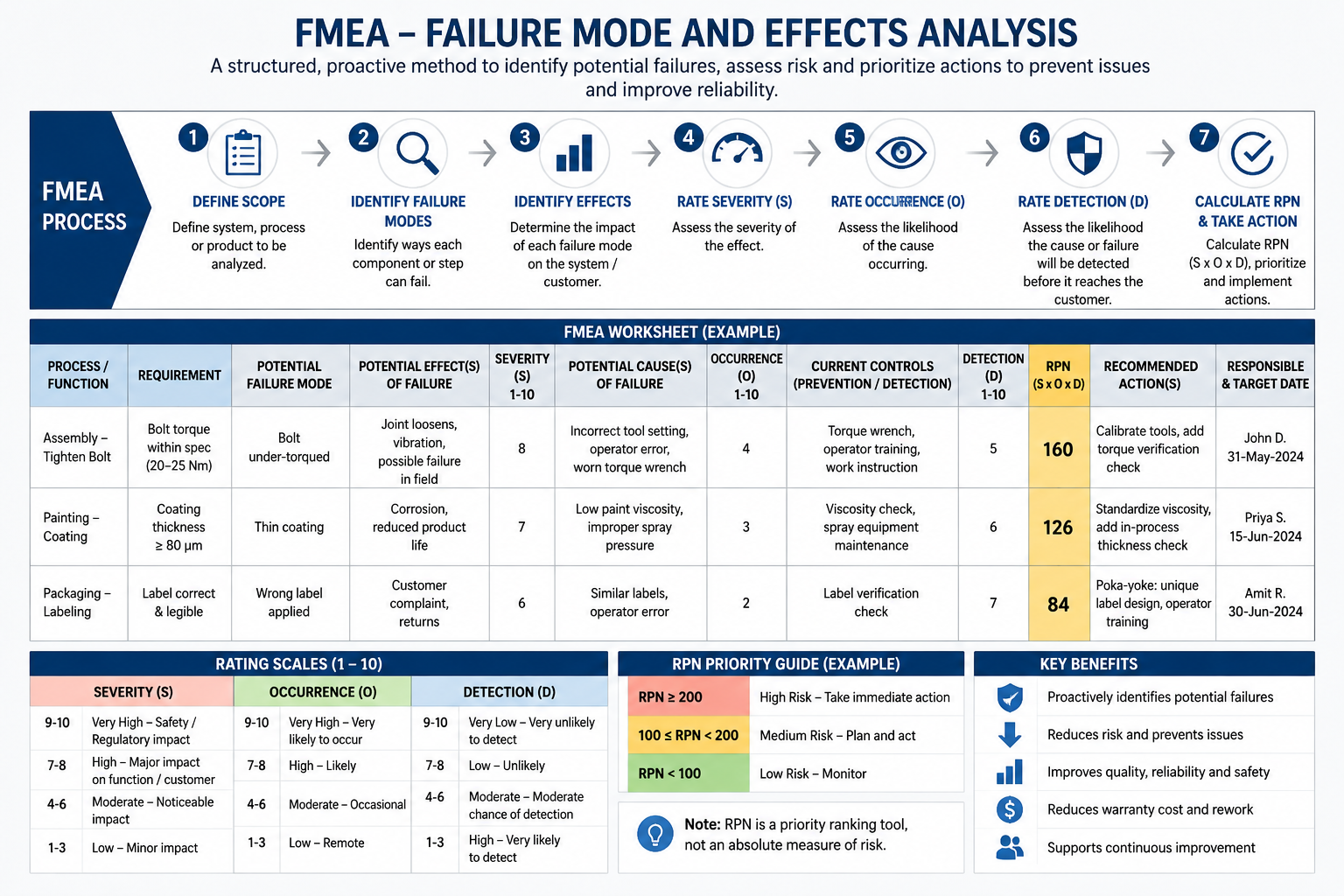
FMEA: A Practical Guide to Failure Mode and Effects Analysis for Better Quality, Reliability, and Risk Control
Introduction
Every business wants fewer failures, fewer complaints, lower rework, and more reliable processes.
However, many failures are discovered too late, after the customer is affected, cost has increased, or production has already been disrupted.
Failure Mode and Effects Analysis, commonly known as FMEA, is one of the most effective proactive tools used to identify potential failures before they happen. Instead of waiting for a problem to appear, FMEA helps teams ask a simple but powerful question:
What could go wrong, how serious would it be, why could it happen, and how can we prevent it?
FMEA is widely used in manufacturing, engineering, automotive, healthcare, supply chain, maintenance, product design, and service operations. Its value is not only in completing a worksheet, but in creating a structured risk-thinking culture across the organization.
What Is FMEA?
FMEA stands for Failure Mode and Effects Analysis.
It is a structured risk analysis method used to identify possible failure modes in a product, process, system, or service. It evaluates the possible effects of each failure, identifies the root causes, assesses current controls, and prioritizes improvement actions.
In simple terms:
- Failure Mode means how something could fail.
- Effect means what happens if the failure occurs.
- Cause means why the failure could happen.
- Control means what is currently done to prevent or detect it.
- Action means what should be improved to reduce the risk.
FMEA is a prevention tool.
It helps organizations reduce defects, improve reliability, protect customers, and strengthen operational performance.
Why FMEA Matters
Many organizations solve problems only after they happen.
This reactive approach usually leads to higher costs, urgent firefighting, customer dissatisfaction, and repeated corrective actions.
FMEA changes the mindset from reaction to prevention.
It helps the team identify weak points before they become serious failures. It also allows management to focus resources on the highest-risk areas instead of treating all problems equally.
A well-developed FMEA can support:
- Better product and process design.
- Lower defect rates.
- Fewer customer complaints.
- Reduced warranty claims.
- Improved safety and compliance.
- Stronger preventive action planning.
- Better cross-functional communication.
- More reliable operational performance.
Types of FMEA
There are several types of FMEA depending on the application.
1. Design FMEA
Design FMEA, or DFMEA, focuses on product or system design risks.
It is used to identify how a product design could fail to meet customer, safety, performance, or regulatory requirements.
Examples include:
- A component may break under load.
- A material may not resist corrosion.
- A design tolerance may cause assembly issues.
- A safety feature may not work under certain conditions.
DFMEA is usually performed during product development before the product is released.
2. Process FMEA
Process FMEA, or PFMEA, focuses on process risks.
It is used to identify how a manufacturing, assembly, service, logistics, or administrative process could fail.
Examples include:
- Wrong material used.
- Incorrect machine setting.
- Missing inspection step.
- Labeling error.
- Poor packaging.
- Delayed delivery.
- Incorrect data entry.
PFMEA is very useful for production, warehouse, supply chain, maintenance, and service operations.
3. System FMEA
System FMEA evaluates risks at a broader system level.
It is used when multiple processes, components, technologies, or departments interact with each other.
Examples include:
- ERP system failure affecting order processing.
- Maintenance delay causing production stoppage.
- Supplier failure affecting customer delivery.
- IT system downtime affecting service response.
System FMEA is helpful when organizations want to assess risk across the full operating model.
The Main Elements of an FMEA Worksheet
A practical FMEA worksheet usually includes the following columns:
Process or Function
This defines the process step, product function, or service activity being analyzed.
Example:
Order confirmation, material receiving, welding, assembly, packaging, delivery, or customer support.
Requirement
This describes what the process or function is expected to achieve.
Example:
Correct product, correct quantity, correct torque, correct label, on-time delivery, or complete documentation.
Potential Failure Mode
This describes how the process or function could fail.
Example:
Wrong product shipped, loose bolt, missing document, incorrect invoice, defective coating, or delayed delivery.
Potential Effect of Failure
This explains the impact if the failure reaches the next process or customer.
Example:
Customer complaint, safety risk, product rejection, rework, production downtime, financial loss, or delayed shipment.
Severity
Severity measures how serious the effect is if the failure occurs.
A high severity score means the failure has a major impact on safety, compliance, customer satisfaction, or business performance.
Potential Cause of Failure
This identifies why the failure could happen.
Example:
Operator error, unclear procedure, poor training, machine wear, incorrect setting, supplier issue, missing checklist, or weak system control.
Occurrence
Occurrence measures how likely the cause is to happen.
A high occurrence score means the failure cause happens frequently or is likely to happen again.
Current Controls
Current controls are the existing methods used to prevent or detect the failure.
Examples include:
- Standard operating procedures.
- System validation.
- Preventive maintenance.
- Supplier approval.
- Error-proofing.
- Quality gates.
Detection
Detection measures how likely the current control is to detect the failure before it reaches the customer or next process.
A high detection score usually means the failure is difficult to detect.
Risk Priority Number
The traditional FMEA method calculates the Risk Priority Number using:
RPN = Severity × Occurrence × Detection
RPN helps prioritize risks and decide where improvement actions are needed first.
Recommended Action
This defines what should be done to reduce the risk.
Examples include:
- Add error-proofing.
- Improve procedure clarity.
- Train operators.
- Add inspection control.
- Improve supplier control.
- Change process parameters.
- Improve maintenance plan.
- Automate the control.
- Redesign the product or process.
Responsible Person and Target Date
Every action must have an owner and deadline.
Without ownership, FMEA becomes documentation instead of improvement.
How to Conduct FMEA Step by Step
Step 1: Define the Scope
Start by selecting the product, process, system, or service to be analyzed.
The scope must be clear.
A broad scope makes the analysis confusing, while a narrow scope makes it more practical and actionable.
Example scopes:
- Finished goods packaging process.
- Customer order fulfillment process.
- Maintenance spare parts process.
- New product assembly line.
- Supplier receiving inspection process.
Step 2: Build a Cross-Functional Team
FMEA should not be completed by one person alone.
The best results come from a cross-functional team that understands the process from different angles.
The team may include:
- Supply chain.
- Customer service.
- Supplier representatives when needed.
Cross-functional input improves the quality of risk identification and prevents blind spots.
Step 3: Map the Process or Function
Before identifying failures, the team must understand the process.
This can be done using:
- Process flowchart.
- SIPOC diagram.
- Value stream map.
- Control plan.
- Work instruction.
- Product structure.
- Service journey map.
Clear process understanding leads to better failure analysis.
Step 4: Identify Potential Failure Modes
For each process step or function, ask:
How could this step fail?
Examples:
- Missing information.
- Wrong quantity.
- Incorrect setting.
- Late approval.
- Machine breakdown.
- Material shortage.
- Wrong label.
- Poor measurement.
- Incomplete inspection.
- Incorrect customer data.
The team should focus on realistic failures, not theoretical scenarios that are unlikely or irrelevant.
Step 5: Identify Effects and Rate Severity
For every failure mode, ask:
What happens if this failure occurs?
The effect may impact:
Then assign a severity rating, usually from 1 to 10.
High severity risks require serious attention, even if occurrence is low.
Step 6: Identify Causes and Rate Occurrence
Next, ask:
Why could this failure happen?
The cause should be specific enough to support action.
Weak cause statement:
Operator mistake.
Better cause statement:
Operator selects wrong program because machine setup screen has similar part numbers.
After identifying the cause, rate the occurrence from 1 to 10.
The goal is to understand how frequently or how likely the cause is to happen.
Step 7: Identify Current Controls and Rate Detection
The team should list the current prevention and detection controls.
Prevention controls stop the cause from happening.
Detection controls find the failure before it reaches the customer.
Prevention is stronger than detection.
For example:
- A barcode system that prevents wrong material selection is stronger than a final manual inspection.
- A locked machine parameter is stronger than asking operators to check settings manually.
- A system validation rule is stronger than relying on memory.
Detection is then rated from 1 to 10.
A high detection score means the current controls are weak or the failure is difficult to detect.
Step 8: Calculate RPN and Prioritize Risks
After rating severity, occurrence, and detection, calculate:
RPN = S × O × D
Example:
Severity = 8
Occurrence = 4
Detection = 5
RPN = 8 × 4 × 5 = 160
The higher the RPN, the higher the priority for improvement.
However, RPN should not be used blindly.
A failure with very high severity may require action even if the total RPN is not the highest.
Step 9: Define Corrective and Preventive Actions
FMEA actions should aim to reduce risk by:
- Reducing severity.
- Reducing occurrence.
- Improving detection.
In many cases, severity can only be reduced by design change.
Occurrence can be reduced through prevention controls.
Detection can be improved through stronger inspection, monitoring, or system alerts.
Strong actions include:
- Error-proofing.
- Design change.
- Process redesign.
- Supplier control improvement.
- Preventive maintenance improvement.
- Standard work improvement.
- Training supported by visual controls.
- Digital validation controls.
Weak actions include:
- “Be careful.”
- “Remind the operator.”
- “Discuss with the team.”
- “Improve awareness.”
FMEA should lead to practical and measurable actions.
Step 10: Recalculate Risk After Actions
After actions are implemented, the team should reassess severity, occurrence, and detection.
This creates the revised RPN.
The objective is to confirm whether the action actually reduced the risk.
If the revised risk is still high, additional actions may be required.
Simple FMEA Example
Process Step | Failure Mode | Effect | Cause | S | O | D | RPN | Recommended Action |
Packaging | Wrong label applied | Customer receives wrong product information | Similar labels stored together | 7 | 4 | 6 | 168 | Add barcode verification and separate label storage |
Assembly | Bolt under-torqued | Loose joint and possible field failure | Incorrect torque setting | 8 | 3 | 5 | 120 | Add torque verification and tool calibration control |
Delivery | Late shipment | Customer dissatisfaction | Poor dispatch planning | 6 | 5 | 4 | 120 | Add daily delivery planning dashboard |
This example shows how FMEA converts risk discussion into structured action.
Common Mistakes in FMEA
Mistake 1: Completing FMEA as a Document Only
Many companies complete FMEA because a customer or auditor requires it.
This creates paperwork but not improvement.
FMEA must be treated as a live risk management tool.
Mistake 2: Using Generic Failure Modes
Generic words such as “quality issue” or “process failure” are not helpful.
Failure modes must be specific.
Better examples:
- Wrong part selected.
- Label missing.
- Machine temperature too low.
- Customer order entered incorrectly.
- Supplier certificate missing.
Specific failure modes lead to better actions.
Mistake 3: Confusing Failure Mode, Cause, and Effect
A common mistake is mixing the three elements.
Example:
Failure mode: Wrong label applied.
Effect: Customer receives incorrect product information.
Cause: Similar labels stored in the same location.
Keeping these elements clear improves the quality of analysis.
Mistake 4: Over-Relying on RPN
RPN is useful, but it is not perfect.
Two risks can have the same RPN but very different risk profiles.
For example:
- Risk A: Severity 10, Occurrence 2, Detection 3 = RPN 60.
- Risk B: Severity 4, Occurrence 5, Detection 3 = RPN 60.
Risk A may require more urgent attention because the severity is much higher.
Management should always review high-severity risks carefully.
Mistake 5: Weak Recommended Actions
Actions such as “train staff” or “increase awareness” are often not enough.
Training may be useful, but it should be supported by process controls, visual standards, system rules, or error-proofing.
The best FMEA actions reduce dependence on memory and individual judgment.
FMEA and ISO 9001
FMEA supports the risk-based thinking required by ISO 9001.
ISO 9001 does not require every organization to use FMEA, but FMEA is a strong method for identifying risks and planning preventive actions.
It can support several quality management activities, including:
- Process planning.
- Product realization.
- Operational control.
- Supplier management.
- Nonconformity prevention.
- Corrective action.
- Continual improvement.
For organizations building or improving their quality management system, FMEA can become a practical bridge between risk identification and operational improvement.
FMEA in Manufacturing
In manufacturing, FMEA helps reduce defects and improve process stability.
Typical applications include:
- New product introduction.
- Assembly process design.
- Machine setup control.
- Welding, coating, cutting, filling, or packaging processes.
- Supplier quality control.
- Maintenance planning.
- Final inspection design.
- Control plan development.
Manufacturing FMEA is especially powerful when connected to control plans, work instructions, inspection standards, and corrective action systems.
FMEA in Supply Chain and Warehousing
FMEA is also useful beyond production.
In supply chain and warehouse operations, it can be used to analyze:
- Stockout risks.
- Wrong picking.
- Wrong delivery.
- Poor storage conditions.
- Expired materials.
- Supplier delay.
- Inventory record errors.
- Damaged goods.
- Incorrect demand planning assumptions.
This makes FMEA valuable for companies that want to reduce operational risk and improve service reliability.
FMEA in Service Operations
Service businesses can also benefit from FMEA.
Examples include:
- Delayed customer response.
- Incorrect quotation.
- Missing customer requirement.
- Poor handover between departments.
- Incomplete service report.
- Wrong billing.
- Delayed complaint resolution.
Service FMEA improves customer experience by identifying failure points in the service journey before they damage customer satisfaction.
How FMEA Supports Continuous Improvement
FMEA is not a one-time activity.
It should be updated when:
- A new product is launched.
- A process changes.
- A customer complaint occurs.
- A defect trend appears.
- A new supplier is approved.
- Equipment is changed.
- A serious nonconformity occurs.
- A corrective action is completed.
- Audit findings indicate process weakness.
When used correctly, FMEA becomes part of the continuous improvement cycle.
It helps teams move from repeated problem solving to systematic risk prevention.
Practical FMEA Success Factors
To make FMEA effective, organizations should follow these principles:
Keep It Practical
Do not make the worksheet too complex.
The purpose is to support better decisions, not to create unnecessary documentation.
Use Real Data
Use actual defect records, customer complaints, downtime data, warranty claims, audit findings, and process performance data whenever possible.
Focus on High-Risk Areas
Not every failure requires the same level of attention.
Prioritize the risks that can seriously affect safety, customer satisfaction, compliance, cost, or delivery.
Assign Clear Ownership
Every action must have a responsible person and target date.
Follow Up
FMEA has no value if actions are not implemented.
Regular review meetings are essential.
Link FMEA to Daily Management
The best organizations connect FMEA with KPIs, audits, control plans, SOPs, training, and corrective actions.
The Role of AI in Modern FMEA
Artificial intelligence can support FMEA by accelerating risk identification and improving decision quality.
AI-powered tools can help teams:
- Analyze historical defects.
- Detect repeated failure patterns.
- Suggest possible causes.
- Prioritize high-risk process areas.
- Compare risks across departments.
- Generate draft FMEA worksheets.
- Track action closure.
- Connect risk data with operational KPIs.
However, AI should support expert judgment, not replace it.
The strongest FMEA results come from combining operational experience, process data, quality tools, and structured risk analysis.
FMEA Implementation Roadmap
A practical implementation roadmap may include:
Phase 1: Preparation
Select the process, define the scope, collect process data, and form the team.
Phase 2: Process Mapping
Map the process steps and define requirements for each step.
Phase 3: Risk Identification
Identify failure modes, effects, causes, and current controls.
Phase 4: Risk Evaluation
Rate severity, occurrence, and detection.
Calculate RPN or use an agreed prioritization method.
Phase 5: Action Planning
Define preventive and corrective actions for high-risk items.
Phase 6: Implementation
Assign owners, deadlines, and required resources.
Phase 7: Review and Improvement
Reassess risk after action implementation and update the FMEA regularly.
Conclusion
FMEA is one of the most practical and powerful tools for proactive risk management.
It helps organizations identify what could go wrong, understand the potential impact, prioritize risks, and take preventive action before failures reach the customer.
When used properly, FMEA improves quality, reliability, safety, productivity, and customer satisfaction. It also supports ISO 9001 risk-based thinking and strengthens continuous improvement culture.
The real value of FMEA is not the worksheet itself.
The real value is better decision-making, stronger prevention, and fewer repeated failures.
For organizations seeking operational excellence, FMEA is not just a quality tool.
It is a structured way to build more reliable products, stronger processes, and more resilient business performance.
