
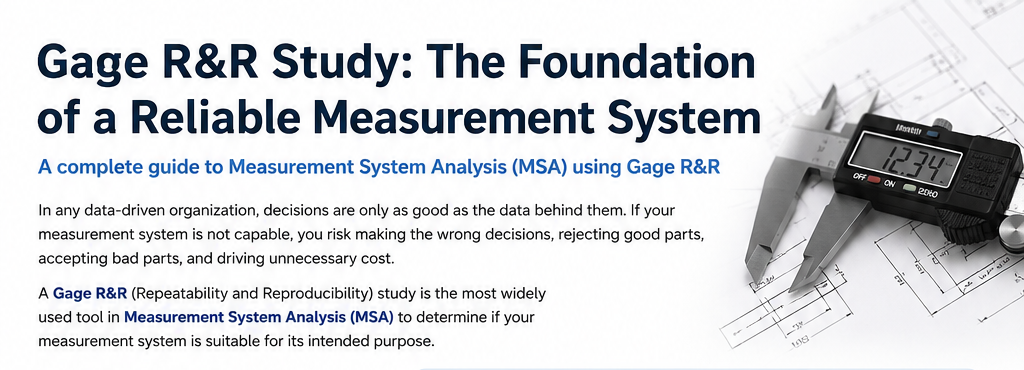
Gage R&R Study: The
Foundation of a Reliable Measurement System
A Complete Guide to Measurement
System Analysis — MSA
In any
data-driven organization, decisions are only as good as the data behind them.
When measurement data is inaccurate, inconsistent, or affected by operator
variation, the business may reject good products, accept defective products,
misjudge process capability, or make improvement decisions based on misleading
information.
This is where
Measurement System Analysis, commonly known as MSA, becomes essential.
A Gage R&R
Study — Repeatability and Reproducibility Study — is one of the most important
tools within MSA. It helps organizations understand whether their measurement
system is reliable enough to support quality control, process improvement,
supplier evaluation, customer requirements, and operational decision-making.
At OpexEdge, we
consider Gage R&R not only a statistical study, but a practical business
protection tool. It protects the organization from acting on poor data.
What Is Measurement System
Analysis — MSA?
Measurement System
Analysis is the structured evaluation of the complete system used to collect
measurement data.
A measurement
system includes:
·
The measuring instrument or
gage.
·
The operator or inspector.
·
The measurement method.
·
The workpiece or part being
measured.
·
The environment where
measurement takes place.
·
The inspection procedure.
·
The calibration and
maintenance condition of the equipment.
·
The way readings are
recorded, rounded, and reported.
MSA answers a
critical question:
Can we trust
the data produced by this measurement system?
If the answer is
no, then process improvement, SPC, capability studies, inspection decisions,
and customer reporting may all be unreliable.
What Is a Gage R&R Study?
A Gage R&R Study evaluates how
much of the observed measurement variation comes from the measurement system
itself.
The term Gage R&R includes two
main components:
Repeatability
Repeatability is the variation that occurs when the same operator measures the
same part multiple times using the same gage under the same conditions. It is
often linked to equipment variation.
Reproducibility
Reproducibility is the variation that occurs when different operators measure
the same part using the same gage. It is often linked to operator technique,
interpretation, training, or method differences.
Together, repeatability and
reproducibility show whether the measurement system is stable, consistent, and
suitable for its intended purpose.
Why Gage R&R Matters
Many organizations focus on improving
machines, materials, suppliers, or operators before checking whether their data
is valid. This creates a serious risk.
If the measurement system is poor, the
organization may not know whether variation is coming from the actual process
or from the way the process is being measured.
A poor measurement system can lead to:
·
Incorrect acceptance or
rejection decisions.
·
False process capability
results.
·
Wrong root cause analysis.
·
Misleading control charts.
·
Customer complaints despite
“acceptable” internal results.
·
Unnecessary process
adjustments.
·
Increased inspection cost.
·
Loss of confidence in
quality data.
A strong measurement system allows the
business to separate real process variation from measurement error.
Total Variation in a Measurement
System
In a simplified
way, total observed variation can be understood as:
Total Observed
Variation = Part-to-Part Variation + Measurement System Variation
Measurement system
variation includes:
·
Repeatability variation.
·
Reproducibility variation.
·
Equipment condition.
·
Operator technique.
·
Method clarity.
·
Environmental effects.
·
Resolution and rounding.
·
Fixture and positioning
variation.
The goal is not to
eliminate all measurement variation. That is usually impossible. The goal is to
make measurement variation small enough compared with the process variation or
tolerance so that decisions remain reliable.
When Should You Conduct a Gage
R&R Study?
A Gage R&R
study should be performed whenever measurement data is used to make important
decisions.
Common situations
include:
·
Before launching a new
product.
·
Before approving a new
inspection method.
·
Before using a new
measuring device.
·
Before conducting a
capability study.
·
Before implementing SPC
control charts.
·
When customer requirements
demand MSA evidence.
·
When operators change.
·
When inspection
instructions are updated.
·
When measurement results
are disputed.
·
After equipment calibration
problems.
·
After changes in fixture,
method, software, or environment.
·
During supplier
qualification.
·
During Six Sigma, Lean, or
operational excellence projects.
If the measurement
system has not been validated, the organization should be careful before using
the data for critical decisions.
Types of Gage R&R Studies
1.
Crossed Gage R&R
A
crossed Gage R&R study is used when every operator can measure every part
multiple times.
This
is the most common type for dimensional inspection, visual scoring, laboratory
testing, and many manufacturing applications.
Example:
·
10 parts.
·
3 operators.
·
2 or 3 repeated trials.
·
Every operator measures
every part.
This
design allows the organization to estimate part-to-part variation,
repeatability, reproducibility, and operator-by-part interaction.
2. Nested
Gage R&R
A
nested Gage R&R study is used when each part can only be measured by one
operator or when the measurement process destroys or changes the part.
This
is common in destructive testing or cases where repeated measurement of the
same part is not practical.
Example:
·
Tensile testing.
·
Chemical testing.
·
Weld destruction testing.
·
Laboratory tests where the
sample changes after testing.
Nested
studies require a different design and analysis method from crossed studies.
3. Attribute Agreement Analysis
Not
all measurement systems produce numerical results. Some inspection systems
classify results as pass/fail, good/bad, acceptable/not acceptable, or defect
category.
In
this case, an attribute agreement study is more suitable than a variable Gage
R&R study.
Attribute
agreement analysis evaluates whether inspectors are consistent with themselves,
consistent with each other, and aligned with the reference standard.
How to Conduct a Gage R&R Study
A successful Gage R&R
study requires planning, discipline, and realistic operating conditions.
Step 1: Define the Measurement
Objective
Start by clarifying what is being
measured and why.
Important questions include:
·
What characteristic is
being measured?
·
Is the characteristic
critical to quality?
·
What is the tolerance?
·
What decision will be made
using the measurement?
·
Is the measurement variable
or attribute?
·
Is the current method
documented?
·
Is the gage calibrated and
suitable?
A Gage R&R study should never be
conducted as a mechanical exercise. It should be linked to a real business or
quality decision.
Step 2: Select Representative Parts
The selected parts should represent the
actual process range.
A common practical approach is to select 8
to 10 parts that cover low, middle, and high values within the expected process
variation.
Avoid selecting parts that are too similar.
If part-to-part variation is too small, the study may make the measurement
system look worse than it actually is.
Good part selection is one of the most
important success factors in Gage R&R.
Step 3: Select Operators
Operators should represent the people who normally
perform the measurement in daily work.
Typically, 2 to 3 operators are selected.
They should use the same method, tools, and
instructions used in the real process. The purpose is not to test ideal
laboratory performance. The purpose is to understand the measurement system
under realistic operating conditions.
Step 4: Define the Number of Trials
Each operator should measure each part more
than once.
A common study design is:
·
10 parts.
·
3 operators.
·
3 trials.
This creates 90 measurement results.
In some cases, 2 trials may be used, but 3
trials often provide stronger insight into repeatability.
Step 5: Randomize the Measurements
The measurement order should be randomized
to reduce bias.
Operators should not know the previous
result when repeating a measurement. Parts can be coded or numbered so that the
operator does not intentionally or unintentionally remember the earlier
reading.
Randomization improves the credibility of
the study.
Step 6: Collect the Data
During data collection, the study owner should ensure
that:
·
The same measurement method
is used.
·
The gage is suitable and
calibrated.
·
Operators follow the
defined procedure.
·
Results are recorded
accurately.
·
Environmental conditions
are controlled where relevant.
·
Operators do not influence
each other’s readings.
Any abnormal event should be recorded because it may
explain unusual variation.
Step 7: Analyze the Results
The results can be analyzed using statistical
software, Excel templates, or quality tools.
Common analysis methods include:
·
Average and Range Method.
·
ANOVA Method.
·
EMP Method in some
applications.
The analysis normally evaluates:
·
Repeatability.
·
Reproducibility.
·
Total Gage R&R.
·
Part-to-part variation.
·
Number of distinct
categories.
·
Operator differences.
·
Operator-by-part
interaction.
·
% contribution.
·
% study variation.
·
% tolerance where
applicable.
How to Interpret Gage R&R Results
A common practical
interpretation is:
Total Gage R&R | Interpretation | Action |
10% or less | Generally acceptable | Measurement system is |
More than 10% up to 30% | May be acceptable | Review improvement |
More than 30% | Generally not | Improve the measurement |
These limits should not
be used blindly. The business context matters.
For example, a
measurement system used for safety-critical parts, customer-critical
dimensions, or regulatory decisions may require stricter expectations. A
measurement system used for early screening or low-risk internal checks may
allow more flexibility.
The correct question is
not only “What is the percentage?” but also:
Is this measurement
system good enough for the decision we are making?
Common Causes of Poor Gage R&R
Results
A poor Gage R&R
result does not always mean the gage itself is bad.
Common causes
include:
·
Poor measurement method.
·
Unclear inspection
instructions.
·
Different operator
techniques.
·
Lack of operator training.
·
Poor fixture or part
positioning.
·
Low gage resolution.
·
Worn or damaged equipment.
·
Poor calibration condition.
·
Environmental variation.
·
Temperature, vibration,
humidity, or lighting issues.
·
Excessive manual judgment.
·
Inconsistent part cleaning
or preparation.
·
Rounding differences.
·
Poor data recording
practices.
The study should be
used to diagnose the measurement system, not to blame operators.
What to Do If Gage R&R Is Too High
If the measurement
system variation is too high, improvement actions should be taken before the
data is used for critical decisions.
Possible actions
include:
Improve the Method
·
Standardize the measurement
procedure.
·
Define exact measurement
points.
·
Clarify part positioning.
·
Add pictures or visual
standards.
·
Remove unclear judgment
from the process.
Improve Operator Capability
·
Train operators.
·
Conduct practical
calibration between inspectors.
·
Verify understanding of the
method.
·
Reduce personal
interpretation.
·
Use reference samples.
Improve the Gage
·
Calibrate the device.
·
Increase measurement
resolution.
·
Repair or replace worn
equipment.
·
Use a more suitable
measuring technology.
·
Improve fixtures and
holding devices.
Improve the Environment
·
Control temperature.
·
Improve lighting.
·
Reduce vibration.
·
Protect the measurement
area from dust or contamination.
·
Improve ergonomics.
Improve the System Design
·
Reduce unnecessary manual
steps.
·
Automate where practical.
·
Use mistake-proofing.
·
Use digital data capture.
·
Simplify the inspection
process.
After improvement, the Gage R&R study should be
repeated to confirm effectiveness.
Gage R&R and Process Capability
A process capability study
depends on reliable measurement data.
If the measurement system
is poor, Cp, Cpk, Pp, and Ppk results may be misleading.
A process may appear
unstable when the real problem is measurement noise. Or a process may appear
capable when the measurement system is not sensitive enough to detect
variation.
That is why MSA should
normally come before capability analysis.
The correct sequence is:
1.
Confirm the measurement
system.
2.
Study process stability.
3.
Evaluate process
capability.
4.
Improve the process based
on reliable data.
Gage R&R and Lean Six Sigma
Gage R&R is especially
important in Lean Six Sigma projects because many projects depend on baseline
data, defect measurement, process comparison, and verified improvement results.
In the DMAIC cycle, MSA is
usually performed during the Measure phase.
Without MSA, the project team
may improve the wrong problem or report improvement that is not statistically
reliable.
A strong Gage R&R study
helps the project team confirm that the data is accurate enough to support root
cause analysis and improvement validation.
Practical Example
Assume a manufacturing company measures
a critical shaft diameter.
The tolerance is tight, and inspection
results are used to decide whether parts are accepted, rejected, or adjusted in
production.
A Gage R&R study is conducted using:
·
10 parts.
·
3 operators.
·
3 repeated trials.
·
One digital micrometer.
·
Randomized measurement
order.
The study shows that Total Gage R&R
is 28%.
This means the measurement system may be
marginal. It may be usable depending on the application, but improvement is
recommended.
Further review shows that operators are
measuring the shaft at slightly different locations. The company updates the
inspection instruction, adds a fixture, trains the operators, and repeats the
study.
The new Total Gage R&R becomes 8%.
Now the measurement system is much more
reliable, and the company can use the data with higher confidence.
What a Professional MSA Report
Should Include
A professional
MSA report should include:
·
Study objective.
·
Product or process details.
·
Characteristic measured.
·
Tolerance and specification
limits.
·
Gage details and
calibration status.
·
Operator list.
·
Part selection method.
·
Study design.
·
Raw measurement data.
·
Statistical method used.
·
Repeatability result.
·
Reproducibility result.
·
Total Gage R&R result.
·
Part-to-part variation.
·
Number of distinct
categories.
·
Charts and visual analysis.
·
Interpretation.
·
Risks.
·
Corrective actions.
·
Final recommendation.
·
Approval and document
control.
A good report
should be easy for quality, operations, engineering, and management teams to
understand.
Common Mistakes in Gage R&R Studies
Organizations often
make mistakes that weaken the value of the study.
Common mistakes
include:
·
Selecting parts that do not
represent process variation.
·
Using operators who do not
normally perform the inspection.
·
Not randomizing the
measurement order.
·
Allowing operators to see
previous results.
·
Using an uncalibrated gage.
·
Ignoring environmental
conditions.
·
Focusing only on the final
percentage.
·
Ignoring graphical
analysis.
·
Treating MSA as a
customer-document requirement only.
·
Not taking corrective
action after poor results.
·
Repeating the study without
changing anything.
·
Using Gage R&R for
attribute data instead of attribute agreement analysis.
MSA should be treated
as a practical decision-support activity, not just a compliance document.
OpexEdge Approach to Gage R&R and
MSA
At OpexEdge, we help
organizations design and conduct practical Measurement System Analysis studies
that support real operational decisions.
Our approach focuses
on:
·
Selecting the correct MSA
method.
·
Designing the study
properly.
·
Preparing data collection
templates.
·
Training operators.
·
Analyzing results.
·
Interpreting business
impact.
·
Identifying improvement
actions.
·
Preparing professional
reports.
·
Building repeatable MSA
procedures.
·
Connecting MSA with
quality, process capability, Lean Six Sigma, and operational excellence.
We do not treat Gage
R&R as a statistical formality. We treat it as a foundation for reliable
decision-making.
Why Your Business Needs a Strong
Measurement System
Every improvement
system depends on trustworthy data.
Before asking
whether the process is capable, stable, improving, or failing, the organization
must first ask:
Can we trust
the measurement system?
A Gage R&R
study helps answer this question with evidence.
When the
measurement system is reliable, the organization can make better decisions,
reduce inspection disputes, improve customer confidence, and focus improvement
efforts on the real sources of variation.
When the
measurement system is weak, the organization risks wasting time, money, and
effort solving the wrong problem.
Conclusion
A Gage R&R study is one of the most
important tools in Measurement System Analysis. It helps organizations
understand whether measurement variation is small enough to support reliable
quality and process decisions.
By separating repeatability, reproducibility,
and part-to-part variation, Gage R&R gives the organization a clear view of
whether the measurement system can be trusted.
For manufacturers, laboratories, suppliers,
service operations, and quality teams, MSA is not optional. It is the
foundation of process control, capability analysis, customer confidence, and
continuous improvement.
Reliable data leads to reliable decisions.
Reliable decisions lead to better performance.

16 Comments