
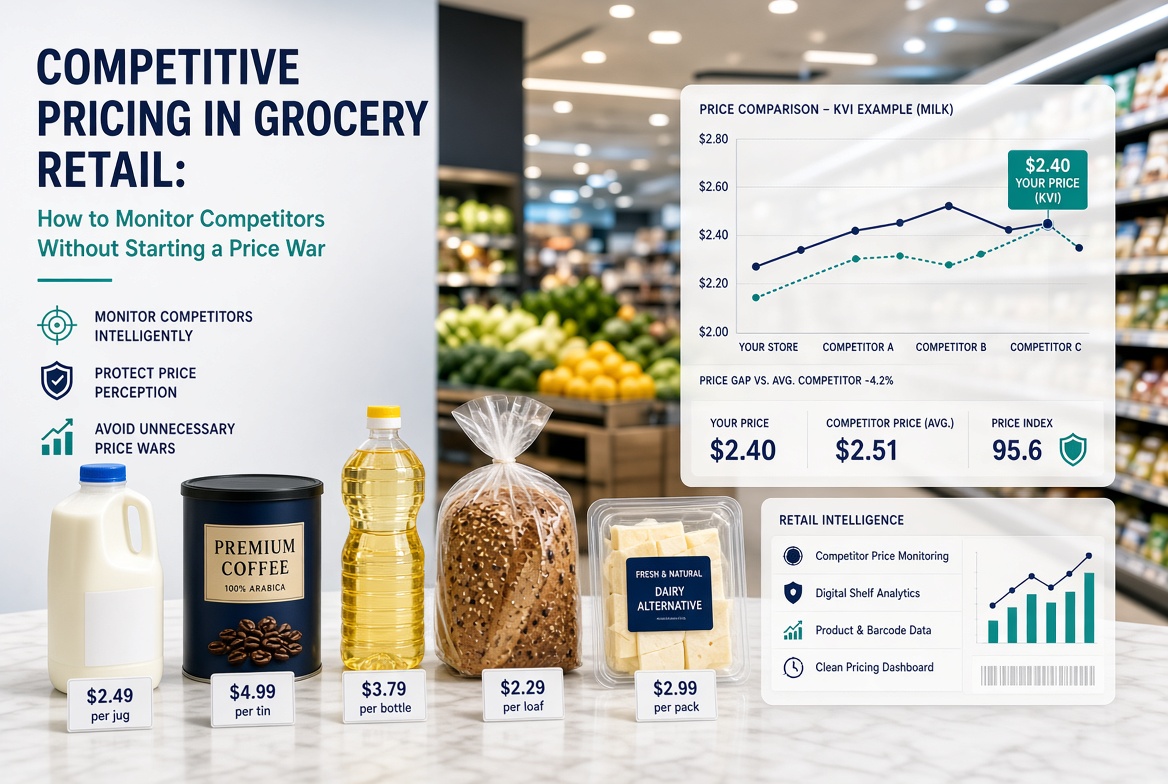
Introduction
In grocery retail, competitors are always changing prices.
A supermarket may lower the price of milk today, a competitor may discount cooking oil tomorrow, and another retailer may launch a promotion on coffee next week.
The natural reaction is often:
“Match the competitor.”
But blindly matching competitor prices can be one of the fastest ways to destroy retail margin.
A retailer does not need to be the cheapest on every product.
Customers do not compare every SKU.
They compare a relatively small number of familiar products, categories, brands, and price signals that shape their perception of whether a retailer is expensive or affordable.
This is where competitive pricing becomes a strategic discipline rather than a simple price-monitoring exercise.
The real objective is not:
“Have lower prices than competitors.”
It is:
“Maintain a competitive price position where customers care, while protecting margin where they do not.”
This requires retailers to understand:
- Which competitor prices matter
- Which products customers actually compare
- How KVI products influence price perception
- When to match a competitor
- When to ignore a competitor price
- How promotions distort competitive comparisons
- How competitor reactions affect pricing decisions
- How to use price indices
- How to avoid destructive price wars
- How AI can turn competitor data into pricing decisions
1. What Is Competitive Pricing?
Competitive pricing is the process of setting and managing prices with explicit consideration of competitor prices, market positioning, customer price perception, and the retailer’s own economics.
It does not mean copying competitors.
A retailer may choose to be:
- Cheaper than competitors
- At parity
- Slightly more expensive
- Premium-priced
- Aggressively priced on selected products
- Competitive on KVIs but margin-oriented elsewhere
The correct position depends on the retailer’s strategy.
For example:
Discount Retailer
May target:
Competitor price index = 97–99
Mainstream Supermarket
May target:
Competitor price index = 99–101
Premium Retailer
May accept:
Competitor price index = 102–110
provided customers perceive sufficient additional value.
The number itself is not the strategy.
The strategy determines the appropriate competitive position.
2. Why Grocery Competitive Pricing Is Different
Competitive pricing is particularly difficult in grocery because retailers may carry thousands or tens of thousands of SKUs.
Prices vary by:
- Brand
- Pack size
- Product specification
- Quality
- Country of origin
- Store format
- Location
- Customer segment
- Promotion
- Loyalty status
- Online channel
- Delivery channel
- Time of day
- Season
A competitor may sell:
1 liter of Brand A milk
while your store sells:
900 ml of Brand B milk
A simple price comparison may produce the wrong conclusion.
Therefore:
Competitive pricing requires comparable products, comparable conditions, and comparable customer value.
3. Not Every Competitor Is Equally Important
A supermarket may have several competitors:
- Hypermarkets
- Discount retailers
- Convenience stores
- Local supermarkets
- Online grocery platforms
- Wholesale clubs
- Specialty stores
But the same competitor does not necessarily matter for every customer mission.
For example:
A neighborhood supermarket may compete strongly with another supermarket located 500 meters away, but only weakly with a hypermarket 20 kilometers away.
An online grocery platform may be a major competitor for planned weekly shopping but less important for emergency purchases.
Therefore, competitive pricing should begin with:
Competitor Mapping
For each store or channel, identify:
- Direct competitors
- Secondary competitors
- Online competitors
- Price leaders
- Promotion leaders
- Premium competitors
- Discount competitors
4. Competitor Price Is Not the Same as Market Price
Suppose three retailers sell the same product:
| Retailer | Price |
| Retailer A | $4.80 |
| Retailer B | $5.00 |
| Retailer C | $5.20 |
The market does not necessarily have one “correct” price.
The retailer may calculate:
Average Market Price
($4.80 + $5.00 + $5.20) ÷ 3
= $5.00
But the most aggressive competitor is:
$4.80
and the highest is:
$5.20
Depending on the retailer’s strategy, it might target:
$4.95
rather than automatically matching $4.80.
This creates an important distinction between:
Competitor Monitoring
and
Competitive Price Positioning
Monitoring tells you what competitors are doing.
Strategy determines what you should do about it.
5. The Price Index
One of the most useful tools in competitive pricing is the Price Index.
A simple formula is:
Price Index = Your Price ÷ Competitor Reference Price × 100
Suppose:
Your price = $5.00
Competitor reference price = $4.80
Then:
Price Index = 5.00 ÷ 4.80 × 100 = 104.2
This means your price is approximately:
4.2% higher
than the competitor reference.
If your price is $4.70:
Price Index = 97.9
You are approximately:
2.1% lower
6. Price Index Should Be Calculated at Multiple Levels
A retailer should not rely on one overall index.
It can calculate:
SKU Price Index
How competitive is an individual product?
Category Price Index
How competitive is an entire category?
KVI Price Index
How competitive are the products customers use to judge price?
Store Price Index
How competitive is a specific store?
Competitor Price Index
How competitive are we against each competitor?
Channel Price Index
How competitive are we online versus offline?
This creates a much more useful competitive pricing dashboard.
7. KVI and Competitive Pricing
This is where the previous articles in the OpexEdge pricing cluster connect.
Not all products have the same impact on customer price perception.
A customer may frequently notice prices for:
- Milk
- Bread
- Eggs
- Rice
- Sugar
- Cooking oil
- Chicken
- Coffee
- Water
- Soft drinks
But the same customer may have little awareness of the price of hundreds of less frequently purchased products.
Therefore:
Competitive pricing should concentrate disproportionate attention on Key Value Items.
If a retailer is 3% above the market on 10,000 obscure SKUs but highly competitive on 200 important KVIs, customers may still perceive the retailer as competitively priced.
The opposite can also happen.
A retailer can have excellent average pricing but appear expensive because several highly visible KVIs are significantly overpriced.
8. The KVI Competitive Pricing Matrix
A useful management framework combines:
KVI Importance
with:
Competitive Price Gap
| Small Price Gap | Large Price Gap | |
| High KVI | Maintain | Immediate Review |
| Low KVI | Monitor | Margin Opportunity |
High KVI + Large Gap
Highest priority.
The retailer should investigate whether the price is damaging price perception.
High KVI + Small Gap
Maintain competitive position.
Low KVI + Large Gap
Potential margin opportunity—assuming customer sensitivity is low.
Low KVI + Small Gap
No major action required.
This prevents the organization from wasting time reacting to every competitor price movement.
9. The Competitor Price Gap
A retailer can also calculate the absolute price gap:
Price Gap = Your Price − Competitor Price
Example:
Your price:
$5.10
Competitor:
$4.90
Price gap:
$0.20
But the percentage gap may be more meaningful:
$0.20 ÷ $4.90 = 4.1%
For a $5 product, $0.20 may be significant.
For a $100 product, $0.20 is irrelevant.
Therefore, price gap analysis should normally include both:
Absolute Gap
and
Percentage Gap
10. Reference Price Matters
Customers do not necessarily compare a product with one competitor.
They develop a mental reference.
For example, a shopper may know that a common product is usually around:
$5
If your price is:
$5.20
the difference may be noticeable.
If your price is:
$4.90
the customer may perceive it as attractive.
Therefore, competitive pricing should consider:
- Competitor prices
- Historical price
- Promotional price
- Customer reference price
- Typical market price
- Brand price architecture
This is why price perception cannot be reduced to competitor price matching.
11. Promotional Prices Can Distort Competitive Intelligence
Suppose:
Your regular price:
$5.00
Competitor regular price:
$5.00
But competitor promotional price:
$4.00
If your pricing system compares your $5.00 with the competitor’s temporary $4.00 and immediately reduces your price, you may unnecessarily sacrifice margin.
The system must distinguish:
Regular Price
from
Promotional Price
and ideally identify:
- Promotion type
- Promotion duration
- Promotion frequency
- Loyalty-only offer
- Coupon price
- Multi-buy price
- Display-only promotion
- Supplier-funded promotion
Otherwise, competitor monitoring can trigger inappropriate reactions.
12. Should You Match Competitor Promotions?
Not necessarily.
Consider:
Competitor promotion:
$10 → $8
Your regular price:
$9
You are already cheaper than the competitor’s normal price.
If you match the promotion and reduce to $8, you may gain little competitive advantage while sacrificing margin.
The correct question is:
What does the customer actually see and compare?
If your regular price already provides a strong value proposition, matching the competitor may be unnecessary.
13. Competitive Pricing Is a Strategic Choice
Retailers can adopt several competitive pricing strategies.
Strategy 1: Price Leadership
Set prices aggressively to establish a low-price reputation.
Best suited to:
- Discount retailers
- High-volume retailers
- Retailers with strong cost structures
Risk:
Margin compression
Strategy 2: Price Parity
Maintain prices close to major competitors.
Example:
Target index = 100
Best suited to mainstream retailers.
Risk:
Competitors can still create differentiation through promotions.
Strategy 3: Selective Price Leadership
Be highly competitive on selected products while maintaining normal margins elsewhere.
This is often more practical.
For example:
200 critical KVIs
may receive aggressive price management while:
thousands of background products
are managed primarily for margin.
Strategy 4: Premium Pricing
Charge more while providing a differentiated value proposition.
The additional value may come from:
- Quality
- Service
- Convenience
- Store experience
- Freshness
- Private label
- Availability
- Loyalty benefits
- Digital experience
Premium pricing fails when the customer sees no reason for the premium.
14. The Danger of a Price War
Suppose Retailer A reduces a KVI from:
$5 → $4.80
Retailer B responds:
$4.80 → $4.60
Retailer A responds:
$4.60 → $4.40
Retailer B responds:
$4.40 → $4.20
The customer benefits temporarily.
But both retailers may eventually sacrifice substantial margin.
If the product is highly elastic, the volume increase may compensate for some margin loss.
But if the price reduction mainly transfers customers between retailers, both businesses may lose profitability.
This creates the central principle:
Do not enter a price war unless you understand the economics and strategic objective.
15. Competitive Response Is Not Always Immediate
A competitor may change price for many reasons:
- Inventory liquidation
- Supplier funding
- Short-term promotion
- Store opening
- Seasonal event
- Competitive attack
- Overstock
- Pricing error
- Clearance
- Customer acquisition campaign
Reacting immediately to every movement can create unnecessary volatility.
A more mature retailer asks:
Is the price change:
Temporary?
Structural?
Promotional?
Strategic?
Localized?
Market-wide?
Only then should a pricing response be considered.
16. Detecting Structural Price Changes
Suppose a competitor changes a product price from:
$5.00 → $4.80
for one week.
This may be a promotion.
But if the price remains:
$4.80
for eight consecutive weeks, the retailer should consider whether the competitor has established a new regular price.
This distinction is critical.
A competitive pricing system should monitor:
Price Level
and
Price Duration
and
Price Frequency
17. Competitive Pricing by Store
A national or regional retailer may face different competitors in different locations.
Store A:
Competitor X dominates.
Store B:
Competitor Y dominates.
Store C:
There is no significant direct competitor.
Therefore, one national competitive price may not always be optimal.
A retailer can develop:
Store-Level Competitive Intelligence
For each store:
- Main competitors
- KVI prices
- Price index
- Promotion intensity
- Market position
- Local customer behavior
This enables localized pricing where appropriate.
18. Online Competitive Pricing
E-commerce makes competitive pricing even more dynamic.
Online prices can change:
- Multiple times per day
- Automatically
- By channel
- By customer segment
- During campaigns
- Based on inventory
- Based on competitor activity
The retailer therefore needs a stronger distinction between:
Price Monitoring
and
Automated Price Response
Automation should not mean:
“Competitor changes price → We immediately change ours.”
It should mean:
“Competitor changes price → System evaluates significance → Pricing rules determine whether action is justified.”
19. Competitive Pricing and Inventory
Inventory can change the correct competitive response.
Suppose your competitor reduces the price of a product while you have:
Very high inventory
You may want to respond aggressively.
But if your inventory is already low, reducing your price could accelerate stock depletion.
Similarly, if the product is nearing expiry, competitive pricing may need to become more aggressive.
Therefore:
Competitive Pricing + Inventory Position
should be evaluated together.
20. Competitive Pricing and Supplier Costs
A competitor price reduction does not automatically mean your cost structure allows the same price.
Suppose:
Your cost:
$7
Competitor estimated cost:
$6.50
Your competitor can sell at:
$7.20
while you would barely break even at that price.
Blind price matching could therefore create a loss.
Competitive pricing decisions should consider:
- Cost
- Margin
- Supplier terms
- Rebates
- Funding
- Logistics
- Store costs
- Inventory position
The competitor price is an input—not the final answer.
21. Competitive Pricing and Price Elasticity
The previous article introduced price elasticity.
Now combine it with competitor pricing.
Suppose:
Product A:
- High KVI
- High elasticity
- Competitor is 5% cheaper
This product deserves immediate attention.
Now consider Product B:
- Low KVI
- Low elasticity
- Competitor is 5% cheaper
The price gap may have little customer impact.
This produces a powerful decision framework:
| KVI | Elasticity | Competitor Gap | Priority |
| High | High | High | Critical |
| High | Low | High | High |
| Low | High | High | Medium |
| Low | Low | High | Low |
This is much more sophisticated than simply ranking products by competitor price difference.
22. Competitive Pricing and Promotions
Competitive pricing and promotion effectiveness should also be connected.
Suppose your competitor is promoting coffee aggressively.
Your options might include:
- Match the promotion
- Ignore it
- Promote another brand
- Promote a complementary product
- Adjust regular price
- Increase loyalty incentive
- Improve visibility
- Offer a different pack size
The best response is not necessarily a lower price.
Sometimes the better response is:
Different Offer
rather than:
Lower Price
23. A Competitive Pricing Decision Tree
Before changing a price because of a competitor, ask:
Question 1
Is the competitor product truly comparable?
If no → Do not react automatically.
Question 2
Is this competitor strategically relevant?
If no → Monitor only.
Question 3
Is the product a KVI?
If no → Lower priority.
Question 4
Is the competitor price temporary?
If yes → Evaluate before reacting.
Question 5
Is the customer likely to notice?
If no → Avoid unnecessary price investment.
Question 6
What is the product’s elasticity?
High elasticity → Greater potential response.
Low elasticity → More pricing flexibility.
Question 7
What happens to margin?
If economics are unacceptable → Redesign the response.
Question 8
What is the strategic objective?
Only then:
Change / Hold / Promote / Monitor
24. The Competitive Pricing Dashboard
A practical competitive pricing dashboard should include:
| KPI | Purpose |
| Price Index | Overall competitive position |
| KVI Price Index | Customer price perception |
| Competitor Gap | Difference vs. competitor |
| Number of Price Changes | Market volatility |
| Competitor Promotion Rate | Competitive intensity |
| Price Match Rate | Degree of direct matching |
| Margin Impact | Cost of competitive response |
| Elasticity | Expected demand response |
| Market Share | Strategic outcome |
| Stock Position | Supply constraint |
| Supplier Funding | Available price support |
| Price Position by Store | Local competitiveness |
A management dashboard should highlight exceptions rather than force managers to inspect thousands of SKUs.
For example:
Red
High-KVI + large competitive gap + high elasticity
Amber
Moderate gap or uncertain competitor movement
Green
Competitive position within target range
25. Competitive Pricing Governance
Pricing should have clear decision rights.
A practical governance model might define:
Category Manager
Can approve routine changes within predefined limits.
Pricing Manager
Reviews major competitive moves.
Commercial Director
Approves strategic price positioning.
Finance
Reviews material margin impact.
AI/Pricing Engine
Provides recommendations and scenario analysis.
The objective is to prevent two extremes:
No control
and
Too much bureaucracy
26. AI-Powered Competitive Pricing
AI can transform competitor pricing from a spreadsheet exercise into a continuous decision system.
An AI pricing engine can combine:
- Competitor prices
- Historical prices
- KVI classification
- Price elasticity
- Promotions
- Customer behavior
- Sales
- Margin
- Inventory
- Seasonality
- Store
- Supplier funding
It can identify patterns such as:
Competitor price changes on this KVI have historically caused a measurable traffic response.
Or:
This competitor promotion has historically produced little customer switching.
Or:
Matching this price would reduce margin without a meaningful volume benefit.
This is much more valuable than simply collecting competitor prices.
27. From Price Monitoring to Price Intelligence
There are three levels of competitive pricing maturity.
Level 1 — Price Monitoring
“What are competitors charging?”
Data collection.
Level 2 — Competitive Intelligence
“What do competitor changes mean?”
Analysis.
Level 3 — Competitive Price Optimization
“What should we do?”
Decision support and optimization.
The progression is:
Data → Insight → Decision
This distinction is critical when designing retail pricing systems.
28. Common Competitive Pricing Mistakes
Mistake 1: Matching every competitor price
Creates unnecessary margin erosion.
Mistake 2: Treating every competitor as equally important
Different competitors affect different customer missions.
Mistake 3: Ignoring KVI status
Not every SKU shapes price perception equally.
Mistake 4: Confusing promotions with regular prices
Temporary discounts should not automatically redefine your pricing strategy.
Mistake 5: Ignoring elasticity
A price change can have very different demand consequences across products.
Mistake 6: Ignoring cannibalization
Price changes can shift customers between your own products.
Mistake 7: Ignoring cost economics
You cannot always match a competitor’s price profitably.
Mistake 8: Reacting too quickly
A temporary competitor move can trigger a permanent margin sacrifice.
Mistake 9: Using one national price strategy
Local competition can differ dramatically.
Mistake 10: Optimizing for price instead of value
Customers compare the total value proposition—not just the number on the shelf.
29. The OpexEdge Competitive Pricing Framework
A practical framework can be summarized as:
C — Competitor Mapping
Identify relevant competitors by store, channel and customer mission.
O — Comparable Products
Ensure that products, pack sizes and conditions are genuinely comparable.
M — Market Position
Define the desired price position.
P — Price Intelligence
Monitor competitor prices, promotions and structural changes.
E — Evaluate KVI Impact
Prioritize products that influence customer price perception.
T — Test Economics
Assess elasticity, margin and expected demand response.
I — Identify Response
Choose between match, hold, promote, reposition or ignore.
T — Track Results
Measure sales, margin, traffic and customer response.
I — Improve
Learn from competitive reactions.
V — Value-Based Decision
Consider the total customer value proposition.
E — Execute Governance
Ensure pricing decisions follow defined rules and authority levels.
The framework changes the question from:
“What is the competitor price?”
to:
“What should our price be, given the competitor, customer, economics and strategic objective?”
30. A Practical Example
Imagine a supermarket selling a popular coffee SKU.
Your price:
$10.00
Competitor:
$9.50
Price index:
105.3
The product is:
- High KVI
- High purchase frequency
- High price awareness
- High elasticity
At first glance, matching $9.50 looks logical.
But the retailer investigates further.
Economics
Cost:
$7.00
At $10:
Gross profit per unit:
$3.00
At $9.50:
Gross profit:
$2.50
The retailer estimates that the 5% price reduction could increase volume by approximately 8%.
Suppose current sales are:
10,000 units
Current gross profit:
10,000 × $3 = $30,000
At $9.50:
Expected volume:
10,800 units
Gross profit:
10,800 × $2.50 = $27,000
The price match would reduce gross profit by:
$3,000
Therefore, simply matching the competitor is economically unattractive.
The retailer then evaluates alternatives:
- Match only during key shopping periods
- Negotiate supplier funding
- Promote another coffee SKU
- Maintain price but strengthen loyalty offer
- Reduce price partially to $9.70
- Improve availability and merchandising
The best response may therefore be:
Competitive enough without blindly matching.
31. The Ultimate Competitive Pricing Principle
Competitive pricing should protect three things simultaneously:
Customer Perception
“Your prices are fair.”
Competitive Position
“You are not materially disadvantaged against relevant competitors.”
Economic Health
“You still make sustainable profit.”
These three objectives must be balanced.
Optimizing only one creates problems.
Lowest Price
May destroy margin.
Highest Margin
May damage traffic and customer perception.
Perfect Price Match
May create unnecessary price wars.
The objective is therefore:
Competitive where it matters. Profitable where it can be. Strategic everywhere.
Conclusion
Competitive pricing is not a race to copy competitors.
It is a structured decision-making discipline.
The strongest grocery retailers understand that customers do not evaluate thousands of prices equally. A relatively small number of visible, frequently purchased products can disproportionately influence price perception.
That makes KVI identification essential.
Price elasticity then helps estimate customer response.
Promotion effectiveness helps determine whether competitive offers create incremental value.
Competitive intelligence adds the external market dimension.
And AI can connect all of these signals into a continuous pricing decision system.
The mature retailer therefore does not ask:
“What is our competitor charging?”
It asks:
“How important is this competitor, how important is this product, how sensitive are our customers, what will happen to our margin, and what response best supports our strategy?”
That is the difference between competitive price monitoring and competitive pricing strategy.
The Grocery Pricing Authority Cluster
This article completes the fifth layer of the OpexEdge grocery pricing framework:
- Pricing Strategy in Grocery Retail
What should the overall pricing strategy be?
↓
- KVI Identification in Grocery Retail
Which products shape customer price perception?
↓
- Grocery Price Elasticity
How will customers respond to price changes?
↓
- Promotion Effectiveness in Grocery Retail
Did promotional investment create profitable incremental demand?
↓
- Competitive Pricing in Grocery Retail
How should the retailer respond to competitors?
↓
- AI-Powered Grocery Pricing
How can these signals be integrated into intelligent pricing decisions?
The next article should therefore be AI-Powered Grocery Pricing, where we bring the entire framework together into a practical AI pricing architecture covering data, elasticity, KVIs, competitors, promotions, inventory, price recommendations, scenario simulation and governance.
Related Articles
https://opexedg.com/post/grocery-retail-pricing-strategy/
https://opexedg.com/post/kvi-identification-grocery-retail/
https://opexedg.com/post/grocery-price-elasticity/
https://opexedg.com/post/competitive-pricing-grocery-retail/
https://opexedg.com/post/promotion-effectiveness-grocery-retail/
https://opexedg.com/post/ai-powered-retail-pricing/
