
Introduction
For decades, retail pricing was largely a combination of merchant experience, competitor checks, historical sales, supplier negotiations, and spreadsheets.
That model worked reasonably well when retailers had fewer products, fewer competitors, slower price changes, and limited access to customer data.
Modern grocery retail is different.
A supermarket may manage thousands of products across multiple stores and channels while competitors change prices, promotions, and assortments continuously.
At the same time, customers have unprecedented price transparency.
A shopper can compare prices across retailers within seconds.
This creates a fundamental challenge:
How can a retailer make thousands of pricing decisions quickly without sacrificing margin, customer trust, or strategic control?
Artificial intelligence provides part of the answer.
But AI-powered pricing is not simply:
“Use AI to change prices.”
That approach is too simplistic.
A real AI-powered pricing system combines:
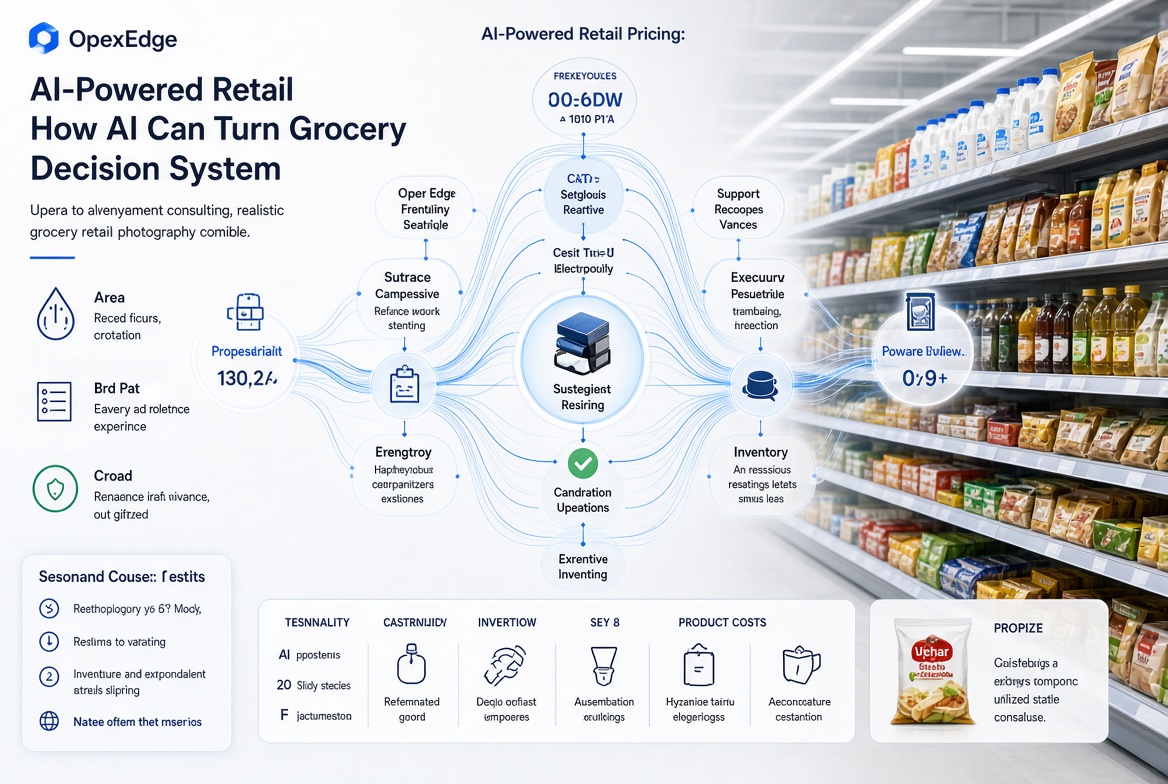
Customer Demand + KVI Importance + Price Elasticity + Competitor Prices + Promotions + Inventory + Cost + Margin + Seasonality + Business Strategy
and converts those signals into pricing recommendations or, where appropriate, controlled automated actions.
The objective is not to find the lowest price.
It is not even to maximize revenue.
The objective is:
Find the price that best balances customer value, competitive position, demand, inventory, and sustainable profit.
1. What Is AI-Powered Retail Pricing?
AI-powered retail pricing uses machine learning, statistical modeling, optimization, and automation to analyze pricing and demand signals and recommend—or automatically execute—pricing decisions.
Traditional pricing might look like:
Manager → Spreadsheet → Competitor Check → Price Decision
AI-powered pricing can look like:
Data → Demand Model → Elasticity → Competitive Analysis → Scenario Simulation → Optimization → Recommendation → Approval/Execution → Learning
The important difference is not simply speed.
It is the ability to evaluate many variables simultaneously.
2. Why Traditional Retail Pricing Struggles at Scale
Imagine a retailer with:
30,000 SKUs
across:
100 stores
with prices potentially changing frequently.
Even if a category manager could review 100 products per day, manually reviewing every SKU would be impractical.
The retailer therefore relies on:
- Rules
- Periodic reviews
- Category-level assumptions
- Competitor snapshots
- Historical pricing
- Merchant judgment
These tools remain valuable.
But they become insufficient when the number of decisions increases.
AI can evaluate thousands of pricing scenarios much faster than a human team.
The human role then shifts from:
Making every price decision
to:
Setting strategy, reviewing exceptions, and governing the system.
3. AI Does Not Replace Pricing Strategy
This distinction is critical.
AI can optimize within a defined objective.
It cannot independently decide what the retailer’s business strategy should be.
For example, management must determine:
- Are we a price leader?
- Do we target price parity?
- Which KVIs are strategic?
- What margin level is acceptable?
- Which customers are most important?
- How aggressively should we respond to competitors?
- What products can carry higher margins?
- Which categories are traffic drivers?
- What price image should the retailer create?
AI then helps answer:
Given those strategic objectives, what pricing decisions are most likely to produce the desired outcome?
Therefore:
Strategy defines the destination.
AI helps determine the route.
4. The Data Foundation
AI-powered pricing is only as good as the data feeding it.
A pricing system may need:
Product Data
- SKU
- Brand
- Category
- Pack size
- Product attributes
- Private label status
Sales Data
- Units
- Revenue
- Transactions
- Basket
- Store
- Date/time
Price Data
- Regular price
- Promotional price
- Historical prices
- Markdown
- Loyalty price
Cost Data
- Purchase cost
- Supplier funding
- Rebates
- Logistics cost where relevant
Competitive Data
- Competitor prices
- Competitor promotions
- Competitor availability
Inventory Data
- Stock level
- Days of supply
- Stock-outs
- Excess inventory
- Expiry risk
Customer Data
Where appropriately governed:
- Segment
- Purchase frequency
- Promotion response
- Loyalty behavior
- Basket relationships
Context Data
- Seasonality
- Holidays
- Weather
- Events
- Local market conditions
The more reliable these inputs are, the more useful the pricing model becomes.
5. The First AI Layer: Demand Forecasting
Before recommending a price, the system needs to estimate demand.
A simple conceptual model is:
Demand = f(Price, Promotion, Seasonality, Competition, Availability, Store, Customer, Product)
For example, the system may estimate:
At $10:
1,000 units
At $9.50:
1,080 units
At $9:
1,180 units
At $8.50:
1,300 units
This creates a demand curve.
The retailer can then combine that demand curve with cost and margin.
6. The Second AI Layer: Price Elasticity
The system estimates how customers respond to price changes.
Elasticity can differ dramatically between products.
For example:
Product A
Price increase of 5%
Demand falls 12%.
Highly elastic.
Product B
Price increase of 5%
Demand falls 2%.
Relatively inelastic.
An AI pricing system can estimate elasticity at multiple levels:
- SKU
- Category
- Store
- Customer segment
- Season
- Shopping mission
This is far more useful than applying one elasticity assumption across an entire category.
7. KVI Intelligence
The previous KVI article established an important principle:
Not every SKU influences price perception equally.
AI can continuously evaluate KVI status using signals such as:
- Purchase frequency
- Price awareness
- Price sensitivity
- Competitive availability
- Sales importance
- Basket influence
- Store-choice impact
A product can therefore move between KVI levels over time.
For example:
A particular beverage may become a KVI during summer.
A traditional food product may become highly visible during Ramadan.
A household product may become a major price reference during an inflationary period.
AI can detect these changes rather than relying on a static annual KVI list.
8. Competitive Price Intelligence
A modern AI pricing engine can ingest competitor information and identify:
- Competitor price changes
- Promotion changes
- Price gaps
- Competitive price trends
- Competitor pricing intensity
- Persistent versus temporary changes
But the system should not automatically respond to every competitor movement.
Instead, it should evaluate:
Is this competitor relevant?
Is the product a KVI?
Is the price difference material?
Is the competitor change temporary?
How price-sensitive are customers?
What happens to our margin if we respond?
This transforms:
Competitor Monitoring
into:
Competitive Decision Intelligence
9. Promotion Intelligence
Promotions add another layer of complexity.
The AI system should distinguish between:
Regular Demand
and
Promotional Demand
It can analyze:
- Promotional uplift
- Incremental sales
- Promotion elasticity
- Cannibalization
- Basket impact
- Stock-up
- Post-promotion decline
- Supplier funding
- Promotion frequency
This allows the system to estimate whether a proposed promotion is likely to create:
Incremental Profit
rather than merely:
Incremental Units
10. Inventory-Aware Pricing
Price should not be evaluated independently from inventory.
Suppose a retailer has:
45 days of inventory
and normal demand.
A small price reduction may help accelerate sales.
Now consider another SKU with:
2 days of inventory
A price reduction may create a stock-out.
The optimal price is therefore partly a function of inventory position.
AI can incorporate:
- Current inventory
- Forecast demand
- Replenishment lead time
- Target stock
- Stock-out risk
- Excess inventory
- Expiry risk
This creates:
Inventory-Aware Pricing
11. Margin-Aware Pricing
A price recommendation should always consider economics.
Suppose:
Cost = $7
Potential prices:
| Price | Expected Units | Gross Profit/Unit | Expected Gross Profit |
| $10.00 | 1,000 | $3.00 | $3,000 |
| $9.50 | 1,080 | $2.50 | $2,700 |
| $9.00 | 1,180 | $2.00 | $2,360 |
| $10.50 | 930 | $3.50 | $3,255 |
The lowest price does not produce the highest profit.
In this simplified scenario:
$10.50
generates the highest gross profit.
But the final decision may still depend on:
- KVI status
- Competitive gap
- Customer price perception
- Basket impact
- Strategic positioning
Therefore AI should optimize against the retailer’s chosen objective—not blindly maximize one mathematical output.
12. Revenue Optimization vs. Profit Optimization
This distinction is essential.
A retailer can optimize:
Revenue
Price × Quantity
or:
Gross Profit
(Price − Cost) × Quantity
or potentially:
Contribution
Including additional relevant costs.
The optimal price can differ substantially depending on the objective.
A retailer focused only on revenue may choose a lower price.
A retailer focused on gross profit may choose a higher price.
A retailer focused on customer acquisition may deliberately accept lower short-term profitability.
Therefore the system must know:
What are we optimizing?
13. Scenario Simulation
One of the most powerful applications of AI is scenario analysis.
Instead of asking:
“What price should we use?”
management can ask:
“What happens if we choose $9.50?”
The system can estimate:
- Units
- Revenue
- Margin
- Basket
- Competitive position
- Inventory
- Market share
- Cannibalization
Then compare it with:
$9.75
$10.00
$10.25
$10.50
This converts pricing from a single-point decision into a controlled business simulation.
14. The Price Optimization Engine
Conceptually, the pricing engine solves:
Maximize Objective
subject to:
- Customer demand
- Price elasticity
- Competitor position
- Minimum margin
- Maximum price change
- Inventory constraints
- Strategic rules
- Regulatory constraints
- Pricing architecture
- KVI requirements
A simplified profit objective can be represented as:
Maximize Profit = (Price − Cost) × Demand(Price)
A real system is much more complex because demand depends on multiple variables.
But this simple formula illustrates the core principle:
The optimal price is where the economics of price and demand produce the best business outcome.
15. Pricing Rules Still Matter
AI does not eliminate business rules.
In fact, strong AI pricing systems need clear constraints.
Examples:
Maximum Price Change
Do not change a product by more than:
±5% per cycle
KVI Rule
Critical KVIs must remain within:
Target competitive index
Margin Rule
Do not recommend prices below:
Minimum approved margin
Brand Rule
Premium brands must maintain:
Minimum price positioning
Private Label Rule
Maintain:
Defined price gap versus national brands
These rules protect the business from unrealistic recommendations.
16. Human-in-the-Loop Pricing
Fully automated pricing is not appropriate for every retailer or every SKU.
A better maturity model is:
Level 1 — AI Insight
AI identifies opportunities.
Human makes the decision.
Level 2 — AI Recommendation
AI recommends a price.
Human approves.
Level 3 — Controlled Automation
AI changes prices within predefined rules.
Exceptions go to humans.
Level 4 — Adaptive Optimization
The system continuously learns and adjusts within strategic boundaries.
Most retailers should progress gradually through these levels.
17. Explainable AI Is Critical
A pricing manager should not receive:
Recommended Price: $9.37
without explanation.
The system should explain the major drivers.
For example:
Recommended price: $9.50
Reason:
- Competitor median: $9.60
- Current price: $10.00
- KVI score: High
- Estimated elasticity: −2.1
- Expected volume: +7%
- Expected gross profit: +3%
- Inventory: Normal
- Competitor promotion: Temporary
- Confidence: 87%
This transforms AI from a black box into a decision-support tool.
18. Confidence Scores
AI recommendations should include confidence.
For example:
Recommendation: Increase price to $10.25
Confidence: 92%
versus:
Recommendation: Reduce price to $9.70
Confidence: 58%
Low confidence may occur because:
- Limited historical price variation
- Poor competitor data
- New product
- Major seasonality
- Recent assortment change
- Stock-out history
- Insufficient observations
This allows managers to distinguish:
Strong recommendation
from:
Model uncertainty
19. AI Pricing for New Products
New products create a major challenge because there is little historical data.
AI can use:
- Similar products
- Brand
- Category
- Pack size
- Competitor prices
- Product attributes
- Customer segment
- Comparable launches
This is sometimes referred to as:
Analog-Based Pricing
Instead of waiting months for historical data, the retailer uses comparable products to create an initial pricing hypothesis.
The system can then learn from actual sales.
20. AI and Dynamic Pricing
Dynamic pricing means prices can change according to changing market conditions.
Potential inputs include:
- Demand
- Inventory
- Competition
- Time
- Seasonality
- Customer response
- Supply conditions
But dynamic pricing should not mean:
Prices change constantly.
Excessive price changes can create:
- Customer confusion
- Loss of trust
- Operational complexity
- Negative price perception
The right frequency depends on the product and channel.
21. Grocery Dynamic Pricing Requires Special Care
Some grocery products have strong customer price sensitivity.
Frequent price changes on highly visible products may damage trust.
Therefore:
Critical KVI
Stable and highly competitive.
Important KVI
Moderate flexibility.
Background Product
Greater pricing flexibility.
This creates a segmented dynamic pricing strategy rather than applying one algorithm to everything.
22. AI and Personalized Pricing
AI can potentially identify differences in customer price sensitivity.
However, personalized pricing raises important issues around:
- Customer trust
- Transparency
- Fairness
- Regulation
- Brand reputation
- Data governance
A retailer should therefore distinguish between:
Personalized Offers
and
Hidden Personalized Prices
For many retailers, personalized promotions and loyalty offers may be more appropriate than individually changing the visible shelf price.
23. AI and Private Label Pricing
Private label creates another optimization opportunity.
Suppose:
National Brand:
$10
Private Label:
$7
The retailer needs to manage the perceived value gap.
If private label is too close to the national brand, customers may choose the national brand.
If it is too cheap, the retailer may sacrifice margin unnecessarily or weaken perceived quality.
AI can optimize:
- Private label price
- National brand price
- Price gap
- Category margin
- Customer switching
- Basket economics
This is an example of portfolio pricing, not simply SKU pricing.
24. Pricing the Category Instead of the SKU
A major advancement in AI pricing is recognizing that products interact.
If Product A becomes cheaper, customers may buy less of Product B.
If Product C becomes cheaper, sales of Product D may increase.
Therefore, the optimization problem becomes:
How should we price the entire category?
rather than:
What price should Product A have?
This requires modeling:
- Substitution
- Complementarity
- Cannibalization
- Brand switching
- Pack-size switching
25. Cross-Price Elasticity
Cross-price elasticity helps measure relationships between products.
For example:
A price reduction in Brand A may reduce demand for Brand B.
That suggests substitution.
A price reduction in pasta may increase demand for pasta sauce.
That suggests complementarity.
AI can discover these relationships from transaction data.
This allows retailers to evaluate pricing decisions at the:
Basket Level
rather than only the SKU level.
26. AI Pricing Architecture
A practical architecture can be structured into eight layers.
Layer 1 — Data
Sales, prices, costs, inventory, competition, promotions, customer and product data.
↓
Layer 2 — Data Quality
Validation, cleansing, product matching, missing values and anomaly detection.
↓
Layer 3 — Analytics
Elasticity, KVI, competition, promotion and customer analysis.
↓
Layer 4 — Forecasting
Demand and inventory forecasting.
↓
Layer 5 — Optimization
Price and promotion scenario modeling.
↓
Layer 6 — Decision Engine
Business rules, constraints and strategic objectives.
↓
Layer 7 — Execution
ERP, POS, e-commerce and promotion systems.
↓
Layer 8 — Learning
Actual results feed back into the models.
This creates a continuous loop:
Sense → Predict → Decide → Execute → Learn
27. The Data Quality Problem
AI cannot compensate for bad pricing data indefinitely.
Common problems include:
- Incorrect product matching
- Wrong pack sizes
- Missing competitor prices
- Duplicate SKUs
- Incorrect cost
- Promotion flags missing
- Stock-outs treated as zero demand
- Incorrect price history
- Delayed data
- Inconsistent store identifiers
For example:
If the system interprets a stock-out as:
Demand = 0
it may conclude that customers do not want the product.
The correct interpretation may be:
Demand was unavailable because inventory was zero.
This distinction can materially affect the pricing model.
28. AI Should Detect Data Anomalies
An AI system should also question its own inputs.
For example:
Competitor price:
Yesterday: $10
Today: $1
Tomorrow: $10
The system should flag this as potentially anomalous rather than immediately recommending:
$1
Similarly:
Sales suddenly increase by:
900%
The system should investigate:
- Promotion
- Data error
- New store
- Bulk transaction
- Competitor stock-out
- Seasonal event
before using the data for optimization.
29. AI Pricing Dashboard
A management dashboard can provide:
Price Position
- Overall price index
- KVI price index
- Competitor gap
Demand
- Forecast
- Actual
- Elasticity
- Forecast accuracy
Profit
- Gross margin
- Incremental margin
- Margin at risk
Competition
- Competitor movements
- Promotion intensity
- Price gaps
Inventory
- Days of supply
- Stock-out risk
- Excess inventory
AI Recommendations
- Recommended price
- Expected volume
- Expected revenue
- Expected profit
- Confidence
- Main recommendation drivers
The dashboard should focus on exceptions and decisions, not merely display data.
30. AI Pricing KPIs
A mature AI pricing program should measure both business results and model performance.
Business KPIs
- Gross margin
- Revenue
- Volume
- Market share
- Price index
- KVI price index
- Promotion ROI
- Basket value
- Inventory turns
Model KPIs
- Forecast accuracy
- Recommendation acceptance rate
- Recommendation accuracy
- Price elasticity stability
- Model confidence
- Exception rate
- Data quality
- Model drift
This is important because:
A technically accurate model is not necessarily a commercially successful model.
31. Measuring AI Pricing Impact
Suppose a retailer introduces AI pricing.
Management should not simply report:
“AI generated 5,000 price recommendations.”
That is an activity metric.
The business should measure:
- Incremental margin
- Revenue impact
- Price perception
- Competitive position
- Inventory improvement
- Promotion efficiency
- Customer response
The ultimate question is:
Did AI improve the quality of pricing decisions?
32. AI Pricing Pilot
A retailer does not need to deploy AI across every SKU immediately.
A controlled pilot can begin with:
One category
or:
One group of stores
or:
A defined KVI portfolio
The pilot can compare:
Control Group
Traditional pricing.
Test Group
AI-supported pricing.
Then measure:
- Revenue
- Margin
- Units
- Price index
- Customer response
- Inventory
This provides a much stronger business case than implementing the entire system at once.
33. A Practical AI Pricing Example
Consider a supermarket selling a major cooking-oil brand.
Current:
Price = $12
Cost:
$8
Weekly volume:
5,000
Current gross profit:
$20,000
The AI system analyzes:
- Historical elasticity
- Competitor prices
- KVI score
- Current inventory
- Seasonality
- Promotions
- Category relationships
It generates three scenarios:
| Scenario | Price | Expected Volume | Expected GP |
| A | $11.50 | 5,600 | $19,600 |
| B | $12.00 | 5,000 | $20,000 |
| C | $12.50 | 4,650 | $20,925 |
Pure profit optimization favors:
$12.50
But the system identifies the product as:
High KVI
and the competitor price is:
$12.10
The retailer may decide that $12.50 creates an unacceptable price-perception risk.
The final recommendation could therefore be:
$12.10–$12.20
rather than the mathematically highest-margin price.
This illustrates why AI must operate within commercial strategy.
34. AI Pricing Is a Decision System, Not a Price Calculator
The real value of AI pricing comes from combining signals.
A traditional price calculator asks:
“What price gives me the desired margin?”
An AI pricing system asks:
“Given customer behavior, competition, elasticity, inventory, promotions, cost and strategic objectives, what pricing decision is most likely to create the desired business outcome?”
That is a fundamentally different capability.
35. Common AI Pricing Mistakes
Mistake 1: Starting with the algorithm
The retailer buys technology before defining the business problem.
Mistake 2: Ignoring data quality
Bad inputs produce unreliable recommendations.
Mistake 3: Optimizing only revenue
Revenue growth can destroy margin.
Mistake 4: Ignoring KVI
The mathematically optimal price may damage customer price perception.
Mistake 5: Automating too early
Poorly governed automation can amplify errors.
Mistake 6: Treating all SKUs equally
Different products have different strategic roles.
Mistake 7: Ignoring competitor context
A price recommendation without market context can be misleading.
Mistake 8: Ignoring inventory
Demand and supply must be considered together.
Mistake 9: Using black-box recommendations
Managers need to understand why the system recommends a price.
Mistake 10: Measuring technology instead of business results
The number of AI recommendations is not the objective.
36. The OpexEdge AI-Powered Retail Pricing Framework
The complete framework can be summarized as:
A — Assess
Understand pricing strategy, data, products and competitive environment.
I — Integrate
Connect sales, price, cost, inventory, competitor and customer signals.
P — Predict
Forecast demand and customer response.
O — Optimize
Evaluate price and promotion scenarios.
P — Protect
Apply KVI, margin, inventory and strategic constraints.
E — Explain
Show managers why a recommendation was generated.
X — Execute
Deploy approved pricing decisions.
E — Evaluate
Measure actual business results.
D — Develop
Continuously improve models, rules and pricing strategy.
This creates the OpexEdge pricing cycle:
Assess → Integrate → Predict → Optimize → Protect → Explain → Execute → Evaluate → Develop
37. The Complete Grocery Pricing System
The six articles in this authority cluster now form a connected pricing architecture:
1. Pricing Strategy
Defines the overall commercial direction.
2. KVI Identification
Determines which products influence customer price perception.
3. Grocery Price Elasticity
Measures customer response to price.
4. Promotion Effectiveness
Measures whether promotional investment creates incremental value.
5. Competitive Pricing
Determines how the retailer should respond to the market.
6. AI-Powered Retail Pricing
Connects all these signals into a continuous decision system.
The progression is:
Strategy
↓
Customer Perception
↓
Demand Response
↓
Promotion Economics
↓
Competitive Intelligence
↓
AI Optimization
This creates a coherent Retail Pricing Intelligence System, rather than six unrelated articles.
Conclusion
AI will not make retail pricing successful simply because it can calculate prices faster.
The real opportunity is to create a pricing system that continuously learns from:
- Customers
- Competitors
- Demand
- Promotions
- Inventory
- Costs
- Products
- Stores
- Market conditions
The most powerful AI pricing systems will not simply ask:
“What price should we charge?”
They will ask:
“What pricing decision creates the best balance between customer value, competitive position, demand, inventory and sustainable profit?”
That is the real transition:
From pricing based on periodic analysis
to:
pricing based on continuous intelligence.
And ultimately:
AI should not replace the merchant. It should give the merchant a much better view of the consequences of every pricing decision.
Related Articles
https://opexedg.com/post/grocery-retail-pricing-strategy/
https://opexedg.com/post/kvi-identification-grocery-retail/
https://opexedg.com/post/grocery-price-elasticity/
https://opexedg.com/post/competitive-pricing-grocery-retail/
https://opexedg.com/post/promotion-effectiveness-grocery-retail/
https://opexedg.com/post/ai-powered-retail-pricing/
