
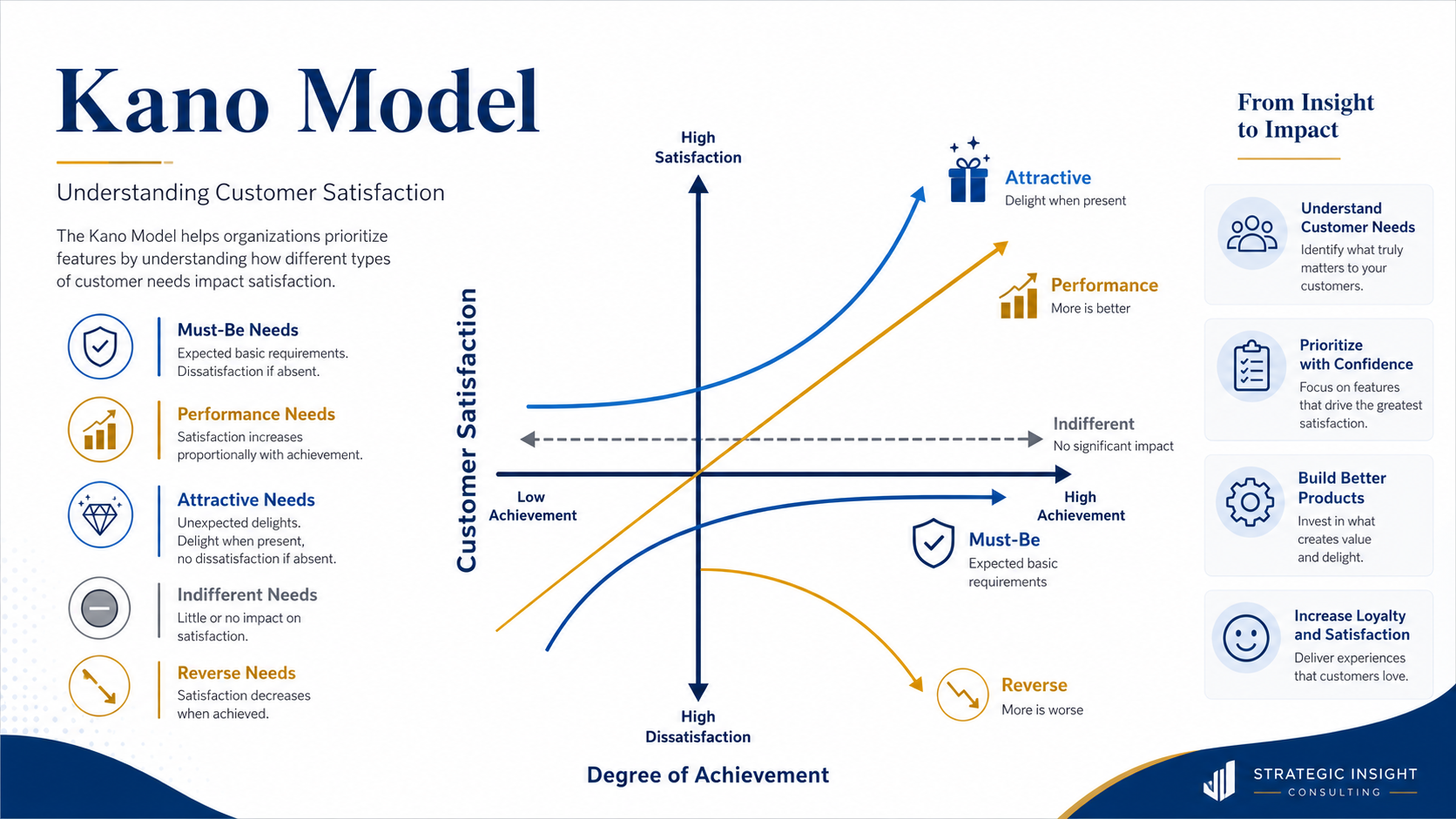
Kano Model: A Practical Framework for Understanding Customer Satisfaction and Prioritizing What Really Matters
Introduction
Not every customer requirement has the same impact on satisfaction.
Some features are expected as a basic minimum.
Some features increase satisfaction when they are improved.
Some features surprise customers and create delight.
The Kano Model is a powerful quality and customer-experience framework that helps organizations understand these differences. It supports better decisions in product development, service design, process improvement, customer experience, and operational excellence.
Instead of treating all customer requirements equally, the Kano Model helps businesses ask a smarter question:
Which requirements prevent dissatisfaction, which ones improve satisfaction, and which ones create competitive advantage?
For companies working in competitive markets, this distinction is critical. Customers do not only judge a product or service by what is included. They judge it by whether it meets their expectations, solves their problems, saves their time, and occasionally gives them something better than expected.
What Is the Kano Model?
The Kano Model was developed by Professor Noriaki Kano and introduced in the field of quality management. The model explains the relationship between product or service performance and customer satisfaction.
The core idea is simple:
Customer satisfaction does not increase in a straight line for every feature.
Some requirements must exist, or the customer becomes dissatisfied.
Some requirements create satisfaction when performance improves.
Some requirements create delight because customers did not expect them.
This makes the Kano Model especially useful for prioritization. It helps businesses avoid wasting resources on features that customers do not value, while ensuring that basic expectations are never ignored.
The Main Categories of the Kano Model
1. Must-Be Requirements
Must-be requirements are the basic expectations customers assume will already be present.
If these requirements are missing, customers become dissatisfied.
However, if they are present, customers may not feel especially impressed.
They simply consider them normal.
For example, in an e-commerce business, customers expect secure payment, clear pricing, accurate order confirmation, and reliable delivery information.
If these basics are missing, trust is damaged.
If they are present, customers may not praise the business because they expected them anyway.
Must-be requirements are the foundation of customer satisfaction.
They do not create excitement, but failure to meet them creates strong dissatisfaction.
2. Performance Requirements
Performance requirements are directly linked to satisfaction.
The better the performance, the higher the customer satisfaction.
The worse the performance, the lower the satisfaction.
For example, faster delivery, shorter response time, better product durability, easier navigation, and more accurate demand forecasting can all improve customer satisfaction.
In this category, customers can usually explain what they want.
They may say:
“We want faster delivery.”
“We want fewer errors.”
“We want better support.”
“We want more accurate stock availability.”
Performance requirements are important because they often become the basis of competition.
Businesses can compare themselves against competitors and improve measurable performance indicators.
3. Attractive Requirements
Attractive requirements are the features or service elements that delight customers.
Customers may not ask for them because they do not expect them.
But when these features are provided, satisfaction increases significantly.
For example, a customer may not expect proactive delivery updates, personalized recommendations, free setup guidance, smart reorder reminders, or a detailed after-sales follow-up call.
When these elements are delivered well, they create a positive emotional reaction.
Attractive requirements can help a business stand out in the market.
They are often the source of innovation and differentiation.
However, attractive requirements can change over time. What delights customers today may become expected tomorrow.
This is why businesses must continuously listen to customers and monitor changing expectations.
4. Indifferent Requirements
Indifferent requirements are features that do not significantly affect customer satisfaction.
Customers do not strongly care whether these features exist or not.
Adding them may increase cost or complexity without creating real value.
For example, a company may invest in a complicated dashboard, but customers may only need three simple performance indicators.
The Kano Model helps identify these low-value additions before resources are wasted.
This is especially important in product development, digital transformation, and service improvement projects.
5. Reverse Requirements
Reverse requirements are features that may satisfy some customers but dissatisfy others.
For example, a highly automated service may be appreciated by customers who prefer speed and self-service.
But other customers may dislike it because they prefer human support.
This category reminds businesses that customer segments are different.
A feature that works for one group may not work for another.
That is why Kano analysis should be supported by customer segmentation and real voice-of-customer data.
Why the Kano Model Matters for Business
The Kano Model is not only a product-design tool.
It is a decision-making framework.
It helps leadership teams, product managers, consultants, operations managers, and service designers make better choices about where to invest time, money, and improvement effort.
It prevents poor prioritization
Many businesses try to improve everything at the same time.
This creates scattered effort and weak results.
The Kano Model helps teams focus on what matters most.
First, fix the must-be requirements.
Second, improve the performance requirements.
Third, add attractive requirements that create differentiation.
It protects customer trust
A business cannot build loyalty on exciting features if basic expectations are failing.
For example, a retailer should not focus on advanced personalization while customers are still facing stock errors, delayed deliveries, or unclear return policies.
The Kano Model keeps the improvement sequence realistic.
Basics first.
Performance second.
Delight third.
It supports innovation
Innovation is not only about adding new technology.
Innovation is about creating meaningful value.
The Kano Model helps identify opportunities where a small improvement can create a strong emotional impact.
This makes it useful for digital services, SaaS platforms, e-commerce, retail, healthcare services, logistics, manufacturing, and consulting businesses.
It improves resource allocation
Every organization has limited resources.
Time, budget, people, and technology must be used carefully.
The Kano Model helps decision-makers avoid investing heavily in features that customers do not value.
It also helps justify why some features should be prioritized over others.
Kano Model Example in E-Commerce
Consider an online furniture store.
Customers may have many expectations, but not all expectations have the same effect.
Must-Be Requirements
The website must work properly.
Prices must be clear.
Product dimensions must be accurate.
Payment must be secure.
Customers must receive order confirmation.
Delivery promises must be reliable.
If any of these fail, customers may lose trust immediately.
Performance Requirements
Delivery speed affects satisfaction.
Product quality affects satisfaction.
Customer service response time affects satisfaction.
Accuracy of stock availability affects satisfaction.
The better the business performs in these areas, the more satisfied customers become.
Attractive Requirements
A room-size guide could help customers choose suitable furniture.
A proactive WhatsApp update could reduce anxiety.
A post-delivery care guide could improve the customer experience.
A happy call after delivery could create a professional impression.
These features may not be expected, but they can create strong satisfaction.
Indifferent Requirements
A complicated 3D configurator may not matter to customers if they simply want clear photos, dimensions, and delivery dates.
Adding advanced features without validating customer interest can waste resources.
How to Apply the Kano Model
Step 1: Collect Voice of Customer Data
Start by collecting customer feedback from multiple sources.
These may include surveys, interviews, complaints, reviews, support tickets, sales feedback, and operational data.
The goal is to understand what customers expect, what they value, and what frustrates them.
Step 2: List Customer Requirements
Convert customer feedback into clear requirement statements.
For example:
“Customers need accurate delivery dates.”
“Customers need fast response to complaints.”
“Customers need clear product specifications.”
“Customers appreciate proactive order updates.”
Each requirement should be specific and measurable where possible.
Step 3: Classify Each Requirement
Classify each requirement into one of the Kano categories:
Must-be
Performance
Attractive
Indifferent
Reverse
This classification can be done through workshops, customer surveys, or structured analysis.
Step 4: Prioritize Improvement Actions
The prioritization logic should be practical.
Fix must-be failures first.
Improve performance drivers second.
Add attractive features third.
Remove or reduce effort on indifferent features.
Review reverse features carefully by customer segment.
Step 5: Monitor Changes Over Time
Customer expectations change.
A feature that once created delight can become a basic expectation.
For example, real-time delivery tracking was once a premium feature.
Today, many customers expect it as standard.
This means Kano analysis should not be a one-time exercise.
It should be repeated regularly as part of continuous improvement.
Kano Model and Operational Excellence
Operational excellence is not only about reducing cost.
It is about delivering value consistently.
The Kano Model supports operational excellence by connecting customer expectations with process priorities.
For example, if customers are dissatisfied because of late deliveries, the business should not only improve customer service scripts.
It should investigate root causes in demand planning, inventory control, supplier reliability, warehouse picking, transport scheduling, and order tracking.
This turns customer satisfaction into an operational improvement roadmap.
The Kano Model can also be combined with other tools such as:
Voice of Customer analysis
Quality Function Deployment
Lean Six Sigma
Root Cause Analysis
SIPOC
Customer Journey Mapping
Process KPIs
Corrective Action Plans
When combined properly, these tools help businesses move from customer complaints to measurable improvement.
Common Mistakes When Using the Kano Model
Mistake 1: Treating all customer requests as equal
Not every request deserves the same priority.
Some requests are critical.
Some are useful.
Some are distractions.
The Kano Model helps separate them.
Mistake 2: Ignoring basic requirements
Businesses sometimes focus on innovation while basic service quality is weak.
This creates frustration.
Customers will not appreciate attractive features if the fundamentals are failing.
Mistake 3: Using internal opinions only
Kano analysis should not depend only on what managers think customers want.
It should be supported by real customer feedback.
Mistake 4: Forgetting that expectations change
Customer expectations evolve.
Today’s attractive feature may become tomorrow’s must-be requirement.
Businesses must keep reviewing the model.
Benefits of the Kano Model
The Kano Model helps organizations:
Understand customer expectations more clearly.
Prioritize features and improvement actions.
Reduce wasted investment.
Improve product and service design.
Increase customer satisfaction.
Support innovation.
Strengthen competitive differentiation.
Improve decision-making between teams.
Connect customer experience with operational improvement.
When Should a Business Use the Kano Model?
The Kano Model is useful when a business needs to make decisions about customer value.
It can be used when:
Launching a new product.
Improving a service.
Redesigning a customer journey.
Prioritizing software features.
Reducing customer complaints.
Improving e-commerce experience.
Developing a consulting service package.
Reviewing customer satisfaction survey results.
Building a roadmap for digital transformation.
Improving quality management systems.
It is especially useful when there are many possible improvements but limited resources.
Conclusion
The Kano Model is a practical and powerful framework for understanding customer satisfaction.
It helps businesses move beyond simple feature lists and focus on what customers truly value.
By separating must-be requirements, performance requirements, attractive requirements, indifferent requirements, and reverse requirements, organizations can make smarter decisions.
The strongest businesses do not only ask:
“What can we add?”
They ask:
“What must never fail?”
“What improves satisfaction?”
“What creates delight?”
“What does the customer not care about?”
“What may satisfy one segment but frustrate another?”
When used correctly, the Kano Model becomes more than a prioritization tool.
It becomes a bridge between customer expectations, operational excellence, and business growth.
At OpexEdge Consultancy, the Kano Model can be used as part of customer experience improvement, service design, product prioritization, quality management, and operational excellence projects to help businesses focus on the improvements that create real customer value.
Need help understanding what your customers really value?
OpexEdge Consultancy can help you analyze customer requirements, classify improvement opportunities, and build a practical action plan using the Kano Model and operational excellence tools.
Contact OpexEdge Consultancy to transform customer feedback into measurable business improvement.
info@opexedg.com

4 Comments