
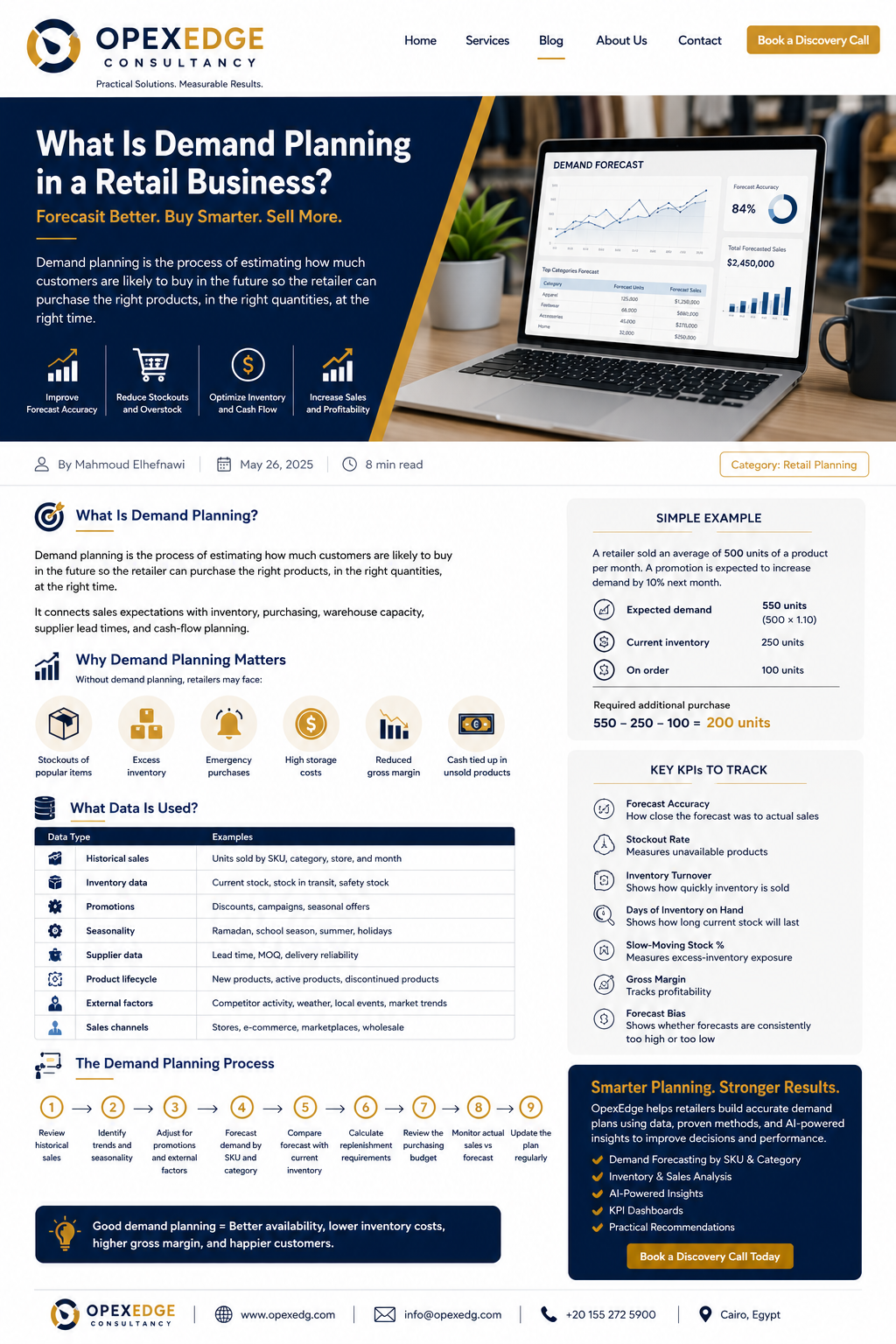
What Is Demand Planning in a Retail Business?
Demand planning is the process of estimating how much customers are likely to buy in the future so the retailer can purchase the right products, in the right quantities, at the right time.
It connects sales expectations with inventory, purchasing, warehouse capacity, supplier lead times, and cash-flow planning.
The main question is:
How much demand should we expect for each product, category, store, and sales channel during the coming weeks or months?
Why Demand Planning Matters
Without demand planning, retailers may face:
- Stockouts of popular items
- Excess inventory
- Slow-moving stock
- Emergency purchases
- High storage costs
- Cash tied up in unsold products
- Missed sales opportunities
- Reduced gross margin
- Weak purchasing-budget control
A good demand plan helps the retailer balance product availability with inventory cost.
What Data Is Used?
Retail demand planning usually uses:
| Data Type | Examples |
| Historical sales | Units sold by SKU, category, store, and month |
| Inventory data | Current stock, stock in transit, safety stock |
| Promotions | Discounts, campaigns, seasonal offers |
| Seasonality | Ramadan, school season, summer, holidays |
| Supplier data | Lead time, MOQ, delivery reliability |
| Product lifecycle | New products, active products, discontinued products |
| External factors | Competitor activity, weather, local events, market trends |
| Sales channels | Stores, e-commerce, marketplaces, wholesale |
Simple Example
A retailer sold an average of 500 units per month of a certain product.
The business expects a 10% increase next month due to a promotion.
Expected demand:
500 × 1.10 = 550 units
If the retailer has 250 units in stock and 100 units already on order:
Required additional purchase = 550 − 250 − 100 = 200 units
The actual calculation may also include safety stock and supplier lead time.
Main Steps in Retail Demand Planning
- Review historical sales.
- Identify trends and seasonality.
- Adjust for promotions, holidays, and external factors.
- Forecast demand by SKU and category.
- Compare forecasted demand with current inventory.
- Calculate replenishment requirements.
- Review the purchasing budget.
- Monitor actual sales versus forecast.
- Update the plan regularly.
Important KPIs
| KPI | Purpose |
| Forecast Accuracy | Measures how close the forecast was to actual sales |
| Forecast Bias | Shows whether forecasts are consistently too high or too low |
| Stockout Rate | Measures unavailable products |
| Service Level | Measures the ability to meet customer demand |
| Inventory Turnover | Shows how quickly stock is sold |
| Days of Inventory on Hand | Shows how long current stock will last |
| Slow-Moving Stock % | Measures excess-inventory exposure |
| Purchase Plan Adherence | Measures execution against the approved plan |
| Gross Margin | Tracks profitability |
Demand Planning vs Open-to-Buy Planning
These two concepts work together:
| Demand Planning | Open-to-Buy Planning |
| Estimates what customers are likely to buy | Controls how much the retailer can spend |
| Focuses on expected demand | Focuses on purchasing budget |
| Uses sales trends and seasonality | Uses inventory, sales plans, and purchase commitments |
| Helps determine required stock | Helps prevent overspending |
Demand planning tells you what and how much you may need.
Open-to-buy planning tells you how much you can afford to purchase.
How AI Can Help
AI-assisted demand planning can help retailers:
- Detect sales patterns faster
- Identify seasonal demand
- Flag stockout risks
- Identify overstocked categories
- Forecast demand by SKU
- Compare actual sales with forecasts
- Recommend purchasing adjustments
- Highlight slow-moving products
- Support better category-level decisions
AI should support buyer and management decisions, not replace them.

3 Comments