Sales Funnel: The Journey to Generate Conversions
A sales funnel is not just a marketing diagram. It is the structured journey that moves a potential customer from first awareness to trust, decision, purchase, and long-term relationship.
Many businesses spend money on advertising, content, websites, social media, and sales teams, but still struggle to convert visitors into qualified leads or paying customers. The problem is often not traffic. The real problem is that the customer journey is unclear, disconnected, or full of friction.
A strong sales funnel helps businesses understand what customers need at every stage, what information they require before buying, where they drop off, and how to improve conversion performance. Conversion Rate Optimization focuses on removing friction and guiding prospects toward specific actions such as sign-up, quote request, purchase, or consultation booking. (Salesforce)
At OpexEdge Consultancy, we treat the sales funnel as a business-performance system, not only a marketing tool. It connects strategy, customer experience, digital marketing, sales process, data analysis, operational readiness, and continuous improvement.
A sales funnel is the step-by-step path a prospect follows before becoming a customer. The journey usually starts when a person discovers your brand, product, or service, then continues through evaluation, comparison, trust-building, decision-making, and finally conversion.
A conversion funnel is commonly used to understand how visitors move toward becoming customers and where they abandon the process.
A practical sales funnel answers five important business questions:
- How do potential customers discover us?
- What problem are they trying to solve?
- What makes them trust us?
- What prevents them from buying?
- What action should they take next?
Without these answers, businesses may generate traffic but fail to generate revenue.
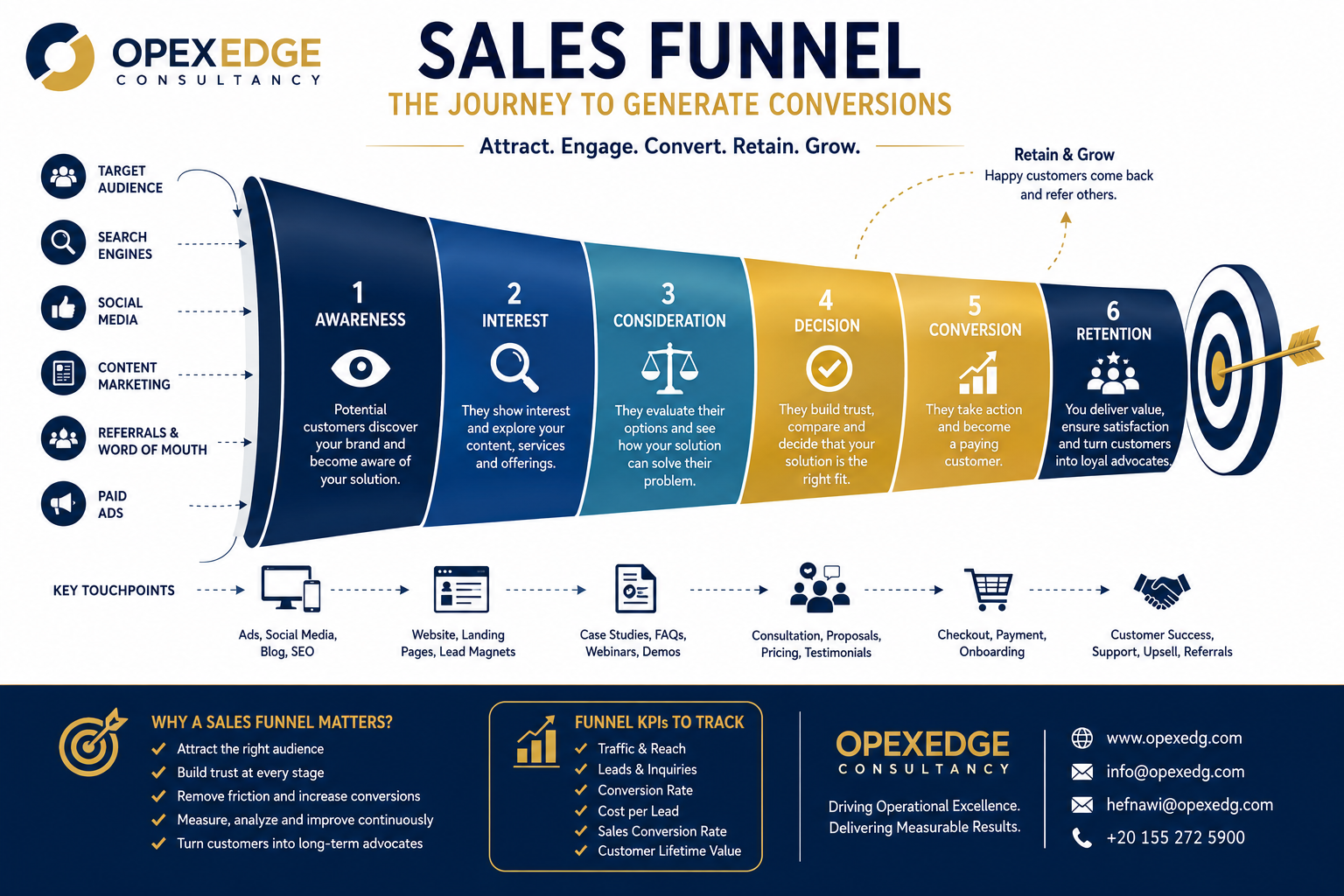
Sales Funnel Stages
The Main Stages of the Sales Funnel
- Awareness
At this stage, the customer discovers that your company exists. This may happen through search engines, social media, referrals, advertising, events, articles, or word of mouth.
The goal is not to sell immediately. The goal is to attract the right audience and create initial recognition.
Examples of awareness content:
- Educational blog posts
- LinkedIn posts
- SEO articles
- Short videos
- Industry insights
- Problem-focused guides
For OpexEdge, awareness content may include topics such as operational excellence, demand planning, warehouse optimization, customer experience, ISO 9001, KPI development, and process improvement.
- Interest
Once people know your brand, they need a reason to continue. At this stage, they start exploring your content, services, case studies, and expertise.
The goal is to show relevance.
A potential customer may think:
“Does this company understand my problem?”
“Have they solved similar issues before?”
“Is this service suitable for my business?”
Useful content at this stage includes service pages, expert profiles, case studies, downloadable checklists, diagnostic tools, and practical guides.
- Consideration
In the consideration stage, the prospect is comparing options. They may compare your business with competitors, internal solutions, freelancers, agencies, or doing nothing.
The goal is to build trust and reduce risk.
This is where businesses must explain:
- The problem clearly
- The service scope
- Expected deliverables
- Implementation approach
- Timeline
- Benefits
- Proof of experience
- Next steps
A weak consideration stage creates hesitation. A strong consideration stage makes the decision easier.
- Decision
At the decision stage, the customer is close to taking action. They may request a quote, book a call, download a questionnaire, ask for a proposal, or purchase a service.
The goal is to make the next step simple and clear.
Important decision-stage elements include:
- Strong CTA
- Clear pricing or quote process
- Contact information
- Trust signals
- Testimonials or case studies
- Expert profile link
- Simple form
- Fast response process
For example, OpexEdge service pages already use clear actions such as “Request a Quote” and contact details for business inquiries. (Operational Excellence Edge Consultancy)
- Conversion
Conversion happens when the customer completes the desired action.
This can include:
- Buying a service
- Booking a consultation
- Requesting a quote
- Submitting a questionnaire
- Signing a contract
- Downloading a lead magnet
- Joining a workshop
- Starting an assessment
However, conversion is not the end of the journey. It is the beginning of delivery, satisfaction, and repeat business.
- Retention and Advocacy
The best sales funnel does not stop after the first sale. It continues into customer satisfaction, loyalty, referrals, repeat purchases, and long-term business relationships.
Retention is especially important for consulting, training, operational excellence, ISO systems, supply chain, retail planning, and transformation projects.
A satisfied customer can become:
- A repeat buyer
- A referral source
- A case study
- A testimonial provider
- A long-term strategic partner
Why Sales Funnels Fail
Why Many Sales Funnels Fail
Many companies do not fail because their product or service is weak. They fail because the customer journey is not designed properly.
Common sales funnel problems include:
- Targeting the wrong audience
- Weak value proposition
- Poor website structure
- Unclear service explanation
- No strong CTA
- Slow response to inquiries
- Lack of trust signals
- Missing case studies
- Complicated buying process
- No follow-up system
- No measurement of drop-off points
A sales funnel must be managed like a business process. If the process is unclear, the output will be inconsistent.
Sales Funnel KPIs
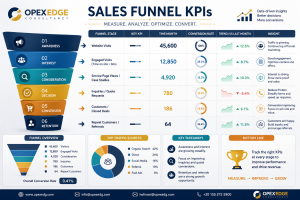
Key Sales Funnel KPIs
To improve a sales funnel, businesses must measure it. Without data, funnel improvement becomes guesswork.
Important KPIs include:
Funnel Stage | KPI |
Awareness | Website visits, impressions, reach, SEO traffic |
Interest | Page views, time on page, content downloads |
Consideration | Service-page visits, return visitors, case-study views |
Decision | Quote requests, consultation bookings, form submissions |
Conversion | Sales conversion rate, close rate, revenue |
Retention | Repeat purchase rate, referrals, customer satisfaction |
A practical funnel dashboard should show where customers enter, where they drop off, and which actions generate revenue.
How to Build a High-Converting Sales Funnel
How to Build a High-Converting Sales Funnel
Step 1: Define the Customer Persona
Before building any funnel, identify the target customer.
Define:
- Industry
- Company size
- Decision maker
- Main pain points
- Budget level
- Buying triggers
- Objections
- Preferred communication channel
For B2B services, the decision maker may be a CEO, operations manager, quality manager, supply chain manager, retail director, factory owner, or business development manager.
Step 2: Map the Customer Journey
Create a journey map that shows how the customer moves from problem awareness to decision.
Ask:
- What does the customer search for?
- What questions do they ask?
- What proof do they need?
- What risks worry them?
- What makes them trust the provider?
- What CTA fits each stage?
Step 3: Match Content to Each Funnel Stage
Each stage needs a different type of content.
Stage | Best Content Type |
Awareness | Educational articles, social posts, short videos |
Interest | Service pages, expert insights, guides |
Consideration | Case studies, comparison pages, FAQs |
Decision | Quote form, consultation CTA, proposal, pricing |
Retention | Follow-up emails, reports, dashboards, support |
Step 4: Create Strong Landing Pages
A strong landing page must be clear, focused, and action-oriented.
It should include:
- Clear headline
- Problem statement
- Service benefits
- Deliverables
- Process steps
- Case study
- Expert profile
- Contact details
- CTA button
- FAQ section
The landing page should not make the visitor work hard to understand the offer.
Step 5: Remove Friction
Friction is anything that slows the customer down or creates doubt.
Examples include:
- Long forms
- Unclear pricing
- Missing contact information
- Confusing navigation
- Weak mobile experience
- No proof of expertise
- Too many CTAs
- Slow response time
Conversion optimization improves the value of existing traffic by helping more visitors complete useful actions. (Salesforce)
Step 6: Use Follow-Up and CRM
Many leads do not convert immediately. They need follow-up.
A simple CRM follow-up process should include:
- Lead source tracking
- Inquiry classification
- Response time monitoring
- Follow-up reminders
- Proposal status tracking
- Lost-reason analysis
- Customer feedback
A funnel without follow-up is incomplete.
Step 7: Improve Continuously
A sales funnel should be reviewed regularly.
Businesses should test:
- Headlines
- CTA wording
- Landing page structure
- Lead magnets
- Form length
- Offer clarity
- Follow-up messages
- Pricing presentation
- Case-study placement
Funnel improvement is a continuous improvement cycle.
Case Study: Improving a Retail and E-Commerce Conversion Journey
A retail and e-commerce business was receiving customer interest but needed a more structured way to convert attention into profitable sales. The business had multiple touchpoints: website visits, product views, add-to-cart actions, customer inquiries, delivery coordination, and after-sales support.
The improvement approach focused on five areas:
- Clarifying the customer journey from product discovery to purchase
- Improving the website and online sales process
- Tracking customer actions such as add-to-cart behavior
- Reducing operational friction in fulfillment and customer service
- Connecting sales, inventory, delivery, and customer experience decisions
Mahmoud Elhefnawi’s OpexEdge expert profile includes strong retail, e-commerce, customer service, operations, and digital strategy experience, including building a cost-effective e-commerce platform, achieving 30 million add-to-cart actions, improving delivery cost efficiency, and managing customer service performance. (Operational Excellence Edge Consultancy)
Business Lessons from the Case
The case shows that sales funnel improvement is not only about marketing. It also depends on:
- Website usability
- Product availability
- Pricing clarity
- Customer service speed
- Delivery reliability
- Inventory control
- Follow-up process
- Customer trust
A sales funnel generates better results when marketing and operations work together.
How OpexEdge Can Help
OpexEdge Consultancy helps businesses design practical, measurable, and conversion-focused sales funnels.
Our support can include:
- Customer journey mapping
- Sales funnel audit
- Website conversion review
- Landing page improvement
- Customer persona development
- Funnel KPI dashboard
- Lead management process
- CRM follow-up structure
- Service offer packaging
- Case-study development
- CTA optimization
- Business improvement roadmap
OpexEdge already provides services connected to operational excellence, demand planning, warehouse assessment, open-to-buy planning, ISO 9001 documentation, and supply chain improvement. These services support stronger business performance by connecting strategy, process, data, and execution.
Learn more from our expert:
Mahmoud Elhefnawi
Operations Excellence Consultant | Supply Chain & Retail Transformation | AI-Assisted Operational Improvement
https://opexedg.com/experts/mahmoud-elhefnawi/
Conclusion
A sales funnel is the journey that turns attention into trust, trust into action, and action into revenue.
Businesses that want more conversions should not only ask, “How can we get more traffic?”
They should also ask, “How can we help the right customer move smoothly from awareness to decision?”
A strong sales funnel connects marketing, sales, customer experience, operations, and data. It shows where customers drop off, what they need at each stage, and how the business can improve performance.
When designed correctly, the sales funnel becomes more than a marketing tool. It becomes a business growth system.
Ready to improve your sales funnel and generate more qualified conversions?
OpexEdge Consultancy can help your business review the customer journey, identify conversion gaps, improve service pages, design funnel KPIs, and build a practical action plan for growth.
Contact OpexEdge Consultancy today to request a sales funnel and conversion journey assessment.
Contact Info
OpexEdge Consultancy
Website: https://opexedg.com
Email: info@opexedg.com
Email: hefnawi@opexedg.com
Mobile / WhatsApp: +20 155 272 5900
Related Topics
- Mahmoud Elhefnawi Expert Profile
https://opexedg.com/experts/mahmoud-elhefnawi/ - Operational Excellence
https://opexedg.com/operational-excellence/ - AI-Powered Retail Demand Planning Service
https://opexedg.com/services/ai-powered-retail-demand-planning/ - AI-Powered Open-To-Buy Planning Service
https://opexedg.com/services/open-to-buy-otb/ - AI-Powered ISO9001 Documentation Service
https://opexedg.com/services/ai-powered-iso9001/ - SWOT Analysis Article
https://opexedg.com/swot-analysis-strategic-framework/ - Pareto Principle 80/20 Article
https://opexedg.com/pareto-principle-80-20-operational-excellence/ - SPC Statistical Process Control Article
https://opexedg.com/spc-statistical-process-control/
Related TopicsTPM, Hypothesis Test , Accuracy, 6Sigma, MSA, POKAYOKE, MUDA, 5S, FMEA, SIPOC, KPI, ISO9001, ISO20022, w/h, demand planning , OTB , KANO, case study, OTB service, demand planning service , SC service, problem solving service ,
