
ISO 9001: The Quality Management Standard That Turns Business Discipline into Customer Trust
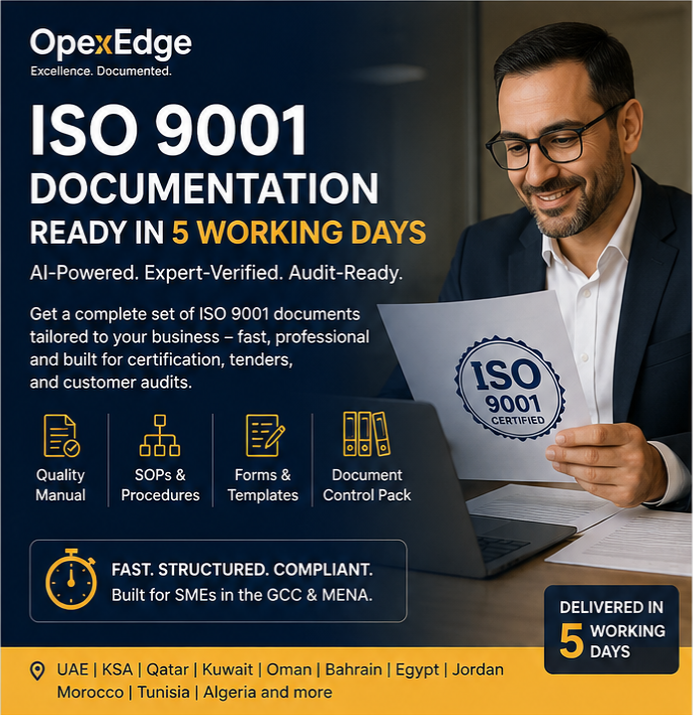
ISO 9001 documents ready in 5 working days?
Yes, it’s possible.
Many SMEs lose tender opportunities, delay certification, or struggle in customer audits because their documents are incomplete, uncontrolled, or not customized to their real business.
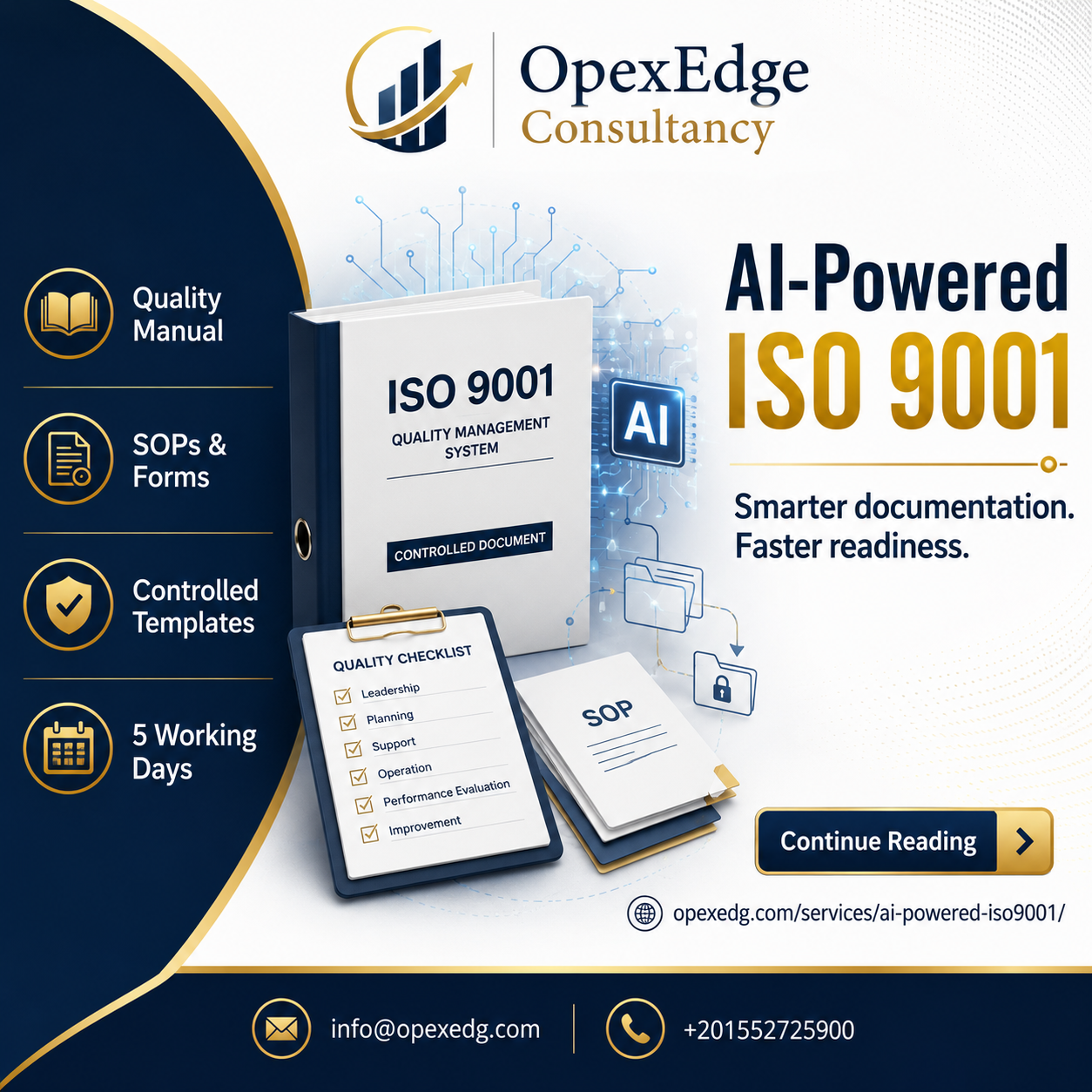
OpexEdge helps you prepare a complete ISO 9001 documentation package using AI-powered tools and expert review.
You get:
✅ Quality Manual
✅ SOPs & Procedures
✅ Controlled Forms & Templates
✅ Document Register / Master List
✅ Editable Word files
✅ Customized documents based on your company scope, logo, and information
✅ Arabic version upon request نسخة بالغة العربية مجانا حسب الطلب
✅ You don’t have to start your documentation from zero
Built for SMEs preparing for:
🎯 ISO 9001 certification
🎯 Tender qualification
🎯 Supplier approval
🎯 Customer audits
🎯 Internal process control
Focus on running your business.
We’ll take care of the documentation.
What OpexEdge offer?
·A tailored list of required ISO 9001 documents applicable to the customer’s business scope.
·A Quality Manual in Word format, customized to the customer’s activities, scope, and organizational structure.
·All required Standard Operating Procedures (SOPs) in Word format, customized based on the collected information.
·Controlled document templates including document code, revision number, issue date, page numbering, approval fields, and customer company logo/information.
·A document register / master list for document control.
·Editable files delivered to the customer for future maintenance and internal use.
How it works?
You download the sample package.
You review the structure and templates.
You download free questionnaire, fill it up , send it back to us.
We adapt the documents to your business using AI-assisted support.
You can request the Arabic version free of charge.
If needed, we help you move toward implementation and audit readiness.
Ready to improve your business performance?
Contact OpexEdge Consultancy to request an AI-powered ISO9001 document development, improve service, and unlock operational value.
Email: info@opexedg.com
WhatsApp: +20-155-272-5900
Know your Expert
Mahmoud Elhefnawi
Hire Us Now -$150
Download Free Questionnaire
Sample ISO9001 Documentation Package
Request a Quote
ISO 9001 is not just a certificate on the wall. It is a structured management system that helps organizations deliver consistent products and services, control operational risk, improve customer satisfaction, and build a culture of continual improvement.
For many businesses, ISO 9001 is the first step toward professionalizing operations. It forces the organization to answer important questions:
Who is responsible for quality?
How are processes controlled?
How are customer requirements understood?
How are mistakes corrected?
How does leadership know whether the business is improving?
When implemented correctly, ISO 9001 becomes much more than documentation. It becomes a practical operating system for quality, accountability, performance, and trust.
Request a Quote
Hire Us Now -$150
What Is ISO 9001?
ISO 9001 is an international standard for quality management systems, commonly known as QMS.
It provides requirements that help organizations consistently meet customer, legal, regulatory, and internal business requirements.
The standard can be applied to almost any organization, regardless of size or industry. It is used by manufacturers, service companies, logistics providers, construction firms, healthcare organizations, technology companies, public agencies, and professional service providers.
At its core, ISO 9001 helps businesses move from informal working habits to controlled, measurable, and improvable processes.A strong ISO 9001 system answers five practical questions:
1. What does the customer require?
2. Which processes are needed to deliver those requirements?
3. Who owns each process?
4. How is performance measured?
5. How does the organization correct problems and improve?
Why ISO 9001 Matters
Many companies grow with experience, effort, and personal knowledge.
This may work for a small team, but as the business expands, informal management becomes risky.
Problems start to appear:
repeated mistakes, unclear responsibilities, customer complaints, poor documentation, supplier inconsistency, weak follow-up, and slow corrective actions.
ISO 9001 helps solve these problems by creating a disciplined system.
It improves the business in several ways:
· It clarifies roles and responsibilities.
· It standardizes important processes.
· It improves customer focus.
· It supports better decision-making through data.
· It reduces repeated errors.
· It strengthens supplier and process control.
· It builds confidence with customers, partners, and auditors.
· It creates a foundation for continual improvement.
The real value of ISO 9001 is not the certificate itself. The real value is the control, consistency, and improvement culture behind the certificate.
Request a Quote
Hire Us Now -$150
ISO 9001 Is Built Around Continual Improvement
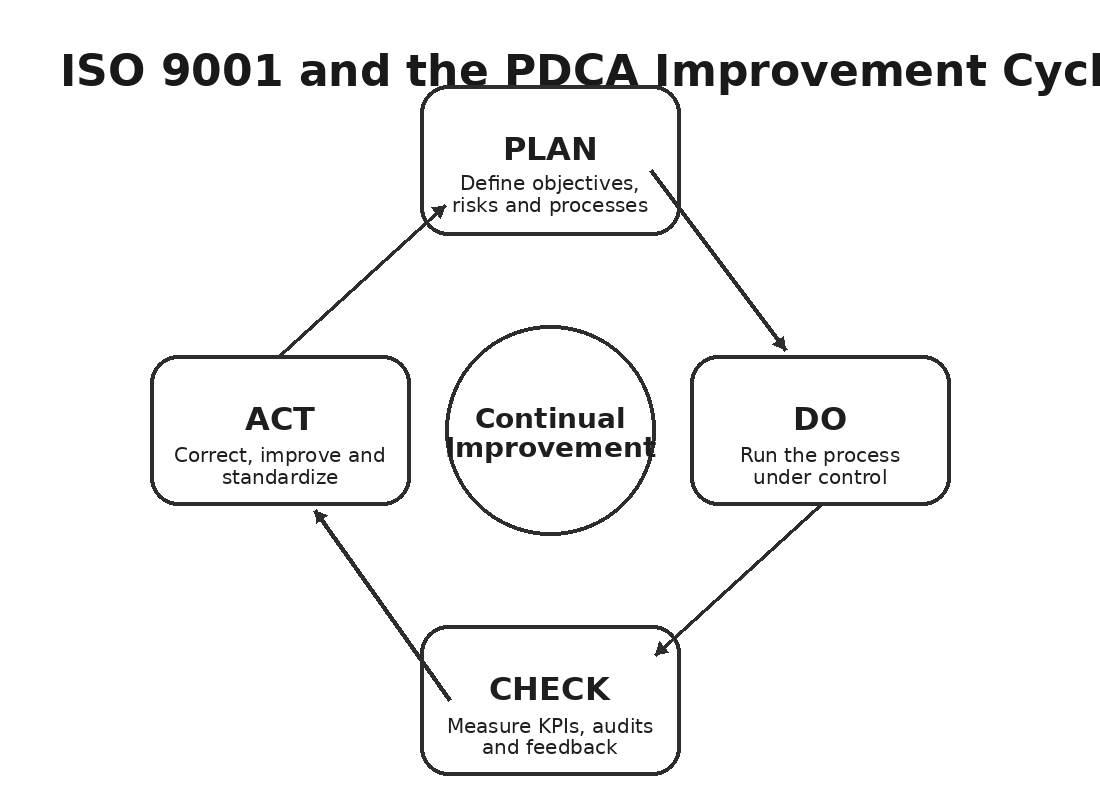
One of the simplest ways to understand ISO 9001 is the PDCA cycle:
Plan: Define objectives, processes, risks, resources, and responsibilities.
Do: Execute the process according to planned controls.
Check: Monitor performance, audit the system, and review results.
Act: Correct problems, improve weak areas, and standardize better practices.
This cycle turns quality into a repeatable management habit.
A company that only writes procedures is not truly implementing ISO 9001.
A company that plans, executes, measures, learns, and improves is using ISO 9001 correctly.
Key ISO 9001 Requirements in Simple Business Language
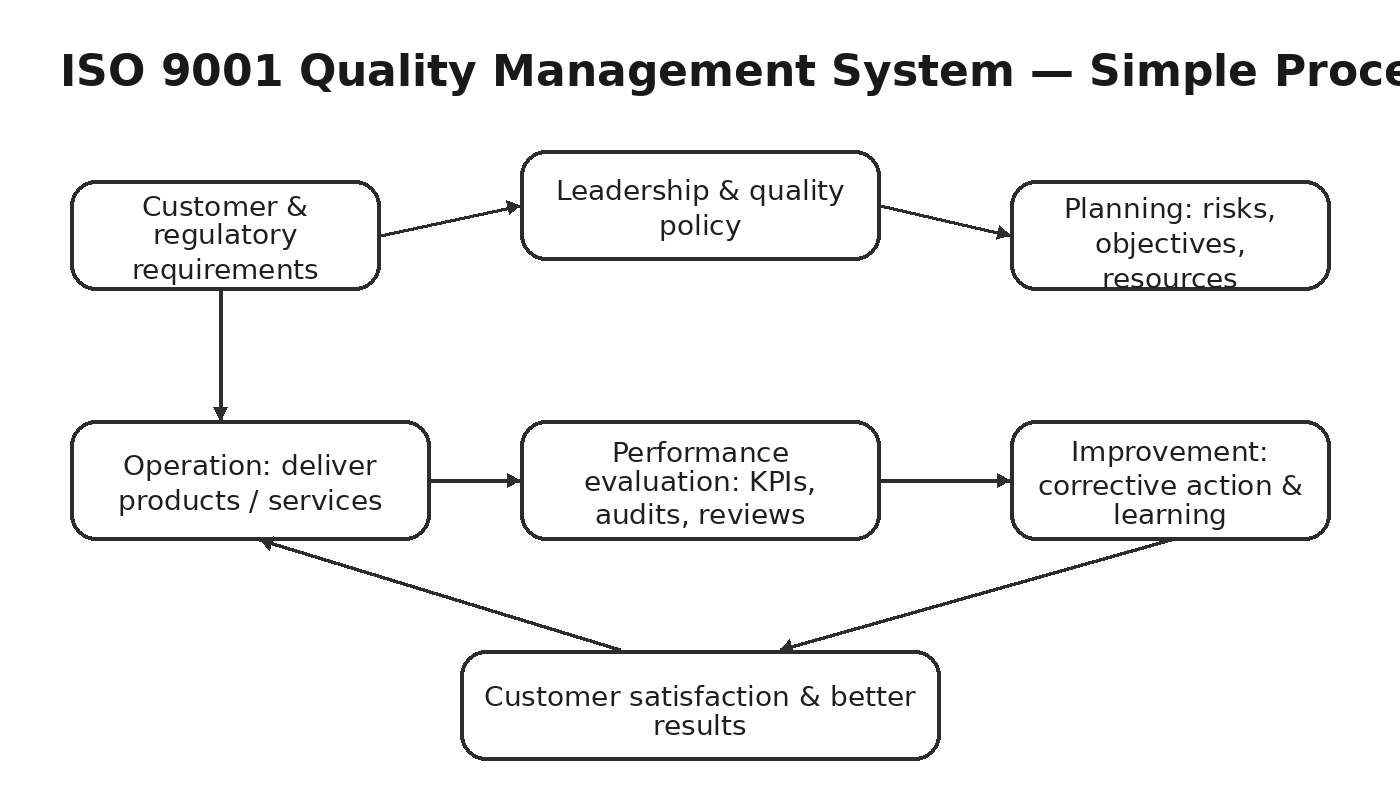
ISO 9001 includes several requirement areas. Instead of looking at them as clauses only, businesses should understand them as management disciplines.
Context of the Organization
The company must understand its internal and external environment. This includes market conditions, customer expectations, legal requirements, supplier conditions, competition, technology, and internal capabilities.
The goal is to ensure the quality management system is relevant to the real business context.
Leadership
Top management must show ownership of the QMS. This includes setting the quality policy, aligning quality objectives with business direction, assigning responsibilities, and supporting process owners.
Leadership must also promote customer focus and continual improvement.
Planning
The organization must plan actions to address risks and opportunities. It must define quality objectives that are measurable and relevant.Examples of quality objectives include reducing customer complaints, improving on-time delivery, reducing rework, improving supplier performance, or increasing first-pass yield.
Support
The organization must provide the resources needed to run the QMS. This includes people, infrastructure, work environment, monitoring equipment, knowledge, competence, communication, and documented information.
Support is important because poor training, weak communication, and missing resources often cause quality problems.
Operation
This is where the business delivers its product or service. ISO 9001 requires operational processes to be planned, controlled, and monitored.
This may include customer communication, design and development, purchasing, production, service delivery, inspection, release, delivery, and control of nonconforming outputs.
Performance Evaluation
The company must check whether the QMS is working. This includes monitoring customer satisfaction, measuring process performance, conducting internal audits, and holding management reviews.Performance evaluation turns the QMS from a document system into a management system.
Improvement
The organization must respond to nonconformities, take corrective actions, and improve the QMS. Improvement should be based on evidence, not guesswork.
A good corrective action system does not only fix the visible issue. It identifies root causes and prevents recurrence.
The Main Principles Behind ISO 9001
ISO 9001 is built around quality management principles that guide how an organization should think and operate.
1. Customer Focus
Quality starts with understanding what the customer needs and expects. A company cannot claim to have a strong quality system if it does not capture customer requirements, monitor customer satisfaction, and respond properly to complaints or feedback.
Customer focus means the organization must design its processes around delivering value.
2. Leadership
ISO 9001 requires leadership involvement. Quality cannot be delegated only to the quality department. Top management must define the quality direction, provide resources, assign responsibilities, review performance, and promote improvement.Without leadership commitment, ISO 9001 becomes paperwork.
With leadership commitment, it becomes a business management tool.
3. Process Approach
A business is a network of connected processes.
Sales affects planning.
Planning affects purchasing.
Purchasing affects production or service delivery.
Delivery affects customer satisfaction.
ISO 9001 encourages organizations to manage these processes as a connected system, not as isolated departments.
4. Risk-Based Thinking
ISO 9001 encourages organizations to identify risks and opportunities that may affect quality performance. This does not mean every company needs a complicated risk register. It means the business should think ahead and prevent problems before they happen.
Examples include supplier failure, unclear customer specifications, machine breakdown, staff competency gaps, inventory shortages, delivery delays, and documentation errors.
5. Evidence-Based Decision-Making
Good quality management depends on facts. ISO 9001 pushes organizations to use data, not assumptions. This includes customer complaints, process KPIs, audit results, nonconformities, delivery performance, inspection results, and corrective action effectiveness.
6. Continual Improvement
The goal of ISO 9001 is not perfection from day one. The goal is to create a system that improves over time.Continual improvement means the organization learns from problems, audits, customer feedback, process results, and management reviews.
ISO 9001 Certification: What It Means and What It Does Not Mean
ISO 9001 certification means an independent certification body has audited the organization’s quality management system and confirmed that it conforms to ISO 9001 requirements.
However, certification does not mean the organization is perfect. It does not guarantee that every product or service will always be flawless. It means the organization has a structured system to control quality, manage nonconformities, monitor performance, and improve.
Certification can be valuable when customers, tenders, regulators, or supply-chain partners require independent assurance.
For many companies, certification improves credibility. But the strongest value comes when ISO 9001 is used as a business improvement system, not just as an audit requirement.
Common Mistakes in ISO 9001 Implementation
Many organizations fail to gain value from ISO 9001 because they implement it incorrectly.
Mistake 1: Starting with Templates Instead of Processes
Templates are useful, but they should not lead the project. The right starting point is understanding how the business actually works. A practical ISO 9001 project starts with process mapping, responsibility clarification, risk identification, and performance gaps.
Mistake 2: Treating ISO as a Quality Department Project
ISO 9001 belongs to the whole organization. Sales, operations, procurement, warehouse, production, HR, maintenance, finance, and top management all affect quality. If only the quality department is involved, the system becomes isolated and weak.
Mistake3: Creating Too Much Documentation
ISO 9001 requires controlled documented information, but it does not require unnecessary paperwork. Documentation should be useful, simple, and connected to real work. Good documentation helps people perform correctly. Bad documentation exists only to satisfy auditors.
Mistake 4: Weak Corrective Actions
Some companies close nonconformities quickly without understanding root causes. This creates repeated problems.A strong corrective action process asks:
What happened?
Why did it happen?
What is the root cause?
What action will prevent recurrence?
How will effectiveness be verified?
Mistake 5: Ignoring Performance Data
A QMS without measurement is weak. ISO 9001 should be connected to KPIs such as complaints, defects, rework, delivery performance, process cycle time, supplier quality, audit findings, and customer satisfaction.
Request a Quote
Hire Us Now -$150
How to Implement ISO 9001 in Practice
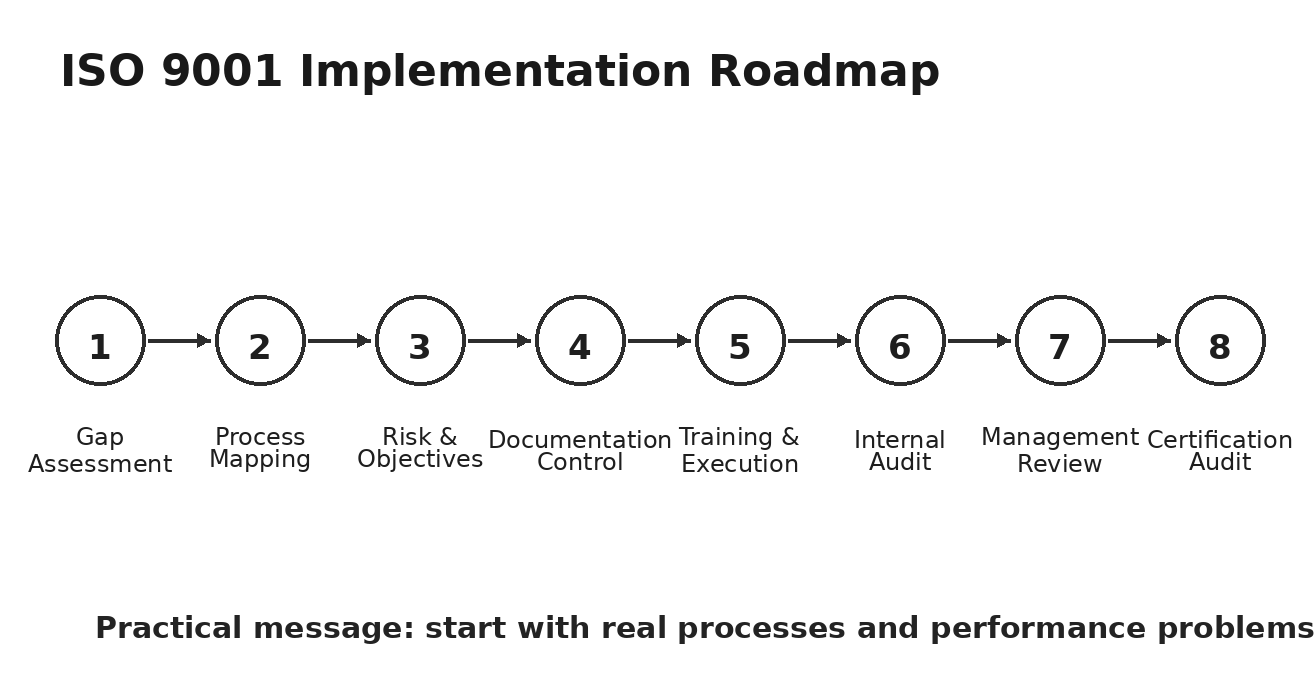
A practical ISO 9001 implementation should follow a clear roadmap.
Step 1: Conduct a Gap Assessment
Compare the current business system against ISO 9001 requirements. Identify missing controls, weak processes, unclear responsibilities, and documentation gaps.
Step 2: Map Key Processes
Identify the main processes that affect customer satisfaction and business performance. These may include sales, order management, procurement, production, service delivery, quality control, delivery, complaints, and supplier management.
Step 3: Define Risks, Objectives, and KPIs
Set measurable quality objectives. Identify risks and opportunities for each critical process. Link objectives to business performance.
Step 4: Build Simple Documentation
Create or improve the needed documents, such as quality policy, process procedures, forms, work instructions, records, audit plan, corrective action log, and management review inputs.Documentation should be clear, controlled, and useful.
Step 5: Train the Team
Employees need to understand their responsibilities, process controls, quality objectives, and how to report problems.Training should focus on practical execution, not only awareness.
Step 6: Run the System
The QMS must be applied in real operations. Records should be generated, KPIs measured, nonconformities reported, and corrective actions managed.
Step 7: Conduct Internal Audits
Internal audits check whether the system conforms to ISO 9001 and whether it is effectively implemented.
A good internal audit does not only search for mistakes. It identifies risk, weakness, and improvement opportunities.
Step 8: Hold Management Review
Top management must review QMS performance, audit results, customer feedback, process performance, risks, resources, corrective actions, and improvement needs.
Management review connects ISO 9001 with business strategy.
Step 9: Prepare for Certification Audit
Once the system is implemented and records are available, the organization can invite an independent certification body for audit.
Certification should be the result of a working system, not the reason for creating paperwork.
ISO 9001 and Operational Excellence
ISO 9001 supports operational excellence because it creates the basic management structure required for stable and improving operations.
Operational excellence needs standard processes, clear ownership, performance measurement, root cause analysis, risk control, and continual improvement. These elements are also central to ISO 9001.
For example:
· Lean needs process stability.
· Six Sigma needs reliable data.
· TPM needs standard maintenance and responsibility.
· Supply chain improvement needs supplier and process control.
· Customer service improvement needs complaint analysis and corrective action.
ISO 9001 provides the management foundation for all these improvement methods.
The Future of ISO 9001
ISO 9001 continues to evolve because business conditions are changing. Organizations now face stronger expectations around resilience, digitalization, sustainability, climate-related considerations, supply-chain risk, and stakeholder confidence.
Companies certified to ISO 9001:2015 should not wait passively for future revisions. They can start strengthening their systems now by reviewing risk management, process performance, customer satisfaction, supplier control, data quality, and improvement effectiveness.
The organizations that gain the most value from ISO 9001 are those that see it as a living system, not a one-time certification project.
Practical Checklist: Is Your ISO 9001 System Effective?
Use these questions to assess whether your QMS is truly working:
· Are customer requirements clearly captured and reviewed?
· Are process owners defined?
· Are quality objectives measurable?
· Are risks and opportunities reviewed regularly?
· Are employees trained on actual process requirements?
· Are documents controlled and updated?
· Are KPIs reviewed by management?
· Are internal audits finding useful improvement opportunities?
· Are corrective actions based on root cause analysis?
· Are repeated problems decreasing?
· Is customer satisfaction improving?
· Is top management actively involved?
If the answer to many of these questions is no, the organization may have an ISO system in form, but not in function.
Conclusion
ISO 9001 is one of the most powerful management tools for building quality, consistency, customer trust, and continual improvement.
Its value is not limited to certification. The real benefit comes from using ISO 9001 to control processes, reduce risk, clarify responsibilities, improve decision-making, and strengthen organizational learning.
A successful ISO 9001 implementation should be practical, simple, measurable, and connected to business objectives.
In a competitive market, customers do not only buy products or services. They buy confidence. ISO 9001 helps organizations build that confidence through a disciplined quality management system.
Request a Quote
Hire Us Now -$150
If your organization wants to implement ISO 9001, improve an existing quality management system, prepare for certification, or convert your ISO system from paperwork into real operational performance, OpexEdge Consultancy can support you with practical assessment, roadmap development, process improvement, internal audit preparation, and corrective action planning.
Related Topics
TPM | Hypothesis Test | Accuracy | 6 Sigma | MSA | POKA YOKE | MUDA | 5S | FMEA | SIPOC | KPI | ISO9001 |
Gage R&R Study and Measurement System Analysis — Complete MSA Guide | OpexEdge Consultancy
Root Cause Analysis: FishBone Diagram and 5-Whys
Quality Function Deployment (QFD)
AI-Powered ISO9001 Documentation Requirements Service
ISO 9001:2026 Requirements Explained: A Practical Guide to Every QMS Requirement
How to Implement ISO 9001: A Step-by-Step Guide to Building an Effective QMS
ISO 9001 Internal Audit: A Practical Guide to Auditing Your Quality Management System
ISO 9001 Risk-Based Thinking: A Practical Guide to Identifying and Controlling QMS Risks
ISO 9001 Documentation: What Documents and Records Does a QMS Really Need?
ISO 9001 Documentation: What Documents and Records Does a QMS Really Need?
