
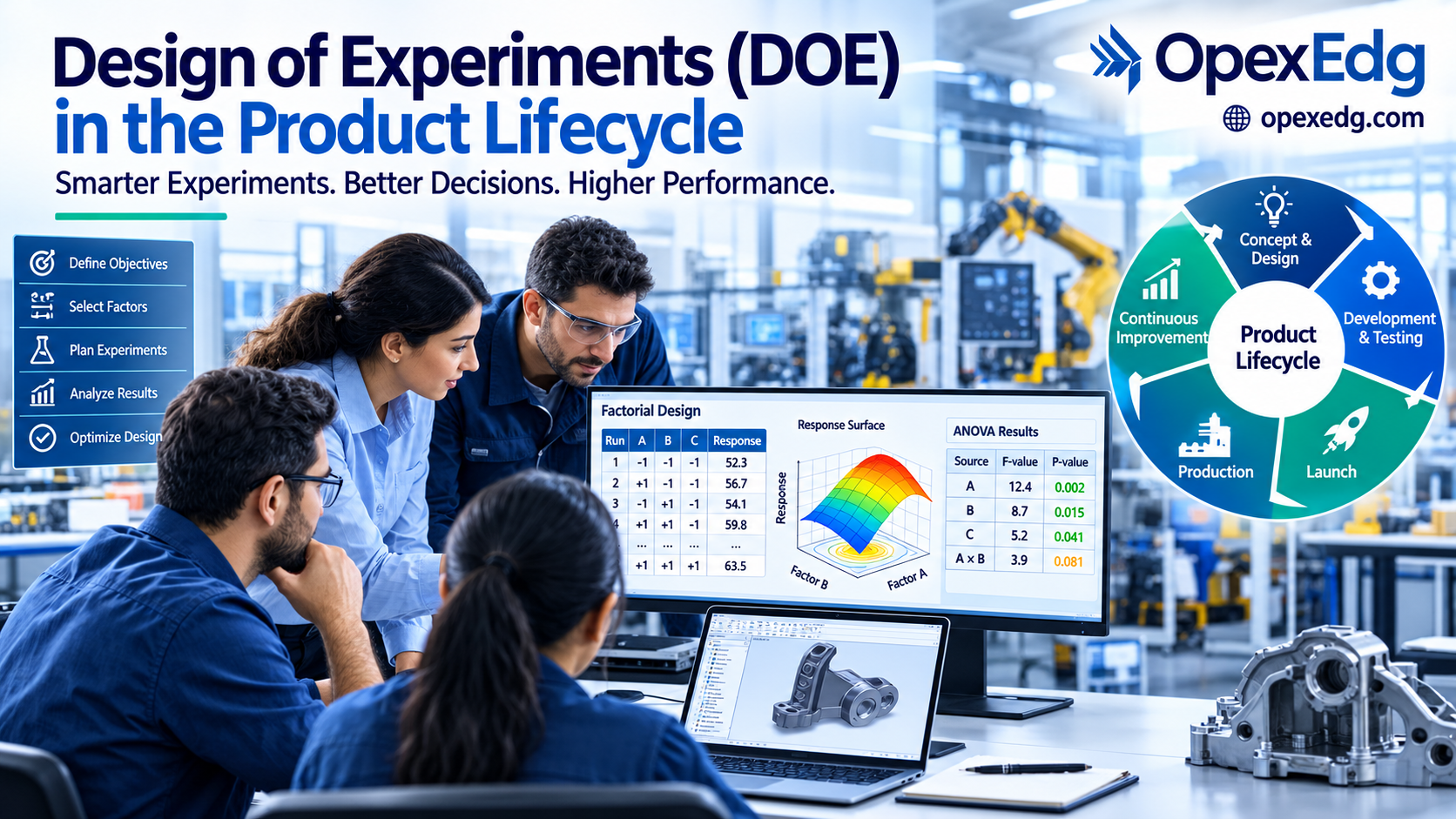
Smarter Experiments. Better Decisions. Higher Product Performance.
Design of Experiments (DOE) is one of the most powerful methods available to engineers, quality professionals, product developers, and operational excellence teams for understanding cause and effect.
Instead of changing one variable at a time and relying on trial and error, DOE provides a structured method for changing multiple factors systematically, measuring their effects, identifying interactions, and determining the combination of conditions that delivers the desired performance.
But DOE should not be viewed only as a statistical tool used during manufacturing optimization.
Its real strategic value appears when it is connected to the product lifecycle.
From the early definition of product requirements to product design, prototyping, process development, production, launch, warranty analysis, and continuous improvement, DOE can help organizations convert uncertainty into measurable knowledge and engineering decisions into validated evidence.
This article explains how Design of Experiments works, why it is more powerful than one-factor-at-a-time experimentation, and how organizations can integrate DOE throughout the product lifecycle to improve performance, quality, cost, reliability, and speed of development.
What Is Design of Experiments (DOE)?
Design of Experiments is a structured statistical approach for planning, conducting, analyzing, and interpreting controlled experiments.
The objective is to understand how selected input factors affect one or more response variables.
For example, imagine a manufacturing process where product strength depends on:
- Temperature
- Pressure
- Cure time
- Material formulation
- Machine speed
The response might be:
- Tensile strength
- Dimensional accuracy
- Defect rate
- Product weight
- Cycle time
- Energy consumption
A conventional approach might change temperature first, then pressure, then cure time, while attempting to keep everything else constant.
DOE takes a different approach.
It deliberately changes multiple factors according to a statistically designed experiment so that the organization can determine:
- Which factors matter?
- How strongly does each factor affect the response?
- Do factors interact with each other?
- What combination of settings produces the desired result?
- How robust is the optimized condition?
This is why DOE is fundamentally a decision-making methodology, not simply a mathematical exercise.
ASQ describes DOE as a method for planning, conducting, analyzing, and interpreting controlled tests and highlights its ability to identify both main effects and interactions between factors.
Why DOE Is Better Than Trial and Error
Many engineering organizations still rely heavily on one-factor-at-a-time experimentation.
For example:
Increase temperature → test the product → increase pressure → test again → change speed → test again.
This approach appears simple, but it has a major weakness:
It can miss interactions.
Suppose temperature improves strength only when pressure is high.
If temperature and pressure are never changed together, the engineering team may never discover this relationship.
DOE deliberately investigates combinations of factors.
This makes it possible to discover relationships such as:
Temperature × Pressure → Product Strength
rather than simply:
Temperature → Product Strength
That distinction is extremely important.
A product or manufacturing process is rarely controlled by isolated variables. Real systems contain interactions between materials, geometry, machine settings, environmental conditions, processing parameters, operators, and equipment.
DOE provides a structured way to understand those interactions.
The Basic Language of DOE
Before integrating DOE into the product lifecycle, it is useful to understand several fundamental concepts.
Factors
Factors are the input variables that the experimenter deliberately changes.
Examples include:
- Temperature
- Pressure
- Speed
- Material type
- Tool geometry
- Feed rate
- Cure time
- Wall thickness
Levels
Levels are the specific values selected for each factor.
For example:
| Factor | Low Level | High Level |
| Temperature | 160°C | 180°C |
| Pressure | 50 bar | 70 bar |
| Cure Time | 10 min | 20 min |
Response
The response is the output that the experiment measures.
Examples:
- Strength
- Weight
- Cycle time
- Yield
- Defect rate
- Noise
- Reliability
- Cost
Main Effect
A main effect represents the influence of one factor on the response.
For example:
Increasing temperature from 160°C to 180°C increases tensile strength.
Interaction Effect
An interaction occurs when the effect of one factor depends on the level of another factor.
For example:
Increasing temperature improves strength significantly when pressure is 70 bar, but has a much smaller effect at 50 bar.
Interactions are one of the most valuable reasons to use DOE rather than simple trial-and-error experimentation.
Replication
Replication means repeating experimental conditions to estimate experimental variation and improve confidence in the conclusions.
Randomization
Randomizing the order of experimental runs helps reduce the influence of uncontrolled variables or time-related effects.
Blocking
Blocking allows known sources of nuisance variation—such as material batches, production shifts, machines, or operators—to be accounted for in the experiment.
These principles are fundamental to obtaining reliable experimental conclusions.
DOE and the Product Lifecycle
The greatest opportunity for DOE is not simply performing experiments.
It is connecting the experiments to the decisions that occur throughout the product lifecycle.
A typical product lifecycle can be viewed as:
Market & Requirements → Product Design → Prototype → Process Design → Production → Launch → Customer Use → Continuous Improvement
DOE can contribute at every stage.
- DOE During Requirements and Concept Development
DOE can begin earlier than many organizations realize.
At the concept stage, engineering teams often face multiple competing design variables.
For example, an industrial product may need to achieve:
- High strength
- Low weight
- Low manufacturing cost
- High reliability
- Low energy consumption
These objectives can conflict.
DOE can be used during early engineering studies to understand which design variables have the greatest influence on the critical product responses.
For example:
Design factors
- Material thickness
- Material grade
- Geometry
- Reinforcement location
- Surface treatment
Responses
- Strength
- Weight
- Cost
- Fatigue life
This provides engineering teams with evidence about which variables deserve the most attention.
Lifecycle benefit
DOE helps prevent a common product-development problem:
optimizing the wrong variables.
Instead of spending months refining factors that have little impact, teams can identify the variables that truly drive product performance.
- DOE During Product Design
DOE becomes particularly valuable during detailed product development.
Engineers frequently need to determine the relationship between design parameters and product performance.
For example, consider a component where engineers want to maximize strength while minimizing weight.
Possible factors include:
- Wall thickness
- Rib height
- Rib spacing
- Material grade
- Fillet radius
Responses could include:
- Tensile strength
- Fatigue life
- Weight
- Deflection
- Cost
A factorial DOE can determine which variables have significant effects and whether combinations of design parameters create unexpected interactions.
This can support:
- Design optimization
- Design robustness
- Material selection
- Geometry optimization
- Lightweighting
- Cost reduction
- Reliability improvement
DOE therefore becomes a bridge between engineering design and quantitative evidence.
- DOE During Prototype Development
Prototypes are often used to learn how a product behaves before production.
However, prototype testing can become expensive when every iteration changes several variables without a structured plan.
DOE can make prototype learning more efficient.
Instead of asking:
“What should we change next?”
the engineering team can ask:
“Which experiment will provide the most useful information about the variables affecting performance?”
This changes prototype development from iterative trial and error into structured learning.
For example, a prototype experiment might investigate:
Factors
- Material
- Geometry
- Assembly torque
- Operating temperature
Responses
- Strength
- Leakage
- Noise
- Energy consumption
The results can then guide the next design iteration.
- DOE During Design Verification and Validation
Before a product is released, organizations need confidence that it meets its intended requirements.
DOE can support verification and validation by systematically investigating the operating conditions that influence product performance.
For example:
A product may be required to operate across:
- High and low temperatures
- High and low loads
- Different input voltages
- Different speeds
- Different material conditions
DOE can help determine whether these factors affect critical product responses.
This can reveal:
- Sensitive operating conditions
- Interaction effects
- Performance boundaries
- Robust operating regions
- Potential failure mechanisms
The objective is not simply to demonstrate that the product works under one condition.
The objective is to understand how robustly it works across the intended operating space.
- DOE During Process Development
This is one of the most common and valuable applications of DOE.
Once the product design is established, the organization must determine how to manufacture it consistently.
Manufacturing processes typically contain many controllable variables.
For example:
Injection molding
- Mold temperature
- Injection pressure
- Injection speed
- Holding pressure
- Cooling time
Machining
- Cutting speed
- Feed rate
- Tool geometry
- Depth of cut
- Coolant condition
Assembly
- Torque
- Press force
- Alignment
- Assembly speed
- Lubrication
DOE can identify which process parameters influence critical quality characteristics.
This allows the organization to move from:
“We think this setting works.”
to:
“We have experimental evidence that these settings produce the required response.”
- DOE and Process Capability
DOE and capability studies answer different but complementary questions.
DOE asks:
Which factors cause the response to change?
Process capability asks:
Can the resulting process consistently meet specification?
For example:
- DOE identifies that temperature and pressure are critical.
- The team determines the optimum operating window.
- The process is established using those settings.
- Capability studies determine whether the stabilized process can consistently meet specifications.
- SPC is then used to monitor the process over time.
This creates a powerful improvement sequence:
DOE → Optimization → Capability → SPC
The sequence moves the organization from experimentation to sustained control.
OpexEdg’s machine capability guidance similarly distinguishes short-term machine performance from broader process capability and ongoing process control.
- DOE During Production Launch
The product launch phase is where engineering assumptions meet production reality.
A process that worked during prototype production may behave differently at production scale.
Reasons include:
- Different machines
- Higher production speed
- Different operators
- Supplier variation
- Larger material batches
- Environmental changes
- Tool wear
- Increased cycle frequency
DOE can be used during launch to identify critical production parameters and establish robust operating windows.
This reduces the risk of discovering important process interactions only after mass production begins.
- DOE During Production and Continuous Improvement
DOE does not end after product launch.
Production processes naturally change over time.
Examples include:
- Tool wear
- Material changes
- Supplier changes
- Machine aging
- New operators
- Environmental changes
- Maintenance interventions
- New production rates
When performance begins to deteriorate, DOE can help determine the root drivers.
For example:
Scrap rate has increased from 2% to 5%.
Instead of adjusting parameters randomly, the team can define potential factors and design an experiment to determine which ones are responsible.
This makes DOE an important component of continuous improvement and operational excellence.
A Practical DOE Example
Consider a manufacturer producing a high-strength component.
The engineering team wants to maximize tensile strength.
Three factors are suspected to influence performance:
| Factor | Low | High |
| Temperature | 160°C | 180°C |
| Pressure | 50 bar | 70 bar |
| Cure Time | 10 min | 20 min |
A 2³ factorial design creates eight combinations.
The measured responses might look like this:
| Run | Temperature | Pressure | Cure Time | Strength |
| 1 | 160 | 50 | 10 | 643 MPa |
| 2 | 160 | 50 | 20 | 671 MPa |
| 3 | 160 | 70 | 10 | 725 MPa |
| 4 | 160 | 70 | 20 | 752 MPa |
| 5 | 180 | 50 | 10 | 760 MPa |
| 6 | 180 | 50 | 20 | 792 MPa |
| 7 | 180 | 70 | 10 | 838 MPa |
| 8 | 180 | 70 | 20 | 872 MPa |
The analysis can then investigate:
- Main effects
- Two-factor interactions
- Three-factor interactions
- Statistical significance
- Response surface
- Predicted optimum
In this illustrative example, the combination of:
180°C + 70 bar + 20 minutes
produces the strongest response.
But the important result is not simply the best experimental run.
The real value comes from understanding why performance changes and whether the process has a sufficiently robust operating window around the optimum.
DOE Methods Used Across the Product Lifecycle
Different lifecycle questions require different experimental designs.
Screening Designs
Used when many factors may influence the response.
The objective is to identify the vital few factors.
Typical application:
Which of 12 possible process variables actually influence defect rate?
Full Factorial Designs
Useful when the number of factors is manageable and interactions are important.
For two-level factors, a full factorial design investigates all combinations.
For example:
2 factors → 4 combinations
3 factors → 8 combinations
4 factors → 16 combinations
ASQ specifically highlights full and fractional factorial designs as ways to study multiple factors and interactions efficiently.
Fractional Factorial Designs
When many factors exist, a full factorial may require too many experimental runs.
A fractional factorial design investigates a carefully selected subset of combinations.
This reduces experimental effort while still providing useful information about important effects, subject to the design’s assumptions and aliasing structure.
Response Surface Methodology
Once the important factors have been identified, Response Surface Methodology (RSM) can be used to model the response and search for an optimum.
This is particularly useful when the objective is:
Find the best combination of settings.
Rather than simply determining whether a factor matters, the team can investigate the shape of the response and identify an operating region.
Robust Design
DOE can also be used to improve robustness.
The objective is not merely to find a setting that works under ideal conditions.
The objective is to find a design or process that continues to perform well when unavoidable sources of variation change.
This is particularly important for products that must operate across:
- Temperature ranges
- Loads
- Material variation
- Manufacturing variation
- Environmental conditions
- Customer usage conditions
DOE + FMEA: From Risk Identification to Evidence
FMEA identifies potential failure modes and evaluates their risks.
DOE can then help investigate the factors associated with important failure modes.
This creates a useful connection:
FMEA → Critical Risks → Experimental Factors → DOE → Optimized Controls
For example:
FMEA identifies excessive vibration as a potential failure mechanism.
Possible factors might include:
- Speed
- Load
- Alignment
- Bearing clearance
DOE can then determine which factors and interactions drive vibration.
This transforms a theoretical risk into experimentally supported engineering knowledge.
DOE + Value Engineering
DOE also has a strong relationship with Value Engineering.
Value Engineering seeks to improve the relationship between:
Function, Performance, Quality, and Cost.
OpexEdg’s Value Engineering methodology emphasizes improving function and performance while controlling lifecycle cost.
DOE can provide the quantitative evidence needed to evaluate alternatives.
For example:
Alternative A
Higher material cost but higher strength.
Alternative B
Lower material cost but potentially higher process variation.
DOE can investigate how material, geometry, and process parameters affect performance.
The organization can then determine whether a lower-cost alternative can deliver equivalent or better function.
This is much stronger than selecting the cheapest option based only on purchase price.
DOE + Product Lifecycle Management
A mature organization should not allow experimental knowledge to disappear after a project ends.
DOE results should become part of the product’s knowledge base.
Important outputs can include:
- Critical factors
- Optimal settings
- Operating windows
- Response models
- Design rules
- Process parameters
- Validation evidence
- Capability results
- Lessons learned
- Control-plan inputs
This creates a closed learning loop:
Experiment → Knowledge → Design Decision → Process Control → Field Data → New Experiment
That is the foundation of a learning product organization.
OpexEdg’s product and service lifecycle framework similarly emphasizes connecting product design, process design, production, customer feedback, and continuous improvement rather than treating them as isolated departmental activities.
Common Mistakes When Using DOE
DOE is powerful, but poor experimental design can produce misleading conclusions.
- Starting without a clear objective
The team should define the question before designing the experiment.
Bad question:
“Let’s run a DOE and see what happens.”
Better question:
“Which process factors significantly affect dimensional variation, and what operating window minimizes it?”
- Poor factor selection
Not every variable should automatically become a DOE factor.
Factors should be selected using:
- Engineering knowledge
- Process maps
- FMEA
- Historical data
- Customer requirements
- Subject-matter expertise
- Ignoring measurement-system capability
A DOE is only as reliable as its measurements.
If the measurement system introduces excessive variation, the experiment may identify measurement noise instead of true process effects.
- Using unrealistic factor levels
Experimental levels should represent technically meaningful and safe operating conditions.
An experiment outside the realistic operating region may generate statistically interesting but practically useless conclusions.
- Ignoring interactions
Looking only at individual factor effects can miss the relationships that actually control performance.
- Optimizing one response while damaging another
Real products usually have multiple objectives.
For example:
Maximize strength + minimize weight + minimize cost + maintain reliability.
DOE should therefore be connected to multi-response optimization where appropriate.
- Stopping after finding an optimum
The optimum is not necessarily the most robust operating point.
The organization should confirm the result and determine whether reasonable variation around the selected settings still produces acceptable performance.
A Practical OpexEdge DOE Framework
A practical lifecycle-oriented DOE methodology can be structured into eight steps:
Step 1 — Define the business and engineering objective
What decision must the experiment support?
Step 2 — Define the response
What measurable outcome represents success?
Step 3 — Identify potential factors
Use engineering knowledge, FMEA, process maps, historical data, and customer requirements.
Step 4 — Select factor levels
Define realistic and technically meaningful experimental ranges.
Step 5 — Select the DOE design
Choose an appropriate screening, factorial, response-surface, mixture, or other design.
Step 6 — Conduct the experiment
Apply appropriate randomization, replication, blocking, measurement controls, and documentation.
Step 7 — Analyze and optimize
Evaluate main effects, interactions, statistical significance, practical significance, and response behavior.
Step 8 — Confirm and institutionalize
Run confirmation experiments, validate the optimum, update specifications and controls, and transfer the knowledge into the product lifecycle.
The final step is critical.
A DOE should create organizational knowledge—not just a statistical report.
The Strategic Value of DOE Across the Lifecycle
When integrated correctly, DOE can deliver benefits at multiple levels.
| Lifecycle Stage | DOE Contribution |
| Requirements | Identify important performance drivers |
| Concept | Compare design alternatives |
| Product Design | Optimize critical design variables |
| Prototype | Reduce iteration and learning time |
| Verification | Understand operating conditions |
| Process Development | Identify critical process parameters |
| Production Launch | Establish robust operating windows |
| Production | Solve variation and quality problems |
| Cost Reduction | Optimize performance versus cost |
| Reliability | Investigate factors affecting failures |
| Continuous Improvement | Establish cause-and-effect relationships |
| Next Product Generation | Convert lessons learned into better designs |
The strategic advantage is therefore much larger than the experiment itself.
DOE creates a knowledge chain connecting engineering decisions across the product lifecycle.
DOE as a Competitive Advantage
Companies compete not only on the products they manufacture but also on how quickly they can learn.
A company that learns through uncontrolled trial and error may require dozens of iterations.
A company that uses structured experimentation can often obtain significantly more information from a smaller number of carefully planned trials.
This creates advantages in:
- Development speed
- Engineering confidence
- Product quality
- Manufacturing stability
- Cost reduction
- Innovation
- Reliability
- Customer satisfaction
ASQ notes that designed experiments are particularly useful when multiple inputs may influence an output and that DOE can be used to identify important factors, interactions, and settings that reduce variation.
Final Perspective
Design of Experiments should not be treated as a statistical technique that appears only when a process problem becomes difficult.
It should be considered part of the organization’s product lifecycle engineering system.
Used early, DOE can help engineers make better design decisions.
Used during development, it can reduce prototype iterations.
Used during process development, it can identify critical parameters.
Used during production launch, it can establish robust operating windows.
Used during continuous improvement, it can identify the true causes of variation.
And used as part of the organizational knowledge system, DOE can ensure that lessons learned from one product become inputs to the next generation.
The real question is therefore not:
“Should we use DOE?”
The better question is:
“Where in our product lifecycle are we currently making decisions based on assumptions that could be replaced by experimental evidence?”
That is where DOE creates its greatest value.
Better experiments create better knowledge.
Better knowledge creates better decisions.
Better decisions create better products.
How OpexEdge Can Help
OpexEdge helps organizations connect engineering, quality, manufacturing, cost, and operational excellence into a practical improvement system.
DOE can be integrated with:
- Product lifecycle management
- Product and process development
- Value Engineering
- Design for Manufacturing
- Design for Assembly
- FMEA
- Process capability
- Machine capability
- SPC
- Six Sigma
- Root cause analysis
- Cost optimization
- Continuous improvement
The objective is not simply to perform statistical experiments.
The objective is to use data, engineering knowledge, and structured experimentation to improve product and business performance across the lifecycle.
OpexEdg — Architecting Business Transformation from Zero to Scale.
FAQ
What is Design of Experiments (DOE)?
DOE is a structured statistical method for planning experiments, changing multiple factors systematically, and determining how those factors affect one or more responses.
Why is DOE important in product development?
DOE helps engineers identify the factors that significantly affect product performance and understand interactions between design variables, reducing trial-and-error development.
What is the difference between DOE and one-factor-at-a-time testing?
DOE changes multiple factors according to a planned design and can identify interactions, while one-factor-at-a-time testing generally examines variables separately.
How is DOE used in manufacturing?
DOE can identify critical process parameters, optimize operating conditions, reduce variation, improve yield, and establish robust process windows.
How does DOE support the product lifecycle?
DOE can be applied from concept and product design through prototyping, validation, process development, production launch, and continuous improvement.
What is the relationship between DOE and process capability?
DOE identifies factors and settings that influence performance; capability analysis then determines whether the resulting process can consistently meet specifications.
Can DOE reduce product development cost?
Yes. By extracting more information from structured experiments, DOE can reduce unnecessary prototype iterations, improve optimization efficiency, and help identify lower-cost solutions without sacrificing performance.
Is DOE useful for Value Engineering?
Yes. DOE can provide quantitative evidence for evaluating design, material, and process alternatives against performance, quality, and cost objectives.
