
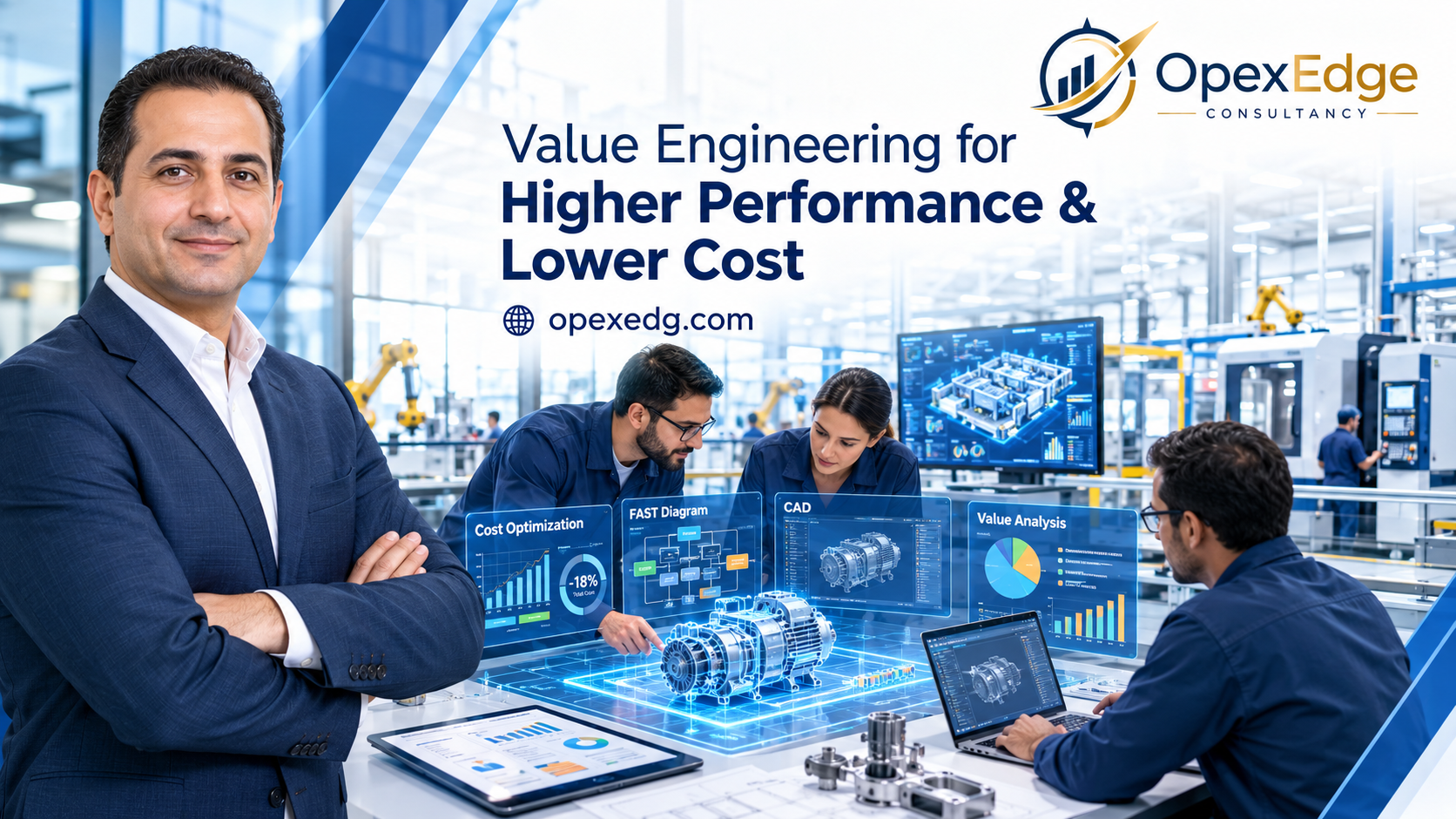
Delivering Maximum Value at the Lowest Total Cost
In today’s highly competitive markets, organizations must continually improve products, processes, and services while controlling costs. Simply reducing expenses is rarely sustainable if it compromises quality or customer satisfaction.
Value Engineering (VE) is a systematic, function-oriented methodology that improves value by analyzing the relationship between function, quality, performance, and cost. Rather than asking, “How can we make this cheaper?” Value Engineering asks, “How can we deliver the required function at the lowest total life cycle cost?”
Originally developed for manufacturing, Value Engineering is now widely applied across construction, healthcare, infrastructure, aerospace, automotive, logistics, and service industries.
Why Value Engineering Matters
Organizations often overspend because products and processes evolve over time without continuous review. Unnecessary features, inefficient materials, redundant operations, and outdated designs increase costs without adding value.
Value Engineering enables organizations to:
- Reduce product and project costs
- Improve functionality
- Enhance product quality
- Eliminate unnecessary features
- Increase profitability
- Improve customer satisfaction
- Support innovation
- Accelerate product development
- Reduce manufacturing complexity
- Improve sustainability
Value Engineering creates competitive advantage by delivering more value with fewer resources.
Understanding Value
The fundamental equation of Value Engineering is:
Value = Function ÷ Cost
Increasing value can be achieved by:
- Improving functionality while maintaining cost
- Reducing cost without reducing functionality
- Improving functionality while simultaneously reducing cost
- Eliminating unnecessary functions
The objective is to optimize value—not simply reduce expenses.
Section Image
Image Prompt
Professional infographic illustrating the Value equation (Value = Function ÷ Cost) with examples of increasing function, reducing cost, and optimizing product performance.
The Value Engineering Job Plan
A structured Value Engineering study typically follows six phases.
| Phase | Purpose |
| Information | Understand objectives, requirements, and costs |
| Function Analysis | Define essential and secondary functions |
| Creativity | Generate alternative solutions |
| Evaluation | Assess ideas for feasibility and value |
| Development | Refine selected alternatives |
| Presentation | Recommend implementation plans |
This systematic approach ensures objective decision-making and measurable outcomes.
Section Image
Image Prompt
Professional flowchart illustrating the six phases of the Value Engineering Job Plan with clean icons, arrows, and engineering visuals.
Function Analysis
Function Analysis is the heart of Value Engineering.
Each product or process is analyzed by asking:
- What is its purpose?
- Why is it needed?
- Does it provide customer value?
- Can another method perform the same function?
- Is every component necessary?
Functions are generally classified as:
Basic Functions
Essential for the product to perform its intended purpose.
Secondary Functions
Enhance appearance, convenience, or additional features but are not essential.
Removing unnecessary secondary functions often produces significant savings.
Section Image
Image Prompt
Engineer analyzing product components using FAST (Function Analysis System Technique) diagrams with digital engineering software and product cross-sections.
Techniques Used in Value Engineering
Successful Value Engineering studies utilize multiple analytical tools, including:
- Function Analysis System Technique (FAST)
- Cost-Worth Analysis
- Brainstorming
- Pareto Analysis
- Failure Mode and Effects Analysis (FMEA)
- Design for Manufacturing (DFM)
- Design for Assembly (DFA)
- Benchmarking
- Risk Assessment
- Life Cycle Cost Analysis
Combining these tools enables data-driven decisions and innovative solutions.
Section Image
Image Prompt
Engineering workspace displaying FAST diagrams, Pareto charts, FMEA worksheets, CAD software, and cost analysis dashboards.
Applications of Value Engineering
Value Engineering delivers measurable improvements across many industries.
Manufacturing
- Product redesign
- Material optimization
- Process simplification
- Assembly improvement
Construction
- Material substitution
- Structural optimization
- Project cost reduction
Supply Chain
- Packaging optimization
- Logistics improvements
- Inventory reduction
Healthcare
- Process efficiency
- Equipment selection
- Patient flow optimization
Services
- Workflow simplification
- Automation opportunities
- Customer experience improvement
Section Image
Image Prompt
Collage showing Value Engineering applications across manufacturing plants, construction projects, healthcare facilities, logistics operations, and service organizations.
Digital Technologies Supporting Value Engineering
Modern organizations increasingly leverage digital technologies to enhance Value Engineering initiatives.
Examples include:
- Digital Twin Technology
- Artificial Intelligence
- Simulation Software
- CAD/CAM Systems
- Product Lifecycle Management (PLM)
- ERP Systems
- Business Intelligence Dashboards
- Predictive Analytics
- 3D Printing for Prototyping
Digital tools accelerate analysis, reduce development time, and improve decision quality.
Section Image
Image Prompt
Advanced engineering laboratory featuring AI-driven design optimization, digital twins, CAD workstations, PLM software, and collaborative engineering dashboards.
Common Value Engineering Mistakes
Organizations often fail to realize the full benefits of Value Engineering because they:
- Focus only on cost reduction
- Ignore customer requirements
- Exclude cross-functional expertise
- Conduct VE too late in development
- Resist innovative ideas
- Overlook life cycle costs
- Skip implementation planning
- Lack executive support
- Fail to measure results
Successful Value Engineering balances functionality, quality, cost, and customer expectations.
Real-World Case Study
Industrial Equipment Manufacturer
Challenge
A manufacturer of industrial pumping systems experienced:
- Rising material costs
- Increasing production expenses
- Long assembly times
- Growing market competition
- Pressure to maintain product quality
The company needed to improve profitability without compromising product performance.
OpexEdg Approach
Our consultants facilitated a Value Engineering program that included:
- Function Analysis workshops
- Product cost breakdown
- Design simplification
- Alternative material evaluation
- Supplier collaboration
- Assembly optimization
- Design for Manufacturing review
- Life Cycle Cost Analysis
Results
Within eight months, the organization achieved:
- 18% reduction in manufacturing costs
- 22% fewer product components
- 27% shorter assembly time
- 15% improvement in product reliability
- 20% reduction in procurement costs
- Improved customer satisfaction
- Faster product launches
- Increased operating margins
The project demonstrated that strategic Value Engineering can reduce costs while improving overall product performance.
Benefits of Value Engineering
Organizations implementing Value Engineering commonly achieve:
- Lower production costs
- Higher product quality
- Increased customer value
- Reduced waste
- Improved profitability
- Faster product development
- Better supplier collaboration
- Greater innovation
- Enhanced sustainability
- Stronger competitive positioning
Best Practices
Successful Value Engineering programs should:
- Begin early in product development
- Include multidisciplinary teams
- Focus on customer value
- Challenge existing assumptions
- Use objective data
- Evaluate life cycle costs
- Encourage creativity
- Measure implementation results
- Integrate with Lean Manufacturing
- Promote continuous improvement
Why Choose OpexEdge?
OpexEdg helps organizations unlock greater value through structured engineering methodologies, operational excellence, and business transformation.
Our expertise includes:
- Value Engineering
- Cost Engineering
- Lean Manufacturing
- Product Cost Optimization
- Industrial Engineering
- Operational Excellence
- Design for Manufacturing (DFM)
- Design for Assembly (DFA)
- Process Improvement
- Supply Chain Optimization
- Manufacturing Strategy
- Continuous Improvement
Contact an Expert
Mahmoud Elhefnawi
Senior Operations Excellence & Business Transformation Consultant
🌐 Expert Profile
https://opexedg.com/experts/mahmoud-elhefnawi/
🌐 Website
https://opexedg.com
📧 Contact OpexEdg to explore how Value Engineering can improve your products, projects, manufacturing operations, and overall business performance.
Unlock Greater Value Without Compromising Quality
Every product, process, and project contains opportunities to eliminate unnecessary costs while improving functionality and customer satisfaction.
Whether you are designing a new product, optimizing manufacturing operations, or managing a capital project, OpexEdg provides practical Value Engineering solutions that deliver measurable financial and operational results.
Schedule your Value Engineering Assessment today and discover how to maximize value while minimizing total life cycle costs.
Related TopicsTPM, Hypothesis Test , Accuracy, 6Sigma, MSA, POKAYOKE, MUDA, 5S, FMEA, SIPOC, KPI, ISO9001, ISO20022, w/h, demand planning , OTB , KANO, case study, OTB service, demand planning service , SC service, problem solving service ,
