
Introduction: Why Kaizen Matters in Modern Business
In a competitive business environment, organizations cannot rely on occasional improvement projects to maintain performance. Rising customer expectations, cost pressures, quality requirements, supply-chain disruptions, and technological change demand a more systematic approach to improving how work is performed.
Kaizen provides a practical philosophy for achieving continuous improvement by involving people at every organizational level in identifying problems, eliminating waste, improving processes, and sustaining better ways of working.
Originating in Japanese management practice, Kaizen is widely associated with Lean thinking and the Toyota Production System. Its fundamental idea is straightforward: instead of waiting for a major transformation, organizations should continuously improve their processes through disciplined problem-solving, experimentation, and learning.
However, Kaizen is much more than asking employees to suggest ideas. Successful implementation requires leadership commitment, process visibility, reliable performance data, standardized work, structured improvement methods, and a culture that treats problems as opportunities to learn.
For manufacturers, service providers, engineering organizations, and business leaders, Kaizen can become a foundation for operational excellence when improvement activities are aligned with customer value and measurable business results.
This guide explains what Kaizen means, its principles, implementation methods, practical applications, performance indicators, common mistakes, and its relationship with Lean, Six Sigma, quality management, and the product lifecycle.
-
What Is Kaizen?
Kaizen is a Japanese term commonly translated as continuous improvement. It combines the idea of change with the idea of improvement and describes an ongoing effort to make processes, products, services, and working systems better.
In an organizational context, Kaizen means systematically identifying opportunities for improvement and implementing changes that enhance performance while reducing unnecessary effort, defects, delays, costs, and other forms of waste.
The philosophy emphasizes three essential concepts:
- Continuous improvement: Improvement is an ongoing activity rather than a one-time project.
- Employee involvement: The people who perform and manage the work contribute their knowledge to improving it.
- Process-based problem-solving: Decisions are based on understanding actual conditions, investigating root causes, testing solutions, and measuring results.
Kaizen is often associated with small, incremental improvements. These can be valuable because they allow organizations to learn quickly, test changes with manageable risk, and build improvement capability over time.
However, Kaizen does not mean that every improvement must be small. The philosophy can support substantial improvements when a series of experiments, process redesigns, or coordinated changes are needed.
The defining characteristic is not the size of the change. It is the disciplined, continuous approach to improving performance.
Kaizen versus occasional improvement projects
A traditional improvement project may have a defined beginning, end, budget, and target. Kaizen encourages organizations to maintain improvement as a normal part of daily operations, even after major projects have finished.
For example, a factory might launch a major automation project to increase capacity. Kaizen complements that investment by continuously improving machine setup, material presentation, maintenance routines, work instructions, and defect prevention.
The major project changes the system; ongoing Kaizen helps the system perform better and sustain its results.
-
The Core Principles of Kaizen
A successful Kaizen culture is built on several mutually reinforcing principles.
2.1 Customer value comes first
Improvement should begin with understanding what customers value and what the organization must deliver.
Customers may expect reliable quality, shorter delivery times, competitive prices, consistent service, or products that perform as intended. Kaizen helps organizations examine whether their processes contribute to these outcomes or create unnecessary cost and complexity.
An activity should not be considered successful simply because it reduces the workload of one department. Its effect on the complete process and the customer must also be considered.
2.2 Everyone participates in improvement
Kaizen is not the exclusive responsibility of an improvement department, quality engineer, or Lean specialist.
Operators, technicians, engineers, supervisors, support teams, and senior managers all have different perspectives on process performance. Frontline employees may recognize recurring obstacles that are difficult to identify from management reports alone.
Organizations should make it practical for employees to raise concerns, propose changes, participate in experiments, and receive feedback on their ideas.
Participation must be meaningful. Asking for suggestions without providing time, resources, or follow-up can undermine trust.
2.3 Problems should be visible
Problems that remain hidden cannot be managed effectively.
Visual management, process boards, performance dashboards, standard work, and clearly defined operating conditions help teams identify deviations from expected performance.
The purpose of visibility is not to blame individuals. It is to understand what is happening and make the next appropriate action clear.
2.4 Improve processes rather than blaming people
When a defect, delay, or mistake occurs, the immediate question should not be who to blame. The team should investigate why the process allowed the problem to occur.
Potential causes may include unclear instructions, poor equipment condition, unsuitable material, inadequate training, inconsistent methods, or an ineffective control system.
Individual accountability still matters, particularly for deliberate violations or unsafe behavior. Nevertheless, sustainable improvement requires identifying and correcting the underlying causes of recurring problems.
2.5 Go to the actual workplace
The Japanese term gemba refers to the place where value-creating work takes place.
In manufacturing, this may be the production line, inspection area, warehouse, or maintenance workshop. In service organizations, it may be a customer service center, laboratory, project office, or the digital workflow through which a service is delivered.
Managers and improvement teams should observe actual work, speak with the people performing it, and verify data before proposing solutions.
A process description or management dashboard is useful, but it may not reveal every practical obstacle.
2.6 Use facts and structured problem-solving
Kaizen is most effective when teams replace assumptions with evidence.
Before changing a process, establish its current performance. Investigate the causes of the problem, formulate a proposed solution, test it, and compare the results against the baseline.
Tools such as the PDCA cycle, the Five Whys, Pareto analysis, process mapping, and cause-and-effect diagrams can help teams organize this work.
2.7 Standardize successful improvements
An improvement is incomplete if the organization cannot sustain it.
Once a change has demonstrated better performance, the team should update the relevant work instructions, process parameters, checklists, training materials, visual controls, and performance standards.
Standardization creates a new baseline from which the next improvement can begin.
Kaizen and standardized work are therefore complementary: standards establish the current best-known method, and Kaizen challenges the organization to improve it further.
-
The PDCA Cycle: The Foundation of Kaizen
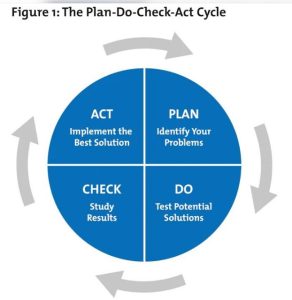
The Plan–Do–Check–Act cycle provides a practical structure for continuous improvement. It allows teams to develop an improvement hypothesis, test a change, evaluate the evidence, and determine the next action. Source: Lean Management Institute.
Plan: Understand the problem and define the target
Start by describing the current condition and identifying the performance gap.
Define the problem in measurable terms, establish a baseline, investigate potential causes, and specify the intended outcome.
For example, a production line may have a first-pass yield of 92%, while the target is 97%. The team should investigate the types of defects, when they occur, which products are affected, and what conditions contribute to them.
A strong plan includes a clear problem statement, an objective, a measurement method, an owner, and an improvement hypothesis.
Do: Test the proposed change
Implement the proposed solution on a manageable scale whenever practical.
A team might test a revised work instruction, a different tool arrangement, an improved inspection method, or a new material-delivery sequence.
The purpose is to learn whether the change works under real operating conditions, not merely to complete an action item.
Check: Measure the results
Compare actual performance with the baseline and expected outcome.
Determine whether the improvement achieved its target, whether the result is repeatable, and whether any unintended consequences occurred.
For example, a reduction in cycle time is not necessarily a success if it increases defects, creates unsafe conditions, or transfers work to another bottleneck.
Act: Standardize, adapt, and repeat
If the change produces a verified improvement, incorporate it into the standard process and communicate the new method.
If the results are disappointing, investigate why and revise the hypothesis. If the evidence is inconclusive, collect more data or conduct another test.
The cycle then begins again.
The objective of PDCA is not to complete four steps once. It is to build a repeatable habit of learning and improving.
- How to Implement Kaizen in an Organization
Kaizen implementation should begin with a defined business need rather than a campaign to generate ideas without clear priorities.
The following eight-step approach provides a practical starting point.
Step 1: Define the business objective
Identify the performance issue that matters most to customers and the organization.
Possible priorities include:
- Reducing defects and rework.
- Improving delivery reliability.
- Shortening production or service lead time.
- Increasing equipment availability.
- Reducing material waste and operating costs.
- Improving safety and ergonomics.
- Simplifying administrative processes.
The objective should be specific enough to guide improvement and measurable enough to evaluate the outcome.
Step 2: Establish the current condition
Observe the process and collect reliable baseline data.
Depending on the problem, useful measures may include cycle time, downtime, defect rate, first-pass yield, work-in-process inventory, changeover time, or customer response time.
Document the existing process so that the team can distinguish the actual condition from the intended procedure.
Step 3: Identify and prioritize opportunities
Map the process, observe work, review performance data, and consult employees.
Prioritize opportunities according to their impact on customer value, risk, cost, feasibility, and strategic relevance.
A simple prioritization matrix can help compare expected benefit with implementation effort. However, safety, regulatory compliance, and product conformity must not be compromised for convenience or short-term savings.
Step 4: Investigate root causes
Avoid jumping directly to solutions.
Use the Five Whys to explore causal relationships, a fishbone diagram to organize possible causes, or Pareto analysis to identify the most significant categories of loss.
Validate the suspected causes through observation and data wherever possible.
The goal is to understand why the problem occurs, not merely to remove its visible symptoms.
Step 5: Develop and test countermeasures
Generate practical solutions with the people who understand the process.
Examples include repositioning frequently used tools, simplifying a work sequence, introducing mistake-proofing, clarifying inspection criteria, improving material replenishment, or revising maintenance procedures.
Select a suitable test, assign responsibilities, and define how success will be measured.
Step 6: Evaluate the outcome
Compare the results against the baseline and target.
Assess whether the improvement is repeatable and whether it has affected other important measures, such as quality, safety, cost, delivery, or employee workload.
Document lessons learned, including unsuccessful experiments. A well-controlled experiment that disproves an assumption can still improve organizational understanding.
Step 7: Standardize and sustain
Update the process documentation and train affected employees.
Introduce appropriate visual controls, audit checks, or performance reviews to ensure the new method is followed and remains effective.
Assign an accountable process owner and define what should happen if performance deteriorates.
Step 8: Continue improving
Review the results, identify the next performance gap, and begin another PDCA cycle.
Successful Kaizen programs do not end when a target is achieved. They use improved performance as the starting point for the next opportunity.
-
Essential Kaizen Tools and Techniques
Kaizen is a philosophy and management approach, not a single tool. Different techniques support different stages of improvement.
PDCA
Use PDCA to structure experiments, test improvement ideas, evaluate outcomes, and standardize successful changes.
Gemba walks
Observe the actual workplace and process conditions. Ask questions, verify facts, identify obstacles, and understand the experience of employees performing the work.
A gemba walk should encourage learning and problem-solving rather than become a fault-finding inspection.
The Five Whys
Ask why a problem occurred, then investigate the answer to uncover deeper contributing causes.
The technique is useful for straightforward problems, but it should not be treated as a rule that every problem has exactly five causes or can be solved through five questions.
Fishbone diagram
Organize potential causes into categories such as people, methods, machines, materials, measurement, and environment.
This helps teams explore several possible explanations before deciding which causes to test.
Pareto analysis
Use data to identify the categories contributing most to a problem. For example, a defect Pareto chart may show that a small number of failure modes account for a large proportion of rework.
The familiar 80/20 relationship is a useful heuristic, not a guaranteed distribution.
5S
The five Japanese terms commonly represented by 5S are Sort, Set in Order, Shine, Standardize, and Sustain.
5S helps create an organized, visible, and controlled workplace. It can support Kaizen by making abnormalities easier to identify and reducing unnecessary movement, searching, and handling.
Standardized work
Document the current best-known method for performing a process safely and consistently.
Standards provide a baseline for measuring improvement and help prevent successful changes from being lost.
Visual management
Use visual signals, boards, labels, status indicators, and process dashboards to make conditions and deviations understandable at a glance.
Value stream mapping
Map material and information flows across a complete value stream to identify waiting, unnecessary movement, excess inventory, bottlenecks, and other sources of delay.
Value stream mapping is particularly useful when the problem extends beyond a single workstation or department.
Poka-yoke: mistake-proofing
Design the process, equipment, or interface to prevent a foreseeable mistake or detect it immediately.
Examples include fixtures that prevent incorrect part orientation, connectors that fit only the intended connection, and software validation that identifies missing mandatory information.
A3 problem-solving
Use a concise, structured problem-solving report to communicate the background, current condition, root-cause analysis, proposed countermeasures, action plan, and follow-up results.
The format encourages disciplined thinking and clear communication.
-
Kaizen and the Seven Wastes in Lean
One of Kaizen’s major applications is reducing muda, the Japanese term commonly used in Lean for waste: activities that consume resources without creating value from the customer’s perspective.
The seven traditional categories of manufacturing waste are:
- Transportation: Unnecessary movement of materials between locations.
- Inventory: Excess raw materials, work in process, or finished goods that create cost and conceal problems.
- Motion: Unnecessary movement by people, such as reaching, walking, searching, or bending.
- Waiting: Idle time caused by equipment downtime, missing materials, approvals, or process imbalances.
- Overproduction: Producing earlier or in greater quantities than needed.
- Overprocessing: Performing unnecessary steps, excessive inspections, or work beyond customer requirements.
- Defects: Errors, scrap, rework, and failures that consume additional resources.
An eighth category, unused human talent, is also widely recognized in modern Lean practice. It occurs when employees’ knowledge, creativity, and problem-solving capabilities are not effectively used.
Kaizen helps teams identify these forms of waste, understand their causes, and design better processes.
However, eliminating waste should not mean removing activities that are necessary for safety, legal compliance, quality assurance, or customer protection. The objective is to improve how value is delivered while maintaining required controls.
-
Kaizen in Manufacturing: A Practical Example
Consider a manufacturing company experiencing recurring delays during product changeovers.
The production team observes that machines remain idle while operators search for tools, wait for setup information, and make repeated adjustments before production can restart.
Management initially assumes that operators need to work faster. A Kaizen investigation reveals that the underlying problem is the setup process itself.
Current condition
For illustration, assume the baseline data show:
- Average changeover time: 60 minutes.
- Changeovers per day: 4.
- Production losses from changeovers: 240 minutes per day.
The team observes several changeovers and identifies the main causes of lost time.
Root-cause analysis
The investigation reveals that tools are stored in different locations, setup instructions are incomplete, and some materials are prepared only after the machine stops.
Improvement actions
The team introduces a practical set of countermeasures:
- Prepare tools and materials before the machine stops.
- Organize a dedicated setup cart.
- Standardize setup instructions and adjustment sequences.
- Clearly identify required settings and inspection criteria.
- Train operators in the revised method.
- Record changeover time and monitor setup-related quality issues.
Illustrative results
Suppose a controlled trial reduces average changeover time from 60 minutes to 40 minutes, with four changeovers per day.
The daily time saved would be:
[
(60-40)\times4=80\text{ minutes/day}
]
This represents a 33.3% reduction in average changeover time.
The team should then verify that the improvement is repeatable and does not compromise safety, quality, or equipment reliability. It should also assess whether the recovered time translates into additional usable capacity, lower overtime, improved delivery, or another measurable business benefit.
These figures are illustrative, not reported results from a real company.
The most important lesson is that sustainable improvement came from understanding and redesigning the process, not simply demanding greater speed from employees.
-
Applying Kaizen Beyond Manufacturing
Kaizen is applicable wherever work follows a process and performance can be evaluated.
Healthcare
Improvement teams may reduce unnecessary patient waiting, improve handover procedures, simplify supply replenishment, or make documentation more reliable. Clinical safety and professional requirements remain essential constraints.
Logistics and warehousing
Kaizen can improve picking routes, dock scheduling, inventory accuracy, replenishment, loading sequences, and order fulfillment.
Service organizations
Customer service teams can reduce repeated contacts, simplify case routing, improve response times, and eliminate redundant approvals.
Engineering and product development
Engineering teams can improve design reviews, reduce repeated design changes, clarify requirements, strengthen verification plans, and improve collaboration between design, manufacturing, and quality functions.
Administration and office processes
Organizations can reduce duplicate data entry, unnecessary reporting, slow approvals, unclear responsibilities, and avoidable handoffs between departments.
Digital products and software
Teams can improve defect triage, automated testing, deployment workflows, incident response, documentation, and customer feedback loops.
Across all these settings, the principle remains the same: understand the current process, identify the cause of poor performance, test a better method, measure the result, and sustain the improvement.
-
Kaizen and the Product Lifecycle
For organizations that design, manufacture, deliver, and support products, Kaizen can support improvement throughout the product lifecycle rather than being limited to factory operations.
The product lifecycle includes stages such as opportunity identification, concept development, design, verification and validation, industrialization, production, distribution, customer use, service, and end-of-life management.
At every stage, teams can use evidence from actual performance to improve the product or the processes that support it.
Concept and requirements
Kaizen can improve how customer needs are captured, requirements are prioritized, risks are identified, and cross-functional teams make decisions.
Repeated clarification requests or late requirement changes may indicate opportunities to improve the requirements process.
Product design and engineering
Engineering teams can investigate recurring design errors, excessive complexity, unnecessary part variation, and avoidable engineering changes.
Design reviews, lessons learned, and structured problem-solving can help prevent known problems from being repeated in subsequent projects.
Verification and validation
Kaizen can improve test preparation, test execution, defect classification, laboratory utilization, and the feedback loop between test results and design decisions.
A recurring failure should trigger investigation of the underlying design, process, measurement, or test-method causes.
Industrialization and manufacturing
This stage offers opportunities to improve manufacturability, assembly sequence, setup time, tooling, process capability, production flow, and mistake-proofing.
Lessons from pilot production can be incorporated into process standards before full-scale production.
Production and supply chain
Teams can improve first-pass yield, equipment availability, material flow, supplier quality, scheduling, inventory accuracy, and delivery reliability.
Production data and supplier feedback can also reveal opportunities to improve product design or sourcing decisions.
Customer use and after-sales service
Warranty claims, customer complaints, service records, repair time, and returned-product analysis provide valuable evidence about product performance.
Kaizen helps organizations convert this information into corrective actions and improvements to future product versions.
End-of-life and sustainability
Improvement opportunities may include easier disassembly, better material recovery, reduced packaging, more efficient reverse logistics, and improved handling of end-of-life products.
The appropriate priorities depend on product design, customer needs, safety, regulatory requirements, and the organization’s environmental objectives.
Closing the lifecycle feedback loop
The greatest opportunity arises when information from later lifecycle stages informs earlier decisions.
For example, repeated field failures may reveal a design weakness. The organization can investigate the failure, update design rules, improve verification methods, revise manufacturing controls, and apply the lessons to future products.
This creates a continuous learning loop between design, production, service, and the next generation of products.
Kaizen therefore supports not only incremental operational improvements but also the organizational learning needed to improve product performance over time.
-
Kaizen, Lean, Six Sigma, and Total Quality Management
Kaizen works particularly well when integrated with complementary improvement approaches. These methods overlap, but they do not have identical purposes.
Kaizen versus Lean
Lean focuses on maximizing customer value while minimizing waste across processes and value streams.
Kaizen provides an ongoing improvement philosophy and set of practices that help organizations identify and implement improvements within a Lean system.
Lean helps teams understand where the system loses value; Kaizen helps them improve it continuously.
Kaizen versus Six Sigma
Six Sigma emphasizes reducing variation and defects through structured, data-driven problem-solving.
Kaizen is often associated with frequent, practical improvements and broad employee participation.
A straightforward workplace organization problem may be suitable for a small Kaizen experiment. A complex process with multiple interacting variables and significant variation may require Six Sigma methods and more advanced statistical analysis.
The approaches can complement each other: Kaizen identifies improvement opportunities, while Six Sigma provides deeper analytical methods when the problem demands them.
Kaizen versus Total Quality Management
Total Quality Management, or TQM, is a broader management philosophy centered on quality, customer satisfaction, employee involvement, and improvement throughout the organization.
Kaizen supports TQM by providing an ongoing approach to identifying and implementing process improvements.
Kaizen and the PDCA cycle
PDCA is a structured learning and improvement cycle. Kaizen is the broader continuous improvement philosophy and practice that can use PDCA repeatedly.
Kaizen and innovation
Kaizen and innovation are complementary rather than competing strategies.
Kaizen improves existing processes and builds the capability to solve problems continuously. Innovation may introduce fundamentally new products, technologies, business models, or process architectures.
Organizations often need both: breakthrough changes to remain competitive and continuous improvement to make the resulting systems reliable and effective.
-
Kaizen and Quality Management Systems
Kaizen can reinforce a quality management system by turning performance information, audit findings, customer complaints, nonconformities, and corrective actions into opportunities for learning.
Within an ISO 9001-aligned quality management system, organizations can connect continuous improvement to process performance, risk-based thinking, evidence-based decisions, leadership, and customer satisfaction. ISO describes the PDCA cycle as a way to manage processes and improve the effectiveness of a management system.
Official guidance: ISO — Quality management.
A practical integration approach includes:
- Using process objectives to identify improvement priorities.
- Reviewing trends in defects, complaints, delays, and process performance.
- Investigating root causes rather than merely correcting individual incidents.
- Assigning responsibilities and deadlines for improvement actions.
- Verifying whether corrective actions have been effective.
- Updating documented information and training when processes change.
- Sharing lessons across relevant teams and processes.
Kaizen does not replace the requirements of a quality management system, formal corrective action, risk assessment, validation, or regulatory compliance. It complements them by creating a continuous mechanism for learning and improving.
-
Measuring Kaizen Performance
A Kaizen program should be evaluated by the quality and sustainability of its results, not simply by the number of ideas submitted or workshops completed.
The appropriate indicators depend on the problem being addressed.
| Performance area | Example KPI | What it helps evaluate |
| Quality | First-pass yield | Proportion of units that pass without rework |
| Quality | Defect rate | Frequency of product or process failures |
| Productivity | Cycle time | Time required to complete a defined process |
| Delivery | On-time delivery | Reliability in meeting customer commitments |
| Equipment | Unplanned downtime | Time lost to unexpected equipment interruptions |
| Flow | Work-in-process inventory | Material accumulated between process steps |
| Cost | Cost of poor quality | Financial impact of defects and rework |
| Safety | Relevant safety indicators | Whether improvements maintain or enhance safe work |
| Participation | Implemented improvement ideas | Whether employee suggestions lead to action |
| Sustainability | Standard-work compliance and result stability | Whether improvements are maintained |
Leading and lagging indicators
Lagging indicators measure outcomes that have already occurred, such as defect rates, operating costs, or delivery performance.
Leading indicators track activities that may support future performance, such as completion of root-cause investigations, follow-up audits, employee participation, or timely testing of countermeasures.
A balanced Kaizen dashboard uses both types of measures.
For example, an increase in implemented ideas may indicate stronger participation, but it does not prove that the business is performing better. The team must also verify improvements in relevant quality, delivery, cost, productivity, and safety outcomes.
Calculate the financial benefit carefully
When evaluating the financial effect of Kaizen, distinguish between theoretical capacity, actual cost reduction, and realized financial benefit.
Time saved does not automatically equal cash saved. It may create additional capacity, reduce overtime, improve delivery, or allow the organization to avoid future investment.
A credible benefit calculation should state the baseline, measurement period, assumptions, implementation cost, and method used to verify the result.
-
Common Kaizen Implementation Mistakes
Many organizations understand the principles of Kaizen but struggle to turn them into sustained results.
Treating Kaizen as a short-term campaign
A launch event may create enthusiasm, but continuous improvement requires recurring routines, management support, and follow-up.
Better approach: Integrate improvement into daily management, team meetings, and process reviews.
Focusing on the number of suggestions
A large suggestion count can look impressive without producing meaningful improvements.
Better approach: Evaluate ideas by their contribution to customer value, process performance, risk reduction, and learning.
Ignoring employee involvement
Improvements designed without the people performing the work may overlook practical constraints and create resistance.
Better approach: Involve affected employees in observing the process, developing countermeasures, testing solutions, and reviewing results.
Implementing solutions without root-cause analysis
Changing a setting or adding an inspection may temporarily hide a problem while leaving its underlying cause unresolved.
Better approach: Verify suspected causes and select countermeasures that address the evidence.
Failing to establish a baseline
Without reliable starting data, teams cannot determine whether the process has improved.
Better approach: Define the measure, measurement method, operating conditions, and baseline period before implementation.
Making improvements without standardization
Employees may return to the previous method when instructions, training, or visual controls remain unchanged.
Better approach: Update standards, communicate the new method, and monitor whether the result is sustained.
Using Kaizen to demand more work from employees
Kaizen should improve processes, reduce unnecessary effort, and make work safer and more reliable. It should not become a mechanism for continually increasing workload without addressing constraints.
Better approach: Combine performance goals with respect for people, employee feedback, safe work practices, and realistic resource planning.
Optimizing one department at the expense of the whole system
A local improvement can shift inventory, workload, or delays to another process.
Better approach: Evaluate the effect on the complete value stream and the outcomes that matter to customers.
Neglecting management behavior
If managers punish employees for identifying problems or fail to act on reported obstacles, people may stop participating.
Better approach: Leaders should respond constructively, remove barriers, provide resources, and coach teams in disciplined problem-solving.
-
Building a Sustainable Kaizen Culture
Kaizen becomes sustainable when the organization treats improvement as part of its management system rather than an additional activity competing with daily work.
Leadership commitment
Leaders should establish clear priorities, allocate time for improvement, and demonstrate through their actions that learning and problem-solving are valued.
Employee capability
Provide practical training in process observation, problem definition, root-cause analysis, PDCA, and performance measurement. Training should be reinforced through real improvement activities.
Daily management routines
Short team meetings, visual performance boards, escalation procedures, and regular follow-up can help teams identify abnormal conditions and resolve issues promptly.
Recognition and feedback
Recognize employees who identify problems, share learning, and contribute to meaningful improvements. Ensure suggestions receive a clear response, even when they cannot be implemented.
Coaching rather than command-and-control
Managers should develop employees’ ability to solve problems rather than simply provide answers. Asking what the data show, what has been learned, and what should be tested next encourages scientific thinking.
Cross-functional collaboration
Many operational problems arise at the interfaces between departments. Quality, engineering, production, maintenance, procurement, logistics, and customer service should work together when the problem crosses functional boundaries.
Sustain and scale
Once an improvement is verified, share the learning with other processes where it is relevant. Replication should still include local validation because different products, equipment, and operating conditions may require different controls.
-
A Practical 30-Day Kaizen Launch Plan
Organizations that are new to Kaizen can begin with one clearly defined process rather than attempting a company-wide rollout immediately.
Week 1: Observe and measure
- Select a process with a visible performance problem.
- Identify the process owner and involve the people performing the work.
- Collect baseline data and document the current method.
- Define one measurable improvement objective.
Week 2: Analyze and plan
- Map the process and identify sources of waste.
- Investigate root causes using appropriate tools.
- Select one or more practical countermeasures.
- Agree on responsibilities, test conditions, and success criteria.
Week 3: Test and learn
- Implement the selected changes on a controlled scale.
- Record performance under comparable conditions.
- Review effects on quality, safety, cost, and delivery.
- Adjust the solution based on evidence.
Week 4: Standardize and review
- Confirm whether the improvement achieved its target.
- Update work instructions and train affected employees.
- Assign ownership for maintaining the new method.
- Schedule follow-up checks and select the next improvement opportunity.
At the end of the 30 days, review not only the immediate performance result but also the quality of the problem-solving process and the team’s ability to repeat it.
This is a starting framework, not a guarantee that every problem can be resolved within a month. Complex technical issues, validation requirements, and capital investments may require longer timelines.
Conclusion: Kaizen as a Foundation for Operational Excellence
Kaizen is a practical approach to continuous improvement that combines employee involvement, process discipline, structured problem-solving, and sustained learning.
Its strength lies in making improvement a repeatable part of everyday work. By observing actual conditions, identifying root causes, testing countermeasures, measuring outcomes, and standardizing successful changes, organizations can progressively improve the performance of their processes.
However, Kaizen is not simply a collection of tools, a suggestion scheme, or a series of improvement workshops. It requires leadership commitment, reliable data, employee capability, and a management system that sustains the gains.
When integrated with Lean, Six Sigma, quality management, and product lifecycle management, Kaizen can help organizations improve quality, reduce waste, strengthen delivery performance, increase operational reliability, and learn from customer and process feedback.
The central lesson is simple: continuous improvement becomes a competitive advantage when it is embedded in how an organization thinks, manages, and works every day.
For organizations seeking stronger performance, lower operational waste, and a more systematic approach to improvement, Kaizen offers a practical starting point for building lasting operational excellence.
Explore more operational excellence insights and improvement resources at OpexEdg.
FAQ
What does Kaizen mean?
Kaizen is a Japanese term commonly translated as continuous improvement. It describes an ongoing effort to improve processes, products, services, and working methods through structured problem-solving and employee involvement.
What are the five principles of Kaizen?
Commonly emphasized principles include customer focus, continuous improvement, employee involvement, process-based problem-solving, and standardization. Different frameworks may organize the principles differently.
What is the PDCA cycle in Kaizen?
PDCA stands for Plan, Do, Check, and Act. It provides a repeatable method for identifying an improvement opportunity, testing a solution, evaluating results, and standardizing or refining the change.
What is the difference between Kaizen and Lean?
Lean is a broader management approach focused on customer value and waste reduction. Kaizen is a continuous improvement philosophy that helps teams improve processes within a Lean system and beyond it.
What are the most common Kaizen tools?
Common tools include PDCA, the Five Whys, fishbone diagrams, Pareto analysis, 5S, standardized work, gemba walks, value stream mapping, and mistake-proofing.
Can Kaizen be used outside manufacturing?
Yes. Kaizen can improve healthcare, logistics, software development, engineering, customer service, administration, and other processes wherever teams can identify and measure improvement opportunities.
How does Kaizen support operational excellence?
Kaizen helps organizations continuously improve quality, productivity, delivery, safety, and cost by involving employees in evidence-based problem-solving and sustaining successful changes.
How does Kaizen relate to product lifecycle management?
Kaizen uses feedback from design, production, customer use, and after-sales service to improve products and supporting processes throughout their lifecycle.
Related topics
SIPOC Process Model: How to Map and Improve Business Processes
Failure Mode and Effect Analysis FMEA
5S Methodology: Building a Clean, Safe, and High-Performance Workplace
MUDA and the 7 Wastes: How Lean Organizations Eliminate Waste and Create More Customer Value
Poka Yoke: Building Quality Into the Process, Not Inspecting It Afterward
KPI Development: Measuring What Matters to Improve Effectiveness and Efficiency
Six Sigma: A Data-Driven Methodology for Operational Excellence
Accuracy and Precision: The Foundation of Reliable Business Decisions
Hypothesis Test , Fact Vs Illusion
Total Productive Maintenance: Turning Maintenance into a Profit Protection System
SPC Statistical Process Control: The Authority Behind Stable, Predictable, and Profitable Processes
Pareto Principle 80/20: How to Focus on the Vital Few That Drive Operational Performance
Root Cause Analysis: FishBone Diagram and 5-Whys
Control Charts: The Complete Guide to Monitoring Process Stability and Improving Performance
Voice of the Customer Study
Process Capability Study
The Complete Product & Service Lifecycle Framework
Value Engineering: Improve Performance, Reduce Costs & Maximize Business Value
