
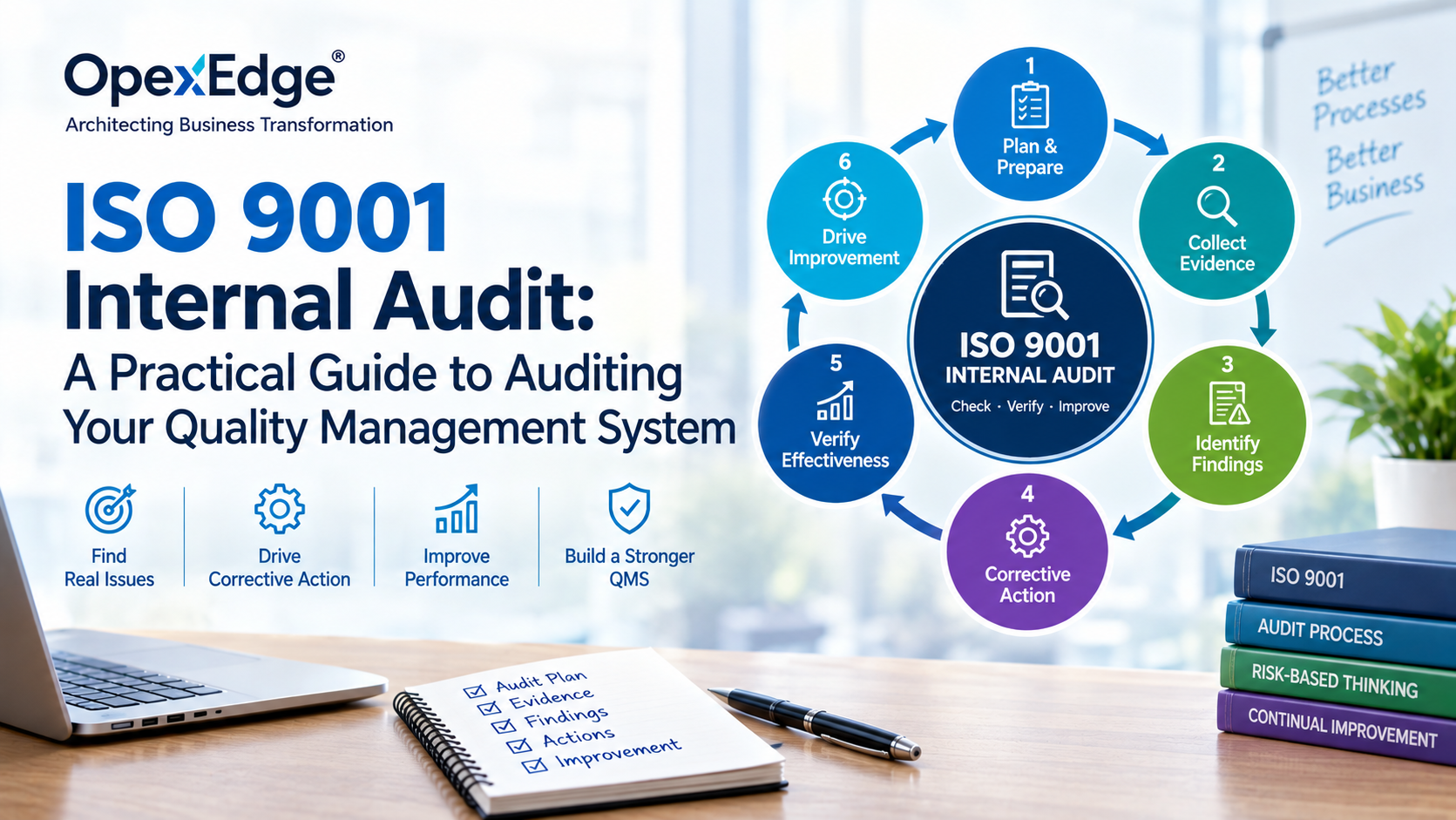
How to plan, conduct, document, and improve internal audits under ISO 9001:2026
An ISO 9001 internal audit should answer a much more important question than:
“Do we have the required documents?”
The real question is:
“Is our quality management system actually working?”
A company can have procedures, forms, work instructions, records, KPIs, and certificates—and still have processes that create defects, delays, customer complaints, rework, excessive cost, or operational risk.
That is why internal auditing should not become a document-checking exercise.
A well-designed internal audit examines how work is actually performed, compares evidence with defined requirements, identifies gaps, and provides management with information that can be used to improve the QMS.
ISO 9001:2026 continues to place internal auditing within performance evaluation, while ISO 19011:2026 provides current guidance for managing and conducting management-system audits.
The objective is not simply to find nonconformities.
The objective is to understand whether the management system is capable of delivering its intended results.
What Is an ISO 9001 Internal Audit?
An ISO 9001 internal audit is a systematic examination of the organization’s Quality Management System to determine whether it:
- Meets the organization’s own QMS requirements
- Meets the applicable ISO 9001 requirements
- Is effectively implemented
- Is maintained
- Produces the intended results
- Provides opportunities for improvement
Internal audits are commonly called first-party audits because they are conducted by or on behalf of the organization itself.
This makes them fundamentally different from a certification audit.
The certification body is assessing conformity from an external perspective.
The internal audit should help the organization understand its own system.
That distinction changes the mindset completely.
A weak audit asks:
“Can you show me the procedure?”
A stronger audit asks:
“Show me how this process works.”
A powerful audit asks:
“Show me the evidence that this process is achieving its intended result.”
Why Internal Audits Often Fail
Many organizations perform internal audits every year but receive surprisingly little value from them.
The audit calendar is completed.
The reports are filed.
The findings are closed.
And the same problems return six months later.
Why?
Because the audit process has become administrative rather than analytical.
Common problems include:
1. Auditing documents instead of processes
The auditor checks whether a procedure exists but does not verify whether employees actually follow it.
2. Using the same checklist every year
A static checklist can miss new risks, organizational changes, new products, new suppliers, system changes, and recurring problems.
- Auditing departments instead of processes
Customers do not experience “departments.”
They experience processes.
An order may move through sales, planning, purchasing, warehouse, production, logistics, invoicing, and customer service.
A problem at the handover between two departments may therefore remain invisible when each department is audited separately.
- Treating every process as equally important
A critical production process with repeated customer complaints should not receive exactly the same audit attention as a low-risk administrative activity.
- Asking questions without verifying evidence
An employee saying “we always do that” is not sufficient audit evidence.
The auditor should verify.
- Closing findings without eliminating causes
A correction can remove the immediate problem without preventing recurrence.
- Measuring audit completion instead of audit effectiveness
A company can achieve:
100% audit completion
while still having a weak QMS.
The more important question is:
What did the audits reveal, and what changed because of them?
ISO 9001 Internal Audit Requirements
ISO 9001:2026 requires organizations to conduct internal audits at planned intervals to provide information about whether the QMS conforms to organizational and standard requirements and is effectively implemented and maintained.
The internal audit programme should be planned and maintained, with attention to factors such as:
- Importance of the processes
- Changes affecting the organization
- Results of previous audits
- Audit frequency
- Audit methods
- Responsibilities
- Planning requirements
- Reporting
For each audit, the organization should establish appropriate:
- Objectives
- Criteria
- Scope
- Auditor assignments
- Reporting arrangements
- Follow-up actions
The audit process also needs to protect objectivity and impartiality.
In practical terms, someone should not simply audit their own work and declare it effective.
The organization also needs documented evidence of the audit programme and audit results.
ISO 9001 Internal Audit vs Certification Audit
| Internal Audit | Certification Audit |
| Conducted by or for the organization | Conducted by an independent certification body |
| First-party audit | Third-party audit |
| Focuses on organizational improvement and conformity | Determines conformity for certification purposes |
| Can examine emerging risks and improvement opportunities | Must follow certification rules and audit objectives |
| Usually part of the organization’s audit programme | Part of the certification cycle |
| Results belong to the organization’s management system | Results contribute to certification decisions |
The two types of audits should not be treated as substitutes.
A strong internal audit programme should help the organization understand and improve its QMS before an external auditor arrives.
The ISO 9001 Internal Audit Process
A practical internal audit can be structured into eight stages:
- Establish the audit programme
↓
- Select the audit
↓
- Define objectives, scope and criteria
↓
- Prepare the audit
↓
- Conduct the audit
↓
- Evaluate evidence and findings
↓
- Report and initiate corrective action
↓
- Verify effectiveness and improve the audit programme
This creates a closed loop rather than a one-time inspection.
- Establish the Internal Audit Programme
The audit programme is broader than an individual audit plan.
It defines how the organization will manage its internal audits over a period of time.
A useful programme should answer:
- What will be audited?
- How frequently?
- Why?
- By whom?
- Using which methods?
- Against which criteria?
- How will results be reported?
- How will follow-up be performed?
Do not simply create a departmental calendar
A common approach is:
| Month | Department |
| January | Sales |
| February | Purchasing |
| March | Production |
| April | Warehouse |
| May | HR |
| June | Finance |
This is easy to administer.
But it may not be the best way to understand process performance.
A stronger programme considers the significance and performance of processes.
For example:
| Process | Importance | Previous Findings | Change | Audit Attention |
| Purchasing | High | High | New suppliers | High |
| Production | High | Medium | New product | High |
| Warehouse | High | High | ERP change | High |
| HR | Medium | Low | Stable | Normal |
| Administration | Low | Low | Stable | Lower |
This produces a more intelligent audit programme.
- Select the Audit
Once the programme is established, determine which audit will actually be performed.
The selection should consider:
Process importance
How strongly does the process affect:
- Customer requirements?
- Product or service conformity?
- Cost?
- Delivery?
- Safety?
- Regulatory compliance?
- Business continuity?
Previous audit results
Repeated findings should influence future audit attention.
Organizational changes
Examples include:
- New ERP system
- New factory
- New supplier
- New product
- New service
- New process
- New equipment
- Restructuring
- New legislation
- Significant workforce changes
A process that was stable two years ago may require greater attention today.
- Define Audit Objectives, Scope and Criteria
These three concepts are often confused.
Audit objective
What do you want to learn?
Example:
Determine whether the purchasing process effectively controls supplier selection, purchasing requirements, supplier performance, and incoming material risks.
Audit scope
What part of the organization or process will be examined?
Example:
Supplier selection, purchasing, incoming inspection, supplier performance monitoring, and corrective action.
Audit criteria
What will the auditor compare the evidence against?
Possible criteria include:
- ISO 9001 requirements
- Company procedures
- Process requirements
- Customer requirements
- Contractual requirements
- Regulatory requirements
- Internal policies
- Defined KPIs
- Approved work instructions
A strong audit plan makes these elements explicit.
- Prepare the Audit
Preparation determines much of the audit’s quality.
Before visiting the process, the auditor should understand:
- Process objectives
- Process inputs
- Process outputs
- Process owner
- Key risks
- Relevant procedures
- KPIs
- Previous findings
- Customer complaints
- Corrective actions
- Relevant changes
- Supplier performance
- Available records
This is where a process map becomes extremely useful.
A SIPOC can help the auditor understand suppliers, inputs, process activities, outputs, and customers before starting the audit.
[Internal link: SIPOC Process Model]
The auditor should not arrive with only a checklist.
The auditor should arrive with a hypothesis about where the process may succeed, fail, or create risk.
- Conduct the Audit
An effective audit is an evidence-gathering process.
The auditor should use several techniques.
Interview
Ask employees how work is actually performed.
But do not stop at the answer.
If an employee says:
“We check every incoming shipment.”
Ask:
- What do you check?
- How do you know what to check?
- Who performs the check?
- Where are the requirements defined?
- Show me the last shipment.
- Show me the inspection record.
- What happens when the shipment fails?
- Who decides whether it can be accepted?
The conversation moves from claim → evidence.
Follow the Process
One of the most powerful auditing techniques is to follow an actual transaction through the process.
For example, in purchasing:
Purchase requirement
↓
Purchase requisition
↓
Supplier selection
↓
Purchase order
↓
Supplier delivery
↓
Incoming inspection
↓
Acceptance/rejection
↓
Inventory
↓
Supplier performance evaluation
Instead of asking whether each step exists, the auditor follows a real example.
This can reveal problems that a checklist cannot.
Use the “Show Me” Principle
A useful internal-audit habit is:
Ask → Observe → Verify → Trace
For example:
Ask
“How do you control obsolete documents?”
Observe
Look at the actual workstation or digital system.
Verify
Check the current document revision.
Trace
Select an older document and determine what happened to it.
This creates objective evidence.
- Audit Evidence: Facts, Not Opinions
Audit conclusions should be based on objective evidence.
Evidence can include:
- Records
- Reports
- System transactions
- KPIs
- Emails
- Approved documents
- Interviews
- Observations
- Physical conditions
- Customer complaints
- Inspection results
- Training records
- Supplier evaluations
- Maintenance records
- Corrective action records
A useful principle is:
Do not audit what someone says. Audit what can be demonstrated.
For example:
Statement:
“Our customer complaints are monitored.”
Evidence:
Complaint log + trend analysis + assigned actions + effectiveness verification.
The second provides a much stronger basis for an audit conclusion.
- Sampling During an ISO 9001 Audit
An auditor normally cannot examine every transaction.
Sampling is therefore essential.
For example, if a company processed 5,000 customer orders, the auditor may select a sample.
But the sample should not be chosen randomly without thought.
Consider:
- High-risk transactions
- Recent transactions
- Previous problem cases
- Customer complaints
- Different shifts
- Different employees
- Different locations
- Different products
- Exceptional cases
For example, if the company has a history of errors during night shifts, auditing only daytime transactions could produce a misleading conclusion.
Process-Based Auditing
A powerful approach is to audit across the complete process rather than stopping at organizational boundaries.
Consider an order-to-delivery process:
Customer order
→ Sales
→ Planning
→ Purchasing
→ Warehouse
→ Production
→ Quality
→ Logistics
→ Customer
The auditor should examine the handoffs.
Why?
Because many operational failures occur between functions.
Examples:
- Sales fails to communicate a specification.
- Planning receives incomplete information.
- Purchasing orders the wrong material.
- Warehouse records incorrect quantities.
- Production uses an obsolete instruction.
- Quality identifies the problem too late.
- Logistics receives incomplete delivery information.
A department-by-department audit can miss the interaction.
A process audit can expose it.
Auditing KPIs
An internal audit should not only ask whether KPIs exist.
It should examine whether the KPIs actually support process control.
Consider an order fulfillment process.
A company may report:
On-time delivery = 96%
That sounds positive.
But the auditor should ask:
- How is on-time delivery defined?
- What is the source of the data?
- Is the data reliable?
- What is excluded?
- Are customer-requested date changes included?
- What happens to late orders?
- Are repeated causes analyzed?
- Is performance improving?
- Are actions taken when targets are missed?
This connects auditing with performance management.
OpexEdge’s KPI framework emphasizes the connection between process performance, customer satisfaction, risks, corrective actions, and continual improvement.
[Internal link: KPI Development]
Auditing Risk Controls
A mature audit does not only ask:
“What can go wrong?”
It asks:
“What controls have been designed to prevent or detect it?”
For example, suppose a purchasing process has a risk of buying material from an unapproved supplier.
The auditor can examine:
Risk
Unapproved supplier used.
↓
Control
Approved supplier list.
↓
Execution
Purchase order references approved supplier.
↓
Evidence
Supplier approval record.
↓
Performance
Supplier quality KPI.
↓
Problem
Supplier failure.
↓
Action
Corrective action and supplier reassessment.
This transforms risk management from a document into an operating control.
Tools such as FMEA can also support this thinking.
[Internal link: FMEA]
8. Identifying Audit Findings
Not every observation should automatically become a nonconformity.
The auditor should distinguish between:
Conformity
The evidence demonstrates that the requirement is being fulfilled.
Nonconformity
The evidence demonstrates that a requirement has not been fulfilled.
Opportunity for improvement
The organization may be meeting requirements, but there may be a reasonable opportunity to improve effectiveness or efficiency.
Good practice
The audit identifies a practice that may provide useful learning for other processes.
The exact terminology and classification approach should follow the organization’s audit methodology.
The key principle is:
Findings must be supported by evidence.
How to Write a Strong Nonconformity
A weak finding says:
“Purchasing process is not effective.”
This is too vague.
A stronger finding contains:
Requirement
What should happen?
Evidence
What was actually observed?
Gap
How does the evidence demonstrate that the requirement was not fulfilled?
For example:
The purchasing process requires supplier performance to be evaluated periodically. During the audit, three active suppliers were found without documented performance evaluations for the defined review period.
This is much easier to investigate and correct.
Finding → Root Cause → Corrective Action
Finding the problem is only the beginning.
The next question is:
Why did the system allow the problem to occur?
Suppose:
Finding
Supplier evaluations were not completed.
A superficial action might be:
“Complete the missing evaluations.”
That corrects the immediate problem.
But why were they missed?
Possible causes could include:
- No clear ownership
- No reminder mechanism
- Incorrect responsibility matrix
- KPI not monitored
- ERP workflow missing
- Procedure unclear
- Employee competence issue
- Management follow-up ineffective
The corrective action should address the relevant cause—not merely repeat the missing activity.
This is where Root Cause Analysis becomes an important part of the audit-to-improvement cycle.
[Internal link: Root Cause Analysis]
Verify Corrective Action Effectiveness
One of the most important parts of internal auditing is often neglected:
effectiveness verification.
Suppose an audit finds repeated invoice errors.
The company trains the employee and closes the finding.
But three months later, the same error occurs.
The corrective action was completed.
The problem was not eliminated.
Therefore:
Action completion ≠ effectiveness.
A proper follow-up should ask:
- Was the action implemented?
- Did it address the identified cause?
- Did performance improve?
- Did the problem recur?
- Is additional action necessary?
A useful effectiveness measure might be:
Invoice error rate before action
vs.
Invoice error rate after action
The audit system becomes much stronger when it closes the loop between finding, action, and measurable result.
Internal Audit Checklist: What Should You Ask?
A practical audit checklist can be organized around five dimensions.
- Requirement
What requirement applies?
- Process
How is the activity actually performed?
- Control
What prevents errors or detects them?
- Evidence
What demonstrates that the control is working?
- Performance
Is the process achieving its intended result?
For example:
Audit Dimension |
Purchasing Example |
| Requirement | Approved suppliers must be controlled |
| Process | How are suppliers selected? |
| Control | Approved supplier list |
| Evidence | Current supplier approval records |
| Performance | Supplier quality and delivery KPIs |
This is much stronger than a checklist consisting only of:
“Do you have an approved supplier list?”
Example: Auditing a Customer Service Process
Imagine a service company with increasing customer complaints.
A document-focused audit might verify:
- Customer complaint procedure exists
- Complaint form exists
- Complaint log exists
A process-focused audit goes further.
Customer complaint received
↓
Complaint classified
↓
Responsible person assigned
↓
Response provided
↓
Root cause investigated
↓
Corrective action implemented
↓
Customer informed
↓
Effectiveness verified
↓
Complaint trend analyzed
Now the audit is examining the complete customer-feedback loop.
The organization can discover whether complaints are merely being recorded—or actually being used to improve the business.
Example: Auditing a Manufacturing Process
Consider a production line experiencing increasing rework.
The auditor should examine:
- Production requirements
- Work instructions
- Employee competence
- Machine condition
- Material availability
- Inspection methods
- Measurement equipment
- Process parameters
- Defect records
- Rework records
- Scrap
- Customer complaints
- Previous corrective actions
- Process KPIs
The objective is not to blame production.
The objective is to determine whether the QMS controls the process effectively.
Internal Audit and Continual Improvement
The most valuable internal audit programmes create a learning loop:
Audit
↓
Evidence
↓
Finding
↓
Root Cause
↓
Corrective Action
↓
Effectiveness
↓
Learning
↓
Improved Process
↓
Next Audit
This turns internal auditing into a continuous improvement mechanism.
Without this loop, audits become repetitive administrative exercises.
With it, audits become part of the organization’s management system.
How Management Should Use Internal Audit Results
Internal audit results should not remain inside the Quality Department.
Management should be able to see:
- Major recurring findings
- Process weaknesses
- Repeated corrective actions
- Overdue actions
- High-risk processes
- Performance deterioration
- Customer-related issues
- Supplier-related problems
- Systemic issues
- Improvement opportunities
This creates an important connection between:
Internal Audit → KPI Performance → Corrective Action → Management Review → Improvement
An audit finding should therefore be capable of becoming a management decision.
How Often Should You Conduct Internal Audits?
ISO 9001 does not prescribe one universal frequency for every process.
The appropriate frequency should reflect the organization’s circumstances and audit programme.
Consider:
- Process importance
- Previous audit results
- Changes
- Performance
- Customer complaints
- Nonconformities
- Risk
- Complexity
- Regulatory requirements
- New products or services
- New technology
- Organizational changes
A high-impact process with repeated problems may require more attention than a stable low-impact process.
The objective is not:
“Audit everything equally.”
The objective is:
“Allocate audit attention where it provides the greatest information and control value.”
Internal Audits in Small Businesses
Small businesses sometimes believe that internal auditing requires a large quality department.
It does not.
The audit system can be scaled to the organization.
A small company may have:
- A simple audit programme
- A small number of trained auditors
- Process-based audits
- Digital evidence
- Focused checklists
- Short audit cycles
- Management follow-up
The important issue is not the size of the audit department.
It is the effectiveness of the audit process.
However, objectivity and impartiality still matter.
If internal resources are limited, organizations may need to use personnel from other areas or qualified external support to avoid simply auditing their own work.
ISO 9001:2026 and Internal Auditing
The publication of ISO 9001:2026 makes this an important time to review existing internal audit systems.
Organizations transitioning from ISO 9001:2015 should review:
- Audit criteria
- Audit checklists
- Clause references
- Process maps
- Audit programme
- Auditor competence
- Risk considerations
- Organizational changes
- Quality culture-related requirements
- Documented information
- Corrective-action follow-up
Do not simply change “2015” to “2026” on an old checklist.
A transition should ask a more important question:
Does our audit system still examine the way our business actually operates?
The new edition should be treated as an opportunity to strengthen the management system—not simply update document references.
ISO 19011:2026 is also now the current published guidance standard for management-system auditing, replacing the 2018 edition. It emphasizes auditing principles including integrity, fair presentation, due professional care, confidentiality, independence, evidence-based auditing, and risk-based auditing.
Common ISO 9001 Internal Audit Mistakes
Mistake 1: Auditing only before certification
Internal auditing should be a management activity, not a pre-certification ritual.
Mistake 2: Using a huge checklist
More questions do not necessarily produce a better audit.
Good questions produce useful evidence.
Mistake 3: Auditing documents instead of execution
A perfect procedure cannot compensate for a poorly controlled process.
Mistake 4: Ignoring process interfaces
Many problems occur at handoffs.
Mistake 5: Treating every finding as isolated
Repeated findings may indicate a systemic problem.
Mistake 6: Closing actions without verification
An implemented action is not automatically an effective action.
Mistake 7: Measuring audit completion
The number of completed audits says little about whether the QMS improved.
Mistake 8: Ignoring business performance
Quality systems should connect to customer satisfaction, process performance, risk, cost, delivery, and improvement.
The Internal Audit Effectiveness Dashboard
Organizations can go beyond simply tracking:
Number of audits completed
A stronger dashboard might include:
| KPI | What It Shows |
| Audit Programme Completion | Whether planned audits were performed |
| Findings per Audit | Number of issues identified |
| Repeat Finding Rate | Whether previous problems recur |
| Corrective Action Closure Time | Speed of response |
| Overdue Actions | Follow-up discipline |
| Effectiveness Verification Rate | Whether actions were checked |
| Recurrence Rate | Whether causes were actually addressed |
| High-Risk Process Coverage | Attention given to important processes |
| Customer-Related Findings | Connection to customer experience |
| Improvement Opportunities Implemented | Value generated beyond compliance |
This changes the question from:
“Did we complete the audits?”
to:
“Are our audits improving the management system?”
A Practical ISO 9001 Internal Audit Checklist
Before the audit:
- Define the audit objective
- Define the scope
- Define audit criteria
- Review previous audit results
- Review relevant changes
- Review process performance
- Review complaints and nonconformities
- Select an appropriate auditor
- Prepare questions and evidence sources
During the audit:
- Interview relevant employees
- Observe actual work
- Review documented information
- Trace real transactions
- Verify controls
- Sample records
- Check process performance
- Record objective evidence
- Identify findings clearly
After the audit:
- Report results
- Communicate findings
- Assign corrective actions
- Determine root causes
- Define deadlines
- Verify implementation
- Verify effectiveness
- Identify recurring/systemic issues
- Feed significant results into management review
- Improve the audit programme where necessary
From Compliance Audit to Operational Excellence
There are two very different ways to view internal auditing.
Traditional view
Requirement → Checklist → Finding → Corrective Action → Close
Operational Excellence view
Business objective → Process → Risk → Control → Evidence → Performance → Finding → Root Cause → Improvement → Measurable Result
The second approach creates a much stronger connection between ISO 9001 and business performance.
This is consistent with the broader purpose of a QMS: not simply maintaining documentation, but establishing a system that supports consistent performance, customer satisfaction, risk management, and continual improvement.
How OpexEdge Approaches Internal Auditing
At OpexEdge, internal auditing is viewed as part of the broader operational management system.
The objective is not to create more paperwork.
The objective is to connect:
Requirements
↓
Processes
↓
Controls
↓
Evidence
↓
KPIs
↓
Risks
↓
Corrective Actions
↓
Continual Improvement
This approach helps organizations move beyond:
Compliance → Control → Capability → Continuous Improvement → Operational Excellence
For organizations preparing or strengthening an ISO 9001 system, the internal audit should become a test of whether the QMS actually works in the real business.
Frequently Asked Questions
Is an internal audit required for ISO 9001?
Yes. ISO 9001 includes internal auditing as part of evaluating the performance of the QMS.
Is ISO 19011 mandatory for ISO 9001 internal audits?
ISO 19011 provides auditing guidance. It is not itself a certification requirement that an organization must implement as a separate management-system standard.
It is useful for designing and improving an internal audit programme.
Can employees audit their own departments?
The organization must ensure objectivity and impartiality in the audit process. In practice, auditors should avoid auditing their own work or responsibilities where this would compromise objectivity.
How often should an ISO 9001 internal audit be performed?
There is no single frequency appropriate for every organization or process. The audit programme should reflect process importance, changes, previous audit results, and the organization’s circumstances.
Does every department need a separate audit?
Not necessarily.
A process may cross several departments, and process-based auditing can provide a more complete picture than auditing organizational departments separately.
What is the difference between an audit finding and a corrective action?
A finding identifies the result of evaluating evidence against audit criteria.
A corrective action addresses the cause of a nonconformity to prevent recurrence.
Is an ISO 9001 internal audit the same as a certification audit?
No.
An internal audit is a first-party audit conducted by or for the organization. A certification audit is performed by an independent certification body.
Can internal audits identify improvement opportunities?
Yes.
A strong audit programme can identify conformity, nonconformity, risks, and opportunities for improvement.
Final Takeaway
An ISO 9001 internal audit should not be a yearly search for paperwork.
It should be a structured test of whether the organization’s management system works.
The strongest audits connect:
Requirements
→ Processes
→ Controls
→ Evidence
→ Performance
→ Risks
→ Findings
→ Root Causes
→ Corrective Actions
→ Effectiveness
→ Continual Improvement
That is when an internal audit stops being a compliance activity and becomes a management tool.
The real question is not whether your company can pass an audit.
The real question is whether your audit system can help your company become better.
Related OpexEdge Resources
- ISO 9001: More Than a Certificate — How a Quality Management System Becomes a Business Performance Engine
- How to Implement ISO 9001: A Step-by-Step Guide to Building an Effective QMS
- SIPOC Process Model: How to Map and Improve Business Processes
- Root Cause Analysis: Fishbone Diagram and 5 Whys
- KPI Development: Measuring What Matters to Improve Effectiveness and Efficiency
- Failure Mode and Effects Analysis (FMEA)
Need Help Building Your ISO 9001 Documentation?
OpexEdge provides AI-Powered ISO 9001 Documentation support combining AI-powered tools with expert review to help organizations build practical, business-specific QMS documentation.
ISO 9001 documents ready in 5 working days? Yes, it’s possible.
The objective is not to create a collection of generic templates.
It is to build documentation that reflects how your business actually operates.
[Explore the AI-Powered ISO 9001 Documentation Service]
Know Your Expert: Mahmoud Elhefnawi — Operational Excellence Architect
Related Topics
TPM | Hypothesis Test | Accuracy | 6 Sigma | MSA | POKA YOKE | MUDA | 5S | FMEA | SIPOC | KPI | ISO9001 |
Gage R&R Study and Measurement System Analysis — Complete MSA Guide | OpexEdge Consultancy
Root Cause Analysis: FishBone Diagram and 5-Whys
Quality Function Deployment (QFD)
AI-Powered ISO9001 Documentation Requirements Service
ISO 9001:2026 Requirements Explained: A Practical Guide to Every QMS Requirement
How to Implement ISO 9001: A Step-by-Step Guide to Building an Effective QMS
ISO 9001 Internal Audit: A Practical Guide to Auditing Your Quality Management System
ISO 9001 Risk-Based Thinking: A Practical Guide to Identifying and Controlling QMS Risks
ISO 9001 Documentation: What Documents and Records Does a QMS Really Need?
ISO 9001 Documentation: What Documents and Records Does a QMS Really Need?
