
Introduction: Implementing ISO 9001 Is About Building a System, Not a Folder
Many companies begin ISO 9001 implementation with the wrong question:
“Which documents do we need?”
They start searching for:
- Quality Manual templates
- SOP templates
- ISO procedures
- Forms
- Checklists
- Policies
- Audit templates
Documents are important, but they are not the QMS.
A Quality Management System is the way an organization manages its processes so that it can consistently meet customer and applicable requirements, monitor performance and continually improve.
ISO describes ISO 9001 as a framework for establishing, implementing, maintaining and continually improving a QMS. ISO also emphasizes leadership commitment, process understanding, performance measurement, training, audits and management review as practical elements of building an effective system.
The implementation mindset should therefore be:
Understand the business → Define the processes → Identify risks → Establish controls → Measure performance → Improve
Not:
Buy templates → Fill forms → Prepare for auditor
This guide explains how to implement ISO 9001 step by step, with particular attention to small and growing businesses that need a QMS that actually supports operations.
What Does ISO 9001 Implementation Mean?
ISO 9001 implementation means establishing and operating a Quality Management System that meets the applicable requirements of ISO 9001.
The system should be integrated into the organization’s actual operations.
That means the QMS should influence activities such as:
- Sales
- Customer requirement review
- Product or service development
- Purchasing
- Supplier management
- Production
- Service delivery
- Inspection
- Customer service
- Complaints
- Performance measurement
- Internal auditing
- Corrective action
- Management review
- Continual improvement
The goal is not to create a separate “ISO department” that operates beside the business.
The goal is to make quality management part of the business.
ISO 9001 Implementation at a Glance
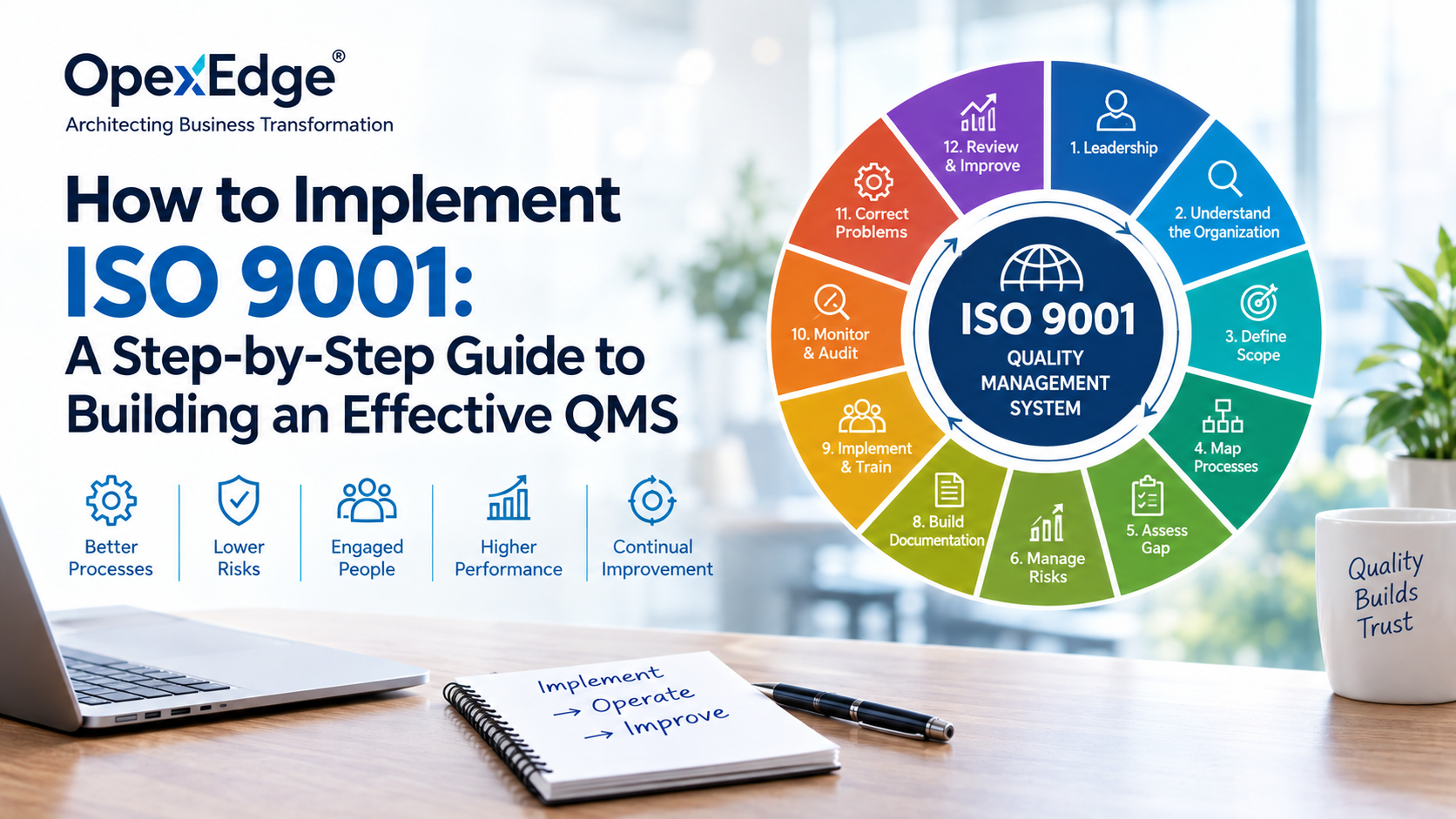
A practical implementation roadmap can be organized into 12 stages:
- Secure Leadership Commitment
↓
- Understand the Organization
↓
- Define the QMS Scope
↓
- Map the Business Processes
↓
- Conduct a Gap Assessment
↓
- Identify Risks and Opportunities
↓
- Establish Quality Objectives and KPIs
↓
- Build Necessary QMS Documentation
↓
- Implement and Train
↓
- Monitor and Audit
↓
- Correct Problems
↓
- Conduct Management Review and Improve
The exact sequence can be adapted to the organization’s size, complexity and existing management system.
ISO’s own guidance for organizations starting their QMS journey emphasizes leadership commitment, process documentation, metrics, training, audits and regular system review.
Step 1 — Secure Leadership Commitment
ISO 9001 implementation should start with management.
Not with the Quality Manager.
Not with the consultant.
Not with an external auditor.
Top management needs to understand why the organization is implementing ISO 9001 and what business outcomes are expected.
Possible objectives include:
- improving customer satisfaction;
- reducing defects;
- reducing complaints;
- improving process consistency;
- qualifying for new customers;
- entering new markets;
- improving supplier performance;
- reducing rework;
- improving management control;
- preparing for certification.
The Wrong Approach
“The customer asked for ISO certification, so Quality needs to get it done.”
This can produce a compliance-driven system.
The Stronger Approach
“We need a management system that makes our business more consistent, measurable and capable of meeting customer requirements.”
The second approach creates ownership beyond the Quality function.
Step 2 — Understand the Organization Before Writing Procedures
Before creating documentation, understand the business.
Ask:
- What does the company actually do?
- Who are its customers?
- What products or services are provided?
- What are the critical processes?
- Where do errors occur?
- What causes customer complaints?
- Which suppliers are critical?
- Where does management currently lose visibility?
- Which processes depend too heavily on individual employees?
- Which activities create the greatest quality risks?
This is the point where ISO 9001 implementation becomes an Operational Excellence exercise.
You are not designing documentation.
You are designing a management system around the real organization.
Step 3 — Define the QMS Scope
The organization needs to define what its Quality Management System covers.
The scope should reflect:
- organizational activities;
- locations;
- products and services;
- relevant processes;
- applicable requirements.
For example:
“Design, manufacture and distribution of industrial electrical control panels.”
Or:
“Provision of equipment maintenance, installation and after-sales services.”
A good scope is clear enough that employees, customers and auditors can understand what the QMS covers.
Step 4 — Map the Business Processes
This is one of the most important implementation steps.
Before writing SOPs, understand the process architecture.
A typical organization might have:
Management Processes
- Strategy
- Business planning
- Management review
- Risk management
Core Processes
- Marketing
- Sales
- Customer requirement review
- Product/service development
- Procurement
- Production/service delivery
- Delivery
- Customer support
Support Processes
- Human resources
- Training
- IT
- Maintenance
- Finance
- Document control
The next question is:
How do these processes interact?
For example:
Sales
→ Customer requirements
→ Planning
→ Procurement
→ Production
→ Inspection
→ Delivery
→ Customer feedback
→ Corrective action
This is where the SIPOC Process Model can be extremely useful.
OpexEdge’s SIPOC guide explains how SIPOC can help organizations understand suppliers, inputs, processes, outputs and customers before developing improvement initiatives or documentation.
Related OpexEdge resource:
SIPOC Process Model: How to Map and Improve Business Processes
Step 5 — Conduct an ISO 9001 Gap Assessment
Do not immediately start writing documents.
First determine:
Where are we now?
compared with:
Where do we need to be?
A gap assessment compares the existing management system against the applicable ISO 9001 requirements.
A practical gap assessment can examine:
| Area | Questions |
| Context | Have relevant internal and external issues been identified? |
| Customers | Are customer requirements understood and reviewed? |
| Processes | Are key processes defined and controlled? |
| Leadership | Is management actively involved? |
| Risks | Are significant risks and opportunities addressed? |
| Objectives | Are measurable quality objectives established? |
| Competence | Are people competent for their roles? |
| Documentation | Is necessary documented information controlled? |
| Suppliers | Are external providers appropriately controlled? |
| Operations | Are processes controlled? |
| KPIs | Is performance measured and analyzed? |
| Audit | Is there an effective internal audit process? |
| Corrective Action | Are recurring problems investigated? |
| Management Review | Does management review QMS performance? |
| Improvement | Is the system continually improved? |
The output should not simply be a list of nonconformities.
It should become an implementation roadmap.
Step 6 — Identify Risks and Opportunities
ISO 9001 uses risk-based thinking to help organizations consider factors that could affect intended QMS results.
A practical implementation should therefore ask:
What could go wrong?
and:
What could make the process perform better?
Examples:
| Process | Risk | Opportunity |
| Purchasing | Supplier delays | Dual sourcing |
| Production | Process variation | SPC |
| Sales | Incorrect requirements | Structured contract review |
| HR | Skill gaps | Competency matrix |
| Warehouse | Inventory errors | Barcode controls |
| Service | Repeat complaints | Root cause analysis |
| Maintenance | Unexpected downtime | Preventive maintenance |
Risk management should be connected to actual processes.
A risk register sitting in a spreadsheet while employees operate differently has limited value.
Step 7 — Establish Quality Objectives and KPIs
The organization needs measurable objectives that help management understand whether the QMS is delivering its intended results.
Examples include:
Customer
- Customer satisfaction
- Complaint rate
- Customer retention
- Warranty claims
Delivery
- On-time delivery
- Order cycle time
- Service response time
Quality
- Defect rate
- First-pass yield
- Rework
- Returns
Supplier
- Supplier defect rate
- Supplier on-time delivery
- Incoming inspection failures
Improvement
- Corrective-action closure time
- Repeat nonconformities
- Improvement-project completion
The important point is not the number of KPIs.
It is the connection between:
KPI → Target → Owner → Review → Action
OpexEdge’s KPI Development article explains how KPIs can connect effectiveness, efficiency, process performance and improvement.
Related resource:
KPI Development: Measuring What Matters to Improve Effectiveness and Efficiency
Step 8 — Build the Necessary QMS Documentation
Only after understanding the processes should the organization determine what needs to be documented.
This is a critical principle.
Do not ask:
“What ISO documents can we find online?”
Ask:
“What documented information is necessary to control our processes and demonstrate effective operation?”
Documentation can include:
- Quality policy
- Quality objectives
- Process descriptions
- SOPs
- Work instructions
- Forms
- Records
- Specifications
- Inspection criteria
- Supplier evaluation records
- Training records
- Audit records
- Corrective action records
- Management review records
The amount and complexity should reflect the organization.
A small service company does not need the same documentation architecture as a multinational manufacturer.
ISO’s guidance for SMEs specifically recognizes that smaller organizations have different needs and resources and provides implementation guidance tailored to those circumstances.
Step 9 — Develop Processes Before Training People on Them
A common implementation mistake is training employees on procedures that do not actually reflect how work is performed.
Instead:
Map the process
↓
Identify risks
↓
Define controls
↓
Develop the practical procedure
↓
Test it
↓
Improve it
↓
Train employees
This sequence produces much stronger adoption.
For example, before creating a purchasing SOP, understand:
Purchase Request
→ Approval
→ Supplier Selection
→ Quotation
→ Purchase Order
→ Delivery
→ Inspection
→ Invoice
→ Supplier Performance
Then determine where errors can occur and which controls are needed.
Step 10 — Implement the QMS in the Real Business
Documentation alone does not implement ISO 9001.
The system must be used.
Employees should actually:
- follow the defined processes;
- use controlled information;
- record required evidence;
- monitor KPIs;
- report nonconformities;
- perform inspections;
- evaluate suppliers;
- address customer complaints;
- implement corrective actions.
This is the point where the organization discovers whether its QMS design works in practice.
And that is important.
A procedure that looks excellent on paper may fail when exposed to real operating conditions.
Step 11 — Train Employees and Build Competence
Training should not be limited to:
“Here is ISO 9001. Please read it.”
Employees need to understand how the QMS affects their jobs.
Sales employees need to understand:
- customer requirements;
- contract review;
- communication;
Purchasing employees need to understand:
- supplier requirements;
- evaluation;
- purchasing specifications;
- supplier performance.
Production employees need to understand:
- process controls;
- specifications;
- inspection;
- nonconforming outputs.
Managers need to understand:
- objectives;
- KPIs;
- risks;
- corrective action;
- management review.
The goal is not ISO knowledge for its own sake.
The goal is competence in performing quality-critical work.
Step 12 — Establish Document and Record Control
A QMS can become dangerous when employees are working with different versions of the same information.
Document control should address issues such as:
- identification;
- approval;
- revision;
- availability;
- distribution;
- access;
- obsolete versions;
- retention;
For example:
Imagine production has three versions of a work instruction.
One operator uses Version 3.
Another uses Version 5.
Quality has Version 6.
The organization does not have a documentation problem.
It has a process-control problem.
Step 13 — Monitor Process Performance
Once processes are operating, collect evidence.
Monitor:
- quality;
- delivery;
- customer satisfaction;
- supplier performance;
- process performance;
- objectives;
- nonconformities;
- corrective actions.
This is where dashboards and KPI systems become useful.
But avoid creating dashboards that nobody uses.
A KPI should support a management decision.
For example:
On-time delivery = 91%
is information.
But:
On-time delivery = 91% → target = 97% → supplier delay accounts for 4 percentage points → corrective action assigned
is management.
Step 14 — Conduct Internal Audits
Internal auditing should test whether the system works.
A weak audit asks:
“Do you have a procedure?”
A stronger audit asks:
“Show me how this process actually works.”
For example, in purchasing:
Customer requirement
→ Purchase requirement
→ Supplier selection
→ Quotation
→ Purchase order
→ Delivery
→ Inspection
→ Supplier evaluation
→ Corrective action
The auditor follows the process and collects objective evidence.
This is a process audit, not a document hunt.
Step 15 — Manage Nonconformities and Corrective Actions
Problems will occur.
The objective of a QMS is not to pretend that problems never happen.
The objective is to ensure that problems are:
Detected → Contained → Investigated → Corrected → Prevented from recurring
A strong corrective-action process asks:
What happened?
What was the immediate cause?
What is the root cause?
Could the same problem exist elsewhere?
What action will prevent recurrence?
How will effectiveness be verified?
This is where Root Cause Analysis becomes an important supporting capability.
OpexEdge’s RCA article specifically addresses the connection between structured root-cause analysis, corrective action and ISO 9001.
Related resource:
Root Cause Analysis: Fishbone Diagram and 5 Whys
Step 16 — Conduct Management Review
Management review should answer:
Is the QMS producing the results we need?
Management should review relevant information such as:
- audit results;
- customer feedback;
- KPI performance;
- quality objectives;
- nonconformities;
- corrective actions;
- supplier performance;
- risks;
- opportunities;
- resource requirements;
- improvement opportunities.
The output should include decisions and actions.
A management review meeting that produces only minutes but no decisions is not achieving its full purpose.
Step 17 — Improve the QMS
The implementation is not finished when the organization receives certification.
That is where continual improvement begins.
A mature QMS creates a cycle:
Measure
↓
Identify Gap
↓
Analyze Cause
↓
Take Action
↓
Verify Effectiveness
↓
Standardize
↓
Measure Again
This is essentially the management logic behind PDCA.
And it is where ISO 9001 becomes closely connected to Operational Excellence.
ISO 9001 Implementation Timeline
There is no universal implementation duration.
The required effort depends on:
- company size;
- number of locations;
- process complexity;
- number of employees;
- regulatory requirements;
- existing management systems;
- documentation maturity;
- management commitment;
- certification objectives.
A small company with simple processes and strong existing controls may progress much faster than a large organization operating across multiple sites.
A practical roadmap could look like:
| Phase | Typical Focus |
| Phase 1 | Leadership and project planning |
| Phase 2 | Context, scope and process mapping |
| Phase 3 | Gap assessment |
| Phase 4 | Risks, objectives and KPIs |
| Phase 5 | QMS documentation |
| Phase 6 | Implementation and training |
| Phase 7 | Performance monitoring |
| Phase 8 | Internal audit |
| Phase 9 | Corrective actions |
| Phase 10 | Management review |
| Phase 11 | Final readiness assessment |
| Phase 12 | Certification audit, if applicable |
The timeline should be based on the organization’s readiness rather than an arbitrary number of days.
ISO 9001 Implementation for Small Businesses
Small businesses often assume ISO 9001 requires a large quality department.
It does not.
ISO states that its requirements are applicable to organizations regardless of size or type, and ISO provides dedicated guidance for SMEs.
A small organization can often create a practical QMS using existing people and processes.
For example:
Managing Director
Strategic direction and management review
Operations Manager
Process ownership and performance
Quality Coordinator
QMS coordination and audits
Department Managers
Process control and KPIs
Employees
Execution and quality awareness
The organization does not necessarily need a large bureaucracy.
It needs clear responsibilities and effective processes.
ISO 9001 Implementation for a Manufacturing Company
A manufacturing implementation may focus heavily on:
- production processes;
- process parameters;
- inspection;
- equipment;
- calibration;
- supplier quality;
- traceability;
- nonconforming product;
- process capability;
- maintenance;
- customer specifications.
Tools such as FMEA, SPC and process capability analysis can strengthen the QMS.
OpexEdge’s FMEA guide explains how FMEA can support risk-based thinking by identifying potential failures and planning preventive controls.
Its SPC guide demonstrates how statistical process control can turn process data into practical control and improvement actions.
ISO 9001 Implementation for Service Companies
A service company may have very different quality risks.
Examples include:
- incorrect customer requirements;
- missed deadlines;
- inconsistent service delivery;
- employee competency;
- communication failures;
- incomplete records;
- customer complaints;
- supplier dependency.
The QMS should therefore be designed around the actual service journey.
For example:
Customer Inquiry
→ Requirement Understanding
→ Quotation
→ Contract
→ Planning
→ Service Delivery
→ Verification
→ Customer Feedback
→ Improvement
ISO 9001 does not require every organization to look like a factory.
The principles can be applied to manufacturing, consulting, construction, logistics, technology, healthcare, education and many other sectors. ISO notes that the standard is adapted across a wide range of industries.
Common ISO 9001 Implementation Mistakes
Mistake 1 — Starting With Templates
Templates should support the QMS.
They should not define the QMS.
Mistake 2 — Creating Too Much Documentation
More documents do not automatically mean better quality.
Documentation should support effective process control.
Mistake 3 — Quality Owns Everything
The Quality function cannot operate every business process.
Process owners must own their processes.
Mistake 4 — Ignoring Existing Processes
Many organizations already have useful controls.
The first question should be:
What do we already do well?
Then:
What is missing or ineffective?
Mistake 5 — Treating Training as Attendance
A training certificate does not automatically prove competence.
The organization needs evidence that people can perform their responsibilities effectively.
Mistake 6 — Creating KPIs Nobody Reviews
A KPI without management action is often just reporting.
Mistake 7 — Performing Internal Audits Too Late
Internal audits should be used as a learning mechanism during implementation, not only immediately before certification.
Mistake 8 — Fixing Symptoms Instead of Causes
Replacing a defective product solves today’s customer problem.
Understanding why the defect occurred prevents tomorrow’s problem.
Mistake 9 — Treating Certification as the Finish Line
Certification is one possible outcome.
The management system should continue operating and improving after certification.
ISO 9001 Implementation Checklist
Use this as a high-level implementation checklist.
Leadership
- Leadership commitment established
- Business objectives defined
- QMS responsibility assigned
- Resources identified
Context
- Organizational context assessed
- Interested parties identified
- QMS scope defined
Processes
- Core processes identified
- Support processes identified
- Process interactions mapped
- Process owners assigned
Gap Assessment
- Existing controls reviewed
- ISO 9001 gaps identified
- Implementation priorities established
Risk and Planning
- Risks identified
- Opportunities identified
- Quality objectives established
- KPIs defined
- Change-management needs identified
Documentation
- Required documented information identified
- Procedures developed where necessary
- Work instructions developed where necessary
- Forms and records established
- Document-control system established
Implementation
- Processes implemented
- Employees trained
- Competence evaluated
- Records generated
- KPIs monitored
Evaluation
- Customer satisfaction monitored
- Process performance analyzed
- Supplier performance reviewed
- Internal audit conducted
- Nonconformities addressed
Improvement
- Corrective actions implemented
- Root causes investigated
- Effectiveness verified
- Management review conducted
- Improvement opportunities identified
Certification
- QMS readiness assessed
- Certification body selected, if certification is required
- Certification audit planned
ISO 9001 Implementation vs ISO 9001 Certification
These terms are often confused.
Implementation
Means building and operating the QMS.
Certification
Means an independent certification body assesses the organization’s QMS against the applicable standard and, where requirements are met, issues certification.
Certification is not mandatory for using ISO 9001. ISO explicitly notes that organizations can implement ISO 9001 without becoming certified.
This distinction matters.
An organization should first build a functioning management system.
Certification can then verify the system.
What Does a Successful ISO 9001 Implementation Look Like?
A successful implementation should eventually make the organization less dependent on firefighting.
You should see:
Clearer processes
Employees understand how work should flow.
Clearer responsibilities
People know who owns decisions and processes.
Better visibility
Management can see process performance.
Better customer focus
Requirements and feedback are systematically managed.
Better risk control
Potential failures are identified earlier.
Better problem solving
Recurring problems receive structured root-cause analysis.
Better consistency
Processes become less dependent on individual employees.
Better improvement
Performance data creates action.
That is the real value of implementation.
ISO 9001 Implementation in the Age of AI
AI can accelerate parts of QMS implementation, but it should not replace management judgment or expert review.
AI can assist with:
- document drafting;
- process analysis;
- questionnaire processing;
- gap-assessment preparation;
- document comparison;
- identifying missing information;
- organizing evidence;
- generating draft procedures;
- analyzing quality data;
- identifying patterns in complaints;
- supporting corrective-action analysis.
But the organization remains responsible for determining whether the information is accurate and whether the resulting QMS is appropriate for its actual operations.
The strongest model is:
AI for speed + Expert judgment for quality + Management ownership for decisions
This is particularly relevant for SMEs that need a practical QMS without building a large internal quality function.
Frequently Asked Questions
How do you implement ISO 9001?
A practical implementation begins with leadership commitment and understanding the organization, then defines the QMS scope, maps processes, performs a gap assessment, identifies risks, establishes objectives and KPIs, develops necessary documentation, implements the processes, trains employees, conducts internal audits, addresses corrective actions and performs management review.
How long does ISO 9001 implementation take?
There is no universal timeline. Implementation depends on company size, complexity, existing processes, number of locations, resources, management commitment and the maturity of the existing management system.
Can a small business implement ISO 9001?
Yes. ISO 9001 is designed to be applicable to organizations of different sizes and sectors. ISO also provides specific implementation guidance for SMEs.
Do I need a consultant to implement ISO 9001?
No. An organization can implement ISO 9001 internally. External expertise can nevertheless reduce implementation time, provide specialized knowledge and help identify gaps that internal teams may overlook.
Do I need a Quality Manager?
Not necessarily. The organization needs appropriate responsibilities and authorities, but the structure should reflect its size and complexity.
Do I need to write a Quality Manual?
Not necessarily. ISO 9001:2026 is not intended to impose a uniform documentation structure on every organization. The focus should be on the documented information necessary for an effective QMS.
Do I need ISO certification?
No. ISO 9001 implementation and ISO 9001 certification are different. Certification is optional unless a customer, regulator, contract or market requirement makes it necessary.
What should I do first when implementing ISO 9001?
Start by understanding the business.
Identify the organization’s key processes, customers, requirements, risks and current controls before creating documentation.
Should I buy ISO 9001 templates?
Templates can save time, but they should be adapted to the organization’s actual processes. Generic templates copied without understanding the business can create documentation that does not reflect reality.
What is the biggest mistake when implementing ISO 9001?
Treating ISO 9001 as a documentation or certification project rather than a management-system implementation.
Can ISO 9001 improve business performance?
Yes, when implemented as an operating management system rather than a paperwork exercise. A well-designed QMS can connect customer requirements, processes, risks, performance measurement and continual improvement.
The OpexEdge Approach to ISO 9001 Implementation
At OpexEdge, we see ISO 9001 implementation as a sequence:
Understand
→ Map
→ Assess
→ Design
→ Document
→ Implement
→ Measure
→ Audit
→ Improve
This approach is deliberately different from:
Template → Copy → Sign → Audit
The objective is to make the QMS fit the business.
For a growing company, this can mean building the management infrastructure needed to operate with greater consistency without creating unnecessary bureaucracy.
Need Help Building Your ISO 9001 QMS?
OpexEdge provides an AI-Powered ISO9001 Documentation Service designed to help organizations prepare practical QMS documentation faster while keeping the system connected to their actual business processes.
The service combines:
Structured information gathering
AI-assisted documentation
Operational-excellence methodology
Expert review
The objective is not simply to produce documents.
It is to help create a usable QMS that supports:
- Process control
- Risk management
- Customer requirements
- Quality objectives
- KPIs
- Operational consistency
- Audit readiness
- Continual improvement
ISO 9001 documents ready in 5 working days? Yes, it is possible.
Explore the OpexEdge AI-Powered ISO9001 Documentation Service
Final Takeaway
ISO 9001 implementation should not begin with a document template.
It should begin with the business.
Understand the organization.
Map the processes.
Understand customer requirements.
Identify risks.
Define controls.
Establish measurable objectives.
Document what is necessary.
Train people.
Measure performance.
Audit the system.
Correct problems.
Improve continuously.
That is how ISO 9001 becomes more than certification.
It becomes a management system capable of helping the organization deliver consistent results as it grows.
ISO 9001 provides the framework.
Your business provides the processes.
Management provides the leadership.
Data provides the evidence.
Continual improvement turns the system into capability.
And that is where Quality Management becomes Operational Excellence.
OpexEdge — Architecting Business Transformation from Zero to Scale.
Related Topics
TPM | Hypothesis Test | Accuracy | 6 Sigma | MSA | POKA YOKE | MUDA | 5S | FMEA | SIPOC | KPI | ISO9001 |
Gage R&R Study and Measurement System Analysis — Complete MSA Guide | OpexEdge Consultancy
Root Cause Analysis: FishBone Diagram and 5-Whys
Quality Function Deployment (QFD)
AI-Powered ISO9001 Documentation Requirements Service
ISO 9001:2026 Requirements Explained: A Practical Guide to Every QMS Requirement
How to Implement ISO 9001: A Step-by-Step Guide to Building an Effective QMS
ISO 9001 Internal Audit: A Practical Guide to Auditing Your Quality Management System
ISO 9001 Risk-Based Thinking: A Practical Guide to Identifying and Controlling QMS Risks
ISO 9001 Documentation: What Documents and Records Does a QMS Really Need?
ISO 9001 Documentation: What Documents and Records Does a QMS Really Need?
