
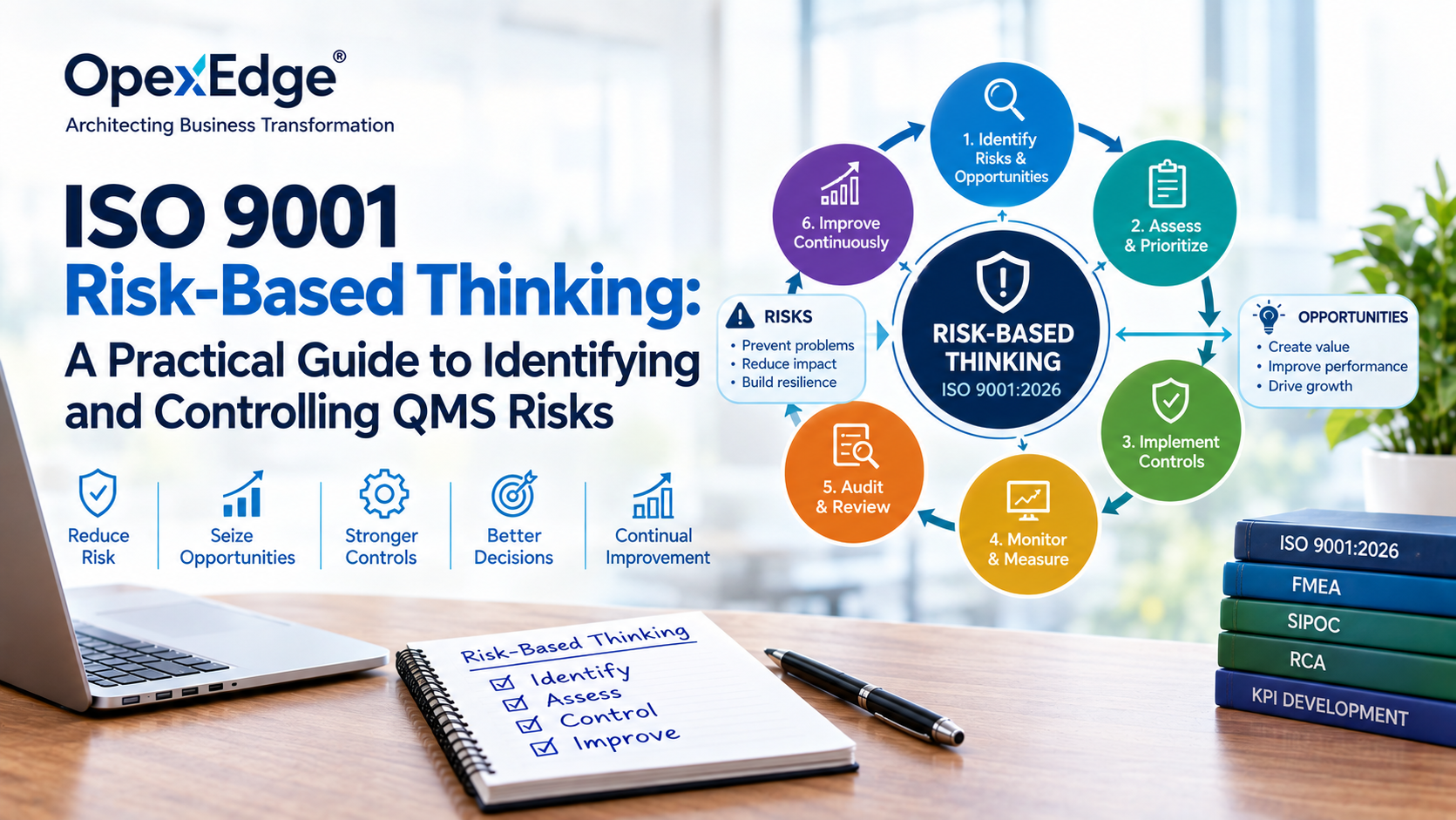
How to identify, assess, control, and monitor risks and opportunities within an ISO 9001:2026 Quality Management System
Most companies do not discover their biggest quality problems because they were impossible to predict.
They discover them because the warning signs were already there.
A supplier was becoming unreliable.
A process was becoming unstable.
Customer complaints were increasing.
An employee was bypassing a control.
A critical machine was approaching the end of its useful life.
A new product was introduced without fully understanding its process risks.
The information existed.
The risk simply was not managed early enough.
This is the thinking behind risk-based thinking in ISO 9001.
It is not about creating a complicated risk register.
It is about building the ability to ask:
What could prevent this process from achieving its intended result—and what should we do about it before the problem becomes serious?
ISO 9001:2026 continues to place risk-based thinking at the heart of quality management. The new edition provides greater clarity around the consideration of risks and opportunities, with a clearer distinction between managing risks and pursuing opportunities. (ISO)
The result is a more useful way of thinking about quality:
Don’t wait for failure to tell you where the risk was.
What Is Risk-Based Thinking in ISO 9001?
Risk-based thinking means considering uncertainty when designing, operating, and improving the Quality Management System.
The basic logic is:
Objective
↓
What could prevent us from achieving it?
↓
What could cause that to happen?
↓
What controls already exist?
↓
Are those controls effective?
↓
What additional action is needed?
↓
How will we know the risk is under control?
This approach helps organizations become proactive instead of relying primarily on corrective action after something goes wrong.
ISO’s own guidance describes risk-based thinking as planning and implementing actions to address risks and opportunities. (ISO)
Risk-Based Thinking Is Not the Same as Risk Management
The two concepts are related, but they are not necessarily identical.
Risk management
Usually refers to a structured system for identifying, assessing, treating, monitoring, and communicating risks.
Risk-based thinking
Is broader.
It means that people throughout the organization consider risk when making decisions and controlling processes.
For example:
A warehouse employee deciding where to store temperature-sensitive material is applying risk-based thinking.
A purchasing manager evaluating supplier dependency is applying risk-based thinking.
A production engineer reviewing a new process is applying risk-based thinking.
A service manager identifying a failure point in the customer journey is applying risk-based thinking.
A management team deciding whether to introduce a new technology is applying risk-based thinking.
It therefore becomes part of the way the business operates—not merely a document maintained by the Quality Department.
What Changed in ISO 9001:2026?
ISO 9001:2026 was officially published on September 16, 2026, replacing ISO 9001:2015. ISO describes the revision as a targeted update that preserves the familiar framework while improving clarity and relevance. (ISO)
One important change is greater clarity around risks and opportunities.
ISO explains that the revised standard provides a clearer distinction between:
- Managing risks
- Pursuing opportunities
This is important because an organization should not treat every uncertainty as something to eliminate.
Some uncertainties represent threats.
Others represent opportunities to create better results.
For example:
| Situation | Risk Perspective | Opportunity Perspective |
| New technology | Implementation failure | Higher productivity |
| New supplier | Quality instability | Lower cost or better capability |
| New market | Customer requirements misunderstood | Revenue growth |
| Automation | System failure | Faster processing |
| New product | Design/process failure | New customer segment |
| Employee training | Competence gap | Higher capability |
A mature QMS considers both sides.
The Difference Between a Risk and an Opportunity
A simple way to understand the distinction is:
Risk
An uncertainty that could negatively affect an intended result.
Opportunity
A situation that could help the organization achieve a beneficial result.
For example:
A company is considering implementing an automated inspection system.
Possible risks
- Software failure
- Incorrect configuration
- Poor employee competence
- Integration problems
- Inaccurate inspection results
Possible opportunities
- Faster inspection
- Better traceability
- Earlier defect detection
- Lower inspection cost
- Better process data
The management decision should consider both.
That is the essence of the revised ISO 9001 approach.
Why Risk-Based Thinking Matters
Without risk-based thinking, quality management can become reactive.
The cycle looks like this:
Problem
↓
Complaint
↓
Investigation
↓
Corrective Action
↓
Problem Returns
↓
Another Corrective Action
A stronger system works earlier:
Objective
↓
Risk
↓
Control
↓
Monitoring
↓
Early Warning
↓
Action
↓
Improved Performance
The second system is more preventive.
Where Should You Identify Risks?
Risk should not be isolated to one risk register.
Potential risks exist throughout the organization.
Organizational Context
Examples:
- Market changes
- Customer expectations
- Competitor changes
- Supply-chain disruption
- Technology changes
- Regulatory changes
- Workforce availability
Leadership
Examples:
- Unclear responsibilities
- Weak quality culture
- Conflicting objectives
- Poor communication
- Lack of management commitment
Sales and Customer Management
Examples:
- Incorrect customer requirements
- Incomplete quotations
- Poor contract review
- Customer concentration
- Changes not communicated
Purchasing
Examples:
- Supplier dependency
- Poor supplier quality
- Long lead times
- Material shortages
- Unapproved suppliers
Production
Examples:
- Equipment failure
- Process variation
- Operator error
- Incorrect parameters
- Material mix-up
Warehouse
Examples:
- Wrong picking
- Stock inaccuracies
- Damaged products
- Expiry
- Poor storage conditions
Service
Examples:
- Delayed response
- Incorrect service information
- Poor handover
- Incomplete service records
- Repeated customer complaints
Information and Technology
Examples:
- System downtime
- Data loss
- Incorrect master data
- Cybersecurity incidents
- Poor system integration
Risk-based thinking therefore belongs everywhere the QMS operates.
Start With the Process, Not the Risk Register
One of the biggest mistakes organizations make is starting with a spreadsheet.
Instead, start with the process.
Ask:
What is the process supposed to achieve?
Then:
What can prevent it from achieving that result?
For example, consider an order fulfillment process.
Objective
Deliver the correct product to the customer on time.
Process
Order received
→ Order reviewed
→ Availability checked
→ Product prepared
→ Delivery planned
→ Product shipped
→ Customer receives order
Now identify possible risks.
| Process Step | Potential Risk |
| Order received | Incorrect customer requirement |
| Order review | Specification misunderstood |
| Availability check | Inventory data inaccurate |
| Product preparation | Wrong item picked |
| Delivery planning | Capacity unavailable |
| Shipment | Incorrect address |
| Delivery | Late delivery |
This is much more useful than starting with:
“What risks should we put into our ISO risk register?”
Use SIPOC to Understand Risk
A SIPOC model can provide an excellent starting point for risk identification.
SIPOC examines:
Suppliers → Inputs → Process → Outputs → Customers
This helps identify where risk can enter and where it can create an impact.
For example:
Supplier
Supplier delivers incorrect material.
↓
Input
Incorrect material enters production.
↓
Process
Production uses the material.
↓
Output
Defective product.
↓
Customer
Customer receives nonconforming product.
The risk is therefore not simply:
“Supplier quality risk.”
It becomes a connected process risk.
This is why process mapping and risk thinking should work together.
[Internal link: SIPOC Process Model]
The Five Questions for Practical Risk Identification
For each important process, ask:
- What are we trying to achieve?
Define the intended result.
- What could go wrong?
Identify potential failure modes.
- What would cause it?
Identify potential causes.
- What would happen if it occurred?
Understand the consequences.
- What controls do we have?
Determine how the organization prevents or detects the problem.
These five questions can turn an abstract risk discussion into an operational analysis.
Risk Identification Example: Purchasing
Suppose the objective is:
Ensure purchased materials meet requirements and are available when needed.
Possible risks include:
| Risk | Possible Cause | Effect |
| Supplier delivers defective material | Weak supplier control | Production defects |
| Supplier delivers late | Poor capacity planning | Production delay |
| Wrong material purchased | Incorrect specification | Product nonconformity |
| Single-source dependency | Limited supplier base | Supply interruption |
| Price increases | Market volatility | Cost pressure |
Now the organization can decide which controls are appropriate.
Risk Controls
Controls are actions or mechanisms designed to prevent, reduce, detect, or respond to risk.
Examples include:
- Approved supplier lists
- Incoming inspection
- Dual sourcing
- Preventive maintenance
- Training
- Competence verification
- System validation
- Error-proofing
- Approval workflows
- Stock policies
- Backup systems
- Process monitoring
- Quality gates
- Standard operating procedures
- Automated alerts
But an important question remains:
Does the control actually work?
Having a control documented does not prove that the risk is controlled.
Control vs Evidence
Consider this example.
Control
“Supplier performance is monitored monthly.”
That sounds good.
But the auditor or manager should ask:
- Where is the data?
- What KPI is used?
- Who reviews it?
- What happens when performance deteriorates?
- Are poor suppliers escalated?
- Has the control prevented supplier problems?
The distinction is:
Control = what we intend to do
Evidence = what demonstrates that it actually happens
Performance = whether it produces the intended result
This distinction is critical for an effective QMS.
How to Assess Risk
Organizations often use a simple scoring system to prioritize risks.
A common approach considers:
Severity × Occurrence
Some organizations also consider detectability.
For example:
Risk Score = Severity × Occurrence × Detection
This is familiar from FMEA.
However, ISO 9001 does not require organizations to use a specific numerical risk-scoring method.
A company can use another suitable method if it helps make consistent decisions.
The objective is not to produce a sophisticated number.
The objective is to answer:
Which risks deserve attention, and what should we do about them?
FMEA as an ISO 9001 Risk Tool
Failure Mode and Effects Analysis (FMEA) is one practical method for structured risk analysis.
FMEA examines:
- Process or function
- Failure mode
- Effect
- Cause
- Existing controls
- Risk
- Recommended action
- Responsibility
- Follow-up
For example:
| Process | Failure Mode | Effect | Cause | Control | Action |
| Packaging | Wrong label | Customer receives incorrect information | Similar labels | Visual check | Barcode verification |
| Assembly | Incorrect torque | Product failure | Incorrect setting | Torque check | Automated torque control |
| Delivery | Late shipment | Customer dissatisfaction | Poor planning | Delivery schedule | Daily dispatch monitoring |
OpexEdge’s FMEA framework provides a detailed practical approach to using FMEA as a proactive risk-control tool. (OpexEdge)
[Internal link: FMEA — Failure Mode and Effects Analysis]
Do You Need FMEA for ISO 9001?
No.
ISO 9001 does not require every organization to use FMEA.
This distinction is important.
ISO 9001 requires organizations to address risks and opportunities appropriately.
The organization can select methods that fit its:
- Size
- Complexity
- Industry
- Processes
- Risks
- Objectives
- Organizational maturity
FMEA may be highly useful in manufacturing.
A service company might use a service-risk matrix.
A small business might use a simple process risk table.
A larger organization might integrate multiple risk-management tools.
The method should serve the business.
Not the other way around.
Risk Treatment: What Should You Do With a Risk?
Once a significant risk has been identified, management can consider different responses.
- Avoid
Change the process or decision so the risk no longer applies.
- Reduce
Introduce controls that lower the likelihood or impact.
- Share
Use appropriate contractual, insurance, outsourcing, or partnership arrangements where suitable.
- Accept
Some risks may be acceptable when the cost of additional control exceeds the expected benefit and the remaining exposure is understood.
The exact response depends on the organization’s circumstances.
The important thing is that the decision is deliberate.
Risk Monitoring
Risk management does not end when an action is completed.
A risk can change.
For example:
A supplier was considered low risk six months ago.
Then:
- Delivery performance declines.
- Defect rate increases.
- Financial pressure appears.
- Lead time increases.
The original assessment may no longer be valid.
This is why risk should be connected to performance data.
Risk Indicators
A powerful approach is to identify indicators that provide early warning.
For supplier risk:
- On-time delivery %
- Defect rate
- Complaint frequency
- Lead-time variation
For production risk:
- Scrap
- Rework
- Downtime
- Process capability
- Defect rate
For customer service risk:
- Response time
- Complaint volume
- Repeat complaints
- Resolution time
For warehouse risk:
- Inventory accuracy
- Picking errors
- Stockouts
- Damage rate
The objective is to detect movement toward danger before the business experiences the full consequence.
Risk-Based Thinking and KPIs
This creates an important relationship:
Risk
↓
Control
↓
KPI
↓
Trend
↓
Decision
For example:
Risk
Supplier delivery failure.
Control
Supplier performance monitoring.
KPI
On-time delivery.
Trend
96% → 94% → 91% → 87%.
Decision
Investigate supplier risk and initiate action.
The KPI has become an early-warning mechanism.
This is much more powerful than keeping the risk in a static register.
[Internal link: KPI Development]
Risk-Based Thinking and Internal Audit
Internal auditing provides another way to test whether risk controls are working.
An internal auditor should ask:
- What are the important risks in this process?
- What controls address them?
- Are the controls implemented?
- Is there evidence?
- Are the controls effective?
- Has the risk changed?
- Have previous problems returned?
This connects Article #3 directly with Article #4:
Risk identifies what could go wrong.
Internal audit checks whether the system is controlling it.
[Internal link: ISO 9001 Internal Audit]
Risk-Based Thinking and Corrective Action
Corrective action is usually triggered by an existing nonconformity.
Risk-based thinking is primarily preventive.
The two should work together.
Consider:
Existing problem
Customer receives incorrect product.
↓
Corrective action
Investigate cause and prevent recurrence.
But then ask:
Where else could the same failure occur?
If the same control weakness exists in other products, processes, branches, or suppliers, the organization should consider the broader risk.
This is where risk-based thinking prevents isolated problem solving.
Root Cause Analysis and Risk
When a risk becomes a real problem, Root Cause Analysis helps determine why.
For example:
Problem
Incorrect product delivered.
↓
Immediate cause
Wrong item picked.
↓
Potential cause
Similar products stored together.
↓
Systemic cause
Warehouse layout and identification controls were not designed to prevent the error.
↓
Corrective action
Redesign storage and introduce stronger identification/error-proofing.
OpexEdge’s Root Cause Analysis framework combines tools such as Fishbone and 5 Whys to move from symptoms toward systemic causes. (OpexEdge)
[Internal link: Root Cause Analysis]
Risk-Based Thinking in Manufacturing
Manufacturing provides many clear examples.
Consider a welding process.
Objective
Produce a weld that meets specification.
Risks
- Incorrect welding parameters
- Poor material condition
- Equipment failure
- Operator error
- Incorrect fixture
- Measurement failure
Controls
- Standard parameters
- Qualified operators
- Preventive maintenance
- First-piece inspection
- Process monitoring
- Calibration
Indicators
- Defect rate
- Rework
- Scrap
- Process capability
- Downtime
Risk-based thinking connects all of these elements.
The result is not simply a risk register.
It is a controlled production process.
Risk-Based Thinking in Supply Chain
Supply chains contain interconnected risks.
Examples include:
- Single-source suppliers
- Long lead times
- Transportation disruption
- Geopolitical changes
- Currency exposure
- Quality failures
- Demand volatility
- Inventory shortages
- Supplier capacity limitations
A useful supply-chain risk assessment should therefore examine both:
Probability of disruption
and
Business impact
For example:
| Supply Risk | Probability | Impact | Possible Response |
| Supplier delay | Medium | High | Safety stock / alternate source |
| Quality failure | Medium | High | Supplier controls |
| Transport disruption | Medium | Medium | Alternative logistics |
| Single-source dependency | High | High | Dual sourcing |
| Demand volatility | High | Medium | Planning flexibility |
Risk-Based Thinking in Service Businesses
Risk is not limited to physical products.
Consider a customer service operation.
Objective
Resolve customer requests correctly and quickly.
Risks
- Request incorrectly recorded
- Customer requirement misunderstood
- Case assigned to wrong employee
- Delayed response
- Incomplete resolution
- Complaint not escalated
Controls
- Standard intake process
- CRM workflow
- Service-level targets
- Escalation rules
- Training
- Quality monitoring
KPIs
- First-response time
- Resolution time
- First-contact resolution
- Repeat complaint rate
- Customer satisfaction
The same risk-based logic applies.
Risk and Opportunity: The Other Side of the Equation
Risk thinking should not make organizations afraid to change.
An organization that only asks:
“What could go wrong?”
may become overly defensive.
A better question is:
“What could go wrong, and what could create a better result?”
Consider automation.
Risks
- Implementation failure
- Employee resistance
- Data quality problems
- Integration failure
Opportunities
- Reduced manual work
- Faster decisions
- Better traceability
- Improved data availability
- Lower operating cost
The goal of ISO 9001:2026 is not to create risk-averse organizations.
It is to encourage more informed decision-making.
ISO specifically describes the revised approach as providing greater clarity on risks and opportunities to support better strategic decision-making. (ISO)
Risk-Based Thinking and Change Management
Business change creates new uncertainty.
Examples:
- New ERP
- New factory
- New supplier
- New product
- New market
- New equipment
- New organizational structure
- Outsourcing
- Automation
- AI adoption
Before implementing significant change, ask:
What are we changing?
What could fail?
What existing controls could be affected?
What new controls are required?
How will we measure whether the change worked?
This makes risk thinking part of change management rather than a separate exercise.
The Risk Register Problem
A risk register can be useful.
But it can also become one of the least useful documents in the QMS.
Typical failure:
Risk register created
↓
Risk scores assigned
↓
Management signs it
↓
File stored
↓
Nobody looks at it again
This is not effective risk-based thinking.
A useful risk system should connect:
Risk → Control → Owner → KPI → Monitoring → Action → Review
If one of these elements is missing, the risk may exist only on paper.
A Practical ISO 9001 Risk Register
A simple risk register might contain:
| Process | Risk | Cause | Impact | Existing Control | Indicator | Action | Owner | Review |
| Purchasing | Supplier delay | Capacity shortage | Production stoppage | Supplier monitoring | OTD % | Dual source | Purchasing | Monthly |
| Warehouse | Wrong picking | Similar SKUs | Customer complaint | Barcode check | Picking errors | Improve scanning | Warehouse | Monthly |
| Production | Equipment failure | Poor maintenance | Downtime | PM programme | MTBF | Review PM | Maintenance | Monthly |
| Service | Delayed response | High workload | Customer dissatisfaction | SLA monitoring | Response time | Capacity adjustment | Service | Weekly |
The format is simple.
The value comes from what management does with it.
Risk Review Questions
During management review or process review, ask:
- Have our major risks changed?
- Have any new risks appeared?
- Are existing controls working?
- Are risk indicators deteriorating?
- Have incidents revealed previously unidentified risks?
- Have customer complaints changed the risk picture?
- Have suppliers become more vulnerable?
- Have organizational changes introduced new risks?
- Are actions being completed?
- Have opportunities been identified?
- Should risk priorities change?
This turns risk management into a living management activity.
How to Build a Risk-Based QMS
A practical implementation sequence is:
Step 1 — Understand the organization
Identify the internal and external factors affecting the QMS.
Step 2 — Identify important processes
Map the processes that create value and deliver customer requirements.
Step 3 — Define intended results
Understand what each process must achieve.
Step 4 — Identify risks and opportunities
Ask what could prevent or improve those results.
Step 5 — Evaluate significance
Prioritize risks based on appropriate criteria.
Step 6 — Define controls
Determine how risks will be prevented, reduced, detected, or managed.
Step 7 — Assign ownership
Make responsibility clear.
Step 8 — Define indicators
Determine how risk-control effectiveness will be monitored.
Step 9 — Integrate into operations
Embed controls into SOPs, systems, training, purchasing, production, service, and decision-making.
Step 10 — Audit
Check whether controls are actually implemented and effective.
Step 11 — Review
Use performance information to reassess risk.
Step 12 — Improve
Strengthen the system based on evidence.
Common Mistakes in ISO 9001 Risk-Based Thinking
Mistake 1: Creating a risk register because the auditor expects one
The objective is effective risk thinking—not a spreadsheet.
Mistake 2: Treating all risks equally
Some risks have much greater potential consequences than others.
Mistake 3: Using arbitrary scores
A number does not automatically create a better decision.
Mistake 4: Confusing causes and risks
“Employee training is poor” may be a cause.
The risk might be:
Incorrect product produced because employees lack the required competence.
Mistake 5: Listing risks without controls
Identifying a risk is only the beginning.
Mistake 6: Listing controls without measuring effectiveness
A control that does not work is not an effective control.
Mistake 7: Ignoring opportunities
Risk-based thinking should consider beneficial opportunities as well as threats.
Mistake 8: Never updating the risk assessment
Risk changes as the business changes.
Mistake 9: Keeping risk separate from KPIs
The strongest systems connect risk indicators to actual process performance.
Mistake 10: Treating risk as the Quality Department’s responsibility
Risk belongs to process owners and management.
Risk-Based Thinking: From ISO Compliance to Operational Excellence
There is a major difference between these two approaches.
Compliance approach
Identify risks → Document them → Review annually
Operational Excellence approach
Business objective → Process → Risk → Control → KPI → Early warning → Decision → Improvement
The second approach creates a direct relationship between quality management and business performance.
That is where risk-based thinking becomes strategically valuable.
It helps management decide:
- Where to invest
- Where to improve
- Where to add controls
- Where to simplify
- Where to automate
- Where to diversify
- Where to investigate
- Where to accept risk
- Where to pursue opportunity
The Role of AI in Risk-Based Thinking
AI can significantly expand the ability of organizations to identify and monitor risk.
Potential applications include:
Risk discovery
Analyze:
- Customer complaints
- Audit findings
- Defect data
- Supplier performance
- Maintenance records
- Process KPIs
to identify emerging patterns.
Risk prediction
AI can identify trends that may indicate increasing risk.
For example:
Supplier defects
2% → 3% → 4.5% → 6%
The organization may want to investigate before the supplier causes a major disruption.
Risk monitoring
AI can continuously monitor large volumes of data and flag unusual patterns.
Decision support
AI can help teams compare possible responses and identify affected processes.
FMEA support
AI can assist teams in generating candidate failure modes, causes, and controls for expert review.
But AI should not become an automatic risk decision-maker.
Human expertise remains essential for understanding:
- Business context
- Customer consequences
- Strategic priorities
- Regulatory implications
- Operational realities
The strongest model is:
AI for pattern recognition + human judgment for decisions.
A Practical Risk-Based Thinking Checklist
Use the following questions for any important process:
Process
- What is the process supposed to achieve?
- Who is the customer?
- What are the critical outputs?
Risk
- What could prevent the intended result?
- What could cause that failure?
- What would be the consequence?
- Are there emerging risks?
Controls
- What controls currently exist?
- Are they implemented?
- Are they effective?
- Is there objective evidence?
Monitoring
- What KPI indicates process health?
- What early-warning indicators exist?
- What trend would trigger action?
Action
- Who owns the risk?
- What action is required?
- By when?
- How will effectiveness be verified?
Opportunity
- Is there an opportunity associated with the situation?
- Could technology improve the result?
- Could the process be simplified?
- Could the organization create additional value?
Final Takeaway
Risk-based thinking is not about predicting every possible failure.
No organization can eliminate uncertainty.
The purpose is to make the organization better at recognizing uncertainty, responding intelligently, and learning before small problems become large ones.
A mature ISO 9001 system therefore connects:
Business Objectives
↓
Processes
↓
Risks & Opportunities
↓
Controls
↓
KPIs
↓
Early Warning
↓
Internal Audit
↓
Corrective Action
↓
Management Review
↓
Continual Improvement
This is the difference between having a risk register and actually managing risk.
And this is where ISO 9001 moves beyond certification.
Risk-based thinking is not a document inside the QMS.
It is a way of running the business.
Frequently Asked Questions
Does ISO 9001:2026 require a risk register?
Not necessarily. ISO 9001 requires organizations to address risks and opportunities, but it does not prescribe one universal risk-register format or one mandatory risk-assessment methodology.
Does ISO 9001 require FMEA?
No. FMEA is one possible risk-analysis method. Organizations should select methods appropriate to their processes and circumstances.
What is risk-based thinking in simple terms?
It means considering what could go wrong—or what could create a better result—when planning, operating, monitoring, and improving a process.
What is the difference between risk and opportunity?
A risk is an uncertainty that could negatively affect an intended result. An opportunity is a situation that could support a beneficial result. ISO 9001:2026 provides greater clarity around considering the two separately. (ISO)
Is risk-based thinking only for the Quality Department?
No. It should be integrated into the organization’s processes and decision-making. Process owners and management have an important role in identifying and controlling risks.
How often should risks be reviewed?
There is no universal interval that is appropriate for every risk. Review frequency should reflect the nature of the process, the significance of the risk, changes, performance trends, and organizational circumstances.
Can AI be used for ISO 9001 risk assessment?
Yes. AI can support data analysis, pattern recognition, risk identification, monitoring, and decision support. However, organizational context and management judgment remain essential.
How does risk-based thinking support continual improvement?
It shifts part of the organization’s attention from reacting to failures toward anticipating potential failures and opportunities, strengthening controls, monitoring performance, and improving processes proactively.
—————————————————————————————————————————
Related Topics
TPM | Hypothesis Test | Accuracy | 6 Sigma | MSA | POKA YOKE | MUDA | 5S | FMEA | SIPOC | KPI | ISO9001 |
Gage R&R Study and Measurement System Analysis — Complete MSA Guide | OpexEdge Consultancy
Root Cause Analysis: FishBone Diagram and 5-Whys
Quality Function Deployment (QFD)
AI-Powered ISO9001 Documentation Requirements Service
ISO 9001:2026 Requirements Explained: A Practical Guide to Every QMS Requirement
How to Implement ISO 9001: A Step-by-Step Guide to Building an Effective QMS
ISO 9001 Internal Audit: A Practical Guide to Auditing Your Quality Management System
ISO 9001 Risk-Based Thinking: A Practical Guide to Identifying and Controlling QMS Risks
ISO 9001 Documentation: What Documents and Records Does a QMS Really Need?
ISO 9001 Documentation: What Documents and Records Does a QMS Really Need?
