
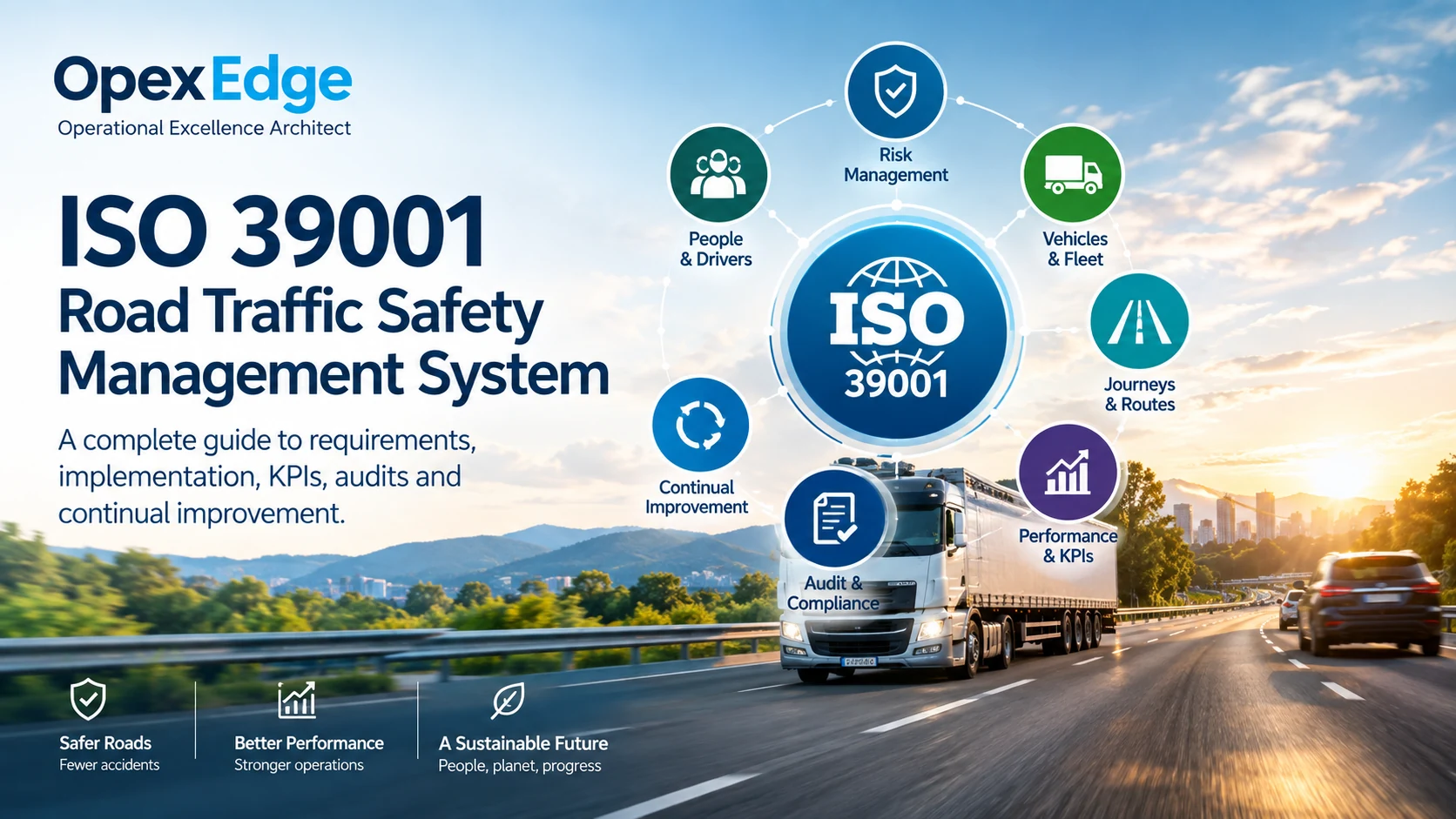
ISO 39001: The Practical Guide to Road Traffic Safety Management Systems
Road traffic safety is often treated as a fleet issue, a driver-training issue, or a compliance issue.
ISO 39001 takes a different approach.
It treats road traffic safety as a management-system responsibility that must be understood, planned, controlled, measured and continuously improved.
That distinction matters.
An organization can have well-maintained vehicles, licensed drivers and documented safety procedures and still have significant road traffic risks. The real question is whether the organization has a systematic way to identify the factors it can control or influence and convert them into measurable road traffic safety improvements.
That is the purpose of ISO 39001 — Road Traffic Safety (RTS) Management Systems — Requirements with guidance for use.
ISO states that ISO 39001 specifies requirements for organizations that interact with the road traffic system and aims to help them reduce deaths and serious injuries related to road traffic crashes that they can influence. (ISO)
This guide explains how to understand ISO 39001 as an operational management system—not simply as another ISO certificate.
What Is ISO 39001?
ISO 39001 is an international standard for establishing, implementing, maintaining and improving a Road Traffic Safety Management System (RTSMS).
It is designed for organizations that interact with the road traffic system, regardless of their size, type or the products and services they provide.
The organization does not have to be a transportation company.
Potentially relevant organizations include:
- Logistics companies
- Fleet operators
- Trucking companies
- Bus and passenger transport operators
- Delivery companies
- Construction companies
- Manufacturing organizations with significant vehicle movements
- Retailers operating delivery fleets
- Service companies with field-service vehicles
- Organizations managing employee commuting
- Organizations contracting transportation services
- Public-sector organizations
- Road infrastructure-related organizations
- Companies whose operations generate substantial road traffic
The critical issue is not whether an organization “owns trucks.”
The issue is whether the organization interacts with road traffic and can influence road traffic safety outcomes.
Why ISO 39001 Matters
Road traffic risk is created by a combination of factors.
A vehicle may be technically safe, but the journey may still be unsafe.
A driver may be competent, but fatigue, excessive speed, poor journey planning or adverse conditions can increase risk.
A company may have a safety policy, but without measurement it may not know whether its controls are actually improving performance.
ISO 39001 therefore moves the organization from:
“We have safety rules.”
to:
“We have a system for managing road traffic safety performance.”
This means connecting:
Risk → Objectives → Controls → Operations → Measurement → Corrective Action → Improvement
That is where ISO 39001 becomes an operational-excellence discipline rather than merely a compliance exercise.
ISO 39001 at a Glance
ISO 39001 uses a management-system structure that organizations can integrate with other ISO management systems.
Its core logic can be viewed as:
- Understand the organization
Identify how the organization interacts with the road traffic system.
- Establish leadership
Define responsibility, commitment and the road traffic safety policy.
- Identify risks and opportunities
Understand the factors that can influence road traffic safety.
- Set objectives
Translate safety priorities into measurable RTS objectives and targets.
- Implement controls
Manage drivers, vehicles, journeys, routes, speeds, fatigue, emergency response and other relevant factors.
- Measure performance
Monitor both outcomes and leading indicators.
- Correct and improve
Use incidents, data, audits and management review to continually improve the system.
ISO’s own implementation guide describes a six-step roadmap based on the Plan-Do-Check-Act improvement logic: scope and context, leadership, planning, implementation, monitoring and evaluation, and continual improvement. (ISO)
The Seven Core Areas of ISO 39001
Although organizations should work from the actual standard and applicable legal requirements, the management-system structure can be understood through seven practical areas.
- Context of the Organization
The first question is:
How does this organization interact with the road traffic system?
This requires understanding internal and external factors that can affect road traffic safety.
For example:
- Number of vehicles
- Types of vehicles
- Types of journeys
- Driver population
- Operating locations
- Routes
- Customer requirements
- Delivery schedules
- Contractor arrangements
- Road conditions
- Weather
- Traffic conditions
- Legal requirements
- Emergency-response arrangements
- Organizational culture
The organization should also determine the relevant interested parties and the scope of its RTS management system.
The result should not be a generic paragraph in an ISO manual.
It should produce an operational picture of where road traffic risk exists.
- Leadership and Road Safety Responsibility
Road safety cannot be delegated entirely to a fleet manager.
Senior management has to establish direction and provide the resources required to operate the system.
Leadership responsibilities can include:
- Establishing the RTS policy
- Assigning responsibilities
- Providing resources
- Establishing objectives
- Supporting safety culture
- Ensuring legal compliance
- Reviewing RTS performance
- Promoting continual improvement
A mature system should make accountability visible.
For example:
Area | Responsible Function | Example KPI |
Driver competence | Fleet/HR | % competent drivers |
Vehicle condition | Fleet/Maintenance | Preventive maintenance compliance |
Speed | Fleet/Safety | Speeding events |
Journey planning | Operations | High-risk journeys reviewed |
Incidents | Safety | Serious incident rate |
Corrective actions | Management | Closure rate |
Contractor safety | Procurement/Operations | Contractor compliance |
This turns road safety from a “safety department issue” into a cross-functional business process.
- Road Traffic Safety Risk and Performance Factors
One of the most important concepts in ISO 39001 is the identification of the RTS performance factors that the organization can control or influence.
The organization should not simply ask:
“How many accidents did we have?”
It should ask:
“What factors are driving our road traffic safety performance?”
These factors can include areas such as:
Exposure
How much road traffic activity is occurring?
Examples:
- Distance travelled
- Number of journeys
- Vehicle-hours
- Traffic volume
- Type of transportation
Intermediate safety factors
What conditions influence the likelihood or severity of a crash?
Examples include:
- Speed management
- Driver fitness
- Fatigue
- Alcohol or drug impairment
- Seat-belt use
- Driver competence
- Vehicle safety
- Vehicle maintenance
- Journey planning
- Route selection
- Emergency response
- Post-crash care
Final outcomes
What ultimately happened?
Examples:
- Fatalities
- Serious injuries
- Crashes
- Serious incidents
The ISO approach therefore allows organizations to manage leading indicators, rather than waiting for serious accidents to occur.
- Road Traffic Safety Objectives and Targets
A road safety policy without measurable objectives is unlikely to produce a controlled management system.
Objectives should be:
- Relevant
- Measurable where appropriate
- Consistent with the RTS policy
- Based on identified performance factors
- Supported by action plans
- Assigned to responsible people
- Monitored over time
For example:
Objective
Reduce speeding-related risk across the company fleet.
Target
Reduce high-risk speeding events by a defined percentage within a specified period.
Actions
- Analyze telematics data
- Identify high-risk drivers/routes
- Conduct targeted coaching
- Review journey schedules
- Establish escalation rules
- Monitor repeat events
KPI
High-risk speeding events per 10,000 km.
This is much more useful than simply stating:
“Drivers must obey speed limits.”
Operational Control
This is where ISO 39001 becomes highly relevant to day-to-day operations.
The organization should translate its RTS objectives into operational controls.
Depending on its activities, this could include:
Driver Management
- Driver selection
- Licensing verification
- Competency assessment
- Driver training
- Defensive driving
- Fatigue awareness
- Impairment controls
- Driver behavior monitoring
- Periodic evaluation
Vehicle Management
- Vehicle selection
- Preventive maintenance
- Safety inspections
- Tire management
- Brake systems
- Safety equipment
- Defect reporting
- Vehicle replacement criteria
Journey Management
- Route planning
- Journey risk assessment
- Scheduling
- Driver rest
- Weather considerations
- Traffic conditions
- High-risk locations
- Emergency planning
Speed Management
- Speed limits
- Telematics
- Alerts
- Driver coaching
- Escalation
- Repeat-offender controls
Contractor Management
Where transportation is outsourced, the organization should consider how it controls or influences contractor road traffic safety performance.
This is particularly important for organizations that have little direct control over the driver but significant influence over:
- Contract requirements
- Delivery schedules
- Vehicle requirements
- Driver requirements
- Performance monitoring
- Supplier selection
Data Collection and Road Traffic Safety KPIs
A strong ISO 39001 system needs reliable data.
But collecting more data does not automatically create better safety management.
The objective is to collect the right data for decision-making.
A practical RTS dashboard could include:
Outcome KPIs
- Fatalities
- Serious injuries
- Crashes
- Serious incidents
Exposure KPIs
- Total kilometers travelled
- Number of journeys
- Vehicle-hours
- Driver-hours
Leading KPIs
- Speeding events
- Harsh braking
- Harsh acceleration
- Seat-belt compliance
- Driver training completion
- Vehicle inspection compliance
- Preventive maintenance completion
- Driver fatigue violations
- Journey-plan compliance
- Defect closure
- Emergency-response training
The important principle is normalization.
For example:
Crashes per 100,000 km
may provide more useful information than:
Total crashes
because the exposure level can change significantly from one period to another.
Incident Management and Continual Improvement
A mature RTS management system does not stop when an incident has been recorded.
The organization should determine:
- What happened?
- Where did it happen?
- Who and what were involved?
- What immediate controls were required?
- What were the contributing factors?
- Were existing controls effective?
- Was there a system failure?
- What corrective action is required?
- How will effectiveness be verified?
- What should be changed elsewhere in the organization?
This is the difference between:
Incident reporting
and
organizational learning.
A crash should therefore become an input to the management system—not merely an entry in an incident log.
ISO 39001 and Process Mapping
One of the most practical ways to implement ISO 39001 is to map the organization’s road-related processes.
For example:
Vehicle Requirement → Driver Assignment → Journey Planning → Vehicle Inspection → Journey Execution → Monitoring → Incident/Deviation → Reporting → Corrective Action → Performance Review
Each stage can then be examined for:
- Risks
- Responsibilities
- Inputs
- Outputs
- Controls
- KPIs
- Records
- Interfaces
- Improvement opportunities
This approach fits naturally with an Operational Excellence methodology.
Instead of creating an ISO documentation system disconnected from operations, the organization can build the RTS management system around the actual business processes.
ISO 39001 and Risk-Based Thinking
Road traffic safety is inherently risk-based.
Consider a delivery company.
The risk profile of a 20-kilometer daytime urban delivery route may be completely different from:
- A 700-kilometer night journey
- A heavy-truck journey
- A journey through difficult terrain
- A journey during severe weather
- A journey operated under tight delivery deadlines
Therefore, the same control may not be equally effective for every journey.
A practical system can classify journeys according to factors such as:
Driver + Vehicle + Route + Distance + Time + Weather + Load + Traffic + Schedule + Environment
The organization can then determine additional controls for higher-risk journeys.
ISO 39001 and Driver Training
Training is important, but training alone is not a road traffic safety management system.
A stronger model is:
Selection → Competence → Training → Observation → Measurement → Coaching → Reassessment
For example, if telematics shows repeated harsh braking by a driver, simply sending the driver to another generic training course may not solve the underlying issue.
The organization should investigate:
- Driver behavior
- Route characteristics
- Traffic conditions
- Vehicle condition
- Scheduling
- Workload
- Fatigue
- Incentives
- Management practices
The objective is to identify the systemic cause, not simply assign blame to the driver.
ISO 39001 and Fleet Management
Fleet management becomes one component of the broader RTS management system.
A fleet program should consider:
Before vehicle deployment
- Vehicle suitability
- Safety specifications
- Intended usage
- Driver requirements
During operation
- Inspections
- Maintenance
- Defect management
- Telematics
- Driver behavior
- Fuel and mileage data
After incidents
- Vehicle inspection
- Failure analysis
- Repair
- Root-cause investigation
- Lessons learned
This creates a connection between:
Fleet Management → Road Safety → Operational Performance
ISO 39001 and Technology
Modern organizations can use technology to strengthen the RTS management system.
Potential technologies include:
- GPS
- Telematics
- Fleet-management platforms
- Driver monitoring
- Dash cameras
- Mobile inspection applications
- Digital incident reporting
- AI-based video analysis
- Predictive maintenance
- Route-risk analytics
- Automated KPI dashboards
However, technology should support the management system rather than replace it.
The important question is not:
“Do we have telematics?”
It is:
“How does telematics data change a management decision?”
That is the Operational Excellence perspective.
ISO 39001 Audit Approach
An ISO 39001 audit should go beyond checking whether procedures exist.
A useful audit can follow the actual process.
For example:
Select a journey → trace the driver → verify competence → inspect the vehicle → review journey planning → examine monitoring data → check incidents → verify corrective actions → review KPI trends.
This provides a much stronger picture of system effectiveness.
Auditors can examine:
Documentation
- RTS policy
- Objectives
- Risk assessments
- Procedures
- Legal requirements
- Action plans
Operational evidence
- Driver records
- Vehicle inspections
- Maintenance records
- Journey plans
- Telematics
- Training records
- Incident reports
Performance evidence
- KPI trends
- Crash rates
- Serious incidents
- Speeding
- Maintenance compliance
- Corrective actions
Management evidence
- Management review
- Decisions
- Resource allocation
- Improvement actions
The key question becomes:
Is the management system producing better road traffic safety performance?
ISO 39001 Management Review
Management review should convert RTS information into decisions.
Management should be able to see:
- Safety performance trends
- Significant incidents
- KPI performance
- Objective achievement
- Compliance issues
- Emerging risks
- Driver performance
- Vehicle performance
- Contractor performance
- Corrective actions
- Resource requirements
- Improvement opportunities
A good dashboard should therefore answer three questions:
What happened?
Lagging indicators
Why is it happening?
Analysis and contributing factors
What are we doing about it?
Actions, owners and deadlines
Integrating ISO 39001 With Other ISO Management Systems
Organizations that already operate management systems do not necessarily need to build ISO 39001 as a completely separate system.
ISO itself notes that the RTS management system can be integrated into or made compatible with other management systems and organizational processes. (gso-sims-preview-doc-aws.s3-eu-west-1.amazonaws.com)
Potential integration points include:
ISO 9001
Process management, competence, documented information, performance evaluation and continual improvement.
ISO 14001
Environmental impacts associated with transportation and fleet operations.
ISO 45001
Occupational health and safety risks affecting drivers and other workers.
ISO 39001
Road traffic safety risks and outcomes.
An integrated management architecture can reduce duplication while maintaining the specific controls required for each discipline.
This is particularly valuable for organizations that already operate multiple management systems.
ISO 39001 and Climate Change
There is also an important current update to understand.
ISO published ISO 39001:2012/Amd 1:2024, titled Climate action changes. The amendment applies to ISO 39001:2012. (ISO)
Organizations implementing or maintaining ISO 39001 should therefore ensure that their management-system context and relevant planning processes appropriately address the climate-action changes introduced by the amendment.
This is one reason organizations should avoid relying on old ISO 39001 templates without checking the current applicable requirements.
Is ISO 39001 Only for Transport Companies?
No.
The standard applies to organizations that interact with the road traffic system.
A manufacturing company, for example, may have:
- Employee commuting
- Supplier transportation
- Customer deliveries
- Company vehicles
- Service engineers
- Forklift/yard interfaces
- Contractor transportation
Even if transportation is outsourced, the organization may still have opportunities to influence safety through:
- Procurement requirements
- Contracts
- Scheduling
- Supplier evaluation
- Delivery requirements
- Vehicle requirements
- Performance monitoring
The key is to understand where the organization has control and where it has influence.
Common ISO 39001 Implementation Mistakes
Mistake 1: Treating ISO 39001 as a documentation project
Creating procedures does not automatically create safer operations.
Mistake 2: Measuring only accidents
Accidents are important, but they are lagging indicators.
Organizations should also monitor relevant leading indicators.
Mistake 3: Focusing only on drivers
Road traffic safety is influenced by drivers, vehicles, journeys, management decisions and operating conditions.
Mistake 4: Ignoring contractors
Outsourced transportation can still create significant organizational risk and influence.
Mistake 5: Collecting data without decisions
A dashboard containing hundreds of indicators is not necessarily an effective management system.
Mistake 6: Treating training as the main solution
Training should be connected to identified risks and measured behavior.
Mistake 7: Separating safety from operations
The strongest systems integrate road safety into the actual business processes.
A Practical ISO 39001 Implementation Roadmap
An organization can structure implementation into the following sequence.
Phase 1 — Diagnose
Understand:
- Current road traffic activities
- Existing controls
- Major risks
- Existing data
- Legal requirements
- Current performance
Phase 2 — Define Scope
Determine:
- Organizational boundaries
- Relevant activities
- Vehicles
- Drivers
- Journeys
- Contractors
- Interfaces
Phase 3 — Establish Leadership
Develop:
- RTS policy
- Roles
- Responsibilities
- Governance
- Resources
Phase 4 — Identify Performance Factors
Determine which RTS factors the organization can control or influence.
Phase 5 — Establish Objectives
Convert the most important performance factors into measurable objectives and action plans.
Phase 6 — Build Operational Controls
Develop the required controls for:
- Drivers
- Vehicles
- Journeys
- Routes
- Speed
- Fatigue
- Emergency response
- Contractors
- Other relevant areas
Phase 7 — Build the Measurement System
Create:
- KPI definitions
- Data sources
- Reporting frequency
- Dashboard
- Escalation rules
- Management review
Phase 8 — Audit
Verify:
- Compliance
- Implementation
- Effectiveness
- Performance
Phase 9 — Improve
Use:
- Incidents
- Trends
- Audit findings
- Data
- Employee feedback
- Management review
to continuously improve the system.
What Should an ISO 39001 Dashboard Look Like?
A useful executive dashboard could contain five layers.
Layer | Example Indicators |
Safety Outcomes | Fatalities, serious injuries, crashes |
Exposure | km travelled, journeys, vehicle-hours |
Driver | Speeding, fatigue, competence, seat-belt compliance |
Vehicle | Defects, inspections, maintenance compliance |
Management | Corrective actions, audits, objective achievement |
The dashboard should allow management to move from:
Result → Cause → Action
rather than simply displaying statistics.
ISO 39001 as an Operational Excellence System
The greatest value of ISO 39001 should not be the certificate.
The real value is creating an organization that can systematically answer:
Where are our road traffic risks?
Which risks can we control?
Which risks can we influence?
How are we controlling them?
How do we know the controls are working?
Where are performance gaps emerging?
What decision should management make next?
That is fundamentally an Operational Excellence question.
The standard provides the management-system structure.
Operational Excellence provides the discipline to connect that structure to:
Process → People → Technology → Data → Performance → Improvement
ISO 39001: Compliance or Business Performance?
ISO 39001 can be approached in two very different ways.
Compliance-driven approach
Policy → Procedures → Training → Records → Audit → Certificate
Performance-driven approach
Risk → Process → Control → Data → KPI → Decision → Improvement
The second model makes the management system part of the organization’s operating system.
For companies with significant transportation exposure, this can connect road traffic safety with:
- Fleet cost
- Vehicle utilization
- Delivery reliability
- Driver productivity
- Maintenance
- Customer service
- Operational risk
- Business continuity
Road traffic safety therefore does not have to sit outside business performance.
It can become part of how the organization manages operational risk.
The Future of ISO 39001
Organizations should also be aware that the ISO 39001 standard is moving toward revision.
ISO currently lists ISO/WD 39001.2 as a working draft under development intended to replace ISO 39001:2012. The published 2012 edition remains the current standard until the revision is formally published. (ISO)
Therefore, organizations planning an ISO 39001 implementation should distinguish between:
Current published requirements
and
future requirements under development.
The working draft should not be treated as a published certification requirement.
Conclusion
ISO 39001 provides organizations with a structured way to manage road traffic safety through leadership, risk identification, objectives, operational controls, performance measurement, auditing and continual improvement.
Its real strength is that it shifts the conversation from:
“How many accidents did we have?”
to:
“What can we systematically control or influence to reduce the risk of death and serious injury?”
For organizations operating fleets, managing transportation, generating significant road traffic or relying on transport contractors, ISO 39001 can become more than an additional ISO certificate.
It can become a management architecture for road traffic safety performance.
And when integrated with process management, data analytics, technology and Operational Excellence, it can turn road safety from a reactive function into a continuously improving business process.
OpexEdge Perspective
At OpexEdge, we view management systems differently from a documentation-first approach.
The objective is to connect the standard to the organization’s actual operating model:
Process → Risk → Control → Data → KPI → Decision → Improvement
For ISO 39001, this means designing the Road Traffic Safety Management System around the organization’s real drivers, vehicles, journeys, contractors, operating conditions and performance data.
The result should be a system that management can actually use—not simply a set of documents prepared for an audit.
OpexEdge — Operational Excellence Architect
Build a Road Traffic Safety Management System That Works in the Real Operation
If your organization operates vehicles, manages transportation, relies on logistics partners or has significant road traffic exposure, OpexEdge can help translate ISO 39001 requirements into practical processes, controls, KPIs, dashboards and improvement actions.
Assess the gap. Map the risk. Build the system. Measure performance. Improve continuously.
Frequently Asked Questions About ISO 39001
What is ISO 39001?
ISO 39001 is an international standard for a Road Traffic Safety (RTS) Management System. It helps organizations that interact with the road traffic system systematically manage factors they can control or influence to reduce deaths and serious injuries resulting from road traffic crashes.
What are the main requirements of ISO 39001?
ISO 39001 requires an organization to establish and operate a road traffic safety management system. Key areas include organizational context, leadership, RTS policy, planning, objectives and action plans, operational controls, performance monitoring, internal audits, management review and continual improvement.
Who can implement ISO 39001?
ISO 39001 can be relevant to any organization that interacts with the road traffic system. This can include transport and logistics companies, fleet operators, manufacturers, retailers, construction companies, service organizations and businesses that use or manage vehicles or outsourced transportation.
Is ISO 39001 only for transport and logistics companies?
No. An organization does not have to be a transport company to implement ISO 39001. The relevant question is whether its activities interact with road traffic and whether it can control or influence road traffic safety factors.
Is ISO 39001 certification mandatory?
ISO 39001 itself does not automatically make certification a legal requirement. An organization can implement the management system without third-party certification. Certification may nevertheless be required by a customer, contract, tender or other business requirement.
How do you get ISO 39001 certification?
A typical certification process involves defining the RTS management-system scope, implementing the required processes and controls, collecting objective evidence, conducting internal audits and management review, and then undergoing an external audit by an appropriate certification body.
How long does ISO 39001 implementation take?
There is no single implementation period. The time depends on the organization’s size, number of vehicles and drivers, operational complexity, existing management systems, data availability, risk profile and level of existing controls.
A company with an established ISO management system may be able to integrate ISO 39001 more efficiently than an organization building its first formal management system.
What KPIs should be used for ISO 39001?
ISO 39001 performance measurement should reflect the organization’s significant road traffic safety factors. Depending on the operation, useful KPIs can include:
- Fatalities and serious injuries
- Crash frequency and severity
- Crashes per distance travelled
- Total kilometers travelled
- Speeding events
- Seat-belt compliance
- Driver training and competence
- Fatigue-related violations
- Vehicle inspection compliance
- Preventive maintenance completion
- Safety-related vehicle defects
- Corrective-action closure
- Contractor safety performance
The exact KPI set should be determined from the organization’s risks, objectives and RTS performance factors rather than copied from a generic checklist.
Does ISO 39001 require accident reduction targets?
ISO 39001 is designed to help organizations reduce deaths and serious injuries related to road traffic crashes that they can influence. It also requires organizations to establish RTS objectives and action plans. The specific objectives and targets should reflect the organization’s context, risks and performance factors.
What is the difference between leading and lagging KPIs in ISO 39001?
Lagging KPIs measure outcomes that have already occurred, such as crashes, fatalities and serious injuries.
Leading KPIs monitor conditions or activities that can influence future safety performance, such as speeding, driver competence, vehicle inspection compliance, fatigue controls and preventive maintenance.
An effective RTS dashboard uses both.
Does ISO 39001 require internal audits?
Yes. Monitoring and evaluation of RTS performance, internal audits and periodic management-system reviews are part of the ISO 39001 management-system approach. Audits should evaluate both conformity and the effectiveness of the system.
What does an ISO 39001 audit check?
An audit can examine the RTS policy, objectives, risk and performance-factor analysis, legal requirements, operational controls, driver and vehicle processes, monitoring data, incidents, corrective actions, internal audits and management review.
A strong audit should also verify whether documented controls are actually operating in the field.
Does ISO 39001 require driver training?
ISO 39001 requires organizations to address relevant competence and operational requirements within their RTS management system. The specific training needed depends on the organization’s activities and identified risks.
Training should therefore be linked to actual road traffic safety risks rather than treated as a standalone compliance activity.
Does ISO 39001 cover fleet management?
Fleet management can be an important part of an ISO 39001 system where vehicles are relevant to the organization’s road traffic safety risks. Areas can include vehicle selection, inspections, maintenance, defects, safety equipment and vehicle-related performance monitoring.
Can ISO 39001 be integrated with ISO 9001?
Yes. ISO 39001 can be integrated with other management systems and organizational processes. Organizations already using ISO 9001 can potentially share elements such as process management, competence, documented information, internal auditing, corrective action and management review while maintaining the specific RTS requirements.
What is ISO 39001:2012 Amendment 1:2024?
ISO 39001:2012/Amd 1:2024 is an amendment titled “Climate action changes.” It was published in February 2024 and applies to ISO 39001:2012. Organizations implementing or maintaining ISO 39001 should consider the amendment as part of their current applicable requirements.
Does Amendment 1:2024 replace ISO 39001:2012?
No. Amendment 1:2024 is an amendment to ISO 39001:2012; it does not constitute a completely new edition of the standard. ISO currently lists ISO 39001:2012 as the published standard and identifies the 2024 climate-action amendment separately.
Is ISO 39001:2012 still current?
Yes. ISO’s current catalogue identifies ISO 39001:2012 as the published standard and states that it was last reviewed and confirmed in 2023. It also lists Amendment 1:2024 and shows that the standard is now designated for revision.
Is a new ISO 39001 edition being developed?
Yes. ISO currently lists ISO/WD 39001.2 as a working draft that will replace ISO 39001:2012. It remains under development, so organizations should not treat the working draft as the current published certification standard.
Should companies wait for the new ISO 39001 edition before implementing the standard?
Organizations should assess their own business requirements and timing. ISO 39001:2012 remains the current published standard, together with Amendment 1:2024, while the replacement edition is still under development. Waiting solely for a future edition may delay improvements that can be implemented under the current standard.
What is the business benefit of ISO 39001?
ISO 39001 provides a structured way to manage road traffic safety risks, establish measurable objectives, monitor performance and continually improve controls. For organizations with significant road traffic exposure, this can connect safety management with fleet management, operational risk, maintenance, driver performance and business processes.
Can ISO 39001 improve road safety without certification?
Yes. The management-system approach can be implemented to improve operational road traffic safety whether or not the organization ultimately obtains third-party certification. Certification provides independent assessment against the applicable standard; implementation itself can be used as a management and improvement framework.
Lorem
