SWOT Analysis: A Strategic Framework for Better Business Decisions
In a fast-changing business environment, companies need more than experience and intuition to make the right strategic decisions. They need a structured way to understand where they stand today, what could hold them back, where growth opportunities exist, and which external risks may affect future performance.
This is where SWOT analysis becomes a powerful business tool.
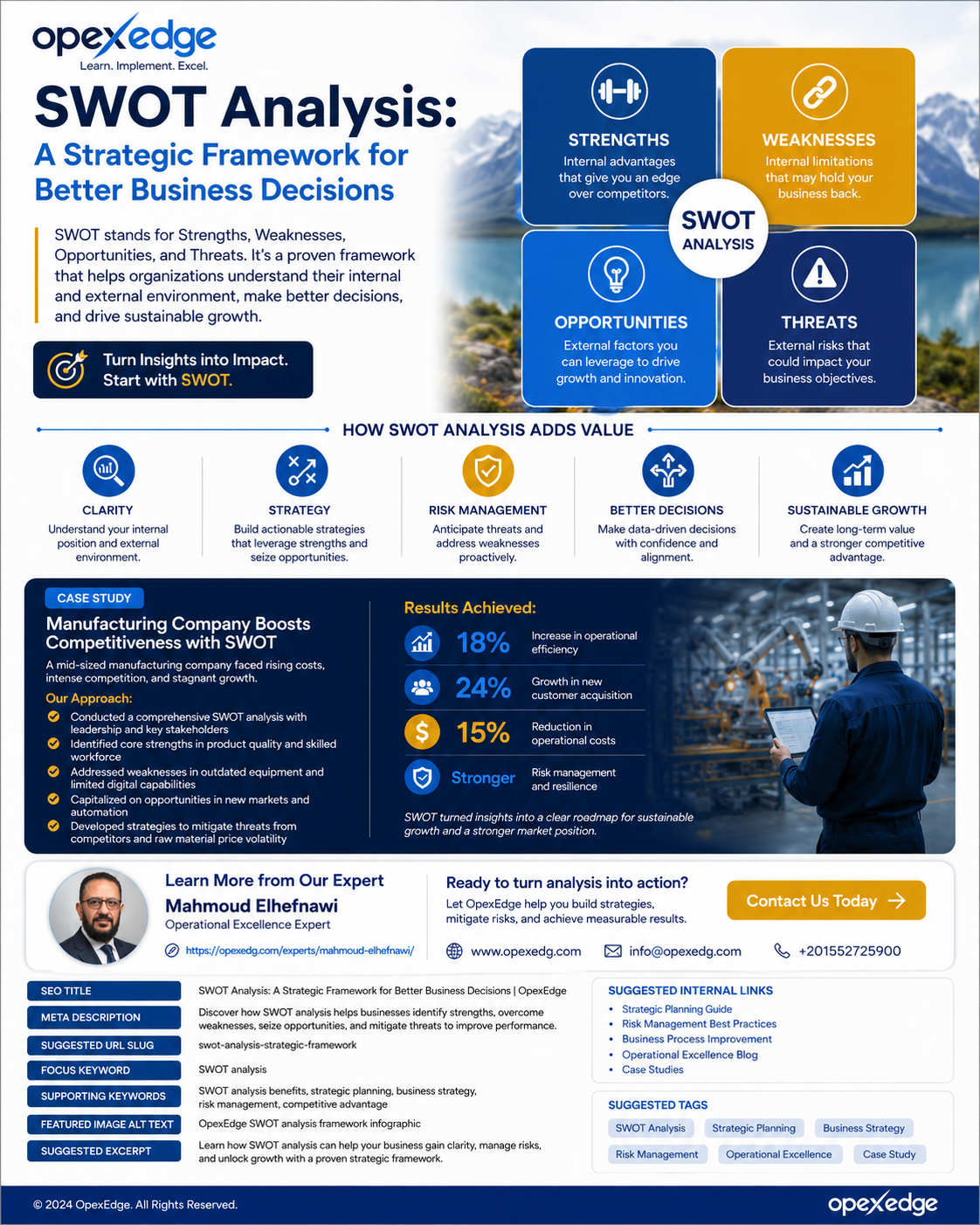
SWOT analysis helps organizations identify their Strengths, Weaknesses, Opportunities, and Threats. When used correctly, it can support strategic planning, operational excellence, risk management, market expansion, and performance improvement.
At OpexEdge, we use SWOT analysis as a practical decision-making framework that connects business insight with measurable action.
What Is SWOT Analysis?
SWOT analysis is a structured strategic planning method used to evaluate internal and external business factors.
The four elements are:
1. Strengths
Strengths are the internal advantages that give a business a competitive edge. These may include strong leadership, skilled employees, efficient operations, loyal customers, strong brand reputation, advanced technology, or unique product quality.
Examples of strengths include:
- Strong customer relationships
- Efficient production process
- Experienced management team
- Strong financial position
- High product quality
- Reliable supplier network
2. Weaknesses
Weaknesses are internal limitations that may reduce performance or prevent growth. These are areas the business can control and improve.
Examples of weaknesses include:
- Poor inventory control
- High operating costs
- Weak digital presence
- Limited staff capabilities
- Outdated systems
- Poor process standardization
3. Opportunities
Opportunities are external factors that the business can use to grow, improve, or gain competitive advantage.
Examples of opportunities include:
- New market demand
- Technology adoption
- Competitor weakness
- New customer segments
- Process automation
- Strategic partnerships
4. Threats
Threats are external risks that may negatively affect business performance.
Examples of threats include:
- Strong competition
- Economic instability
- Supply chain disruption
- Raw material price increases
- Regulatory changes
- Changing customer behavior
Why SWOT Analysis Matters
Many organizations face the same challenge: they collect information but struggle to convert it into strategy.
SWOT analysis solves this problem by organizing business information into a clear decision-making structure. It allows leadership teams to see the business from four important angles: what is working, what needs improvement, what can be captured, and what must be protected.
A strong SWOT analysis helps businesses:
- Improve strategic clarity
- Prioritize improvement initiatives
- Reduce operational risks
- Align teams around common goals
- Identify competitive advantages
- Support investment decisions
- Improve resource allocation
- Build practical action plans
SWOT is especially valuable because it is simple enough for leadership workshops, yet powerful enough to guide major business decisions.
SWOT Analysis and Operational Excellence
SWOT analysis becomes even more powerful when connected with operational excellence.
Operational excellence is not only about reducing waste or improving efficiency. It is about building a business system that consistently delivers value to customers, employees, and stakeholders.
SWOT helps operational excellence teams answer important questions such as:
- Which internal capabilities should we build on?
- Which process weaknesses are affecting performance?
- Which market opportunities require operational readiness?
- Which external threats should be included in risk planning?
- Which improvement projects should come first?
For example, a company may discover that its strength is high product quality, but its weakness is long delivery lead time. This insight can guide improvement projects around production planning, warehouse management, supplier coordination, and logistics performance.
How to Conduct an Effective SWOT Analysis
A successful SWOT analysis should be practical, honest, and data-supported. It should not be a generic brainstorming session only.
Step 1: Define the Objective
Before starting, clarify the purpose of the SWOT analysis.
Examples:
- Improve business strategy
- Launch a new product
- Enter a new market
- Improve operational performance
- Reduce cost
- Improve supply chain resilience
- Evaluate a business unit
A clear objective keeps the analysis focused and useful.
Step 2: Collect Relevant Data
SWOT should be supported by facts whenever possible.
Useful data sources include:
- Sales reports
- Customer feedback
- Market research
- Financial performance
- Process KPIs
- Inventory reports
- Supplier performance
- Competitor analysis
- Employee feedback
The more accurate the data, the stronger the analysis.
Step 3: Identify Strengths
Look for internal capabilities that support business success.
Ask questions such as:
- What do we do better than competitors?
- What do customers appreciate about us?
- Which processes perform well?
- What resources or skills give us an advantage?
- Where do we consistently achieve good results?
Step 4: Identify Weaknesses
Weaknesses should be discussed honestly. The objective is not to blame people, but to identify improvement opportunities.
Ask questions such as:
- Where are we losing time, money, or customers?
- Which processes are unstable?
- What capabilities are missing?
- Which systems are outdated?
- What prevents us from scaling?
Step 5: Identify Opportunities
Opportunities come from the external environment. They should be evaluated based on market attractiveness and the company’s ability to act.
Ask questions such as:
- What market trends can we benefit from?
- Which customer needs are not fully served?
- Can technology improve our performance?
- Are there partnership opportunities?
- Can we enter new segments or regions?
Step 6: Identify Threats
Threats should be assessed early so the business can prepare.
Ask questions such as:
- What external risks could affect revenue?
- Which competitors are gaining strength?
- Are supplier costs increasing?
- Are customer expectations changing?
- Are there regulatory or economic risks?
Step 7: Convert SWOT into Action
The biggest mistake companies make is stopping after the SWOT table.
A good SWOT analysis must lead to action.
The output should include:
- Strategic priorities
- Improvement projects
- Risk mitigation actions
- Responsible owners
- Timelines
- KPIs
- Follow-up review dates
This is what turns SWOT from a discussion tool into a performance improvement tool.
SWOT Matrix: Turning Insight into Strategy
A practical way to use SWOT is to connect the four elements into strategic actions.
Strengths + Opportunities
Use strengths to capture opportunities.
Example: If a company has strong technical expertise and the market is demanding customized solutions, the company can launch a premium service offering.
Strengths + Threats
Use strengths to reduce threats.
Example: If competition is increasing, a company with strong customer relationships can improve retention programs and service quality.
Weaknesses + Opportunities
Fix weaknesses that prevent the company from capturing opportunities.
Example: If e-commerce demand is growing but the company has weak digital systems, it should invest in online sales capability.
Weaknesses + Threats
Reduce weaknesses that expose the business to risk.
Example: If raw material prices are increasing and the company has poor inventory control, it should improve demand planning, supplier negotiation, and stock visibility.
Case Study: Manufacturing Company Improves Competitiveness Using SWOT
Business Context
A mid-sized manufacturing company was facing rising operating costs, slow growth, and stronger competition. The company had good product quality and experienced employees, but performance was affected by outdated equipment, limited digital systems, and weak market visibility.
The leadership team needed a clear strategic direction to improve competitiveness and support sustainable growth.
Challenge
The company faced several challenges:
- Increasing production cost
- Limited automation
- Weak digital reporting
- Slow customer acquisition
- Stronger competitors entering the market
- Raw material price volatility
- Lack of clear improvement priorities
Although the company had internal strengths, it was not using them effectively to capture market opportunities.
SWOT Findings
Strengths
- Strong product quality
- Skilled technical workforce
- Good reputation with existing customers
- Flexible production capability
- Strong knowledge of customer requirements
Weaknesses
- Outdated machines
- Manual reporting process
- High operating cost
- Limited marketing activity
- Weak performance dashboards
- Lack of structured continuous improvement system
Opportunities
- Growing demand in new customer segments
- Ability to introduce automation
- Opportunity to improve digital sales channels
- Potential supplier partnerships
- Market demand for reliable quality suppliers
Threats
- Strong price competition
- Rising raw material costs
- Faster competitors with better technology
- Customer pressure for shorter lead times
- Economic uncertainty
Actions Taken
Based on the SWOT analysis, the company developed a practical improvement roadmap.
Key actions included:
- Prioritizing cost-reduction projects
- Introducing basic operational KPIs
- Improving machine maintenance planning
- Building a digital sales improvement plan
- Strengthening supplier negotiations
- Creating a customer retention program
- Launching continuous improvement workshops
- Reviewing product profitability by customer segment
Results Achieved
After implementing the action plan, the company achieved measurable improvements:
- 18% improvement in operational efficiency
- 15% reduction in selected operating costs
- 24% growth in new customer acquisition
- Better visibility of performance through dashboards
- Stronger risk management and strategic alignment
- Clearer improvement priorities for leadership
The SWOT analysis helped the company move from scattered improvement ideas to a focused strategic roadmap.
Common Mistakes in SWOT Analysis
Although SWOT is simple, many companies use it incorrectly.
Common mistakes include:
1. Being Too Generic
Statements such as “good quality” or “high competition” are not enough. Each point should be specific and supported by evidence.
2. Ignoring Data
SWOT should not depend only on opinions. It should include customer data, financial data, operational KPIs, and market insights.
3. Listing Too Many Points
A long SWOT list can become confusing. Focus on the most important factors that affect strategy and performance.
4. Not Prioritizing
Not all weaknesses or threats have the same impact. Prioritize based on urgency, business impact, and feasibility.
5. No Action Plan
SWOT has limited value if it does not lead to clear actions, owners, deadlines, and KPIs.
When Should a Business Use SWOT Analysis?
SWOT analysis can be used in many business situations, including:
- Annual strategic planning
- Business transformation
- New product launch
- Market expansion
- Operational excellence projects
- Cost reduction programs
- Supply chain assessment
- Competitor analysis
- Risk management
- Business model review
- Startup planning
- Service improvement
It is also useful before major decisions such as entering a new market, investing in technology, launching a new service, or restructuring operations.
SWOT Analysis Template
Businesses can use the following simple structure:
Strengths
What internal capabilities give us an advantage?
Weaknesses
What internal limitations are reducing our performance?
Opportunities
What external conditions can help us grow or improve?
Threats
What external risks could harm our performance?
Strategic Actions
What should we do next?
Owners
Who will be responsible?
KPIs
How will we measure success?
Timeline
When should actions be completed?
How OpexEdge Can Help
At OpexEdge, we help organizations convert analysis into practical improvement actions.
Our SWOT analysis support can include:
- Strategic business assessment
- Operational excellence review
- Process performance evaluation
- Supply chain and inventory assessment
- Risk and opportunity analysis
- KPI development
- Business improvement roadmap
- Leadership workshop facilitation
- Action plan development
- Follow-up performance review
We do not treat SWOT as a theoretical exercise. We use it to help companies make better decisions, reduce risks, and achieve measurable performance improvement.
Learn more from our expert:
Mahmoud Elhefnawi
Operational Excellence Expert
https://opexedg.com/experts/mahmoud-elhefnawi/
Conclusion
SWOT analysis is one of the most practical tools for strategic planning and business improvement. It helps organizations understand their internal capabilities, recognize their limitations, identify growth opportunities, and prepare for external risks.
However, the real value of SWOT does not come from filling a four-box matrix. The real value comes from converting insights into action.
When SWOT is supported by data, linked to operational excellence, and translated into clear improvement projects, it becomes a powerful framework for better business decisions.
If your business needs strategic clarity, stronger performance, and a practical improvement roadmap, SWOT analysis is a strong place to start.
Call to Action
Ready to turn business insights into measurable improvement?
Contact OpexEdge today to conduct a professional SWOT analysis and build a practical action plan for your business.
Website: https://opexedg.com
Email: info@opexedg.com
Email: hefnawi@opexedg.com
Phone: +20 155 272 5900
Start your improvement journey with OpexEdge.
Related TopicsTPM, Hypothesis Test , Accuracy, 6Sigma, MSA, POKAYOKE, MUDA, 5S, FMEA, SIPOC, KPI, ISO9001, ISO20022, w/h, demand planning , OTB , KANO, case study, OTB service, demand planning service , SC service, problem solving service ,

1 Comment