
SIPOC Process Model: A Practical Tool to Understand, Fix, and Improve Business Processes
SIPOC Process Model: Turning Process Confusion into Operational Clarity
Every business has processes. Sales processes, purchasing processes, warehouse processes, customer service processes, production processes, finance processes, and delivery processes.
But the real question is not whether a process exists.
The real question is:
Is the process clearly understood, correctly controlled, and delivering what the customer actually needs?
Many organizations suffer from delays, rework, miscommunication, quality problems, poor handovers, unclear responsibilities, and customer complaints. In many cases, the root cause is not a lack of effort. It is a lack of process clarity.
This is where the SIPOC process model becomes a powerful tool.
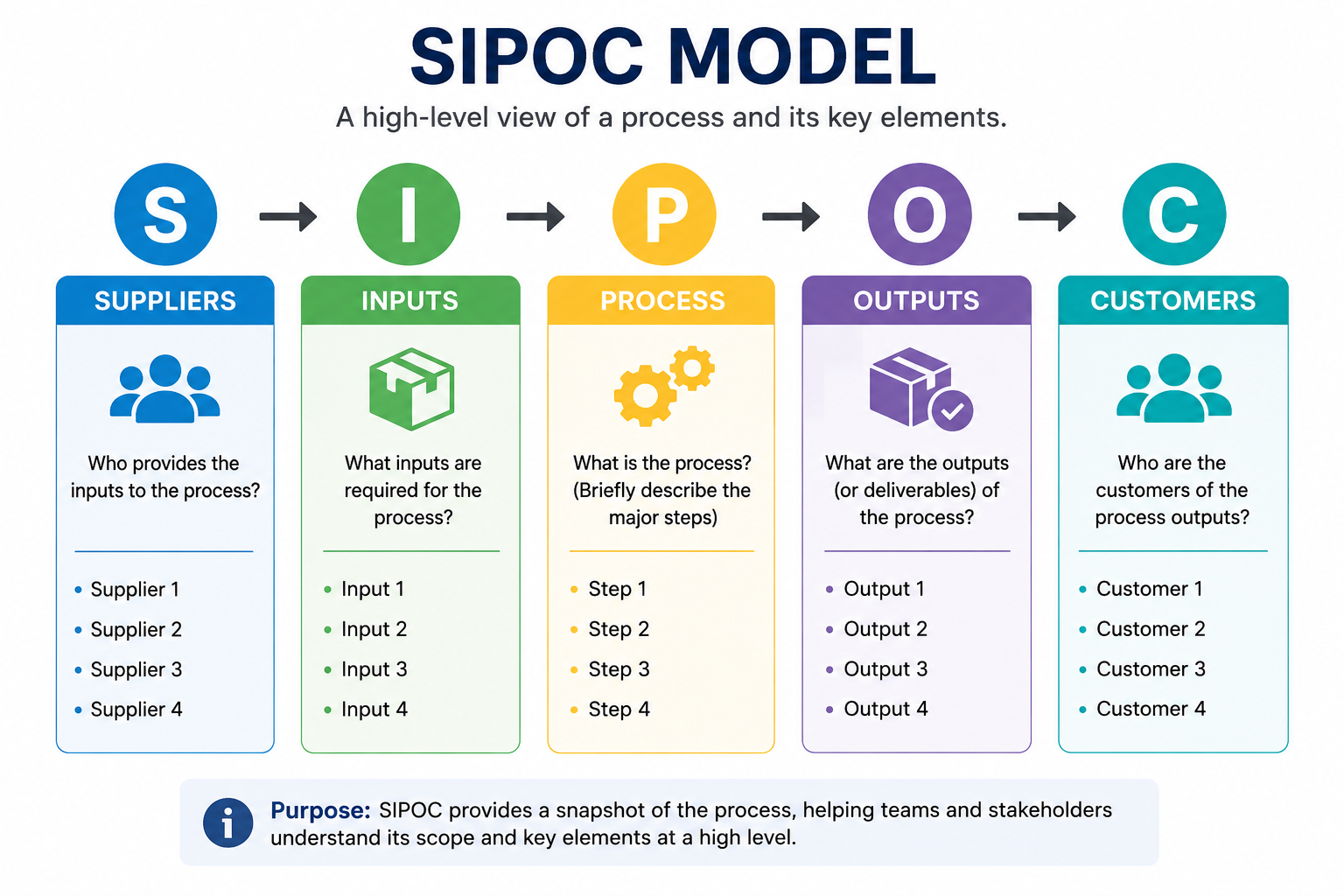
SIPOC helps organizations see the full process from end to end. It shows who provides the inputs, what the process needs, what steps are performed, what outputs are produced, and who receives those outputs.
For companies aiming to improve operational performance, reduce waste, strengthen quality systems, or launch improvement projects, SIPOC is one of the most practical starting points.
What Is the SIPOC Model?
SIPOC stands for:
S – Suppliers
I – Inputs
P – Process
O – Outputs
C – Customers
It is a high-level process mapping tool used to define and understand a business process before going into detailed analysis.
Unlike detailed flowcharts that may include every small activity, decision point, exception, and system transaction, SIPOC gives a clear executive-level view of the process.
It answers five important questions:
- Who supplies the process?
- What inputs are required?
- What are the main process steps?
- What outputs are produced?
- Who receives or depends on these outputs?
This makes SIPOC useful for managers, improvement teams, department heads, quality professionals, consultants, and business owners who need to understand how work really flows across the organization.
Why SIPOC Is Important for Business Improvement
A weak process creates hidden costs.
These costs may appear as late deliveries, stock errors, customer dissatisfaction, wrong reports, repeated approvals, unnecessary emails, duplicated work, long waiting times, or unclear accountability.
The SIPOC model helps reveal these problems early by creating a shared understanding of the process boundaries.
1. It Defines the Process Scope
One of the biggest mistakes in improvement projects is starting without a clear scope.
Teams may spend time discussing issues that are outside the process, outside their control, or not directly related to the improvement objective.
SIPOC prevents this by defining where the process starts, where it ends, and what is included.
For example, in a purchasing process, does the process start when the department requests an item, or when the purchase requisition is approved? Does it end when the supplier delivers the item, or when finance completes payment?
These questions matter because unclear boundaries lead to unclear improvement actions.
2. It Aligns Different Departments
Most business problems happen between departments, not only inside departments.
Sales may blame operations. Operations may blame purchasing. Purchasing may blame suppliers. Finance may blame missing documents. Customer service may blame delivery.
SIPOC brings all stakeholders into one view.
It shows that every process has internal suppliers and internal customers. It also shows that poor inputs from one department create poor outputs for another.
This makes SIPOC a strong tool for cross-functional alignment.
3. It Identifies Critical Inputs
A process cannot produce consistent outputs if its inputs are unstable, incomplete, late, or incorrect.
SIPOC helps teams identify the key inputs needed for successful process execution.
Examples of inputs may include:
- Customer orders
- Forecast data
- Approved specifications
- Raw materials
- Supplier quotations
- Inventory records
- Technical drawings
- Work instructions
- System data
- Quality requirements
Once the key inputs are clear, the organization can start asking: Are these inputs accurate? Are they available on time? Who is responsible for them? Are they controlled?
4. It Clarifies Outputs and Customer Expectations
A process exists to deliver an output.
That output may be a product, a service, a report, an approval, a delivery, a decision, or a completed transaction.
SIPOC helps define not only what the output is, but also who receives it.
This is important because output quality should be judged by customer requirements, not only by internal assumptions.
For example, a warehouse may think that its output is “goods dispatched.” But from the customer’s perspective, the real expectation may be:
- Correct item
- Correct quantity
- Correct location
- Correct delivery date
- Correct documentation
- No damage
- Real-time status visibility
This difference is critical.
The Five Elements of SIPOC
1. Suppliers
Suppliers are the people, departments, systems, or external parties that provide inputs to the process.
A supplier can be external, such as a vendor, logistics provider, or service contractor. It can also be internal, such as sales, planning, finance, HR, production, or IT.
Examples of suppliers:
- Customers
- Sales team
- Procurement department
- Approved vendors
- ERP system
- Warehouse team
- Quality department
- Finance department
The key question is:
Who provides what this process needs to start or continue?
2. Inputs
Inputs are the materials, data, information, approvals, documents, resources, or requirements needed to perform the process.
Examples of inputs:
- Purchase request
- Customer order
- Forecast
- Raw material
- Budget approval
- Product specification
- Delivery schedule
- Quality standard
- Manpower
- Machine availability
- System access
The key question is:
What must be available, correct, and complete for the process to work properly?
3. Process
The process is the sequence of major activities that transform inputs into outputs.
At the SIPOC level, the process should usually be described in 5 to 7 high-level steps. The purpose is not to create a detailed flowchart. The purpose is to define the main flow clearly.
Example for an order fulfillment process:
- Receive customer order
- Check inventory availability
- Confirm order and delivery date
- Pick and pack items
- Dispatch shipment
- Update system status
- Confirm delivery
The key question is:
What are the main steps required to transform inputs into outputs?
4. Outputs
Outputs are the products, services, documents, decisions, or results produced by the process.
Examples of outputs:
- Delivered order
- Approved purchase order
- Completed maintenance job
- Production report
- Invoice
- Quality inspection result
- Customer complaint resolution
- Updated inventory record
The key question is:
What does the process produce, and what should good output look like?
5. Customers
Customers are the people, departments, or organizations that receive the process outputs.
Customers may be external, such as buyers, patients, distributors, or end users. They may also be internal, such as finance, operations, warehouse, sales, management, or quality.
Examples of customers:
- External clients
- Retail stores
- Production department
- Finance team
- Senior management
- Delivery team
- End users
- Regulatory bodies
The key question is:
Who receives, uses, or depends on the output of this process?
SIPOC Example: Warehouse Order Fulfillment Process
A simplified SIPOC for warehouse order fulfillment may look like this:
Suppliers
- Sales team
- Customer
- Inventory planning team
- Warehouse system
- Transport provider
Inputs
- Customer order
- Item master data
- Stock availability
- Delivery address
- Packing requirements
- Dispatch schedule
Process
- Receive order
- Check stock
- Pick items
- Pack shipment
- Prepare documents
- Dispatch order
- Confirm delivery status
Outputs
- Picked and packed order
- Delivery note
- Updated inventory record
- Dispatched shipment
- Delivery confirmation
Customers
- End customer
- Sales team
- Finance department
- Customer service team
- Management
This simple view can quickly reveal common improvement opportunities.
For example:
- Are customer orders complete and accurate?
- Is stock availability reliable?
- Are picking errors frequent?
- Are delivery notes prepared correctly?
- Is inventory updated in real time?
- Does customer service receive delivery confirmation quickly?
These questions can lead directly to measurable improvement actions.
When Should a Business Use SIPOC?
SIPOC can be used in many situations, including:
Before Starting a Process Improvement Project
SIPOC is useful at the beginning of Lean, Six Sigma, Kaizen, operational excellence, or digital transformation projects. It helps the team define the current process before collecting detailed data.
When Departments Disagree About Responsibilities
When responsibilities are unclear, SIPOC helps identify who supplies inputs, who performs the work, who receives outputs, and where handover problems exist.
When Customer Complaints Increase
SIPOC helps trace customer dissatisfaction backward through outputs, process steps, inputs, and suppliers.
When Building or Updating SOPs
A strong standard operating procedure should be based on a clear understanding of the process. SIPOC provides that foundation.
Before Automation or System Implementation
Automating an unclear process can make problems faster, not better. SIPOC helps define the process before investing in ERP, workflow automation, dashboards, or AI-enabled tools.
During ISO or Quality Management System Development
SIPOC supports process-based thinking by helping organizations define interactions, inputs, outputs, responsibilities, and customer requirements.
Benefits of the SIPOC Process Model
Clear Process Boundaries
SIPOC helps teams agree on the start and end points of a process.
Better Communication
It creates a common language between departments and stakeholders.
Improved Customer Focus
It connects process outputs directly to customer needs.
Faster Problem Identification
It helps teams identify missing inputs, weak handovers, unclear suppliers, and poorly defined outputs.
Stronger Improvement Projects
It provides a structured foundation for root cause analysis, KPI development, SOP design, and process redesign.
Better Management Decisions
It gives leaders a concise view of how the process works and where risks may exist.
Common Mistakes When Creating a SIPOC
Mistake 1: Going Too Detailed
SIPOC is not a full process flowchart. It should stay at a high level. If the process section has 20 or 30 steps, the team is probably going too deep.
Mistake 2: Ignoring Internal Customers
Many teams only think about external customers. Internal customers are also important because their requirements affect process performance.
Mistake 3: Listing Activities as Outputs
An output is the result of a process, not the activity itself.
For example, “prepare report” is an activity. “Completed performance report” is an output.
Mistake 4: Missing Input Quality Requirements
It is not enough to list inputs. The team should also ask what makes each input acceptable.
For example, a “customer order” should be complete, approved, correctly priced, and entered into the system.
Mistake 5: Creating SIPOC Without Stakeholders
A SIPOC created by one person may miss important details. The best SIPOC models are built with input from people who actually perform, manage, supply, and receive the process.
SIPOC and KPIs: Turning the Map into Measurable Performance
A SIPOC model becomes more powerful when connected to performance indicators.
After defining suppliers, inputs, process steps, outputs, and customers, the team can identify KPIs such as:
- Process lead time
- First-time-right percentage
- Order accuracy
- On-time delivery
- Input completeness
- Rework rate
- Customer complaint rate
- Approval cycle time
- Cost per transaction
- SLA compliance
- Output quality score
This is where SIPOC moves from a mapping tool to a management tool.
The organization can see not only how the process works, but also how well it performs.
SIPOC and Root Cause Analysis
SIPOC is also useful before root cause analysis.
When a problem occurs, teams often jump directly to solutions. But without understanding the process structure, the solution may address symptoms instead of causes.
SIPOC helps organize the investigation.
For example:
- If the problem is caused by poor supplier performance, look at the supplier column.
- If the problem is caused by missing data, look at the input column.
- If the problem is caused by inefficient workflow, look at the process column.
- If the problem is caused by unclear deliverables, look at the output column.
- If the problem is caused by misunderstood expectations, look at the customer column.
This makes problem-solving more structured and less emotional.
SIPOC and Digital Transformation
Digital transformation should not start with software. It should start with process understanding.
Before implementing automation, dashboards, AI tools, ERP workflows, or digital approval systems, businesses must first understand:
- What process are we improving?
- Who provides the data?
- What inputs are required?
- What are the current process steps?
- What outputs should be generated?
- Who will use the outputs?
- What performance measures should be monitored?
SIPOC answers these questions in a simple and practical way.
For this reason, OpexEdge uses SIPOC as a foundation for process optimization, operational excellence, SOP development, service improvement, and AI-enabled business transformation.
How OpexEdge Helps Businesses Build Effective SIPOC Models
OpexEdge Consultancy helps businesses in Egypt and the Gulf region map, analyze, and improve their processes using practical operational excellence tools.
Our SIPOC process model service is designed to help organizations move from unclear workflows to structured, measurable, and improvement-ready processes.
Our Approach Includes:
1. Process Selection
We identify the process that needs clarification, improvement, standardization, or redesign.
2. Stakeholder Workshop
We bring together the people who supply, execute, manage, and receive the process outputs.
3. SIPOC Mapping
We define suppliers, inputs, process steps, outputs, and customers in a clear and structured format.
4. Gap Identification
We identify missing inputs, unclear handovers, weak controls, duplicated activities, delayed approvals, and customer requirement gaps.
5. KPI Alignment
We connect the process to measurable indicators such as lead time, accuracy, cost, quality, and customer satisfaction.
6. Improvement Recommendations
We provide practical actions to improve process performance, reduce waste, and strengthen control.
7. SOP and Process Documentation Support
We help convert the SIPOC model into clear procedures, work instructions, responsibility matrices, and management reports.
Industries That Can Benefit from SIPOC
The SIPOC model can be applied across different industries and functions, including:
- Retail
- Manufacturing
- Logistics
- Warehousing
- Supply chain
- Healthcare
- Customer service
- Procurement
- Finance
- Maintenance
- Human resources
- Quality management
- Food and beverage
- Distribution
- E-commerce
Any organization that has repeated processes, customer expectations, handovers, data flows, or performance problems can benefit from SIPOC.
Final Thoughts
The SIPOC process model is simple, but its impact can be significant.
It helps organizations understand how work flows, where problems begin, what outputs matter, and who the real customers are.
For businesses seeking operational excellence, SIPOC is not just a diagram. It is a practical starting point for better communication, stronger control, faster improvement, and more customer-focused performance.
If your organization is facing delays, rework, unclear responsibilities, weak handovers, or customer complaints, a SIPOC model can help you see the process clearly and improve it systematically.
Do you know exactly where your business process breaks down?
OpexEdge Consultancy helps businesses map, fix, and optimize their processes using practical operational excellence tools, data-driven analysis, and AI-enabled solutions.
Contact OpexEdge today to develop a clear SIPOC process model and turn process confusion into measurable improvement.
Related Topics
TPM | Hypothesis Test | Accuracy | 6 Sigma | MSA | POKA YOKE | MUDA | 5S | FMEA | SIPOC | KPI | ISO9001 |

15 Comments