
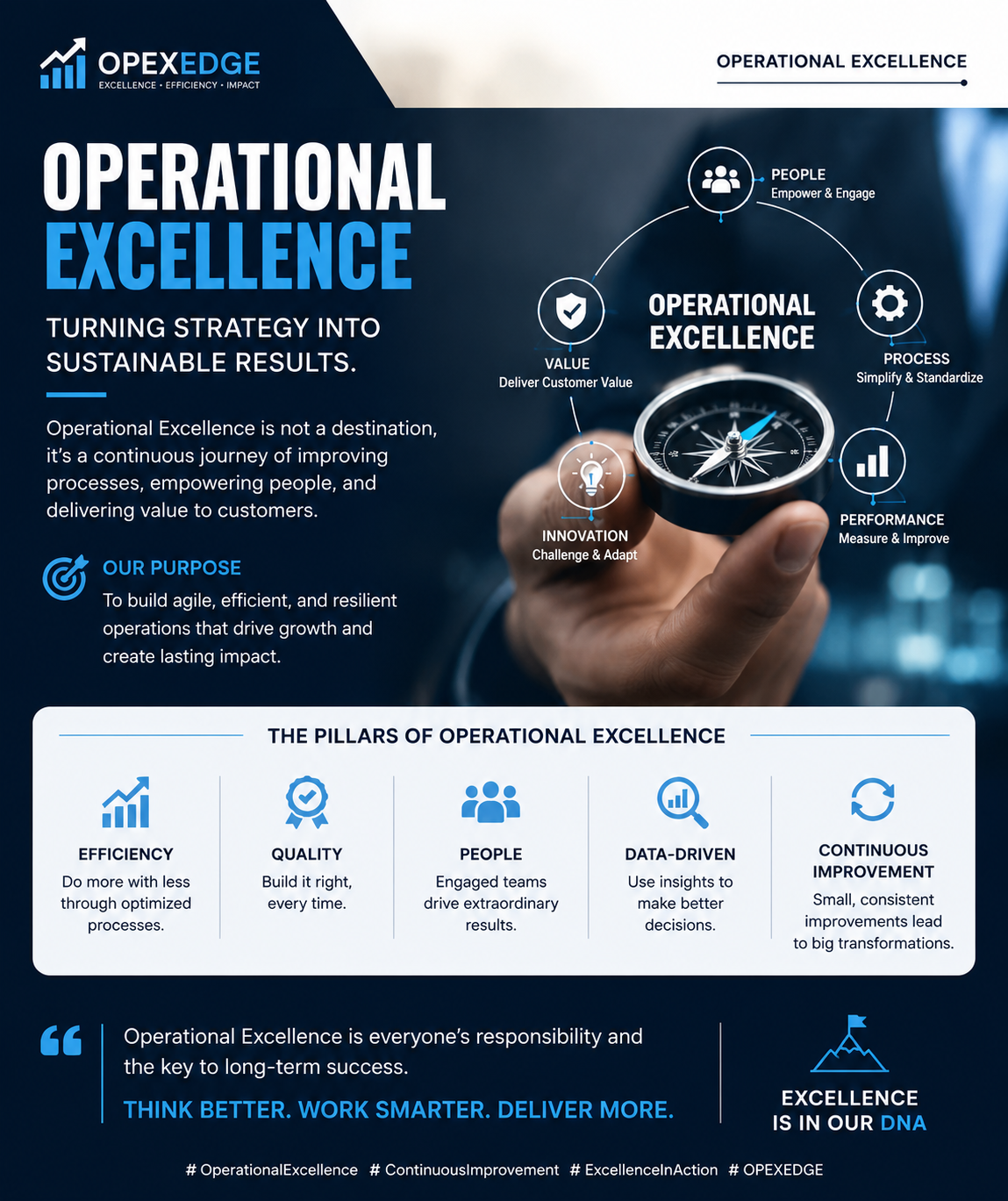
Operational Excellence: Turning Strategy Into Sustainable Business Results
What Is Operational Excellence?
Operational Excellence is the disciplined way an organization designs, manages, improves, and controls its operations to deliver consistent value to customers while reducing waste, variation, delays, and unnecessary cost.
It is not only a cost-reduction program. It is not a one-time improvement project. Operational Excellence is a complete management philosophy that connects strategy, people, processes, technology, performance measurement, and continuous improvement into one operating system.
A company practicing Operational Excellence does not depend only on heroic individual effort. Instead, it builds reliable systems where teams understand the goals, processes are clear, problems are visible, decisions are data-driven, and improvement becomes part of daily work.
In simple terms, Operational Excellence means:
Doing the right work, in the right way, at the right time, with the right resources, to deliver the right value to the customer.
Why Operational Excellence Matters
Many organizations have strong strategies but weak execution. They know where they want to go, but their daily operations are full of delays, rework, unclear ownership, poor communication, inventory issues, quality problems, and firefighting.
This creates a gap between strategy and results.
Operational Excellence closes this gap by turning strategic objectives into practical operating routines, measurable processes, and continuous improvement actions.
Organizations that invest in Operational Excellence can improve:
· Customer satisfaction
· Delivery performance
· Quality and reliability
· Productivity and efficiency
· Cost control
· Employee engagement
· Decision-making speed
· Risk management
· Business scalability
· Profitability and cash flow
In competitive markets, Operational Excellence is no longer optional. It is one of the main reasons why some companies can grow sustainably while others struggle with unstable operations.
Operational Excellence vs. Continuous Improvement
Continuous improvement is a core part of Operational Excellence, but they are not exactly the same.
Continuous improvement focuses on making processes better over time through small or major improvements. It often uses methods such as Lean, Six Sigma, Kaizen, Root Cause Analysis, 5S, Value Stream Mapping, and PDCA.
Operational Excellence is broader. It includes continuous improvement, but also covers leadership alignment, strategy deployment, performance management, process governance, culture, digital enablement, and customer value.
Continuous improvement asks:
How can we improve this process?
Operational Excellence asks:
How can the whole organization operate in a way that consistently delivers strategic results?
The Core Principles of Operational Excellence
1. Customer Value Comes First
Every operational system should begin with one question:
What does the customer truly value?
Customers do not pay for internal complexity, waiting time, rework, approvals, excess inventory, or inefficient handovers. They pay for value.
Operational Excellence helps organizations identify what matters most to customers and align processes around delivering that value with minimum waste.
Examples of customer value include:
· Faster delivery
· Better quality
· Reliable service
· Competitive pricing
· Accurate information
· Easy communication
· Flexible response to demand
When teams understand customer value clearly, improvement efforts become more focused and more effective.
2. Processes Must Be Visible and Standardized
You cannot improve what you cannot see.
Many business problems happen because processes are undocumented, unclear, or performed differently by different people. This leads to variation, mistakes, delays, and dependency on individual experience.
Operational Excellence requires process visibility.
This includes:
· Clear process maps
· Defined inputs and outputs
· Standard operating procedures
· Clear roles and responsibilities
· Defined quality checks
· Measurable process indicators
· Controlled handovers between departments
Standardization does not mean killing creativity. It means creating a stable baseline so the organization can measure performance, detect problems, and improve with confidence.
3. Problems Should Be Solved at the Root Cause
Many organizations spend most of their time treating symptoms. A customer complains, a manager escalates, the team reacts, and the issue is temporarily fixed. Then the same problem appears again.
Operational Excellence requires a different mindset.
Instead of asking, “Who made the mistake?” excellent organizations ask:
Why did the process allow this problem to happen?
Root cause analysis tools such as the 5 Whys, Fishbone Diagram, Pareto Analysis, and process observation help teams move beyond quick fixes and eliminate the real causes of recurring problems.
This reduces firefighting and builds long-term stability.
4. People Must Be Empowered
Operational Excellence is not achieved by systems alone. People create, run, monitor, and improve operations every day.
Employees closest to the work often understand problems better than anyone else. When they are trained, trusted, and involved, they become a powerful source of improvement.
A strong Operational Excellence culture encourages people to:
· Report problems early
· Suggest improvements
· Follow standards
· Use data
· Collaborate across departments
· Take ownership of performance
· Learn from mistakes
Leadership plays a critical role here. Leaders must create a safe environment where problems are visible and improvement is encouraged, not punished.
5. Performance Must Be Measured
Operational Excellence depends on measurement.
Without clear KPIs, teams may work hard but still move in different directions. Good performance indicators create alignment and help leaders understand whether operations are improving or declining.
Effective operational KPIs should measure both efficiency and effectiveness.
Examples include:
· On-time delivery rate
· First pass yield
· Customer complaint rate
· Order fulfillment cycle time
· Inventory accuracy
· Forecast accuracy
· Production downtime
· Cost per unit
· Process lead time
· Rework percentage
· Service level
· Employee productivity
However, measurement should not become reporting for the sake of reporting. KPIs must support decision-making and improvement action.
A good KPI answers three questions:
1. What is happening?
2. Why is it happening?
3. What action should we take?
6. Improvement Must Be Continuous
Operational Excellence is not a project with an end date. Markets change, customers change, technology changes, and internal operations must keep improving.
Continuous improvement can happen through:
· Daily small improvements
· Structured improvement projects
· Cross-functional workshops
· Digital transformation initiatives
· Automation
· Process redesign
· Waste elimination
· Data analysis
· Employee suggestions
The goal is to create a culture where improvement becomes normal work, not extra work.
The Pillars of Operational Excellence
People
People are the foundation of Operational Excellence. Without engaged employees and capable leaders, improvement tools will not create lasting results.
Organizations need clear communication, training, accountability, and leadership commitment.
Process
Processes must be designed to deliver value efficiently. This requires standardization, process mapping, waste reduction, quality control, and continuous review.
Performance
Performance management connects daily operations to business strategy. The right KPIs help teams focus on what matters and make better decisions.
Technology
Technology supports Operational Excellence when it simplifies work, improves visibility, reduces manual errors, and enables faster decisions. Examples include ERP systems, dashboards, automation tools, AI analytics, warehouse systems, and digital workflows.
Continuous Improvement
Continuous improvement ensures that operations do not remain static. It helps the organization adapt, compete, and grow.
Common Operational Excellence Tools
Organizations can use different tools depending on their industry, maturity level, and business challenges.
Lean Management
Lean focuses on eliminating waste and improving flow. It helps organizations reduce delays, overproduction, excess inventory, unnecessary movement, defects, and waiting time.
Six Sigma
Six Sigma focuses on reducing variation and defects through data-driven problem solving. It is useful for quality improvement and process capability enhancement.
5S
5S improves workplace organization through sorting, setting in order, shining, standardizing, and sustaining. It is especially powerful in manufacturing, warehouses, laboratories, and service environments.
Root Cause Analysis
Root Cause Analysis helps teams solve recurring problems permanently instead of repeatedly treating symptoms.
Value Stream Mapping
Value Stream Mapping shows the complete flow of materials, information, and activities required to deliver value. It helps identify waste, bottlenecks, delays, and improvement opportunities.
Standard Operating Procedures
SOPs define the best-known way to perform a process. They reduce variation and support training, consistency, and compliance.
KPI Dashboards
Dashboards make performance visible. They help leaders and teams track trends, identify issues, and act faster.
PDCA Cycle
PDCA stands for Plan, Do, Check, Act. It is a simple but powerful improvement cycle used to test and sustain improvements.
How to Implement Operational Excellence
Step 1: Define the Business Objectives
Operational Excellence should always start with strategy.
The organization must clarify what it wants to improve. Is the goal to reduce cost? Improve customer satisfaction? Increase delivery reliability? Reduce defects? Improve cash flow? Scale operations?
Clear objectives help prevent random improvement activities.
Step 2: Assess the Current State
Before improving operations, the organization needs to understand its current performance.
This can include:
· Process assessment
· KPI review
· Customer complaint analysis
· Waste identification
· Capacity analysis
· Inventory review
· Workflow observation
· Employee interviews
· Data analysis
· System and technology assessment
The purpose is to identify the real gaps between current performance and desired performance.
Step 3: Map Key Processes
Process mapping helps teams see how work actually flows across departments.
It reveals:
· Bottlenecks
· Duplicated work
· Approval delays
· Unclear ownership
· Manual errors
· Poor handovers
· Non-value-added steps
· Rework loops
Once the process is visible, improvement becomes much easier.
Step 4: Define KPIs and Targets
Each key process should have clear performance indicators.
For example, a warehouse process may track picking accuracy, inventory accuracy, order cycle time, space utilization, and labor productivity.
A customer service process may track response time, resolution time, complaint rate, and customer satisfaction.
Targets should be realistic, measurable, and linked to business priorities.
Step 5: Identify Improvement Opportunities
After mapping processes and reviewing data, the organization can prioritize improvement opportunities based on impact and effort.
High-impact opportunities may include:
· Reducing rework
· Improving delivery lead time
· Optimizing inventory
· Reducing downtime
· Improving forecast accuracy
· Standardizing procedures
· Automating manual reporting
· Improving supplier performance
· Reducing customer complaints
Prioritization is important because not every problem can be solved at once.
Step 6: Implement Solutions
Improvement actions should be structured, assigned, and tracked.
Each action should have:
· Clear owner
· Target completion date
· Expected benefit
· Required resources
· Success measure
· Follow-up review
This turns improvement from discussion into execution.
Step 7: Sustain the Results
Many improvement projects fail because results are not sustained.
To sustain Operational Excellence, organizations need:
· Updated SOPs
· Training
· Visual management
· Regular audits
· KPI reviews
· Leadership follow-up
· Process ownership
· Continuous improvement routines
Sustainability is what separates temporary improvement from real Operational Excellence.
Operational Excellence in Different Business Functions
Supply Chain
Operational Excellence in supply chain improves demand planning, supplier performance, inventory control, logistics, and service level.
It helps companies reduce stockouts, excess inventory, emergency purchasing, and poor delivery performance.
Warehousing
In warehouse operations, Operational Excellence improves layout, picking accuracy, space utilization, inventory accuracy, receiving, dispatching, and safety.
Manufacturing
In manufacturing, it improves productivity, equipment reliability, quality, changeover time, material flow, and production planning.
Retail
In retail, Operational Excellence supports better assortment planning, open-to-buy control, demand forecasting, stock availability, markdown reduction, and customer experience.
Service Operations
In service businesses, it improves response time, process consistency, customer satisfaction, error reduction, and team productivity.
Benefits of Operational Excellence
A well-designed Operational Excellence program can deliver measurable benefits, including:
· Lower operating cost
· Faster process cycle time
· Better quality
· Higher customer satisfaction
· Improved employee engagement
· Better decision-making
· Reduced waste
· Improved cash flow
· Stronger compliance
· Higher productivity
· Better scalability
· More predictable performance
The greatest benefit is that the organization becomes more disciplined, more adaptable, and more capable of achieving its strategy.
Common Mistakes to Avoid
Treating Operational Excellence as a Cost-Cutting Program
Cost reduction may be one outcome, but Operational Excellence is mainly about value, flow, quality, and performance.
Starting With Tools Instead of Problems
Tools are useful, but they should solve real business problems. Do not start with “Let’s apply Lean” or “Let’s use Six Sigma.” Start with the business challenge.
Ignoring People
Processes do not improve themselves. Employees must be trained, involved, and empowered.
Measuring Too Many KPIs
Too many KPIs create confusion. Focus on the few indicators that truly reflect performance and guide action.
Not Sustaining Improvements
Without standardization, ownership, and follow-up, improvements will disappear over time.
Operational Excellence and Digital Transformation
Digital transformation can accelerate Operational Excellence, but technology alone is not enough.
Many companies invest in systems but still suffer from poor processes, inaccurate data, weak governance, and unclear ownership.
Before automating a process, the process must be understood and improved. Otherwise, technology may simply automate waste.
The best approach is to combine Operational Excellence with digital tools such as:
· ERP systems
· Business intelligence dashboards
· AI-powered analytics
· Workflow automation
· Warehouse management systems
· Demand planning tools
· Quality management systems
· Digital SOP platforms
When used correctly, technology improves visibility, speed, accuracy, and decision-making.
How OpexEdge Supports Operational Excellence
At OpexEdge, we help organizations move from operational complexity to structured, measurable, and sustainable performance improvement.
Our approach combines practical business experience, process improvement methods, data analysis, AI-powered assessment, and implementation-focused recommendations.
OpexEdge can support businesses through:
· Operational Excellence assessment
· Supply chain assessment
· Warehouse assessment
· Process improvement projects
· KPI development
· Root cause analysis workshops
· SOP development
· Lean and Six Sigma improvement
· AI-powered business diagnostics
· Corrective action planning
· Performance dashboard design
Our goal is not only to identify problems, but to help businesses build better systems, improve execution, and achieve measurable results.
Conclusion
Operational Excellence is the bridge between strategy and execution.
It helps organizations create processes that are clear, measurable, efficient, customer-focused, and continuously improving. It empowers people, improves performance, reduces waste, and builds a culture where problems are solved at the root cause.
In today’s competitive business environment, companies cannot rely on firefighting, individual effort, or disconnected improvement projects. They need a structured operating system that delivers sustainable results.
Operational Excellence is not about perfection. It is about building the discipline to improve every day.
When people, processes, performance, and technology work together, organizations become stronger, faster, and more resilient.
Think better. Work smarter. Deliver more.
Suggested Internal Links
You can add these internal links inside the article:
· Supply Chain Assessment: https://opexedg.com/ai-powered-supply-chain-assessment/
· Warehouse Assessment: https://opexedg.com/warehouse-ai-powered-assessment/
· KPI Development: https://opexedg.com/developing-process-kpis-key-performance-indicators/
· Root Cause Analysis: https://opexedg.com/root-cause-analysis/
· Open-to-Buy Service: https://opexedg.com/services/open-to-buy-otb/
Call to Action
Is your business facing recurring operational problems, high cost, poor visibility, delivery delays, inventory issues, or unstable performance?
OpexEdge can help you assess your current operations, identify improvement opportunities, and build a practical action plan for sustainable results.
Contact OpexEdge today to start your Operational Excellence journey.
Website: https://opexedg.com
Email: info@opexedg.com
Phone: +201552725900
Related TopicsTPM, Hypothesis Test , Accuracy, 6Sigma, MSA, POKAYOKE, MUDA, 5S, FMEA, SIPOC, KPI, ISO9001, ISO20022, w/h, demand planning , OTB , KANO, case study, OTB service, demand planning service , SC service, problem solving service ,

2 Comments