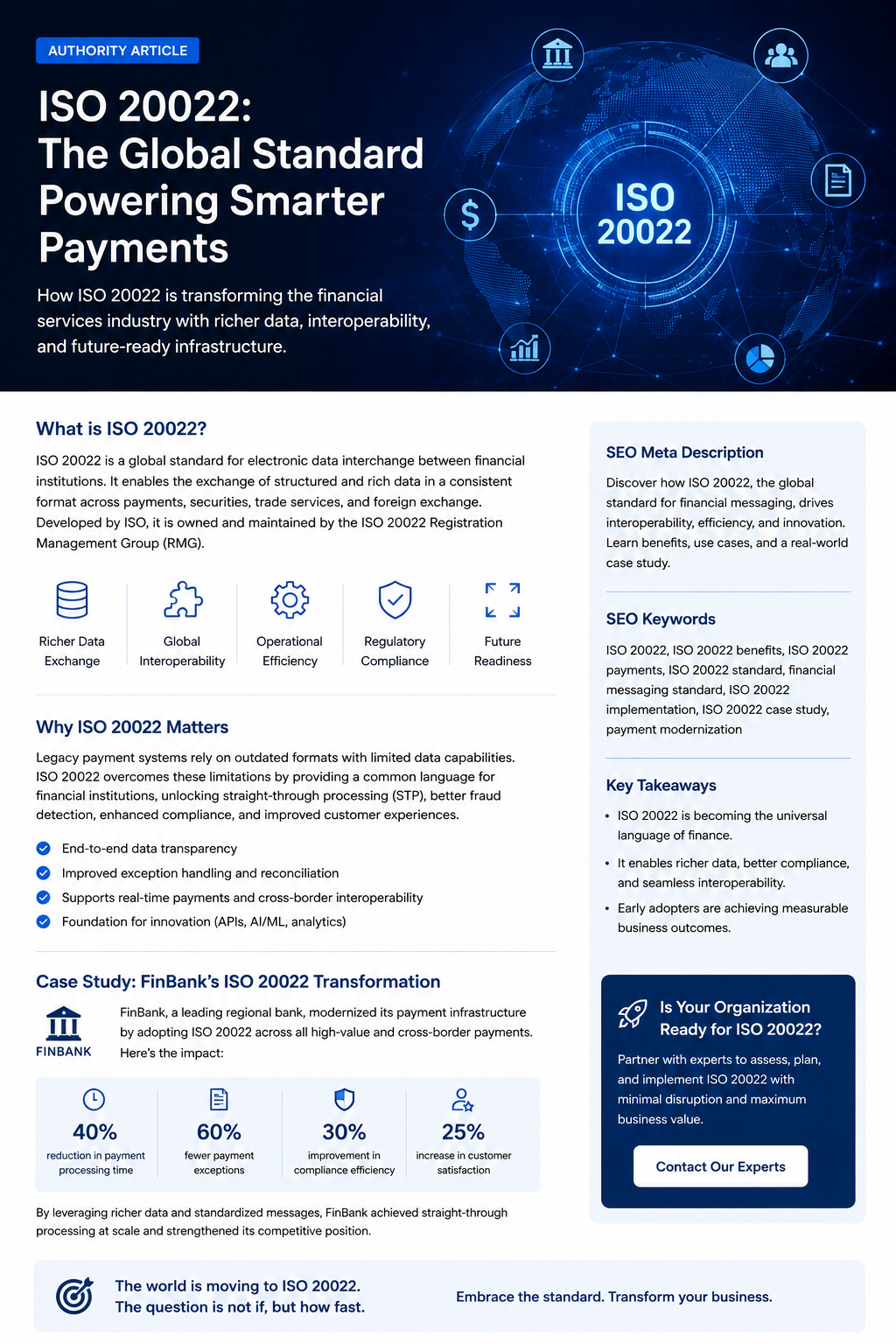
ISO 20022: The Global
Standard Powering Smarter Payments
Financial
services are changing rapidly. Banks, fintech companies, payment processors,
regulators, corporates, and market infrastructures are under increasing
pressure to process payments faster, reduce manual intervention, improve
compliance, and provide better transparency to customers.
At
the center of this transformation is ISO 20022.
ISO
20022 is not simply a new payment message format. It is a global financial
messaging standard designed to improve the quality, structure, and usability of
financial data. It enables banks and financial institutions to exchange richer,
more consistent, and more meaningful information across domestic payments,
cross-border payments, securities, trade finance, cards, and foreign exchange.
For
organizations that treat ISO 20022 as a compliance exercise only, the benefit
may be limited. But for organizations that treat it as a data modernization
opportunity, ISO 20022 can become a powerful foundation for automation,
analytics, compliance, customer experience, and operational excellence.
What Is ISO 20022?
ISO 20022 is an international standard
for electronic data exchange between financial institutions. It provides a
common language and structure for financial messages, allowing different
systems, banks, and payment networks to communicate using consistent business
terms and standardized message formats.
In simple terms, ISO 20022 helps
financial systems describe payment and transaction information in a more
structured way.
Legacy payment messages often rely on
limited text fields and unstructured information. This makes it harder to
identify the payer, beneficiary, purpose of payment, invoice details, address
components, and compliance-related data. ISO 20022 improves this by using
richer data fields and clear definitions.
Instead of sending vague or compressed
information, financial institutions can send structured data that is easier to
validate, screen, reconcile, analyze, and automate.
Why ISO 20022 Matters
The financial industry has
historically depended on multiple message standards, local formats, and
proprietary structures. This created complexity for banks, corporates, payment
processors, and regulators.
ISO 20022 helps solve this problem
by creating a common financial messaging language.
Its importance comes from five major
business needs:
- Better
payment transparency
ISO 20022 enables more detailed payment information to travel with the
transaction. - Improved
automation
Structured data supports straight-through processing and reduces manual
repair. - Stronger
compliance
Clearer party and address data can support sanctions screening, AML
controls, and regulatory reporting. - Greater
interoperability
Banks and payment systems can communicate using a common global standard. - Future-ready
infrastructure
ISO 20022 creates a data foundation for APIs, real-time payments, AI,
analytics, and digital finance.
ISO 20022 vs Legacy Payment
Messaging
The difference
between ISO 20022 and older formats is not only technical. It is operational
and strategic.
Legacy formats often
use short, fixed, and unstructured fields. This limits the amount of
information that can be included in a payment message. When information is
incomplete, banks may need to manually investigate, repair, or request
clarification.
ISO 20022 provides
richer and more structured data. For example, address information can be
separated into fields such as street name, building number, postal code, town,
and country code. This makes it easier for systems to identify, validate, and
process information accurately.
Example Difference
Legacy message approach:
Customer address is entered in free-text lines.
ISO 20022 approach:
Customer address is structured into specific fields.
This simple difference can have a major
impact on compliance screening, payment routing, exception handling,
reconciliation, and customer service.
Key Benefits of ISO 20022
1.
Richer Payment Data
ISO
20022 allows more complete information to be included in payment messages. This
may include invoice references, remittance details, debtor and creditor data,
payment purpose, and structured address information.
For
corporates, this improves cash application and reconciliation. For banks, it
improves payment screening, investigation, and customer support.
2. Improved Straight-Through
Processing
Straight-through
processing means transactions are completed automatically without manual
intervention.
When
payment data is incomplete or unclear, transactions often require manual
repair. ISO 20022 reduces this problem by improving data structure and
standardization.
Better
data quality means fewer exceptions, fewer delays, and lower operational cost.
3. Better Compliance and Risk
Management
Compliance
teams need accurate data to screen transactions properly. Poor-quality data
creates false positives, missed risks, and unnecessary investigations.
ISO
20022 improves the quality of information available for sanctions screening,
anti-money laundering checks, fraud monitoring, and regulatory reporting.
This
does not replace compliance controls, but it strengthens the data foundation
behind them.
4.
Faster Reconciliation
Many
companies still struggle to match incoming payments with invoices, customers,
contracts, or purchase orders. This creates delays in cash posting and
increases finance workload.
With
richer remittance information, ISO 20022 can improve automatic matching between
payments and business documents.
This
is especially valuable for B2B payments, shared service centers, treasury
teams, and high-volume finance operations.
5. Better Customer Experience
Payment
delays are frustrating for customers. Many delays are caused by incomplete
information, unclear references, or manual investigation.
ISO
20022 helps reduce these problems by improving data consistency and
transparency. Customers can receive better payment tracking, clearer
transaction details, and faster issue resolution.
6. Stronger Interoperability
Financial
institutions operate in a connected global environment. Domestic payment
systems, cross-border networks, central banks, fintech platforms, and corporate
treasury systems all need to exchange data.
ISO
20022 supports interoperability by giving these participants a shared messaging
language.
This
is one reason why ISO 20022 is becoming a foundation for payment modernization
around the world.
Main ISO 20022 Use Cases
ISO 20022 is widely associated
with payments, but its scope is broader.
Common use cases include:
·
Cross-border payments
·
High-value payments
·
Real-time payments
·
Corporate-to-bank payment
initiation
·
Bank-to-corporate reporting
·
Cash management messages
·
Securities settlement
·
Trade services
·
Foreign exchange messages
·
Card payment-related
messaging
·
Regulatory and compliance
reporting
For many banks and corporates,
the first priority is payment migration. However, the long-term value comes
from using ISO 20022 data across operations, compliance, finance, customer
service, and analytics.
ISO 20022 and Payment Modernization
Payment modernization
is not only about speed. A fast payment with poor data can still create
operational problems.
Modern payments
require:
·
Speed
·
Accuracy
·
Transparency
·
Traceability
·
Compliance readiness
·
Data quality
·
Automation
·
Interoperability
ISO 20022 supports all
these requirements.
It enables payment
ecosystems to move from message processing to data-driven transaction
management. This is a major shift. Banks can use payment data not only to move
money, but also to improve risk detection, liquidity visibility, customer
insights, and operational decision-making.
Implementation Challenges
Although ISO 20022 offers major
benefits, implementation can be complex.
Many organizations underestimate
the operational impact because they view ISO 20022 as a technology project
only. In reality, it affects systems, data, processes, controls, people,
testing, customer communication, and governance.
Common challenges include:
1. Legacy System Limitations
Older
core banking systems may not support ISO 20022 data fields natively. This can
require upgrades, middleware, translation engines, or system replacement.
2.
Data Quality Issues
Structured
messages require structured data. If customer master data is incomplete,
inconsistent, or outdated, ISO 20022 implementation may expose hidden
data-quality problems.
3. Message Mapping Complexity
Organizations
need to map legacy formats to ISO 20022 messages carefully. Poor mapping can
cause data loss, payment rejection, or compliance gaps.
4.
Process Redesign
Existing
payment operations, exception handling, reconciliation, and investigation
processes may need to be redesigned.
5.
Testing Requirements
Testing
must cover technical validation, business scenarios, exception cases,
compliance checks, customer files, and end-to-end payment flows.
6.
Change Management
Operations,
treasury, compliance, IT, finance, and customer-facing teams must understand
how ISO 20022 changes their work.
ISO 20022 Implementation Roadmap
A successful ISO 20022
program should follow a structured roadmap.
Phase 1: Current-State Assessment
The organization should assess existing
payment systems, message formats, interfaces, customer channels, data quality,
operational processes, and compliance controls.
Key questions include:
·
Which payment flows are
affected?
·
Which systems generate,
transform, receive, or store payment messages?
·
Where is payment data
incomplete or unstructured?
·
Which customer segments
will be impacted?
·
Which regulatory or network
deadlines apply?
Phase 2: Gap Analysis
The next step is to compare current capabilities with ISO
20022 requirements.
The gap analysis should cover:
·
Message format gaps
·
Data field gaps
·
System capability gaps
·
Integration gaps
·
Process gaps
·
Control gaps
·
Reporting gaps
·
Customer readiness gaps
This phase should produce a clear implementation backlog.
Phase 3: Target Operating Model
ISO 20022 should be linked to a target
operating model, not only a technical conversion.
The target model should define:
·
Future payment processing
flow
·
Data ownership
·
Exception handling process
·
Reconciliation process
·
Compliance screening model
·
Customer file submission
process
·
Reporting and analytics
requirements
·
Governance and control
points
Phase 4: Message Design and Mapping
The organization must define how legacy
messages, internal data, and customer files will map to ISO 20022 messages.
This includes field-level mapping,
validation rules, mandatory data elements, optional elements, and business
rules.
Message mapping should be reviewed by IT,
operations, compliance, treasury, and business teams.
Phase 5: Technology Enablement
Depending on system maturity, technology
enablement may include:
·
Core banking system upgrade
·
Payment hub enhancement
·
Middleware implementation
·
Message translation engine
·
API integration
·
Data validation layer
·
Reporting dashboard
·
Exception workflow tool
The objective is not only to send ISO 20022
messages, but to use ISO 20022 data effectively.
Phase 6: Testing and Parallel Run
Testing should include:
·
Unit testing
·
Integration testing
·
End-to-end testing
·
User acceptance testing
·
Network testing
·
Customer file testing
·
Regression testing
·
Exception scenario testing
·
Business continuity testing
A parallel run can help compare legacy
outputs with ISO 20022 outputs before full migration.
Phase 7: Go-Live and Stabilization
Go-live should be supported by a detailed
cutover plan, command center, issue-management process, fallback approach, and
communication plan.
After go-live, the organization should
monitor:
·
Payment rejection rates
·
Manual repair volumes
·
Processing time
·
Compliance alerts
·
Customer inquiries
·
Reconciliation accuracy
·
Data quality issues
·
System performance
Case Study: ISO 20022 Migration
for a Regional Bank
Background
A regional bank processing domestic and
cross-border corporate payments wanted to modernize its payment infrastructure
and prepare for ISO 20022 adoption. The bank had multiple legacy systems,
manual payment repair activities, inconsistent customer master data, and
limited remittance information.
Corporate clients frequently complained about
delayed payment confirmations and poor reconciliation visibility. Internally,
operations teams spent significant time investigating missing references,
incomplete beneficiary data, and unclear payment purpose information.
The bank decided to treat ISO 20022 not only as
a mandatory migration, but as a payment transformation initiative.
Challenge
The bank faced five main challenges:
1. Legacy payment messages were not rich enough to support
automated reconciliation.
2. Customer and beneficiary data were inconsistent across systems.
3. Operations teams relied heavily on manual repair and
investigation.
4. Compliance screening generated unnecessary false positives due
to poor data quality.
5. Corporate clients wanted better payment transparency and
reporting.
The bank needed a structured approach that
reduced migration risk while unlocking business value.
Approach
The bank launched a cross-functional ISO 20022
program involving IT, operations, compliance, treasury, product management, and
customer service.
The project followed seven workstreams:
1. Payment Flow Assessment
All domestic, cross-border, and
corporate payment flows were mapped from initiation to settlement and
reporting.
2. Data Quality Review
Customer, beneficiary, address,
account, and remittance data were reviewed to identify missing or unstructured
information.
3. Message Mapping
Legacy payment fields were mapped to ISO
20022 messages, with special focus on structured party data, remittance
information, payment purpose, and compliance-relevant fields.
4. Process Redesign
Manual repair, investigation,
reconciliation, and customer inquiry processes were redesigned around
structured data.
5. System Enhancement
The payment hub was upgraded to support
ISO 20022 message validation, transformation, and routing.
6.
Testing
The bank conducted end-to-end testing with
internal systems, external networks, and selected corporate customers.
7. Change Management
Operations and customer-facing teams
were trained on new message structures, exception types, and customer
communication requirements.
Results
After implementation, the bank achieved measurable
improvements:
·
Payment repair cases
decreased by 35%.
·
Manual reconciliation
effort decreased by 40%.
·
Corporate payment inquiries
decreased by 25%.
·
Compliance screening
quality improved due to better structured party data.
·
Payment transparency
improved for corporate customers.
·
Operations teams gained
better visibility over exception root causes.
The most important lesson was that ISO 20022
created value only when the bank improved its data, systems, processes, and
governance together.
Lessons Learned from the Case Study
1. ISO 20022 Is a Business
Transformation, Not Only an IT Project
Technology is
important, but the real value comes from better data, better processes, and
better decisions.
2. Data Quality Must Be Addressed
Early
Poor customer and
payment data can delay implementation and reduce the benefits of ISO 20022.
3. Operations Teams Must Be Involved
Payment operations teams
understand the real causes of exceptions, repairs, and customer complaints.
Their input is essential.
4. Testing Must Include Real
Business Scenarios
Technical testing
alone is not enough. Organizations must test real customer files, exception
cases, compliance scenarios, and reconciliation flows.
5. Customers Need Clear Communication
Corporate customers may
need to update their ERP, treasury, or payment file formats. Banks should guide
them early.
ISO 20022 Readiness Checklist
Organizations preparing for
ISO 20022 should review the following checklist:
·
Identify all affected
payment flows.
·
Map all legacy messages to
ISO 20022 equivalents.
·
Assess customer and
beneficiary data quality.
·
Review structured address
requirements.
·
Validate remittance
information capabilities.
·
Upgrade payment systems and
interfaces where needed.
·
Define data ownership and
governance.
·
Redesign exception and
repair processes.
·
Train operations,
compliance, IT, and customer teams.
·
Test with banks, networks,
vendors, and corporate customers.
·
Monitor rejection rates and
repair volumes after go-live.
·
Use ISO 20022 data for
analytics and continuous improvement.
ISO 20022 and Operational Excellence
From an operational
excellence perspective, ISO 20022 supports several improvement goals.
It reduces waste
caused by manual rework, unclear information, duplicated investigation, payment
delays, and reconciliation errors. It also improves process visibility by
making payment data more structured and measurable.
ISO 20022 can support
Lean, Six Sigma, and process improvement initiatives in banking operations
because it gives teams better data to identify root causes.
For example:
·
High repair rates may
indicate poor master data.
·
High rejection rates may
indicate mapping or validation issues.
·
Repeated customer inquiries
may indicate poor payment visibility.
·
Reconciliation delays may
indicate missing remittance information.
By analyzing these
patterns, banks can move from reactive issue handling to proactive process
improvement.
Common Mistakes to Avoid
Mistake 1: Treating ISO 20022 as
a Format Conversion Only
Converting
messages without improving data and processes limits the benefit.
Mistake 2: Starting Data
Cleansing Too Late
Data
cleansing should begin early because structured messages expose poor-quality
data quickly.
Mistake 3: Ignoring Corporate
Customer Readiness
Corporate
customers may need time to update ERP, treasury, and payment file processes.
Mistake 4: Underestimating Testing
ISO
20022 testing must cover business scenarios, not only technical message
validation.
Mistake 5: Not Measuring Benefits
Organizations
should track repair reduction, reconciliation improvement, processing time,
rejection rates, and customer experience.
How OpexEdge Can Support ISO
20022 Transformation
OpexEdge helps
organizations approach ISO 20022 as a business transformation and operational
excellence opportunity.
Our support can
include:
·
ISO 20022 readiness
assessment
·
Current-state payment
process mapping
·
Gap analysis and
implementation roadmap
·
Data quality assessment
·
Process redesign for
payment operations
·
Risk and control review
·
KPI dashboard for migration
performance
·
Change management and
training
·
Post-go-live stabilization
support
·
Continuous improvement
roadmap
The goal is to
help organizations reduce migration risk, improve operational performance, and
unlock the full value of structured financial data.
Conclusion
ISO 20022 is becoming the global language of
modern financial messaging. It improves data quality, supports automation,
strengthens compliance, enhances interoperability, and creates a foundation for
future innovation.
However, the real value of ISO 20022 does not
come from technical migration alone. It comes from using the standard to
improve payment processes, customer experience, risk management,
reconciliation, and decision-making.
Organizations that treat ISO 20022 as a
strategic transformation will be better positioned for the future of digital
finance.
The question is no longer whether ISO 20022
matters.
The real question is whether your organization
is ready to use it as a competitive advantage.
FAQ
What is ISO 20022?
ISO
20022 is an international financial messaging standard used to exchange
structured data between banks, payment systems, financial institutions, and
other financial market participants.
Why is ISO 20022
important?
It
improves data quality, payment transparency, automation, compliance screening,
reconciliation, and interoperability between financial systems.
Is ISO 20022 only
for banks?
No. ISO
20022 affects banks, fintech companies, payment processors, corporates,
treasury teams, regulators, market infrastructures, and technology vendors.
What
are the main benefits of ISO 20022?
The
main benefits include richer data, fewer manual repairs, better compliance,
improved reconciliation, stronger interoperability, and enhanced customer
experience.
What
is the biggest challenge in ISO 20022 implementation?
The
biggest challenge is often data quality. Structured messages require accurate,
complete, and well-governed data.
How
should companies prepare for ISO 20022?
Companies
should assess affected payment flows, review data quality, map legacy messages,
upgrade systems, test thoroughly, train teams, and monitor performance after
go-live.
Suggested Internal Links for
OpexEdge
·
Operational Excellence
Consulting
·
Process Improvement
Services
·
KPI Development
·
Lean Six Sigma
·
Business Process Mapping
·
Digital Transformation
Consulting
·
Supply Chain and Finance
Process Optimization
Is your organization preparing
for ISO 20022 or struggling with payment process complexity?
OpexEdge can help you assess
readiness, redesign payment operations, improve data quality, and build a
practical ISO 20022 implementation roadmap.
Contact OpexEdge today to turn
ISO 20022 compliance into operational excellence.
Related TopicsTPM, Hypothesis Test , Accuracy, 6Sigma, MSA, POKAYOKE, MUDA, 5S, FMEA, SIPOC, KPI, ISO9001, ISO20022, w/h, demand planning , OTB , KANO, case study, OTB service, demand planning service , SC service, problem solving service ,

5 Comments